Science Explorer Back to mapMap
Discussion
Company · Nishinomiya · Japan

Furuno (Japan)

World rank, all time
#24,141
of 34,923
Rank in Japan
#855
of 1,923
Research works
212
▼ 24% vs 2018-21
Citations
2.2k
10.4 per fractional work
Top-10% rate
8.2%
all institutions 10.0%
vs its own fields
0.85×
1.00× is exactly expected
Open access
48%
world 40%
International
17%
world 18%

Which fields of science does Furuno (Japan) work in?

In 2022-now, 41% of research at Furuno (Japan) is in Health Sciences, 34% in Physical Sciences. Its largest fields are Medicine (30%), Social Sciences (11%), Engineering (10%). It does 1.6× the world's share of Health Sciences.

Health Sciences: 16 fractional works · 41.1% of its workMedicine: 11 fractional works · 30.1% of its workPhysiology: 4 fractional works · 9.4% of its workSurgery: 1 fractional works · 3.5% of its workGeriatrics and Gerontology: 1 fractional works · 2.8% of its workOrthopedics and Sports Medicine: 1 fractional works · 2.6% of its workPulmonary and Respiratory Medicine: 1 fractional works · 2.0% of its workRheumatology: 1 fractional works · 1.4% of its workPsychiatry and Mental health: 0 fractional works · 1.3% of its workCardiology and Cardiovascular Medicine: 0 fractional works · 1.1% of its workEndocrinology, Diabetes and Metabolism: 0 fractional works · 1.1% of its workPublic Health, Environmental and Occupational Health: 0 fractional works · 0.9% of its workRehabilitation: 0 fractional works · 0.9% of its workUrology: 0 fractional works · 0.5% of its workComplementary and alternative medicine: 0 fractional works · 0.5% of its workOncology: 0 fractional works · 0.5% of its workPediatrics, Perinatology and Child Health: 0 fractional works · 0.5% of its workBiochemistry: 0 fractional works · 0.3% of its workAnesthesiology and Pain Medicine: 0 fractional works · 0.2% of its workGenetics: 0 fractional works · 0.2% of its workPathology and Forensic Medicine: 0 fractional works · 0.2% of its workPharmacology: 0 fractional works · 0.2% of its workSmaller subfields together: 0 fractional works · 0.2% of its workHealth Professions: 4 fractional works · 9.4% of its workGeneral Health Professions: 1 fractional works · 3.8% of its workPhysical Therapy, Sports Therapy and Rehabilitation: 1 fractional works · 2.3% of its workSpeech and Hearing: 1 fractional works · 2.1% of its workOccupational Therapy: 0 fractional works · 1.2% of its workNursing: 1 fractional works · 1.6% of its workNutrition and Dietetics: 0 fractional works · 1.2% of its workIssues, ethics and legal aspects: 0 fractional works · 0.5% of its workPhysical Sciences: 13 fractional works · 34.0% of its workEngineering: 4 fractional works · 10.2% of its workAerospace Engineering: 2 fractional works · 4.1% of its workElectrical and Electronic Engineering: 0 fractional works · 1.3% of its workMechanical Engineering: 0 fractional works · 1.1% of its workBiomedical Engineering: 0 fractional works · 1.0% of its workOcean Engineering: 0 fractional works · 0.9% of its workControl and Systems Engineering: 0 fractional works · 0.7% of its workCivil and Structural Engineering: 0 fractional works · 0.5% of its workAutomotive Engineering: 0 fractional works · 0.5% of its workMechanics of Materials: 0 fractional works · 0.2% of its workComputer Science: 3 fractional works · 7.9% of its workArtificial Intelligence: 1 fractional works · 2.5% of its workComputer Networks and Communications: 1 fractional works · 2.5% of its workInformation Systems: 0 fractional works · 1.3% of its workComputer Vision and Pattern Recognition: 0 fractional works · 1.0% of its workHardware and Architecture: 0 fractional works · 0.3% of its workSoftware: 0 fractional works · 0.3% of its workEnvironmental Science: 2 fractional works · 5.3% of its workWater Science and Technology: 1 fractional works · 1.8% of its workNature and Landscape Conservation: 1 fractional works · 1.6% of its workGlobal and Planetary Change: 0 fractional works · 1.3% of its workEcology: 0 fractional works · 0.2% of its workEnvironmental Engineering: 0 fractional works · 0.2% of its workSmaller subfields together: 0 fractional works · 0.1% of its workEarth and Planetary Sciences: 2 fractional works · 4.0% of its workAtmospheric Science: 1 fractional works · 2.8% of its workOceanography: 0 fractional works · 1.2% of its workChemistry: 1 fractional works · 3.7% of its workOrganic Chemistry: 1 fractional works · 3.2% of its workSpectroscopy: 0 fractional works · 0.5% of its workMaterials Science: 1 fractional works · 1.8% of its workPolymers and Plastics: 0 fractional works · 1.3% of its workMaterials Chemistry: 0 fractional works · 0.5% of its workChemical Engineering: 0 fractional works · 0.7% of its workFluid Flow and Transfer Processes: 0 fractional works · 0.7% of its workPhysics and Astronomy: 0 fractional works · 0.5% of its workInstrumentation: 0 fractional works · 0.3% of its workAtomic and Molecular Physics, and Optics: 0 fractional works · 0.2% of its workSocial Sciences: 7 fractional works · 19.4% of its workSocial Sciences: 4 fractional works · 11.1% of its workSociology and Political Science: 2 fractional works · 4.1% of its workLaw: 1 fractional works · 2.2% of its workDemography: 0 fractional works · 1.3% of its workCultural Studies: 0 fractional works · 0.9% of its workEducation: 0 fractional works · 0.9% of its workTransportation: 0 fractional works · 0.8% of its workHealth: 0 fractional works · 0.5% of its workPolitical Science and International Relations: 0 fractional works · 0.3% of its workArts and Humanities: 1 fractional works · 3.5% of its workPhilosophy: 0 fractional works · 1.3% of its workLiterature and Literary Theory: 0 fractional works · 0.9% of its workHistory and Philosophy of Science: 0 fractional works · 0.5% of its workMuseology: 0 fractional works · 0.5% of its workVisual Arts and Performing Arts: 0 fractional works · 0.5% of its workDecision Sciences: 1 fractional works · 3.5% of its workInformation Systems and Management: 1 fractional works · 1.8% of its workManagement Science and Operations Research: 1 fractional works · 1.8% of its workPsychology: 0 fractional works · 0.9% of its workClinical Psychology: 0 fractional works · 0.5% of its workExperimental and Cognitive Psychology: 0 fractional works · 0.5% of its workEconomics, Econometrics and Finance: 0 fractional works · 0.3% of its workEconomics and Econometrics: 0 fractional works · 0.3% of its workLife Sciences: 2 fractional works · 5.5% of its workAgricultural and Biological Sciences: 1 fractional works · 3.3% of its workAquatic Science: 1 fractional works · 3.3% of its workBiochemistry, Genetics and Molecular Biology: 1 fractional works · 1.6% of its workMolecular Biology: 0 fractional works · 0.7% of its workBiochemistry: 0 fractional works · 0.3% of its workCell Biology: 0 fractional works · 0.2% of its workClinical Biochemistry: 0 fractional works · 0.2% of its workSmaller subfields together: 0 fractional works · 0.2% of its workNeuroscience: 0 fractional works · 0.5% of its workNeurology: 0 fractional works · 0.5% of its workALL ITS WORKFuruno (Japan)38fractional works, 2022-now
Life Sciences5%Physical Sciences34%Health Sciences41%Social Sciences19%

Each ring splits the one inside it: the four domains of science, their fields, their subfields. Size is fractional works in 2022-now. Every slice is a page; the interactive view zooms down to single topics and colours each by how much more of it this institution does than the world.

Its 4 domains and 19 fields, with their numbers
    1. Medicine1130.1%
    2. Health Professions49.4%
    3. Nursing11.6%
    1. Engineering410.2%
    2. Computer Science37.9%
    3. Environmental Science25.3%
    4. Earth and Planetary Sciences24.0%
    5. Chemistry13.7%
    6. Materials Science11.8%
    7. Chemical Engineering00.7%
    8. Physics and Astronomy00.5%
    1. Social Sciences411.1%
    2. Arts and Humanities13.5%
    3. Decision Sciences13.5%
    4. Psychology00.9%
    5. Economics, Econometrics and Finance00.3%
    1. Agricultural and Biological Sciences13.3%
    2. Biochemistry, Genetics and Molecular Biology11.6%
    3. Neuroscience00.5%
All of science, and how each field's share has moved since 1950: the Science domain explorer

Field profile

Location quotient across every field it publishes in: outside the ring is more than an institution of this size would be expected to publish, inside it is less.

Agricultural and Biological Sciences: 0.70× its world share, 1 worksAgricultural and Bio…Biochemistry, Genetics and Molecular Biology: 0.31× its world share, 1 worksBiochemistry, Geneti…Neuroscience: 0.33× its world share, 0 worksNeuroscienceChemical Engineering: 1.90× its world share, 0 worksChemical EngineeringChemistry: 2.35× its world share, 1 worksChemistryComputer Science: 1.02× its world share, 3 worksComputer ScienceEarth and Planetary Sciences: 2.54× its world share, 2 worksEarth and Planetary …Engineering: 0.68× its world share, 4 worksEngineeringEnvironmental Science: 1.07× its world share, 2 worksEnvironmental ScienceMaterials Science: 0.51× its world share, 1 worksMaterials SciencePhysics and Astronomy: 0.23× its world share, 0 worksPhysics and AstronomyHealth Professions: 3.58× its world share, 4 worksHealth ProfessionsMedicine: 1.56× its world share, 11 worksMedicineNursing: 3.31× its world share, 1 worksNursingArts and Humanities: 1.22× its world share, 1 worksArts and HumanitiesDecision Sciences: 3.66× its world share, 1 worksDecision SciencesEconomics, Econometrics and Finance: 0.14× its world share, 0 worksEconomics, Econometr…Psychology: 0.29× its world share, 0 worksPsychologySocial Sciences: 0.88× its world share, 4 worksSocial Sciences1×world share
more than its size predictsabout as predictedless

Rings at 0.5×, 1× and 2×. Widest outward: Decision Sciences, 3.7×. Every wedge is a field page.

All 19 fields, with their numbers
  1. Decision Sciences3.66×1 works
  2. Health Professions3.58×4 works
  3. Nursing3.31×1 works
  4. Earth and Planetary Sciences2.54×2 works
  5. Chemistry2.35×1 works
  6. Chemical Engineering1.90×0 works
  7. Medicine1.56×11 works
  8. Arts and Humanities1.22×1 works
  9. Environmental Science1.07×2 works
  10. Computer Science1.02×3 works
  11. Social Sciences0.88×4 works
  12. Agricultural and Biological Sciences0.70×1 works
  13. Engineering0.68×4 works
  14. Materials Science0.51×1 works
  15. Neuroscience0.33×0 works
  16. Biochemistry, Genetics and Molecular Biology0.31×1 works
  17. Psychology0.29×0 works
  18. Physics and Astronomy0.23×0 works
  19. Economics, Econometrics and Finance0.14×0 works

Who are the top researchers at Furuno (Japan)?

Ranked on the quality score, Yuji Okuno, Masaki Ogata and Takuo Tsuno lead among researchers whose main affiliation is Furuno (Japan).

  1. 1 Yuji Okuno Japan · #229,939 worldwide 1.9k citations · 56 works
  2. 2 Masaki Ogata Japan · #4,476,972 worldwide 12 citations · 19 works
  3. 3 Takuo Tsuno Japan · #4,523,227 worldwide 1.5k citations · 66 works
  4. 4 Takuo Kashiwa Japan · #4,839,660 worldwide 50 citations · 18 works
  5. 5 Hironori Susaki Japan · #5,048,973 worldwide 117 citations · 23 works
  6. 6 Yasushi Nishimori Japan · #5,120,817 worldwide 169 citations · 38 works
All ranked researchers at Furuno (Japan)

What are the most cited papers from Furuno (Japan)?

The most cited paper from Furuno (Japan) is "Void Structure in Colloidal Dispersions" (Kensaku Ito, Hiroshi Yoshida, Norio Ise, 1994), with 207 citations. Next come "Hericenones C, D and E, stimulators of nerve growth factor (NGF)-synthesis, from the mushroom Hericium erinaceum" (187) and "Antioxidant activity and hypoglycemic effect of ferulic acid in STZ‐induced diabetic mice and KK‐A y mice" (181).

Most cited papers
#PaperReleasedCitations
1 Void Structure in Colloidal Dispersions Kensaku Ito, Hiroshi Yoshida, Norio Ise · Science 7 Jan 1994 207
2 Hericenones C, D and E, stimulators of nerve growth factor (NGF)-synthesis, from the mushroom Hericium erinaceum Hirokazu Kawagishi, Motoharu Ando, Hideki Sakamoto et al. · Tetrahedron Letters 1991 187
3 Antioxidant activity and hypoglycemic effect of ferulic acid in STZ‐induced diabetic mice and KK‐A y mice Motoyo Ohnishi, Takahiko Matuo, Takuo Tsuno et al. · BioFactors 2004 181
4 Cell‐Free Protein Synthesis System Prepared from Insect Cells by Freeze‐Thawing Toru Ezure, Takashi Suzuki, Shoken Higashide et al. · Biotechnology Progress 2006 125
5 FA15, a hydrophobic derivative of ferulic acid, suppresses inflammatory responses and skin tumor promotion: comparison with ferulic acid Akira Murakami, Yoshimasa Nakamura, Koichi Koshimįzu et al. · Cancer Letters Jun 2002 119
All 61 most cited papers, with filters and sorting

Which keywords describe research at Furuno (Japan)?

By fractional works in 2022-now, weighted toward what it does more of than the world: Aging, Muscle Mass, Inflammation, Cancer Cachexia, Sarcopenia, Quality of Life, Physical Performance and Obesity.

▲ more of its work than of the world's◆ about the world's share▼ less than the world's

Size is fractional works in 2022-now in the topics tagged with each word; colour is the word's share of this institution's work against its share of the world's. The 27 words are chosen for being large and distinctive. Each links to the topic it comes from most.

All 27 words, with their numbers
  1. Inflammation4▲ 4.9×7 topics
  2. Aging4▲ 18×3 topics
  3. Muscle Mass4▲ 82×2 topics
  4. Quality of Life3▲ 4.8×11 topics
  5. Cancer Cachexia2▲ 68×1 topic
  6. Sarcopenia2▲ 68×1 topic
  7. Climate Change2▲ 1.79×8 topics
  8. Obesity2▲ 6.2×4 topics
  9. Artificial Intelligence2▲ 3.1×3 topics
  10. Physical Performance2▲ 45×2 topics
  11. Elderly2▲ 18×4 topics
  12. Machine Learning2▲ 1.16×5 topics
  13. Aquaculture1▲ 14×4 topics
  14. Antioxidant Activity1▲ 5.6×3 topics
  15. Rehabilitation1▲ 8.4×3 topics
  16. Bioelectrical Impedance Analysis1▲ 133×1 topic
  17. Body Mass Index1▲ 66×1 topic
  18. Fatty Acids1▲ 32×2 topics
  19. Health Effects1▲ 5.2×3 topics
  20. Phenolic Compounds1▲ 18×3 topics
  21. Biodiversity1▲ 3.9×2 topics
  22. Epidemiology1▼ 0.73×6 topics
  23. Risk Factors1▲ 2.7×5 topics
  24. Frailty1▲ 55×1 topic
  25. Geriatric Assessment1▲ 39×1 topic
  26. Knowledge Management1▲ 4.8×2 topics
  27. Polyphenols1▲ 15×2 topics

Which research topics does Furuno (Japan) publish most on?

By volume in 2022-now: Nutrition and Health in Aging, Body Composition Measurement Techniques, Frailty in Older Adults and Edible Oils Quality and Analysis.

  1. 1 Nutrition and Health in Aging Physiology 2 works
  2. 2 Body Composition Measurement Techniques Physiology 1 works
  3. 3 Frailty in Older Adults Geriatrics and Gerontology 1 works
  4. 4 Edible Oils Quality and Analysis Organic Chemistry 1 works
  5. 5 Water Quality Monitoring Technologies Water Science and Technology 1 works
  6. 6 Innovation, Sustainability, Human-Machine Systems Sociology and Political Science 1 works
  7. 7 Knowledge Management and Technology Management Science and Operations Research 1 works
  8. 8 Personal Information Management and User Behavior Information Systems and Management 1 works
  9. 9 Balance, Gait, and Falls Prevention Physical Therapy, Sports Therapy and Rehabilitation 1 works
  10. 10 Precipitation Measurement and Analysis Atmospheric Science 1 works

How open and international is its research?

Against the world's own shares: the tick on each track. Both are shares of its output, so they sit on one scale and can be read against each other as well as against the world.

openly available47.9%not open52.1%

World: 40% of research is openly available.

with international co-authors16.8%domestic only83.2%

World: 18% is written across borders.

How has Furuno (Japan)'s research output changed?

Output in 2022-2025 was 24% lower than in 2018-2021.

still counting1990200020102020
grewheldshrank

The same series as a ribbon: one cell per year, darker for more. The line above answers how much; this answers when.

Its share of all research

Growing output can still be a shrinking share: all of science grows. This is Furuno (Japan) as a percentage of every work published that year, 0.00016% in 2024.

still counting0.00020%0.00040%0.00060%Furuno (Japan)0.000081% in 202519801990200020102020

Fractional works of Furuno (Japan) over all fractional works that year. How the balance of science has shifted.

Other research institutions in Nishinomiya

All research institutions in Nishinomiya

Share Furuno (Japan)'s ranking

Furuno (Japan) on Science Explorer

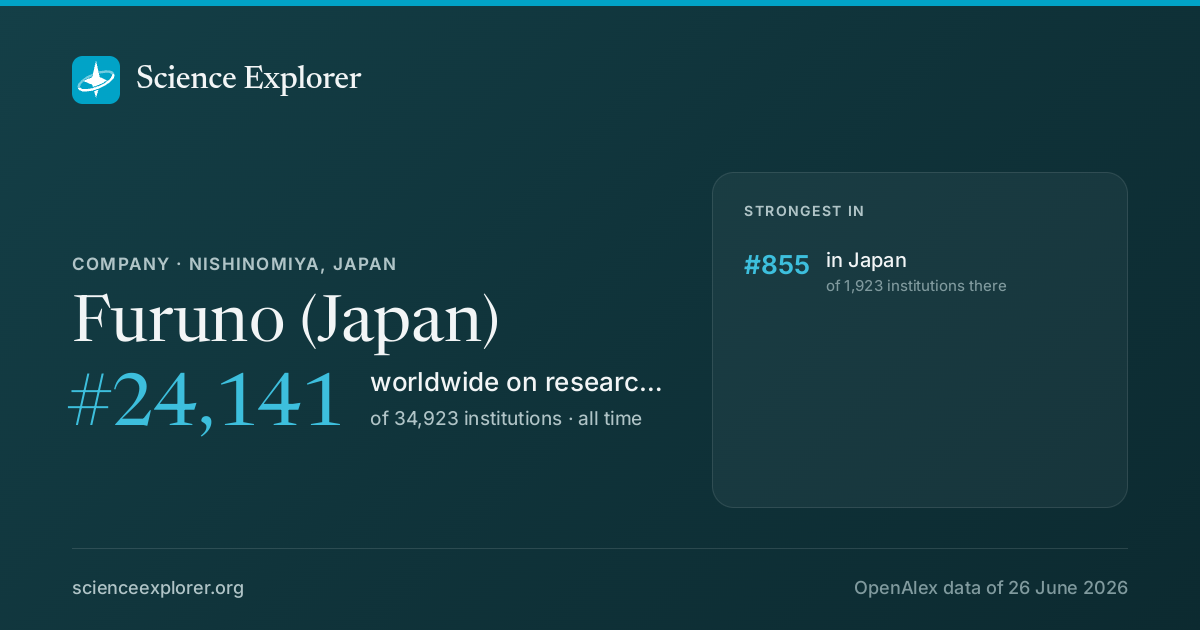
A card with Furuno (Japan)'s standing and the fields it leads in, for a post or a slide. A link to this page previews as the same card.

Download the card

1200 × 630 PNG, sized for social posts, drawn from the latest snapshot.

Badges for a website1Each links back here and updates with every snapshot

Research measures only: rankings here say nothing about teaching, admissions or student experience. Comparable institutions and collaboration partners have tabs of their own, above.

Discussion

Ask a question or share a note about Furuno (Japan). Posts are plain text and can be reported.