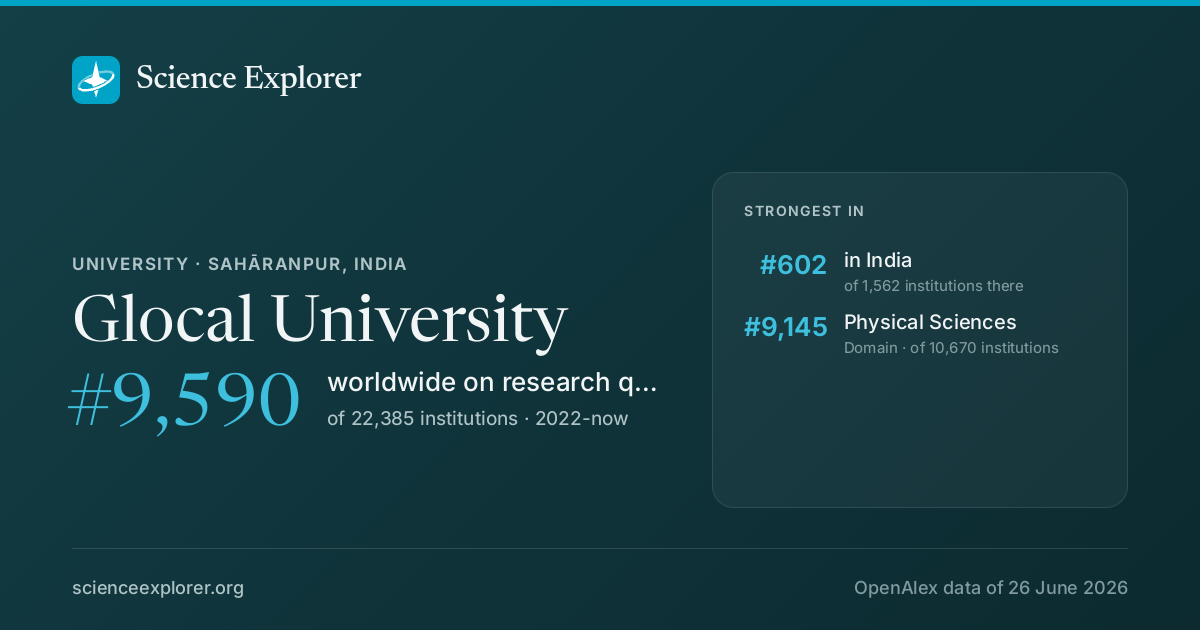
In research, Glocal University stands highest in Physical Sciences (#9,145 of 10,670 worldwide), 2022-now. Relative to its size it is most specialised in Plant Science (Plant Science is 5.0× its share of world research).
Each strip is that field's whole ranked pool, with the notch where Glocal University sits in it, in the colour
of the band that rank falls in. The track under the rate is the rate itself: it carries no average mark, because the average
differs by field (from about 6% in Dentistry to 21% in Economics).
Which fields of science does Glocal University work in?
Life Sciences23%Physical Sciences40%Health Sciences18%Social Sciences19%
Each ring splits the one inside it: the four domains of science, their fields, their subfields. Size is fractional works in 2022-now. Every slice is a page; the interactive view zooms down to single topics and colours each by how much more of it this institution does than the world.
Location quotient, a volume reading rather than an impact one. It surfaces small, lopsided specialities.
Field profile
Location quotient across every field it publishes in: outside the ring is more than an institution of this size would be expected to publish, inside it is less.
more than its size predictsabout as predictedless
Rings at 0.5×, 1× and 2×. Widest outward: Pharmacology, Toxicology and Pharmaceutics, 6.9×. Every wedge is a field page.
All 26 fields, with their numbers
Pharmacology, Toxicology and Pharmaceutics6.89×7 works
Agricultural and Biological Sciences3.09×40 works
Chemistry2.63×11 works
Chemical Engineering2.45×2 works
Decision Sciences2.18×6 works
Materials Science1.66×16 works
Energy1.62×4 works
Business, Management and Accounting1.43×13 works
Economics, Econometrics and Finance1.43×8 works
Nursing1.29×2 works
Computer Science1.24×26 works
Environmental Science1.10×15 works
Mathematics1.10×4 works
Neuroscience0.84×4 works
Biochemistry, Genetics and Molecular Biology0.81×12 works
What are the most cited papers from Glocal University?
The most cited paper from Glocal University is "Green Synthesis of Metal and Metal Oxide Nanoparticles: Principles of Green Chemistry and Raw Materials" (L.M. Soltys, Ostap Olkhovyy, Тетяна Татарчук et al., 2021), with 339 citations. Next come "Latest eco-friendly avenues on hydrogen production towards a circular bioeconomy: Currents challenges, innovative insights, and future perspectives" (328) and "A State-of-The-Art Review on the Latest trends in Hydrogen production, storage, and transportation techniques" (319).
Which keywords describe research at Glocal University?
By fractional works in 2022-now, weighted toward what it does more of than the world: Herbal Medicine, Medicinal Plants, Machine Learning, Drug Discovery, Antioxidant Activity, Antioxidant, Healthcare and Security.
▲ more of its work than of the world's◆ about the world's share▼ less than the world's
Size is fractional works in 2022-now in the topics tagged with each word; colour is the word's share of this institution's work against its share of the world's. The 40 words are chosen for being large and distinctive. Each links to the topic it comes from most.
All 40 words, with their numbers
Machine Learning18▲ 2.0×42 topics
Deep Learning13▲ 1.41×34 topics
Herbal Medicine12▲ 15×9 topics
Medicinal Plants11▲ 11×12 topics
Healthcare11▲ 3.5×8 topics
Climate Change10▲ 1.34×25 topics
Antioxidant10▲ 5.1×26 topics
Antioxidant Activity10▲ 5.6×20 topics
Sustainability10▲ 1.43×26 topics
Internet of Things9▲ 3.9×11 topics
Nanoparticles9▲ 2.7×24 topics
Environmental Impact9▲ 1.87×22 topics
Security9▲ 4.8×12 topics
Drug Discovery9▲ 14×10 topics
Oxidative Stress8▲ 1.74×26 topics
Cancer8▲ 2.1×23 topics
Ethnobotanical Survey7▲ 75×1 topic
Traditional Ecological Knowledge7▲ 55×1 topic
Neuroprotective6▲ 15×7 topics
Synthesis6▲ 5.8×17 topics
Privacy5▲ 6.7×4 topics
Health5▲ 4.7×5 topics
Antimicrobial5▲ 6.5×8 topics
Smart Cities5▲ 6.9×6 topics
Workplace5▲ 20×3 topics
Traditional Medicine5▲ 12×8 topics
Cloud Computing5▲ 6.1×5 topics
Pharmacology5▲ 7.2×13 topics
Wireless Sensor Networks5▲ 4.0×6 topics
Medicinal Chemistry5▲ 6.2×6 topics
Anticancer Agents4▲ 11×9 topics
Decentralization4▲ 7.2×2 topics
Antimicrobial Activity4▲ 8.9×6 topics
Big Data Analytics4▲ 6.8×3 topics
Blockchain4▲ 6.4×1 topic
Smart Contracts4▲ 9.2×1 topic
Plant Growth4▲ 13×5 topics
Energy Transition4▲ 8.6×3 topics
Cytotoxicity3▲ 9.0×6 topics
Immunomodulatory3▲ 38×2 topics
Which research topics does Glocal University publish most on?
Against the world's own shares: the tick on each track. Both are shares of its output, so they
sit on one scale and can be read against each other as well as against the world.
54%46%
openly available54.5%not open45.5%
World: 40% of research is openly available.
30%70%
with international co-authors30.0%domestic only70.0%
World: 18% is written across borders.
How has Glocal University's research output changed?
Output in 2022-2025 was 34% higher than in 2018-2021.
grewheldshrank
The same series as a ribbon: one cell per year, darker for more. The line above answers how much; this answers when.
Its share of all research
Growing output can still be a shrinking share: all of science grows. This is Glocal University as a percentage of every work published that year, 0.0013% in 2024.
Research measures only: rankings here say nothing about teaching, admissions or student experience. Comparable institutions and collaboration partners have tabs of their own, above.
Discussion
Ask a question or share a note about Glocal University. Keep it to the research: no personal attacks, advertising or links. Any reader can report a post, which collapses it for everyone until it is opened.
 India · #1,607,151 worldwide
293 citations · 15 works