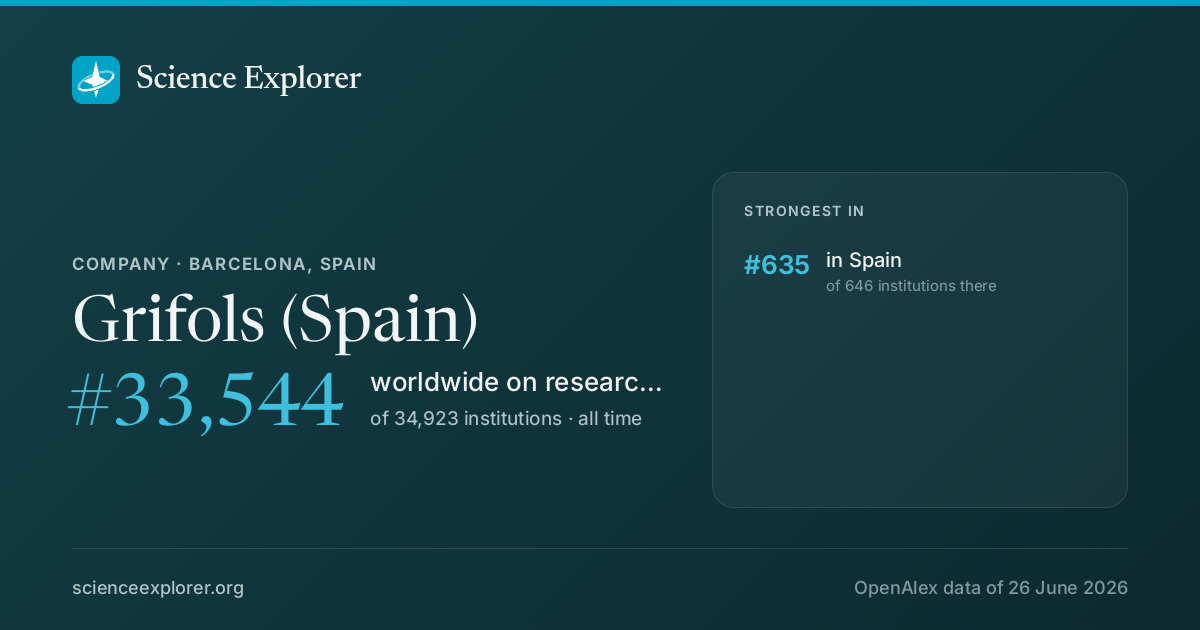
- World rank, all time
- #33,544 of 34,923
- Rank in Spain
- #635 of 646
- Research works
- 130 ▲ 23% vs 2018-21
- Citations
- 1.6k 12.5 per fractional work
- Top-10% rate
- 8.0% all institutions 10.0%
- vs its own fields
- 0.91× 1.00× is exactly expected
- Open access
- 55% world 40%
- International
- 35% world 18%
Which fields of science does Grifols (Spain) work in?
In 2022-now, 65% of research at Grifols (Spain) is in Health Sciences, 28% in Life Sciences. Its largest fields are Medicine (63%), Biochemistry, Genetics and Molecular Biology (16%), Immunology and Microbiology (10%). It does 2.4× the world's share of Health Sciences.
Each ring splits the one inside it: the four domains of science, their fields, their subfields. Size is fractional works in 2022-now. Every slice is a page; the interactive view zooms down to single topics and colours each by how much more of it this institution does than the world.
Its 4 domains and 16 fields, with their numbers
- Health Sciences2765.3%
- Medicine2663.1%
- Health Professions11.5%
- Nursing00.7%
- Life Sciences1127.6%
- Social Sciences24.1%
- Physical Sciences13.0%
- Computer Science11.9%
- Chemistry00.7%
- Engineering00.2%
- Mathematics00.1%
Field profile
Location quotient across every field it publishes in: outside the ring is more than an institution of this size would be expected to publish, inside it is less.
Rings at 0.5×, 1× and 2×. Widest outward: Immunology and Microbiology, 9.5×. Every wedge is a field page.
All 16 fields, with their numbers
- Immunology and Microbiology9.46×4 works
- Medicine3.29×26 works
- Biochemistry, Genetics and Molecular Biology2.95×6 works
- Pharmacology, Toxicology and Pharmaceutics2.06×0 works
- Nursing1.48×0 works
- Neuroscience0.77×0 works
- Economics, Econometrics and Finance0.64×1 works
- Health Professions0.56×1 works
- Chemistry0.45×0 works
- Business, Management and Accounting0.38×0 works
- Psychology0.34×0 works
- Computer Science0.25×1 works
- Mathematics0.09×0 works
- Agricultural and Biological Sciences0.08×0 works
- Social Sciences0.03×0 works
- Engineering0.02×0 works
- Immunology and Microbiology 9.5×
- Medicine 3.3×
- Biochemistry, Genetics and Molecular Biology 3.0×
- Pharmacology, Toxicology and Pharmaceutics 2.1×
- Nursing 1.5×
- Neuroscience 0.8×
- Economics, Econometrics and Finance 0.6×
- Health Professions 0.6×
- Chemistry 0.5×
- Business, Management and Accounting 0.4×
- Psychology 0.3×
- Computer Science 0.2×
- Mathematics 0.1×
- Agricultural and Biological Sciences 0.1×
- Social Sciences 0.0×
- Engineering 0.0×
Who are the top researchers at Grifols (Spain)?
Ranked on the quality score, Leticia Sarasa, María Pascual‐Lucas and Mireia Torres lead among researchers whose main affiliation is Grifols (Spain).
- 1
Leticia Sarasa
 Spain · #677,098 worldwide
1.8k citations · 32 works
- 2
María Pascual‐Lucas
Spain · #768,355 worldwide
1.4k citations · 24 works
- 3
Mireia Torres
Spain · #998,138 worldwide
684 citations · 26 works
- 4
Elisabet Viayna
Spain · #1,097,080 worldwide
1.6k citations · 77 works
- 5
M. Begoña Ruiz-Argüello
Spain · #1,178,049 worldwide
1.6k citations · 32 works
- 6
José Antonio Allué
Spain · #1,282,575 worldwide
1.1k citations · 22 works
- 7
Montserrat Costa
Spain · #1,514,498 worldwide
932 citations · 46 works
- 8
Daniel Nagore
Spain · #1,602,883 worldwide
1.6k citations · 79 works
- 9
Rodrigo Gajardo
Spain · #1,992,950 worldwide
1.5k citations · 50 works
- 10
Antonio Páez
Spain · #2,179,817 worldwide
1.3k citations · 64 works
Which keywords describe research at Grifols (Spain)?
By fractional works in 2022-now, weighted toward what it does more of than the world: Angiogenesis, Extracellular Matrix, Metastasis, Coagulopathy, Cancer Progression, Cell Signaling, Matrix Metalloproteinases and Extracellular Matrix Remodeling.
- Amyloid Hypothesis
- Pediatric Pharmacokinetics
- Medical Ethics
- ACE2 Receptor
- Medication Adherence
- Biosimilars
- Bioanalytical Methods
- Primary Immunodeficiency
- Immunogenicity
- Clinical Trials
- Pandemic
- Biopharmaceuticals
- Oxidative Stress
- Liver Cirrhosis
- Monoclonal Antibodies
- Tissue Inhibitors of Metalloproteinases
- Matrix Metalloproteinases
- Cell Signaling
- Metastasis
- Epidemiology
- Angiogenesis
- Extracellular Matrix
- Cancer Progression
- Coagulopathy
- Extracellular Matrix Remodeling
- Inflammation
- Hepatic Encephalopathy
- Hemostasis
- Clinical Outcomes
- Genetic Mutations
- SARS-CoV-2
- Immune Dysregulation
- Neuroinflammation
- Thrombosis
- Biomarkers
- Neurodegeneration
- Hepatocellular Carcinoma
- Drug Development
- Off-Label Drug Use
- Vaccine
Size is fractional works in 2022-now in the topics tagged with each word; colour is the word's share of this institution's work against its share of the world's. The 40 words are chosen for being large and distinctive. Each links to the topic it comes from most.
All 40 words, with their numbers
- Angiogenesis4▲ 25×5 topics
- Epidemiology3▲ 2.0×18 topics
- Extracellular Matrix3▲ 41×5 topics
- Metastasis3▲ 21×3 topics
- Cancer Progression3▲ 38×2 topics
- Cell Signaling3▲ 44×2 topics
- Coagulopathy3▲ 86×2 topics
- Matrix Metalloproteinases3▲ 49×2 topics
- Extracellular Matrix Remodeling3▲ 431×1 topic
- Tissue Inhibitors of Metalloproteinases3▲ 431×1 topic
- Inflammation3▲ 3.1×17 topics
- Monoclonal Antibodies3▲ 73×3 topics
- Hepatic Encephalopathy2▲ 100×1 topic
- Liver Cirrhosis2▲ 100×1 topic
- Hemostasis2▲ 49×3 topics
- Oxidative Stress2▲ 3.1×9 topics
- Clinical Outcomes2▲ 23×2 topics
- Biopharmaceuticals2▲ 87×3 topics
- Genetic Mutations2▲ 11×2 topics
- Pandemic2▲ 4.6×5 topics
- SARS-CoV-22▲ 15×3 topics
- Clinical Trials2▲ 6.4×5 topics
- Immune Dysregulation2▲ 53×1 topic
- Immunogenicity2▲ 99×2 topics
- Neuroinflammation2▲ 15×4 topics
- Primary Immunodeficiency2▲ 142×1 topic
- Thrombosis2▲ 16×5 topics
- Bioanalytical Methods2▲ 206×1 topic
- Biomarkers2▲ 5.9×8 topics
- Biosimilars2▲ 206×1 topic
- Neurodegeneration2▲ 13×4 topics
- Medication Adherence2▲ 70×2 topics
- Hepatocellular Carcinoma2▲ 17×3 topics
- ACE2 Receptor1▲ 15×2 topics
- Drug Development1▲ 40×2 topics
- Medical Ethics1▲ 27×2 topics
- Off-Label Drug Use1▲ 132×1 topic
- Pediatric Pharmacokinetics1▲ 132×1 topic
- Vaccine1▲ 8.6×4 topics
- Amyloid Hypothesis1▲ 50×1 topic
Which research topics does Grifols (Spain) publish most on?
By volume in 2022-now: Protease and Inhibitor Mechanisms, Liver Disease and Transplantation, Immunodeficiency and Autoimmune Disorders and Biosimilars and Bioanalytical Methods.
Area is fractional works; colour is the subfield each topic belongs to.
- 1 Protease and Inhibitor Mechanisms Cancer Research 3 works
- 2 Liver Disease and Transplantation Hepatology 2 works
- 3 Immunodeficiency and Autoimmune Disorders Immunology 2 works
- 4 Biosimilars and Bioanalytical Methods Immunology 2 works
- 5 Pharmaceutical studies and practices Pediatrics, Perinatology and Child Health 1 works
- 6 Alzheimer's disease research and treatments Physiology 1 works
- 7 Monoclonal and Polyclonal Antibodies Research Radiology, Nuclear Medicine and Imaging 1 works
- 8 Liver Disease Diagnosis and Treatment Epidemiology 1 works
- 9 Ethics and Legal Issues in Pediatric Healthcare Pediatrics, Perinatology and Child Health 1 works
- 10 Platelet Disorders and Treatments Hematology 1 works
How open and international is its research?
Against the world's own shares: the tick on each track. Both are shares of its output, so they sit on one scale and can be read against each other as well as against the world.
World: 40% of research is openly available.
World: 18% is written across borders.
How has Grifols (Spain)'s research output changed?
Output in 2022-2025 was 23% higher than in 2018-2021.
The same series as a ribbon: one cell per year, darker for more. The line above answers how much; this answers when.
Its share of all research
Growing output can still be a shrinking share: all of science grows. This is Grifols (Spain) as a percentage of every work published that year, 0.00018% in 2024.
Fractional works of Grifols (Spain) over all fractional works that year. How the balance of science has shifted.
Other research institutions in Barcelona
- Universitat de Barcelona
- Universitat Politècnica de Catalunya
- Universitat Pompeu Fabra
- CERCA Institution
- Vall d'Hebron Hospital Universitari
- Hospital de Sant Pau
- Universitat Oberta de Catalunya
- Institució Catalana de Recerca i Estudis Avançats


Share Grifols (Spain)'s ranking
Badges for a website1Each links back here and updates with every snapshot

Research measures only: rankings here say nothing about teaching, admissions or student experience. Comparable institutions and collaboration partners have tabs of their own, above.
Discussion
Ask a question or share a note about Grifols (Spain). Keep it to the research: no personal attacks, advertising or links. Any reader can report a post, which collapses it for everyone until it is opened.