Science Explorer Back to mapMap
Discussion
Institution · Ahmedabad · India

Gujarat Kidney Foundation

World rank, all time
#33,936
of 34,923
Rank in India
#1,681
of 1,754
Research works
144
▲ 22% vs 2018-21
Citations
1.8k
12.6 per fractional work
Top-10% rate
5.5%
all institutions 10.0%
vs its own fields
0.85×
1.00× is exactly expected
Open access
56%
world 40%
International
13%
world 18%

Which fields of science does Gujarat Kidney Foundation work in?

In 2022-now, 70% of research at Gujarat Kidney Foundation is in Health Sciences, 13% in Life Sciences. Its largest fields are Medicine (64%), Biochemistry, Genetics and Molecular Biology (7%), Engineering (5%). It does 2.5× the world's share of Health Sciences.

Health Sciences: 24 fractional works · 69.9% of its workMedicine: 22 fractional works · 64.4% of its workNephrology: 3 fractional works · 8.9% of its workPulmonary and Respiratory Medicine: 3 fractional works · 8.5% of its workPublic Health, Environmental and Occupational Health: 2 fractional works · 6.7% of its workEpidemiology: 2 fractional works · 6.2% of its workSurgery: 2 fractional works · 5.7% of its workPediatrics, Perinatology and Child Health: 1 fractional works · 3.9% of its workObstetrics and Gynecology: 1 fractional works · 3.7% of its workUrology: 1 fractional works · 2.5% of its workRheumatology: 1 fractional works · 2.4% of its workHepatology: 1 fractional works · 2.2% of its workEndocrinology, Diabetes and Metabolism: 1 fractional works · 2.0% of its workTransplantation: 1 fractional works · 1.7% of its workInfectious Diseases: 0 fractional works · 1.3% of its workOncology: 0 fractional works · 1.2% of its workPhysiology: 0 fractional works · 1.2% of its workHematology: 0 fractional works · 1.2% of its workGastroenterology: 0 fractional works · 1.0% of its workHealth Informatics: 0 fractional works · 1.0% of its workOtorhinolaryngology: 0 fractional works · 1.0% of its workRadiology, Nuclear Medicine and Imaging: 0 fractional works · 0.8% of its workGenetics: 0 fractional works · 0.5% of its workCardiology and Cardiovascular Medicine: 0 fractional works · 0.3% of its workPsychiatry and Mental health: 0 fractional works · 0.2% of its workRehabilitation: 0 fractional works · 0.2% of its workHealth Professions: 1 fractional works · 3.9% of its workGeneral Health Professions: 1 fractional works · 2.0% of its workEmergency Medical Services: 0 fractional works · 1.4% of its workHealth Information Management: 0 fractional works · 0.4% of its workSmaller subfields together: 0 fractional works · 0.0% of its workDentistry: 0 fractional works · 0.8% of its workPeriodontics: 0 fractional works · 0.5% of its workOral Surgery: 0 fractional works · 0.3% of its workVeterinary: 0 fractional works · 0.5% of its workEquine: 0 fractional works · 0.2% of its workSmall Animals: 0 fractional works · 0.2% of its workSmaller subfields together: 0 fractional works · 0.0% of its workNursing: 0 fractional works · 0.3% of its workNutrition and Dietetics: 0 fractional works · 0.3% of its workLife Sciences: 5 fractional works · 13.2% of its workBiochemistry, Genetics and Molecular Biology: 3 fractional works · 7.5% of its workMolecular Biology: 2 fractional works · 5.2% of its workGenetics: 0 fractional works · 1.4% of its workCancer Research: 0 fractional works · 1.0% of its workAgricultural and Biological Sciences: 1 fractional works · 3.4% of its workGeneral Agricultural and Biological Sciences: 0 fractional works · 1.0% of its workPlant Science: 0 fractional works · 1.0% of its workFood Science: 0 fractional works · 0.5% of its workInsect Science: 0 fractional works · 0.5% of its workHorticulture: 0 fractional works · 0.3% of its workAgronomy and Crop Science: 0 fractional works · 0.2% of its workNeuroscience: 0 fractional works · 1.2% of its workCognitive Neuroscience: 0 fractional works · 1.0% of its workNeurology: 0 fractional works · 0.2% of its workSmaller subfields together: 0 fractional works · 0.0% of its workImmunology and Microbiology: 0 fractional works · 0.6% of its workImmunology: 0 fractional works · 0.5% of its workSmaller subfields together: 0 fractional works · 0.1% of its workPharmacology, Toxicology and Pharmaceutics: 0 fractional works · 0.5% of its workDrug Discovery: 0 fractional works · 0.5% of its workPhysical Sciences: 4 fractional works · 12.2% of its workEngineering: 2 fractional works · 4.9% of its workMechanical Engineering: 1 fractional works · 2.9% of its workBiomedical Engineering: 0 fractional works · 1.0% of its workAutomotive Engineering: 0 fractional works · 0.3% of its workBuilding and Construction: 0 fractional works · 0.3% of its workSmaller subfields together: 0 fractional works · 0.4% of its workChemistry: 1 fractional works · 4.1% of its workOrganic Chemistry: 1 fractional works · 3.4% of its workAnalytical Chemistry: 0 fractional works · 0.5% of its workPhysical and Theoretical Chemistry: 0 fractional works · 0.3% of its workComputer Science: 1 fractional works · 2.1% of its workComputer Networks and Communications: 0 fractional works · 1.0% of its workComputer Vision and Pattern Recognition: 0 fractional works · 0.5% of its workArtificial Intelligence: 0 fractional works · 0.3% of its workComputational Theory and Mathematics: 0 fractional works · 0.3% of its workEnvironmental Science: 0 fractional works · 0.7% of its workEcology: 0 fractional works · 0.3% of its workHealth, Toxicology and Mutagenesis: 0 fractional works · 0.3% of its workSmaller subfields together: 0 fractional works · 0.2% of its workEarth and Planetary Sciences: 0 fractional works · 0.3% of its workOceanography: 0 fractional works · 0.3% of its workSocial Sciences: 2 fractional works · 4.7% of its workSocial Sciences: 1 fractional works · 1.8% of its workEducation: 0 fractional works · 1.0% of its workHealth: 0 fractional works · 0.4% of its workTransportation: 0 fractional works · 0.3% of its workSmaller subfields together: 0 fractional works · 0.1% of its workArts and Humanities: 0 fractional works · 1.0% of its workMusic: 0 fractional works · 1.0% of its workSmaller subfields together: 0 fractional works · 0.0% of its workBusiness, Management and Accounting: 0 fractional works · 1.0% of its workOrganizational Behavior and Human Resource Management: 0 fractional works · 1.0% of its workEconomics, Econometrics and Finance: 0 fractional works · 1.0% of its workFinance: 0 fractional works · 0.9% of its workSmaller subfields together: 0 fractional works · 0.1% of its workALL ITS WORKGujarat KidneyFoundation35fractional works, 2022-now
Life Sciences13%Physical Sciences12%Health Sciences70%Social Sciences5%

Each ring splits the one inside it: the four domains of science, their fields, their subfields. Size is fractional works in 2022-now. Every slice is a page; the interactive view zooms down to single topics and colours each by how much more of it this institution does than the world.

Its 4 domains and 19 fields, with their numbers
    1. Medicine2264.4%
    2. Health Professions13.9%
    3. Dentistry00.8%
    4. Veterinary00.5%
    5. Nursing00.3%
    1. Biochemistry, Genetics and Molecular Biology37.5%
    2. Agricultural and Biological Sciences13.4%
    3. Neuroscience01.2%
    4. Immunology and Microbiology00.6%
    5. Pharmacology, Toxicology and Pharmaceutics00.5%
    1. Engineering24.9%
    2. Chemistry14.1%
    3. Computer Science12.1%
    4. Environmental Science00.7%
    5. Earth and Planetary Sciences00.3%
    1. Social Sciences11.8%
    2. Arts and Humanities01.0%
    3. Business, Management and Accounting01.0%
    4. Economics, Econometrics and Finance01.0%
All of science, and how each field's share has moved since 1950: the Science domain explorer

Field profile

Location quotient across every field it publishes in: outside the ring is more than an institution of this size would be expected to publish, inside it is less.

Agricultural and Biological Sciences: 0.72× its world share, 1 worksAgricultural and Bio…Biochemistry, Genetics and Molecular Biology: 1.40× its world share, 3 worksBiochemistry, Geneti…Immunology and Microbiology: 0.62× its world share, 0 worksImmunology and Micro…Neuroscience: 0.74× its world share, 0 worksNeurosciencePharmacology, Toxicology and Pharmaceutics: 1.36× its world share, 0 worksPharmacology, Toxico…Chemistry: 2.65× its world share, 1 worksChemistryComputer Science: 0.27× its world share, 1 worksComputer ScienceEarth and Planetary Sciences: 0.20× its world share, 0 worksEarth and Planetary …Engineering: 0.32× its world share, 2 worksEngineeringEnvironmental Science: 0.15× its world share, 0 worksEnvironmental ScienceDentistry: 1.65× its world share, 0 worksDentistryHealth Professions: 1.47× its world share, 1 worksHealth ProfessionsMedicine: 3.35× its world share, 22 worksMedicineNursing: 0.65× its world share, 0 worksNursingVeterinary: 3.53× its world share, 0 worksVeterinaryArts and Humanities: 0.34× its world share, 0 worksArts and HumanitiesBusiness, Management and Accounting: 0.30× its world share, 0 worksBusiness, Management…Economics, Econometrics and Finance: 0.44× its world share, 0 worksEconomics, Econometr…Social Sciences: 0.14× its world share, 1 worksSocial Sciences1×world share
more than its size predictsabout as predictedless

Rings at 0.5×, 1× and 2×. Widest outward: Veterinary, 3.5×. Every wedge is a field page.

All 19 fields, with their numbers
  1. Veterinary3.53×0 works
  2. Medicine3.35×22 works
  3. Chemistry2.65×1 works
  4. Dentistry1.65×0 works
  5. Health Professions1.47×1 works
  6. Biochemistry, Genetics and Molecular Biology1.40×3 works
  7. Pharmacology, Toxicology and Pharmaceutics1.36×0 works
  8. Neuroscience0.74×0 works
  9. Agricultural and Biological Sciences0.72×1 works
  10. Nursing0.65×0 works
  11. Immunology and Microbiology0.62×0 works
  12. Economics, Econometrics and Finance0.44×0 works
  13. Arts and Humanities0.34×0 works
  14. Engineering0.32×2 works
  15. Business, Management and Accounting0.30×0 works
  16. Computer Science0.27×1 works
  17. Earth and Planetary Sciences0.20×0 works
  18. Environmental Science0.15×0 works
  19. Social Sciences0.14×1 works

Who are the top researchers at Gujarat Kidney Foundation?

Ranked on the quality score, Prakash Khetan, Kanthi Bansal and Umesh B. Khanna lead among researchers whose main affiliation is Gujarat Kidney Foundation.

  1. 1 Prakash Khetan India · #2,929,590 worldwide 346 citations · 20 works
  2. 2 Kanthi Bansal India · #2,972,225 worldwide 17 citations · 38 works
  3. 3 Umesh B. Khanna India · #3,586,094 worldwide 420 citations · 47 works
  4. 4 PN Nagpal India · #4,012,557 worldwide 31 citations · 16 works
  5. 5 Mallikarjun N. Reddy India · #4,765,654 worldwide 467 citations · 18 works
  6. 6 Ashish C. Koura India · #4,906,223 worldwide 357 citations · 21 works
  7. 7 Nagesh Kamat India · #5,426,002 worldwide 470 citations · 68 works
  8. 8 Manish P. Nagpal India · #6,381,626 worldwide 897 citations · 126 works
All ranked researchers at Gujarat Kidney Foundation

What are the most cited papers from Gujarat Kidney Foundation?

The most cited paper from Gujarat Kidney Foundation is "What do we know about chronic kidney disease in India: first report of the Indian CKD registry" (Mohan M. Rajapurkar, George Tharayil John, Ashok L. Kirpalani et al., 2012), with 457 citations. Next come "Stimulus-Responsive “Smart” Hydrogels as Novel Drug Delivery Systems" (390) and "Glutaraldehyde crosslinked sodium alginate beads containing liquid pesticide for soil application" (272).

Most cited papers
#PaperReleasedCitations
1 What do we know about chronic kidney disease in India: first report of the Indian CKD registry Mohan M. Rajapurkar, George Tharayil John, Ashok L. Kirpalani et al. · BMC Nephrology Open access 5 Mar 2012 457
2 Stimulus-Responsive “Smart” Hydrogels as Novel Drug Delivery Systems Kumaresh S. Soppimath, Tejraj Malleshappa Aminabhavi, A. M. Dave et al. · Drug Development and Industrial Pharmacy 2002 390
3 Glutaraldehyde crosslinked sodium alginate beads containing liquid pesticide for soil application Anandrao R. Kulkarni, Kumaresh S. Soppimath, Tejraj Malleshappa Aminabhavi et al. · Journal of Controlled Release 2000 272
4 Non-steroidal anti-inflammatory drug (NSAID) therapy in patients with hypertension, cardiovascular, renal or gastrointestinal comorbidities: joint APAGE/APLAR/APSDE/APSH/APSN/PoA recommendations Cheuk‐Chun Szeto, Kentaro Sugano, Ji‐Guang Wang et al. · Gut 14 Jan 2020 156
5 Bringing an end to diabetes stigma and discrimination: an international consensus statement on evidence and recommendations Jane Speight et al. · The Lancet Diabetes & Endocrinology Open access 19 Dec 2023 135
All 60 most cited papers, with filters and sorting

Which keywords describe research at Gujarat Kidney Foundation?

By fractional works in 2022-now, weighted toward what it does more of than the world: Chronic Kidney Disease, Inflammation, Treatment, Cardiovascular Disease, Epidemiology, Global Burden, Nutrition and Mortality.

▲ more of its work than of the world's◆ about the world's share▼ less than the world's

Size is fractional works in 2022-now in the topics tagged with each word; colour is the word's share of this institution's work against its share of the world's. The 26 words are chosen for being large and distinctive. Each links to the topic it comes from most.

All 26 words, with their numbers
  1. Epidemiology4▲ 2.6×21 topics
  2. Chronic Kidney Disease3▲ 37×7 topics
  3. Inflammation3▲ 4.4×13 topics
  4. Treatment3▲ 6.3×14 topics
  5. Cardiovascular Disease3▲ 6.5×9 topics
  6. Diagnosis2▲ 5.7×10 topics
  7. Quality of Life2▲ 3.6×5 topics
  8. Management2▲ 6.0×4 topics
  9. Global Burden2▲ 8.6×4 topics
  10. Metabolic Syndrome2▲ 5.7×7 topics
  11. Mortality2▲ 8.1×5 topics
  12. Nutrition2▲ 10×3 topics
  13. Dialysis2▲ 84×1 topic
  14. Hemodialysis2▲ 52×2 topics
  15. Peritoneal Dialysis2▲ 84×1 topic
  16. Public Health2▲ 2.9×8 topics
  17. Ethical Considerations1▲ 12×6 topics
  18. Heart Failure1▲ 8.1×5 topics
  19. Antiviral Therapy1▲ 35×3 topics
  20. Immune Response1▲ 6.3×5 topics
  21. Kidney Transplantation1▲ 55×2 topics
  22. Liver Disease1▲ 36×2 topics
  23. Surgery1▲ 9.2×3 topics
  24. Metallurgy1▲ 48×1 topic
  25. Risk Factors1▲ 2.7×5 topics
  26. Thermochemical1▲ 102×1 topic

Which research topics does Gujarat Kidney Foundation publish most on?

By volume in 2022-now: Dialysis and Renal Disease Management, Metallurgical Processes and Thermodynamics, Ureteral procedures and complications and Hepatitis B Virus Studies.

  1. 1 Dialysis and Renal Disease Management Nephrology 2 works
  2. 2 Metallurgical Processes and Thermodynamics Mechanical Engineering 1 works
  3. 3 Ureteral procedures and complications Obstetrics and Gynecology 1 works
  4. 4 Hepatitis B Virus Studies Epidemiology 1 works
  5. 5 Urinary Bladder and Prostate Research Urology 1 works
  6. 6 Potassium and Related Disorders Pulmonary and Respiratory Medicine 1 works
  7. 7 Organ Donation and Transplantation Public Health, Environmental and Occupational Health 1 works
  8. 8 Renal Diseases and Glomerulopathies Nephrology 1 works
  9. 9 Central Venous Catheters and Hemodialysis Emergency Medical Services 0 works
  10. 10 Kidney Stones and Urolithiasis Treatments Pulmonary and Respiratory Medicine 0 works

How open and international is its research?

Against the world's own shares: the tick on each track. Both are shares of its output, so they sit on one scale and can be read against each other as well as against the world.

openly available55.9%not open44.1%

World: 40% of research is openly available.

with international co-authors12.7%domestic only87.3%

World: 18% is written across borders.

How has Gujarat Kidney Foundation's research output changed?

Output in 2022-2025 was 22% higher than in 2018-2021.

still counting1990200020102020
grewheldshrank

The same series as a ribbon: one cell per year, darker for more. The line above answers how much; this answers when.

Its share of all research

Growing output can still be a shrinking share: all of science grows. This is Gujarat Kidney Foundation as a percentage of every work published that year, 0.00012% in 2024.

still counting0.00020%0.00040%0.00060%Gujarat Kidney Foundation0.00023% in 202519801990200020102020

Fractional works of Gujarat Kidney Foundation over all fractional works that year. How the balance of science has shifted.

Other research institutions in Ahmedabad

All research institutions in Ahmedabad

Share Gujarat Kidney Foundation's ranking
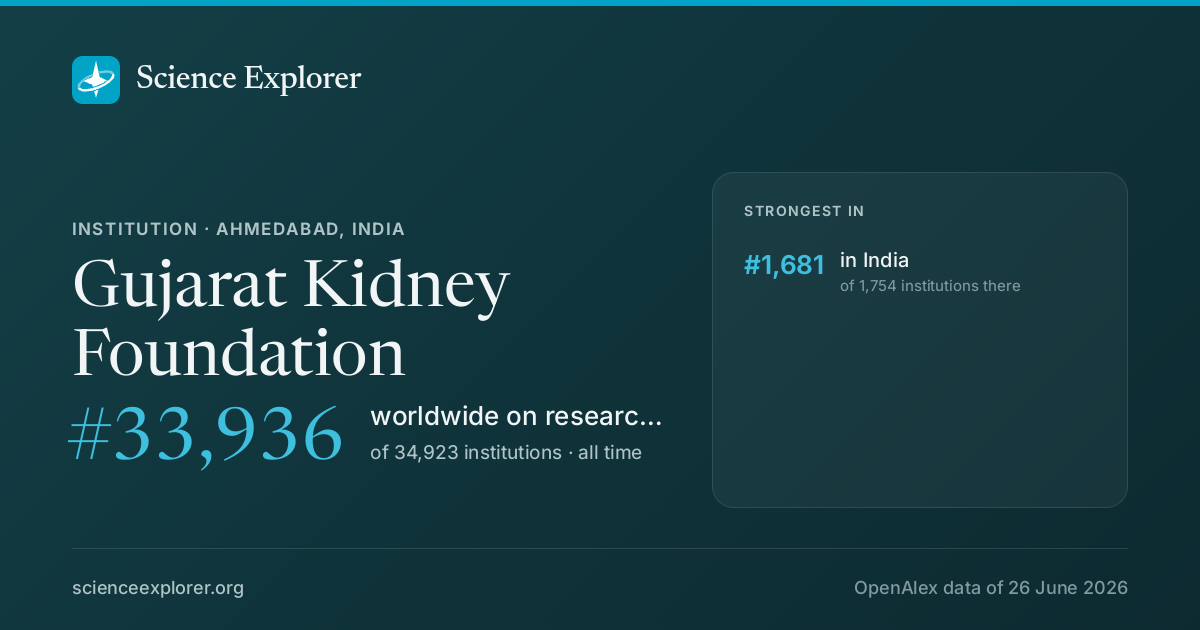
Gujarat Kidney Foundation on Science Explorer

A card with Gujarat Kidney Foundation's standing and the fields it leads in, for a post or a slide. A link to this page previews as the same card.

Download the card

1200 × 630 PNG, sized for social posts, drawn from the latest snapshot.

Badges for a website1Each links back here and updates with every snapshot

Research measures only: rankings here say nothing about teaching, admissions or student experience. Comparable institutions and collaboration partners have tabs of their own, above.

Discussion

Ask a question or share a note about Gujarat Kidney Foundation. Posts are plain text and can be reported.
