Science Explorer Back to mapMap
Discussion
University · Bucharest · Romania

Hyperion University

In research, Hyperion University stands highest in Social Sciences (#12,640 of 14,833 worldwide), over all time.

World rank, all time
#24,148
of 34,923
Rank in Romania
#92
of 174
Research works
244
▼ 37% vs 2018-21
Citations
689
2.8 per fractional work
Top-10% rate
8.5%
all institutions 10.0%
vs its own fields
0.80×
1.00× is exactly expected
Open access
74%
world 40%
International
14%
world 18%

What is Hyperion University known for in research?

The fields where it stands highest, over all time, ranked among every institution above the floor in each field.

FieldWorld rankWhere that sitsTop-10% rateWorks
Social SciencesDomain #12,640 of 14,833 4.2%147

Each strip is that field's whole ranked pool, with the notch where Hyperion University sits in it, in the colour of the band that rank falls in. The track under the rate is the rate itself: it carries no average mark, because the average differs by field (from about 6% in Dentistry to 21% in Economics).

Which fields of science does Hyperion University work in?

In 2022-now, 54% of research at Hyperion University is in Social Sciences, 33% in Physical Sciences. Its largest fields are Social Sciences (19%), Computer Science (14%), Business, Management and Accounting (11%). It does 1.9× the world's share of Social Sciences.

Social Sciences: 21 fractional works · 54.5% of its workSocial Sciences: 7 fractional works · 18.6% of its workSociology and Political Science: 4 fractional works · 9.5% of its workPolitical Science and International Relations: 1 fractional works · 3.2% of its workEducation: 1 fractional works · 1.4% of its workCultural Studies: 0 fractional works · 1.3% of its workGeneral Social Sciences: 0 fractional works · 1.3% of its workGeography, Planning and Development: 0 fractional works · 0.6% of its workDemography: 0 fractional works · 0.6% of its workGender Studies: 0 fractional works · 0.3% of its workCommunication: 0 fractional works · 0.3% of its workSmaller subfields together: 0 fractional works · 0.1% of its workBusiness, Management and Accounting: 4 fractional works · 11.3% of its workManagement Information Systems: 2 fractional works · 5.0% of its workManagement of Technology and Innovation: 1 fractional works · 2.0% of its workStrategy and Management: 1 fractional works · 1.9% of its workAccounting: 0 fractional works · 1.0% of its workMarketing: 0 fractional works · 0.9% of its workOrganizational Behavior and Human Resource Management: 0 fractional works · 0.5% of its workEconomics, Econometrics and Finance: 4 fractional works · 9.1% of its workEconomics and Econometrics: 2 fractional works · 5.2% of its workFinance: 1 fractional works · 2.4% of its workGeneral Economics, Econometrics and Finance: 1 fractional works · 1.6% of its workArts and Humanities: 2 fractional works · 6.4% of its workLiterature and Literary Theory: 1 fractional works · 3.4% of its workPhilosophy: 1 fractional works · 1.7% of its workArcheology: 0 fractional works · 0.4% of its workHistory: 0 fractional works · 0.4% of its workVisual Arts and Performing Arts: 0 fractional works · 0.4% of its workPsychology: 2 fractional works · 5.3% of its workClinical Psychology: 1 fractional works · 2.5% of its workSocial Psychology: 1 fractional works · 2.3% of its workExperimental and Cognitive Psychology: 0 fractional works · 0.4% of its workDecision Sciences: 1 fractional works · 3.8% of its workManagement Science and Operations Research: 1 fractional works · 2.2% of its workInformation Systems and Management: 1 fractional works · 1.5% of its workPhysical Sciences: 13 fractional works · 32.6% of its workComputer Science: 6 fractional works · 14.4% of its workArtificial Intelligence: 2 fractional works · 5.4% of its workInformation Systems: 1 fractional works · 3.7% of its workComputer Networks and Communications: 1 fractional works · 1.5% of its workComputational Theory and Mathematics: 0 fractional works · 1.3% of its workComputer Vision and Pattern Recognition: 0 fractional works · 1.3% of its workComputer Graphics and Computer-Aided Design: 0 fractional works · 0.4% of its workHardware and Architecture: 0 fractional works · 0.4% of its workSoftware: 0 fractional works · 0.4% of its workEngineering: 3 fractional works · 8.8% of its workIndustrial and Manufacturing Engineering: 1 fractional works · 3.0% of its workAerospace Engineering: 1 fractional works · 1.7% of its workElectrical and Electronic Engineering: 1 fractional works · 1.3% of its workMedia Technology: 0 fractional works · 1.1% of its workBuilding and Construction: 0 fractional works · 1.0% of its workControl and Systems Engineering: 0 fractional works · 0.5% of its workSmaller subfields together: 0 fractional works · 0.2% of its workPhysics and Astronomy: 1 fractional works · 3.3% of its workNuclear and High Energy Physics: 1 fractional works · 1.7% of its workStatistical and Nonlinear Physics: 0 fractional works · 0.6% of its workCondensed Matter Physics: 0 fractional works · 0.5% of its workAtomic and Molecular Physics, and Optics: 0 fractional works · 0.4% of its workSmaller subfields together: 0 fractional works · 0.0% of its workEnvironmental Science: 1 fractional works · 2.9% of its workManagement, Monitoring, Policy and Law: 0 fractional works · 1.1% of its workGlobal and Planetary Change: 0 fractional works · 0.8% of its workEnvironmental Engineering: 0 fractional works · 0.4% of its workWater Science and Technology: 0 fractional works · 0.4% of its workEnvironmental Chemistry: 0 fractional works · 0.2% of its workMathematics: 1 fractional works · 2.0% of its workMathematical Physics: 0 fractional works · 1.3% of its workNumerical Analysis: 0 fractional works · 0.6% of its workSmaller subfields together: 0 fractional works · 0.2% of its workEnergy: 0 fractional works · 0.8% of its workRenewable Energy, Sustainability and the Environment: 0 fractional works · 0.8% of its workMaterials Science: 0 fractional works · 0.3% of its workMaterials Chemistry: 0 fractional works · 0.3% of its workHealth Sciences: 3 fractional works · 7.8% of its workHealth Professions: 2 fractional works · 4.2% of its workGeneral Health Professions: 2 fractional works · 4.2% of its workMedicine: 1 fractional works · 3.3% of its workOncology: 0 fractional works · 0.7% of its workNeurology: 0 fractional works · 0.5% of its workPsychiatry and Mental health: 0 fractional works · 0.4% of its workPediatrics, Perinatology and Child Health: 0 fractional works · 0.3% of its workPulmonary and Respiratory Medicine: 0 fractional works · 0.3% of its workRheumatology: 0 fractional works · 0.3% of its workEndocrinology, Diabetes and Metabolism: 0 fractional works · 0.2% of its workHealth Informatics: 0 fractional works · 0.2% of its workPublic Health, Environmental and Occupational Health: 0 fractional works · 0.2% of its workRadiology, Nuclear Medicine and Imaging: 0 fractional works · 0.2% of its workSmaller subfields together: 0 fractional works · 0.2% of its workDentistry: 0 fractional works · 0.3% of its workOral Surgery: 0 fractional works · 0.3% of its workLife Sciences: 2 fractional works · 5.1% of its workAgricultural and Biological Sciences: 2 fractional works · 4.7% of its workPlant Science: 1 fractional works · 1.4% of its workGeneral Agricultural and Biological Sciences: 0 fractional works · 1.2% of its workFood Science: 0 fractional works · 1.1% of its workSoil Science: 0 fractional works · 1.0% of its workNeuroscience: 0 fractional works · 0.5% of its workNeurology: 0 fractional works · 0.3% of its workCognitive Neuroscience: 0 fractional works · 0.2% of its workALL ITS WORKHyperionUniversity39fractional works, 2022-now
Life Sciences5%Physical Sciences33%Health Sciences8%Social Sciences54%

Each ring splits the one inside it: the four domains of science, their fields, their subfields. Size is fractional works in 2022-now. Every slice is a page; the interactive view zooms down to single topics and colours each by how much more of it this institution does than the world.

Its 4 domains and 18 fields, with their numbers
    1. Social Sciences718.6%
    2. Business, Management and Accounting411.3%
    3. Economics, Econometrics and Finance49.1%
    4. Arts and Humanities26.4%
    5. Psychology25.3%
    6. Decision Sciences13.8%
    1. Computer Science614.4%
    2. Engineering38.8%
    3. Physics and Astronomy13.3%
    4. Environmental Science12.9%
    5. Mathematics12.0%
    6. Energy00.8%
    7. Materials Science00.3%
    1. Health Professions24.2%
    2. Medicine13.3%
    3. Dentistry00.3%
    1. Agricultural and Biological Sciences24.7%
    2. Neuroscience00.5%
All of science, and how each field's share has moved since 1950: the Science domain explorer

Field profile

Location quotient across every field it publishes in: outside the ring is more than an institution of this size would be expected to publish, inside it is less.

Agricultural and Biological Sciences: 0.98× its world share, 2 worksAgricultural and Bio…Neuroscience: 0.31× its world share, 0 worksNeuroscienceComputer Science: 1.86× its world share, 6 worksComputer ScienceEnergy: 0.93× its world share, 0 worksEnergyEngineering: 0.59× its world share, 3 worksEngineeringEnvironmental Science: 0.59× its world share, 1 worksEnvironmental ScienceMaterials Science: 0.08× its world share, 0 worksMaterials ScienceMathematics: 1.71× its world share, 1 worksMathematicsPhysics and Astronomy: 1.48× its world share, 1 worksPhysics and AstronomyDentistry: 0.59× its world share, 0 worksDentistryHealth Professions: 1.58× its world share, 2 worksHealth ProfessionsMedicine: 0.17× its world share, 1 worksMedicineArts and Humanities: 2.21× its world share, 2 worksArts and HumanitiesBusiness, Management and Accounting: 3.52× its world share, 4 worksBusiness, Management…Decision Sciences: 3.89× its world share, 2 worksDecision SciencesEconomics, Econometrics and Finance: 4.25× its world share, 4 worksEconomics, Econometr…Psychology: 1.73× its world share, 2 worksPsychologySocial Sciences: 1.47× its world share, 7 worksSocial Sciences1×world share
more than its size predictsabout as predictedless

Rings at 0.5×, 1× and 2×. Widest outward: Economics, Econometrics and Finance, 4.2×. Every wedge is a field page.

All 18 fields, with their numbers
  1. Economics, Econometrics and Finance4.25×4 works
  2. Decision Sciences3.89×2 works
  3. Business, Management and Accounting3.52×4 works
  4. Arts and Humanities2.21×2 works
  5. Computer Science1.86×6 works
  6. Psychology1.73×2 works
  7. Mathematics1.71×1 works
  8. Health Professions1.58×2 works
  9. Physics and Astronomy1.48×1 works
  10. Social Sciences1.47×7 works
  11. Agricultural and Biological Sciences0.98×2 works
  12. Energy0.93×0 works
  13. Engineering0.59×3 works
  14. Environmental Science0.59×1 works
  15. Dentistry0.59×0 works
  16. Neuroscience0.31×0 works
  17. Medicine0.17×1 works
  18. Materials Science0.08×0 works

Who are the top researchers at Hyperion University?

Ranked on the quality score, Radu Bucea-Manea-Țoniș, Liliana Paschia and Cezar Braicu lead among researchers whose main affiliation is Hyperion University.

  1. 1 Radu Bucea-Manea-Țoniș Romania · #2,059,891 worldwide 363 citations · 51 works
  2. 2 Liliana Paschia Romania · #2,566,226 worldwide 253 citations · 22 works
  3. 3 Cezar Braicu Romania · #2,661,108 worldwide 162 citations · 18 works
  4. 4 Alice Iancu Romania · #3,145,052 worldwide 0 citations · 15 works
  5. 5 Emil Răzvan Gatej Romania · #3,469,185 worldwide 35 citations · 15 works
  6. 6 Sever I. Spanulescu Romania · #3,557,655 worldwide 118 citations · 27 works
  7. 7 Cristina Burghelea Romania · #4,105,231 worldwide 110 citations · 33 works
  8. 8 Mihai Covaci Romania · #4,117,405 worldwide 19 citations · 133 works
  9. 9 Anca E. Gheorghiu Romania · #4,488,730 worldwide 64 citations · 41 works
  10. 10 Steliana Rizeanu Romania · #5,070,142 worldwide 134 citations · 45 works
All ranked researchers at Hyperion University

What are the most cited papers from Hyperion University?

The most cited paper from Hyperion University is "Sustainability Analysis of the E-Learning Education System during Pandemic Period—COVID-19 in Romania" (Constantin Aurelian Ionescu, Liliana Paschia, Nicoleta Luminiţa Gudanescu Nicolau et al., 2020), with 154 citations. Next come "Blockchain Technology Enhances Sustainable Higher Education" (106) and "Digitization of Accounting: The Premise of the Paradigm Shift of Role of the Professional Accountant" (102).

Most cited papers
#PaperReleasedCitations
1 Sustainability Analysis of the E-Learning Education System during Pandemic Period—COVID-19 in Romania Constantin Aurelian Ionescu, Liliana Paschia, Nicoleta Luminiţa Gudanescu Nicolau et al. · Sustainability Open access 30 Oct 2020 154
2 Blockchain Technology Enhances Sustainable Higher Education Rocsana Bucea-Manea-Țoniş, Oliva Martins, Radu Bucea-Manea-Țoniș et al. · Sustainability Open access 9 Nov 2021 106
3 Digitization of Accounting: The Premise of the Paradigm Shift of Role of the Professional Accountant Dan Marius Coman, Constantin Aurelian Ionescu, Anişoara Duică et al. · Applied Sciences Open access 25 Mar 2022 102
4 Pathways to inclusive and equitable quality early childhood education for achieving SDG4 goal—a scoping review Dana Rad, Adela Redeș, Alina Felicia Roman et al. · Frontiers in Psychology Open access 22 Jul 2022 88
5 Sustainability in Higher Education: The Relationship between Work-Life Balance and XR E-Learning Facilities Rocsana Bucea-Manea-Țoniş, Radu Bucea-Manea-Țoniș, Violeta Elena Simion et al. · Sustainability Open access 21 Jul 2020 80
All 63 most cited papers, with filters and sorting

Which keywords describe research at Hyperion University?

By fractional works in 2022-now, weighted toward what it does more of than the world: Sustainability, Supply Chain Management, Internet of Things, Ethics, Big Data, Sustainable Development, Artificial Intelligence and Economic Growth.

▲ more of its work than of the world's◆ about the world's share▼ less than the world's

Size is fractional works in 2022-now in the topics tagged with each word; colour is the word's share of this institution's work against its share of the world's. The 29 words are chosen for being large and distinctive. Each links to the topic it comes from most.

All 29 words, with their numbers
  1. Sustainability4▲ 3.8×14 topics
  2. Internet of Things2▲ 7.5×7 topics
  3. Supply Chain Management2▲ 7.2×6 topics
  4. Ethics2▲ 11×8 topics
  5. Big Data2▲ 5.4×6 topics
  6. Sustainable Development2▲ 3.3×11 topics
  7. Artificial Intelligence2▲ 3.5×11 topics
  8. Globalization2▲ 2.4×8 topics
  9. Social Media2▲ 3.3×9 topics
  10. Economic Growth2▲ 4.8×7 topics
  11. Climate Change1▲ 1.19×8 topics
  12. Deep Learning1◆ 0.99×7 topics
  13. Security1▲ 5.1×5 topics
  14. Performance Measurement1▲ 12×2 topics
  15. Cyber-Physical Systems1▲ 10×3 topics
  16. Healthcare1▲ 2.6×5 topics
  17. Innovation1▲ 2.9×8 topics
  18. Management Control Systems1▲ 171×1 topic
  19. Mental Health1▲ 1.98×4 topics
  20. Regulation1▲ 5.2×4 topics
  21. Strategic Management1▲ 19×1 topic
  22. Contemporary Fiction1▲ 258×1 topic
  23. Ethical Climate1▲ 90×1 topic
  24. Financial Performance1▲ 4.7×4 topics
  25. Media1▲ 17×2 topics
  26. Moral Distress1▲ 90×1 topic
  27. Pandemic1▲ 2.6×3 topics
  28. Postmodernism1▲ 69×1 topic
  29. Religion1▲ 5.5×3 topics

Which research topics does Hyperion University publish most on?

By volume in 2022-now: Accounting and Organizational Management, Ethics in medical practice, Contemporary Literature and Criticism and Blockchain Technology Applications and Security.

  1. 1 Accounting and Organizational Management Management Information Systems 1 works
  2. 2 Ethics in medical practice General Health Professions 1 works
  3. 3 Contemporary Literature and Criticism Literature and Literary Theory 1 works
  4. 4 Blockchain Technology Applications and Security Information Systems 1 works
  5. 5 Big Data and Business Intelligence Management Information Systems 1 works
  6. 6 Neural Networks and Applications Artificial Intelligence 1 works
  7. 7 Digital Transformation in Industry Industrial and Manufacturing Engineering 1 works
  8. 8 Technology Adoption and User Behaviour Information Systems and Management 1 works
  9. 9 Mathematical and Theoretical Analysis Mathematical Physics 0 works
  10. 10 Discourse Analysis and Cultural Communication Cultural Studies 0 works

How open and international is its research?

Against the world's own shares: the tick on each track. Both are shares of its output, so they sit on one scale and can be read against each other as well as against the world.

openly available73.9%not open26.1%

World: 40% of research is openly available.

with international co-authors13.8%domestic only86.2%

World: 18% is written across borders.

How has Hyperion University's research output changed?

Output in 2022-2025 was 37% lower than in 2018-2021.

still counting200020052010201520202025
grewheldshrank

The same series as a ribbon: one cell per year, darker for more. The line above answers how much; this answers when.

Its share of all research

Growing output can still be a shrinking share: all of science grows. This is Hyperion University as a percentage of every work published that year, 0.000090% in 2024.

still counting0.00025%0.00050%0.00075%Hyperion University0.00023% in 2025200020102020

Fractional works of Hyperion University over all fractional works that year. How the balance of science has shifted.

Other research institutions in Bucharest

All research institutions in Bucharest

Share Hyperion University's ranking
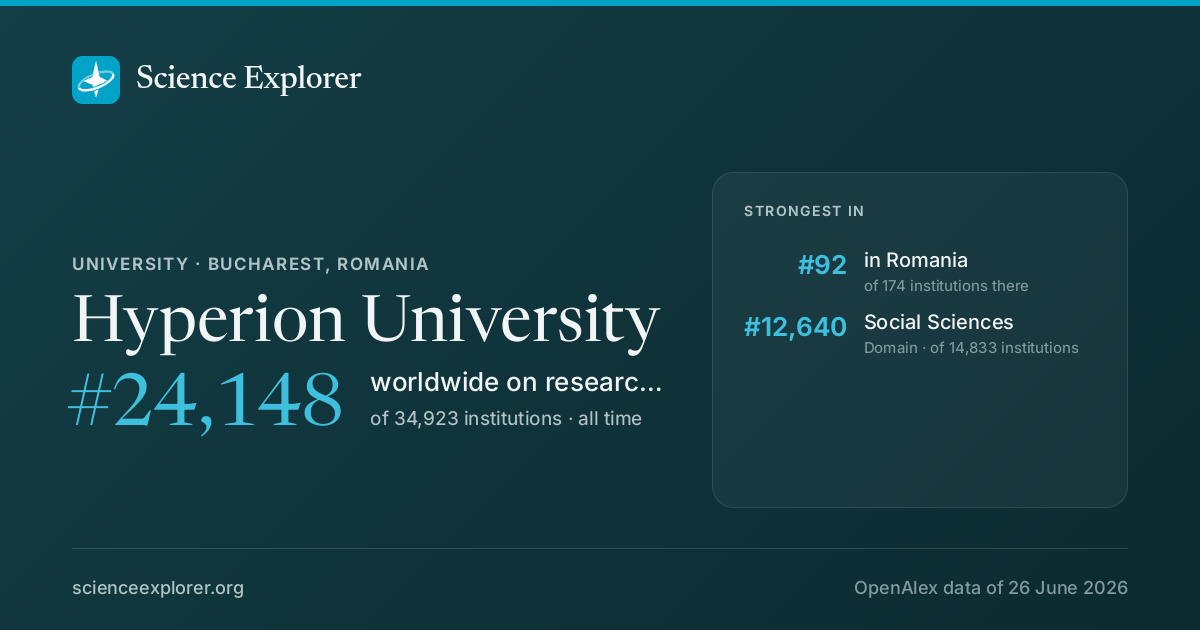
Hyperion University on Science Explorer

A card with Hyperion University's standing and the fields it leads in, for a post or a slide. A link to this page previews as the same card.

Download the card

1200 × 630 PNG, sized for social posts, drawn from the latest snapshot.

Badges for a website1Each links back here and updates with every snapshot

Research measures only: rankings here say nothing about teaching, admissions or student experience. Comparable institutions and collaboration partners have tabs of their own, above.

Discussion

Ask a question or share a note about Hyperion University. Posts are plain text and can be reported.