Institut National Polytechnique de Lorraine
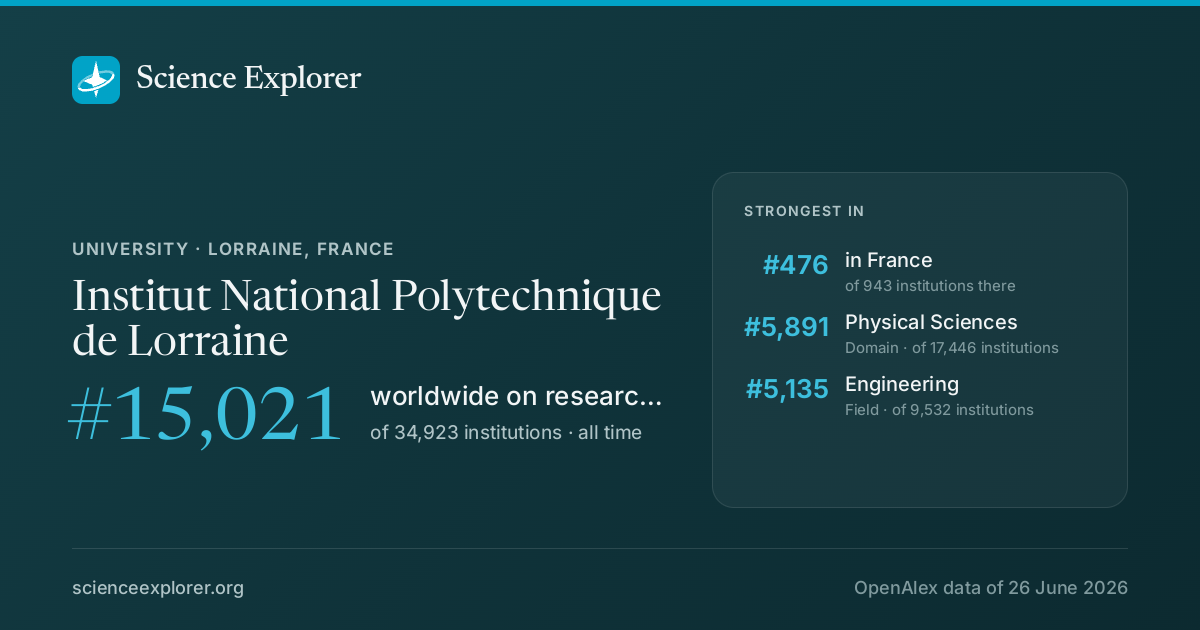
In research, Institut National Polytechnique de Lorraine stands highest in Physical Sciences (#5,891 of 17,446 worldwide) and Engineering (#5,135 of 9,532 worldwide), over all time.
- World rank, all time
- #15,021 of 34,923
- Rank in France
- #476 of 943
- Research works
- 375 ▼ 40% vs 2018-21
- Citations
- 12k 31.6 per fractional work
- Top-10% rate
- 1.6% all institutions 10.0%
- vs its own fields
- 1.18× 1.00× is exactly expected
- Open access
- 18% world 40%
- International
- 12% world 18%
What is Institut National Polytechnique de Lorraine known for in research?
The fields where it stands highest, over all time, ranked among every institution above the floor in each field.
| Field | World rank | Where that sits | Top-10% rate | Works |
|---|---|---|---|---|
| Physical SciencesDomain | #5,891 of 17,446 | 13.4% | 284 | |
| EngineeringField | #5,135 of 9,532 | 14.8% | 131 |
Each strip is that field's whole ranked pool, with the notch where Institut National Polytechnique de Lorraine sits in it, in the colour of the band that rank falls in. The track under the rate is the rate itself: it carries no average mark, because the average differs by field (from about 6% in Dentistry to 21% in Economics).
Which fields of science does Institut National Polytechnique de Lorraine work in?
In all years, 76% of research at Institut National Polytechnique de Lorraine is in Physical Sciences, 16% in Life Sciences. Its largest fields are Engineering (35%), Materials Science (11%), Chemistry (11%). It does 1.8× the world's share of Physical Sciences.
Each ring splits the one inside it: the four domains of science, their fields, their subfields. Size is fractional works in all years. Every slice is a page; the interactive view zooms down to single topics and colours each by how much more of it this institution does than the world.
Its 4 domains and 26 fields, with their numbers
- Physical Sciences28475.8%
- Engineering13135.0%
- Materials Science4211.2%
- Chemistry4110.9%
- Environmental Science174.4%
- Chemical Engineering164.2%
- Computer Science153.9%
- Earth and Planetary Sciences102.6%
- Physics and Astronomy92.4%
- Energy30.8%
- Mathematics10.3%
- Life Sciences6016.0%
- Health Sciences195.2%
- Medicine153.9%
- Nursing41.0%
- Health Professions10.2%
- Veterinary00.1%
- Dentistry00.0%
- Social Sciences113.0%
Field profile
Location quotient across every field it publishes in: outside the ring is more than an institution of this size would be expected to publish, inside it is less.
Who are the top researchers at Institut National Polytechnique de Lorraine?
Ranked on the quality score, Laurent Avaullée, D. Petitjean and Michel Dirand lead among researchers whose main affiliation is Institut National Polytechnique de Lorraine.
- 1
Laurent Avaullée
 France · #2,101,492 worldwide
601 citations · 16 works
- 2
D. Petitjean
France · #2,239,910 worldwide
2.4k citations · 76 works
- 3
Michel Dirand
France · #3,276,765 worldwide
587 citations · 20 works
- 4
Davin Uy
France · #3,590,853 worldwide
558 citations · 19 works
- 5
M. Bouroukba
France · #3,767,829 worldwide
1.6k citations · 66 works
- 6
Jacques DELLACHERIE
France · #4,487,726 worldwide
232 citations · 20 works
- 7
Nathalie Hubert
France · #5,118,916 worldwide
319 citations · 19 works
- 8
M. Dirand
France · #5,525,914 worldwide
1.4k citations · 79 works
- 9
Daniel Balesdent
France · #5,618,582 worldwide
336 citations · 40 works
- 10
Jacques Houriez
France · #5,645,143 worldwide
111 citations · 67 works
Which keywords describe research at Institut National Polytechnique de Lorraine?
By fractional works in all years, weighted toward what it does more of than the world: Nanoparticles, Thermodynamic Properties, Thermodynamics, Enthalpies, Vaporization, Monte Carlo Simulation, Extraction and Supercritical Fluids.
- Cell Culture
- Process Monitoring
- Nucleation
- Stability Analysis
- Fault Detection
- Secondary Metabolites
- Nonlinear Systems
- Crystallization
- Aqueous Solutions
- Surface Tension
- Crystal Growth
- Industrial Applications
- Optimization
- Mechanical Properties
- Biomedical Applications
- Equation of State
- Supercritical Fluids
- Extraction
- Enthalpies
- Thermodynamic Properties
- Nanoparticles
- Thermodynamics
- Vaporization
- Monte Carlo Simulation
- Hydrogen Bonding
- Perturbed-Chain SAFT
- Crystal Engineering
- Nanocomposites
- Heat Transfer
- Model Predictive Control
- Viscosity
- Density
- Binary Mixtures
- Excess Molar Volumes
- Refractive Indices
- Rheology
- Mechanochemistry
- Data-Driven Techniques
- Polymers
- Solubility
Size is fractional works in all years in the topics tagged with each word; colour is the word's share of this institution's work against its share of the world's. The 40 words are chosen for being large and distinctive. Each links to the topic it comes from most.
All 40 words, with their numbers
- Nanoparticles27▲ 5.5×26 topics
- Thermodynamic Properties19▲ 52×3 topics
- Thermodynamics14▲ 40×3 topics
- Enthalpies14▲ 88×1 topic
- Vaporization14▲ 88×1 topic
- Extraction14▲ 20×3 topics
- Monte Carlo Simulation14▲ 12×6 topics
- Supercritical Fluids14▲ 59×2 topics
- Hydrogen Bonding12▲ 13×5 topics
- Equation of State12▲ 41×1 topic
- Perturbed-Chain SAFT12▲ 68×1 topic
- Biomedical Applications11▲ 2.9×17 topics
- Crystal Engineering10▲ 23×3 topics
- Mechanical Properties10▲ 2.8×19 topics
- Nanocomposites9▲ 3.0×15 topics
- Optimization8▲ 4.1×9 topics
- Heat Transfer8▲ 4.1×14 topics
- Industrial Applications8▲ 13×3 topics
- Model Predictive Control8▲ 8.9×5 topics
- Crystal Growth7▲ 5.6×5 topics
- Viscosity7▲ 20×4 topics
- Surface Tension7▲ 20×3 topics
- Density7▲ 45×2 topics
- Aqueous Solutions7▲ 49×2 topics
- Binary Mixtures7▲ 56×2 topics
- Crystallization6▲ 28×3 topics
- Excess Molar Volumes6▲ 62×1 topic
- Nonlinear Systems6▲ 7.6×5 topics
- Refractive Indices6▲ 62×1 topic
- Secondary Metabolites6▲ 17×4 topics
- Rheology6▲ 7.3×7 topics
- Fault Detection6▲ 13×2 topics
- Mechanochemistry6▲ 14×2 topics
- Stability Analysis6▲ 7.1×5 topics
- Data-Driven Techniques6▲ 19×1 topic
- Nucleation6▲ 52×1 topic
- Polymers6▲ 16×3 topics
- Process Monitoring6▲ 15×1 topic
- Solubility6▲ 52×1 topic
- Cell Culture5▲ 13×2 topics
Which research topics does Institut National Polytechnique de Lorraine publish most on?
By volume in 2022-now: Agricultural and Food Sciences, Smart Grid Security and Resilience, Blockchain Technology Applications and Security and Smart Grid Energy Management.
Area is fractional works; colour is the subfield each topic belongs to.
- 1 Agricultural and Food Sciences Forestry 0 works
- 2 Smart Grid Security and Resilience Control and Systems Engineering 0 works
- 3 Blockchain Technology Applications and Security Information Systems 0 works
- 4 Smart Grid Energy Management Electrical and Electronic Engineering 0 works
- 5 Rural Development and Agriculture Management, Monitoring, Policy and Law 0 works
- 6 Oil Palm Production and Sustainability Ecology 0 works
How open and international is its research?
Against the world's own shares: the tick on each track. Both are shares of its output, so they sit on one scale and can be read against each other as well as against the world.
World: 40% of research is openly available.
World: 18% is written across borders.
How has Institut National Polytechnique de Lorraine's research output changed?
Output in 2022-2025 was 40% lower than in 2018-2021.
The same series as a ribbon: one cell per year, darker for more. The line above answers how much; this answers when.
Its share of all research
Growing output can still be a shrinking share: all of science grows. This is Institut National Polytechnique de Lorraine as a percentage of every work published that year, 0.0000046% in 2023.
Fractional works of Institut National Polytechnique de Lorraine over all fractional works that year. How the balance of science has shifted.
Share Institut National Polytechnique de Lorraine's ranking
Badges for a website1Each links back here and updates with every snapshot

Research measures only: rankings here say nothing about teaching, admissions or student experience. Comparable institutions and collaboration partners have tabs of their own, above.
Discussion
Ask a question or share a note about Institut National Polytechnique de Lorraine. Keep it to the research: no personal attacks, advertising or links. Any reader can report a post, which collapses it for everyone until it is opened.