- World rank, all time
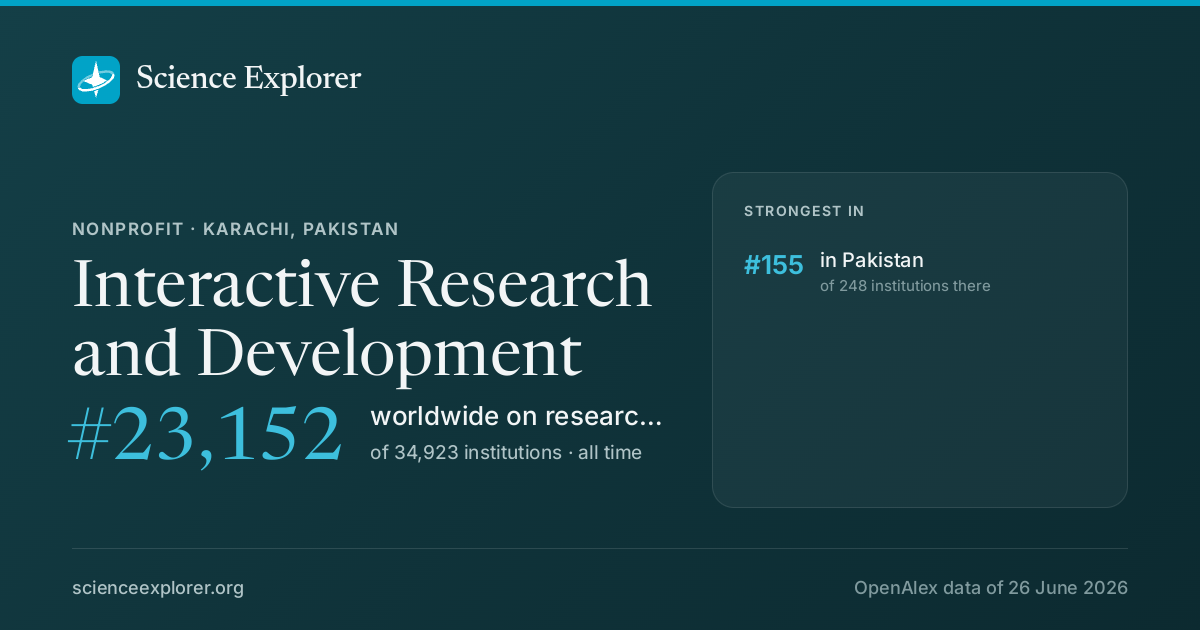
- #23,152 of 34,923
- Rank in Pakistan
- #155 of 248
- Research works
- 157 ▲ 53% vs 2018-21
- Citations
- 2.9k 18.3 per fractional work
- Top-10% rate
- 10.5% all institutions 10.0%
- vs its own fields
- 1.05× 1.00× is exactly expected
- Open access
- 66% world 40%
- International
- 54% world 18%
Which fields of science does Interactive Research and Development work in?
In 2022-now, 43% of research at Interactive Research and Development is in Health Sciences, 30% in Social Sciences. Its largest fields are Medicine (35%), Social Sciences (17%), Computer Science (14%). It does 1.7× the world's share of Health Sciences.
Each ring splits the one inside it: the four domains of science, their fields, their subfields. Size is fractional works in 2022-now. Every slice is a page; the interactive view zooms down to single topics and colours each by how much more of it this institution does than the world.
Its 4 domains and 20 fields, with their numbers
- Health Sciences2443.1%
- Medicine2034.9%
- Health Professions35.3%
- Nursing22.9%
- Social Sciences1730.3%
- Physical Sciences1221.8%
- Computer Science814.1%
- Engineering35.6%
- Mathematics00.9%
- Environmental Science00.7%
- Materials Science00.4%
- Chemical Engineering00.1%
- Chemistry00.0%
- Life Sciences34.8%
Field profile
Location quotient across every field it publishes in: outside the ring is more than an institution of this size would be expected to publish, inside it is less.
Rings at 0.5×, 1× and 2×. Widest outward: Nursing, 5.9×. Every wedge is a field page.
All 20 fields, with their numbers
- Nursing5.93×2 works
- Immunology and Microbiology2.74×2 works
- Psychology2.57×4 works
- Health Professions2.01×3 works
- Computer Science1.81×8 works
- Medicine1.81×20 works
- Social Sciences1.37×10 works
- Business, Management and Accounting0.89×2 works
- Mathematics0.75×0 works
- Decision Sciences0.73×0 works
- Economics, Econometrics and Finance0.64×1 works
- Neuroscience0.49×0 works
- Engineering0.38×3 works
- Chemical Engineering0.34×0 works
- Biochemistry, Genetics and Molecular Biology0.22×1 works
- Environmental Science0.13×0 works
- Materials Science0.10×0 works
- Arts and Humanities0.10×0 works
- Pharmacology, Toxicology and Pharmaceutics0.07×0 works
- Chemistry0.02×0 works
- Nursing 5.9×
- Immunology and Microbiology 2.7×
- Psychology 2.6×
- Health Professions 2.0×
- Computer Science 1.8×
- Medicine 1.8×
- Social Sciences 1.4×
- Business, Management and Accounting 0.9×
- Mathematics 0.8×
- Decision Sciences 0.7×
- Economics, Econometrics and Finance 0.6×
- Neuroscience 0.5×
- Engineering 0.4×
- Chemical Engineering 0.3×
- Biochemistry, Genetics and Molecular Biology 0.2×
- Environmental Science 0.1×
- Materials Science 0.1×
- Arts and Humanities 0.1×
- Pharmacology, Toxicology and Pharmaceutics 0.1×
- Chemistry 0.0×
Who are the top researchers at Interactive Research and Development?
Ranked on the quality score, Saman Ahmed, Saira Khowaja and Aamir Javed Khan lead among researchers whose main affiliation is Interactive Research and Development.
- 1
Saman Ahmed
 Pakistan · #1,600,700 worldwide
301 citations · 19 works
- 2
Saira Khowaja
Pakistan · #1,749,515 worldwide
1k citations · 45 works
- 3
Aamir Javed Khan
Pakistan · #1,897,164 worldwide
3.2k citations · 160 works
- 4
Mubarak Taighoon Shah
Pakistan · #2,027,513 worldwide
571 citations · 49 works
- 5
Ali Habib
Pakistan · #2,139,027 worldwide
473 citations · 20 works
- 6
Subhash Chandir
Pakistan · #2,479,505 worldwide
1.4k citations · 81 works
- 7
Danya Arif Siddiqi
Pakistan · #2,721,345 worldwide
789 citations · 58 works
- 8
Mariam Mehmood
Pakistan · #2,823,400 worldwide
299 citations · 17 works
- 9
Sara Abdullah
Pakistan · #2,958,090 worldwide
401 citations · 24 works
- 10
Aneeta Pasha
Pakistan · #3,348,259 worldwide
231 citations · 25 works
Which keywords describe research at Interactive Research and Development?
By fractional works in 2022-now, weighted toward what it does more of than the world: Epidemiology, Immune Response, Vaccine, Social Media, Health Behavior, Global Access, COVID-19 Vaccine and Vaccine Hesitancy.
- Infrastructure Development
- Internet-based Interventions
- Cognitive Behavioral Therapy
- TCP
- Health Systems
- Distributed Systems
- Continuous Queries
- Child Mortality
- Water Sanitation Hygiene
- Psychological Distress
- Maternal Mortality
- Child Development
- Tuberculosis
- Mycobacterium tuberculosis
- Depression
- Treatment
- Vaccine Hesitancy
- COVID-19 Vaccine
- Vaccine
- Immune Response
- Epidemiology
- Social Media
- Health Behavior
- Global Access
- Diagnosis
- Drug Resistance
- Infectious Diseases
- Public Health
- Artificial Intelligence
- Global Burden
- Anxiety
- Maternal and Child Undernutrition
- Health Inequalities
- Congestion Control
- Data Stream Management
- Grid Computing
- SARS-CoV-2
- Adherence
- Ethical Considerations
- Mobile Health
Size is fractional works in 2022-now in the topics tagged with each word; colour is the word's share of this institution's work against its share of the world's. The 40 words are chosen for being large and distinctive. Each links to the topic it comes from most.
All 40 words, with their numbers
- Epidemiology8▲ 3.3×22 topics
- Immune Response4▲ 13×7 topics
- Social Media4▲ 5.1×4 topics
- Vaccine4▲ 15×5 topics
- Health Behavior3▲ 58×2 topics
- COVID-19 Vaccine3▲ 77×1 topic
- Global Access3▲ 65×2 topics
- Vaccine Hesitancy3▲ 85×1 topic
- Diagnosis3▲ 5.4×7 topics
- Treatment3▲ 4.2×5 topics
- Drug Resistance3▲ 16×4 topics
- Depression3▲ 5.3×6 topics
- Infectious Diseases3▲ 14×6 topics
- Mycobacterium tuberculosis2▲ 71×1 topic
- Public Health2▲ 2.8×9 topics
- Tuberculosis2▲ 76×1 topic
- Artificial Intelligence2▲ 2.8×3 topics
- Child Development2▲ 9.6×3 topics
- Global Burden2▲ 6.3×6 topics
- Maternal Mortality2▲ 15×2 topics
- Anxiety2▲ 6.1×4 topics
- Psychological Distress2▲ 12×3 topics
- Maternal and Child Undernutrition2▲ 34×1 topic
- Water Sanitation Hygiene2▲ 34×1 topic
- Health Inequalities2▲ 21×2 topics
- Child Mortality1▲ 32×1 topic
- Congestion Control1▲ 254×1 topic
- Continuous Queries1▲ 162×1 topic
- Data Stream Management1▲ 162×1 topic
- Distributed Systems1▲ 14×1 topic
- Grid Computing1▲ 72×1 topic
- Health Systems1▲ 32×1 topic
- SARS-CoV-21▲ 7.4×3 topics
- TCP1▲ 254×1 topic
- Adherence1▲ 17×2 topics
- Cognitive Behavioral Therapy1▲ 14×1 topic
- Ethical Considerations1▲ 6.1×3 topics
- Internet-based Interventions1▲ 31×1 topic
- Mobile Health1▲ 14×2 topics
- Infrastructure Development1▲ 85×2 topics
Which research topics does Interactive Research and Development publish most on?
By volume in 2022-now: Vaccine Coverage and Hesitancy, Tuberculosis Research and Epidemiology, Child Nutrition and Water Access and Network Traffic and Congestion Control.
Area is fractional works; colour is the subfield each topic belongs to.
- 1 Vaccine Coverage and Hesitancy Health 3 works
- 2 Tuberculosis Research and Epidemiology Infectious Diseases 2 works
- 3 Child Nutrition and Water Access Nutrition and Dietetics 2 works
- 4 Network Traffic and Congestion Control Computer Networks and Communications 1 works
- 5 Global Maternal and Child Health Pediatrics, Perinatology and Child Health 1 works
- 6 Distributed and Parallel Computing Systems Computer Networks and Communications 1 works
- 7 Advanced Database Systems and Queries Computer Networks and Communications 1 works
- 8 Digital Mental Health Interventions Applied Psychology 1 works
- 9 Innovation and Socioeconomic Development Business and International Management 1 works
- 10 Advanced Research in Systems and Signal Processing Control and Systems Engineering 1 works
How open and international is its research?
Against the world's own shares: the tick on each track. Both are shares of its output, so they sit on one scale and can be read against each other as well as against the world.
World: 40% of research is openly available.
World: 18% is written across borders.
How has Interactive Research and Development's research output changed?
Output in 2022-2025 was 53% higher than in 2018-2021.
The same series as a ribbon: one cell per year, darker for more. The line above answers how much; this answers when.
Its share of all research
Growing output can still be a shrinking share: all of science grows. This is Interactive Research and Development as a percentage of every work published that year, 0.00013% in 2024.
Fractional works of Interactive Research and Development over all fractional works that year. How the balance of science has shifted.
Other research institutions in Karachi
- University of Karachi
- Aga Khan University
- Dow University of Health Sciences
- NED University of Engineering and Technology
- Ziauddin University
- Jinnah Postgraduate Medical Center
- Iqra University
- University of Islamic Studies
Share Interactive Research and Development's ranking
Badges for a website1Each links back here and updates with every snapshot

Research measures only: rankings here say nothing about teaching, admissions or student experience. Comparable institutions and collaboration partners have tabs of their own, above.
Discussion
Ask a question or share a note about Interactive Research and Development. Keep it to the research: no personal attacks, advertising or links. Any reader can report a post, which collapses it for everyone until it is opened.