Science Explorer Back to mapMap
Discussion
Company · Rimini · Italy

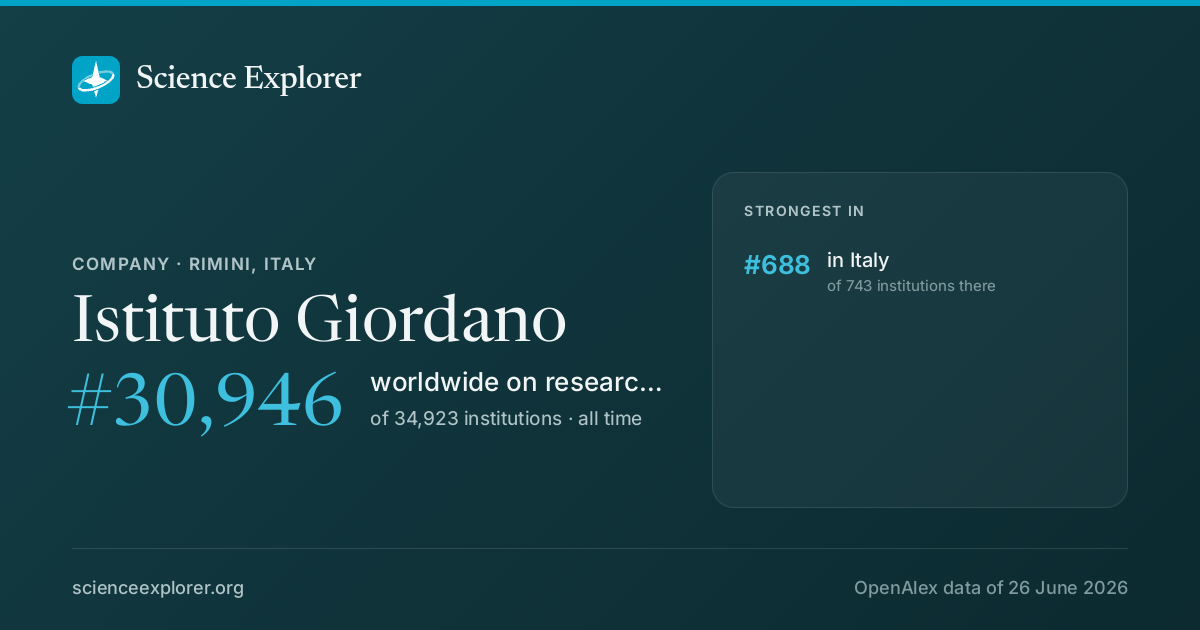
Istituto Giordano

World rank, all time
#30,946
of 34,923
Rank in Italy
#688
of 743
Research works
146
▲ 20% vs 2018-21
Citations
2.2k
15.2 per fractional work
Top-10% rate
8.5%
all institutions 10.0%
vs its own fields
0.92×
1.00× is exactly expected
Open access
22%
world 40%
International
18%
world 18%

Which fields of science does Istituto Giordano work in?

In all years, 58% of research at Istituto Giordano is in Physical Sciences, 17% in Health Sciences. Its largest fields are Environmental Science (16%), Medicine (15%), Earth and Planetary Sciences (13%). It does 1.4× the world's share of Physical Sciences.

Physical Sciences: 85 fractional works · 58.3% of its workEnvironmental Science: 23 fractional works · 15.8% of its workGlobal and Planetary Change: 10 fractional works · 7.0% of its workEnvironmental Engineering: 6 fractional works · 4.2% of its workWater Science and Technology: 2 fractional works · 1.1% of its workHealth, Toxicology and Mutagenesis: 1 fractional works · 0.8% of its workEcological Modeling: 1 fractional works · 0.7% of its workIndustrial and Manufacturing Engineering: 1 fractional works · 0.7% of its workEcology: 1 fractional works · 0.5% of its workEnvironmental Chemistry: 0 fractional works · 0.3% of its workNature and Landscape Conservation: 0 fractional works · 0.3% of its workManagement, Monitoring, Policy and Law: 0 fractional works · 0.2% of its workSmaller subfields together: 0 fractional works · 0.1% of its workEarth and Planetary Sciences: 20 fractional works · 13.5% of its workAtmospheric Science: 12 fractional works · 7.9% of its workEarth-Surface Processes: 6 fractional works · 3.9% of its workOceanography: 1 fractional works · 0.8% of its workGeochemistry and Petrology: 1 fractional works · 0.7% of its workSmaller subfields together: 0 fractional works · 0.2% of its workEngineering: 19 fractional works · 12.7% of its workComputational Mechanics: 3 fractional works · 2.0% of its workElectrical and Electronic Engineering: 3 fractional works · 1.9% of its workAerospace Engineering: 2 fractional works · 1.6% of its workMechanical Engineering: 2 fractional works · 1.6% of its workBiomedical Engineering: 2 fractional works · 1.5% of its workControl and Systems Engineering: 2 fractional works · 1.1% of its workOcean Engineering: 1 fractional works · 0.9% of its workMechanics of Materials: 1 fractional works · 0.6% of its workSafety, Risk, Reliability and Quality: 1 fractional works · 0.5% of its workBuilding and Construction: 0 fractional works · 0.3% of its workMedia Technology: 0 fractional works · 0.3% of its workSmaller subfields together: 1 fractional works · 0.4% of its workMaterials Science: 6 fractional works · 4.0% of its workMaterials Chemistry: 3 fractional works · 1.8% of its workSurfaces, Coatings and Films: 2 fractional works · 1.3% of its workPolymers and Plastics: 1 fractional works · 0.4% of its workElectronic, Optical and Magnetic Materials: 0 fractional works · 0.3% of its workSmaller subfields together: 0 fractional works · 0.3% of its workComputer Science: 5 fractional works · 3.6% of its workArtificial Intelligence: 2 fractional works · 1.5% of its workComputer Vision and Pattern Recognition: 1 fractional works · 0.7% of its workComputational Theory and Mathematics: 1 fractional works · 0.5% of its workInformation Systems: 1 fractional works · 0.5% of its workComputer Science Applications: 0 fractional works · 0.2% of its workSmaller subfields together: 0 fractional works · 0.2% of its workPhysics and Astronomy: 5 fractional works · 3.5% of its workAstronomy and Astrophysics: 3 fractional works · 2.3% of its workStatistical and Nonlinear Physics: 1 fractional works · 0.4% of its workRadiation: 0 fractional works · 0.3% of its workAtomic and Molecular Physics, and Optics: 0 fractional works · 0.2% of its workCondensed Matter Physics: 0 fractional works · 0.2% of its workChemistry: 3 fractional works · 1.9% of its workOrganic Chemistry: 1 fractional works · 1.0% of its workInorganic Chemistry: 1 fractional works · 0.6% of its workSmaller subfields together: 0 fractional works · 0.3% of its workMathematics: 2 fractional works · 1.7% of its workApplied Mathematics: 1 fractional works · 0.7% of its workAlgebra and Number Theory: 0 fractional works · 0.3% of its workGeometry and Topology: 0 fractional works · 0.3% of its workMathematical Physics: 0 fractional works · 0.2% of its workSmaller subfields together: 0 fractional works · 0.1% of its workChemical Engineering: 2 fractional works · 1.1% of its workCatalysis: 1 fractional works · 0.6% of its workProcess Chemistry and Technology: 1 fractional works · 0.4% of its workSmaller subfields together: 0 fractional works · 0.0% of its workEnergy: 1 fractional works · 0.6% of its workRenewable Energy, Sustainability and the Environment: 1 fractional works · 0.6% of its workHealth Sciences: 25 fractional works · 17.0% of its workMedicine: 22 fractional works · 15.0% of its workSurgery: 2 fractional works · 1.5% of its workObstetrics and Gynecology: 2 fractional works · 1.3% of its workPhysiology: 2 fractional works · 1.2% of its workOncology: 2 fractional works · 1.2% of its workPulmonary and Respiratory Medicine: 2 fractional works · 1.1% of its workImmunology and Allergy: 2 fractional works · 1.0% of its workCardiology and Cardiovascular Medicine: 1 fractional works · 0.9% of its workPublic Health, Environmental and Occupational Health: 1 fractional works · 0.8% of its workOtorhinolaryngology: 1 fractional works · 0.7% of its workEpidemiology: 1 fractional works · 0.7% of its workNeurology: 1 fractional works · 0.5% of its workReproductive Medicine: 1 fractional works · 0.5% of its workPharmacology: 1 fractional works · 0.5% of its workEndocrinology, Diabetes and Metabolism: 1 fractional works · 0.4% of its workPathology and Forensic Medicine: 1 fractional works · 0.4% of its workGenetics: 1 fractional works · 0.4% of its workRadiology, Nuclear Medicine and Imaging: 1 fractional works · 0.4% of its workRheumatology: 1 fractional works · 0.4% of its workInfectious Diseases: 0 fractional works · 0.3% of its workPsychiatry and Mental health: 0 fractional works · 0.2% of its workDermatology: 0 fractional works · 0.2% of its workSmaller subfields together: 1 fractional works · 0.4% of its workHealth Professions: 1 fractional works · 1.0% of its workGeneral Health Professions: 1 fractional works · 0.5% of its workSpeech and Hearing: 0 fractional works · 0.3% of its workSmaller subfields together: 0 fractional works · 0.1% of its workDentistry: 1 fractional works · 0.8% of its workOral Surgery: 1 fractional works · 0.4% of its workOrthodontics: 0 fractional works · 0.2% of its workPeriodontics: 0 fractional works · 0.2% of its workVeterinary: 0 fractional works · 0.2% of its workNursing: 0 fractional works · 0.1% of its workSocial Sciences: 23 fractional works · 15.7% of its workSocial Sciences: 9 fractional works · 6.2% of its workSociology and Political Science: 3 fractional works · 1.8% of its workPolitical Science and International Relations: 2 fractional works · 1.6% of its workEducation: 2 fractional works · 1.4% of its workCultural Studies: 1 fractional works · 0.6% of its workAnthropology: 0 fractional works · 0.3% of its workSmaller subfields together: 1 fractional works · 0.5% of its workArts and Humanities: 9 fractional works · 6.2% of its workConservation: 2 fractional works · 1.6% of its workArcheology: 2 fractional works · 1.0% of its workHistory: 2 fractional works · 1.0% of its workHistory and Philosophy of Science: 1 fractional works · 0.7% of its workPhilosophy: 1 fractional works · 0.7% of its workVisual Arts and Performing Arts: 1 fractional works · 0.7% of its workLiterature and Literary Theory: 0 fractional works · 0.2% of its workSmaller subfields together: 0 fractional works · 0.2% of its workEconomics, Econometrics and Finance: 2 fractional works · 1.2% of its workEconomics and Econometrics: 2 fractional works · 1.2% of its workPsychology: 2 fractional works · 1.1% of its workClinical Psychology: 1 fractional works · 0.4% of its workApplied Psychology: 0 fractional works · 0.3% of its workSmaller subfields together: 1 fractional works · 0.4% of its workBusiness, Management and Accounting: 1 fractional works · 0.9% of its workStrategy and Management: 1 fractional works · 0.8% of its workSmaller subfields together: 0 fractional works · 0.1% of its workDecision Sciences: 0 fractional works · 0.1% of its workLife Sciences: 13 fractional works · 9.0% of its workBiochemistry, Genetics and Molecular Biology: 7 fractional works · 4.6% of its workMolecular Biology: 3 fractional works · 2.3% of its workGenetics: 1 fractional works · 0.8% of its workCancer Research: 1 fractional works · 0.5% of its workCell Biology: 1 fractional works · 0.4% of its workBiochemistry: 0 fractional works · 0.3% of its workSmaller subfields together: 0 fractional works · 0.2% of its workAgricultural and Biological Sciences: 4 fractional works · 2.5% of its workPlant Science: 1 fractional works · 0.7% of its workEcology, Evolution, Behavior and Systematics: 1 fractional works · 0.5% of its workFood Science: 1 fractional works · 0.5% of its workAquatic Science: 0 fractional works · 0.2% of its workAgronomy and Crop Science: 0 fractional works · 0.2% of its workSmaller subfields together: 0 fractional works · 0.3% of its workImmunology and Microbiology: 2 fractional works · 1.0% of its workImmunology: 1 fractional works · 0.9% of its workSmaller subfields together: 0 fractional works · 0.1% of its workNeuroscience: 1 fractional works · 0.8% of its workCellular and Molecular Neuroscience: 0 fractional works · 0.3% of its workSmaller subfields together: 1 fractional works · 0.5% of its workPharmacology, Toxicology and Pharmaceutics: 0 fractional works · 0.1% of its workALL ITS WORKIstituto Giordano146fractional works, all years
Life Sciences9%Physical Sciences58%Health Sciences17%Social Sciences16%

Each ring splits the one inside it: the four domains of science, their fields, their subfields. Size is fractional works in all years. Every slice is a page; the interactive view zooms down to single topics and colours each by how much more of it this institution does than the world.

Its 4 domains and 26 fields, with their numbers
    1. Environmental Science2315.8%
    2. Earth and Planetary Sciences2013.5%
    3. Engineering1912.7%
    4. Materials Science64.0%
    5. Computer Science53.6%
    6. Physics and Astronomy53.5%
    7. Chemistry31.9%
    8. Mathematics21.7%
    9. Chemical Engineering21.1%
    10. Energy10.6%
    1. Medicine2215.0%
    2. Health Professions11.0%
    3. Dentistry10.8%
    4. Veterinary00.2%
    5. Nursing00.1%
    1. Social Sciences96.2%
    2. Arts and Humanities96.2%
    3. Economics, Econometrics and Finance21.2%
    4. Psychology21.1%
    5. Business, Management and Accounting10.9%
    6. Decision Sciences00.1%
    1. Biochemistry, Genetics and Molecular Biology74.6%
    2. Agricultural and Biological Sciences42.5%
    3. Immunology and Microbiology21.0%
    4. Neuroscience10.8%
    5. Pharmacology, Toxicology and Pharmaceutics00.1%
All of science, and how each field's share has moved since 1950: the Science domain explorer

Field profile

Location quotient across every field it publishes in: outside the ring is more than an institution of this size would be expected to publish, inside it is less.

Agricultural and Biological Sciences: 0.39× its world share, 0 worksAgricultural and Bio…Biochemistry, Genetics and Molecular Biology: 0.70× its world share, 0 worksBiochemistry, Geneti…Neuroscience: 1.67× its world share, 0 worksNeuroscienceComputer Science: 1.00× its world share, 1 worksComputer ScienceEarth and Planetary Sciences: 0.98× its world share, 0 worksEarth and Planetary …Engineering: 0.27× its world share, 1 worksEngineeringEnvironmental Science: 1.49× its world share, 1 worksEnvironmental ScienceMathematics: 7.17× its world share, 1 worksMathematicsDentistry: 1.19× its world share, 0 worksDentistryHealth Professions: 0.82× its world share, 0 worksHealth ProfessionsMedicine: 0.79× its world share, 2 worksMedicineVeterinary: 6.35× its world share, 0 worksVeterinaryArts and Humanities: 2.30× its world share, 1 worksArts and HumanitiesBusiness, Management and Accounting: 1.43× its world share, 1 worksBusiness, Management…Economics, Econometrics and Finance: 1.61× its world share, 0 worksEconomics, Econometr…Psychology: 2.30× its world share, 1 worksPsychologySocial Sciences: 1.75× its world share, 3 worksSocial Sciences1×world share
more than its size predictsabout as predictedless

Rings at 0.5×, 1× and 2×. Widest outward: Mathematics, 7.2×. Every wedge is a field page.

All 17 fields, with their numbers
  1. Mathematics7.17×1 works
  2. Veterinary6.35×0 works
  3. Arts and Humanities2.30×1 works
  4. Psychology2.30×1 works
  5. Social Sciences1.75×3 works
  6. Neuroscience1.67×0 works
  7. Economics, Econometrics and Finance1.61×0 works
  8. Environmental Science1.49×1 works
  9. Business, Management and Accounting1.43×1 works
  10. Dentistry1.19×0 works
  11. Computer Science1.00×1 works
  12. Earth and Planetary Sciences0.98×0 works
  13. Health Professions0.82×0 works
  14. Medicine0.79×2 works
  15. Biochemistry, Genetics and Molecular Biology0.70×0 works
  16. Agricultural and Biological Sciences0.39×0 works
  17. Engineering0.27×1 works

Who are the top researchers at Istituto Giordano?

Ranked on the quality score, Bernardo Cartoni, Fernanda Trombetti and Axel Osmond lead among researchers whose main affiliation is Istituto Giordano.

  1. 1 Bernardo Cartoni Italy · #3,302,860 worldwide 6 citations · 16 works
  2. 2 Fernanda Trombetti Italy · #3,680,222 worldwide 536 citations · 26 works
  3. 3 Axel Osmond Italy · #3,758,813 worldwide 11 citations · 17 works
  4. 4 G. Orsi Italy · #4,589,015 worldwide 1.3k citations · 43 works
All ranked researchers at Istituto Giordano

What are the most cited papers from Istituto Giordano?

The most cited paper from Istituto Giordano is "One-Way Accumulators: A Decentralized Alternative to Digital Signatures" (Josh Benaloh, Michael de Mare, 1994), with 555 citations. Next come "Origin and growth mechanisms of the sulfated crusts on urban limestone" (173) and "Contribution of atmospheric deposition to the formation of damage layers" (121).

Most cited papers
#PaperReleasedCitations
1 One-Way Accumulators: A Decentralized Alternative to Digital Signatures Josh Benaloh, Michael de Mare · Lecture notes in computer science Conference paper 1994 555
2 Origin and growth mechanisms of the sulfated crusts on urban limestone Dario Camuffo, Marco Del Monte, Cristina Sabbioni · Water Air & Soil Pollution May 1983 173
3 Contribution of atmospheric deposition to the formation of damage layers Cristina Sabbioni · The Science of The Total Environment May 1995 121
4 Changes in aerosol size- and phase distributions due to physical and chemical processes in fog Kevin J. Noone, JOHN A. OGREN, Anneli Hallberg et al. · Tellus B Open access 1992 110
5 M-mode and two-dimensional echocardiography in chronic Chages' heart disease. A clinical and pathologic study. Harry Acquatella, Nelson B. Schiller, Juan José Puigbó et al. · Circulation Oct 1980 108
All 60 most cited papers, with filters and sorting

Which keywords describe research at Istituto Giordano?

By fractional works in all years, weighted toward what it does more of than the world: Air Quality, Satellite Observations, Cultural Heritage, Climate Change, Large-Eddy Simulation, Remote Sensing, Atmospheric Aerosols and Black Carbon.

▲ more of its work than of the world's◆ about the world's share▼ less than the world's

Size is fractional works in all years in the topics tagged with each word; colour is the word's share of this institution's work against its share of the world's. The 40 words are chosen for being large and distinctive. Each links to the topic it comes from most.

All 40 words, with their numbers
  1. Air Quality16▲ 57×3 topics
  2. Climate Change12▲ 3.1×25 topics
  3. Satellite Observations8▲ 51×3 topics
  4. Cultural Heritage8▲ 12×9 topics
  5. Remote Sensing8▲ 4.9×7 topics
  6. Large-Eddy Simulation7▲ 20×4 topics
  7. Epidemiology6◆ 1.07×27 topics
  8. Atmospheric Aerosols6▲ 59×1 topic
  9. Black Carbon6▲ 59×1 topic
  10. Hydrological Cycle6▲ 38×2 topics
  11. Boundary Layer6▲ 28×2 topics
  12. Aerosols6▲ 63×1 topic
  13. Climate6▲ 51×1 topic
  14. Turbulent Flow5▲ 26×2 topics
  15. Conservation5▲ 6.9×6 topics
  16. Water Quality4▲ 7.3×5 topics
  17. CFD Simulation4▲ 25×1 topic
  18. Urban Microclimate4▲ 57×1 topic
  19. Environmental Impact4▲ 1.95×11 topics
  20. Sediment Transport4▲ 14×2 topics
  21. Aeolian Processes3▲ 104×1 topic
  22. Wind Erosion3▲ 104×1 topic
  23. Ozone Depletion3▲ 34×1 topic
  24. Stratospheric Water Vapor3▲ 34×1 topic
  25. Carbon Dioxide3▲ 14×2 topics
  26. Catalysis3▲ 2.3×6 topics
  27. Emissions3▲ 9.5×1 topic
  28. Methane3▲ 32×1 topic
  29. Bioremediation2▲ 11×5 topics
  30. Culture2▲ 3.3×4 topics
  31. Data Assimilation2▲ 7.3×3 topics
  32. Environmental Monitoring2▲ 4.4×2 topics
  33. Forecasting2▲ 9.5×2 topics
  34. Biodeterioration2▲ 52×1 topic
  35. Geomycology2▲ 52×1 topic
  36. Indoor Air Quality2▲ 29×2 topics
  37. Turbulent Flows2▲ 8.4×1 topic
  38. Vortex Dynamics2▲ 6.6×1 topic
  39. Multivariate Statistical Techniques2▲ 28×1 topic
  40. Two-Phase Flow2▲ 11×2 topics

Which research topics does Istituto Giordano publish most on?

By volume in 2022-now: Rings, Modules, and Algebras, Diverse academic and cultural studies, Digital Mental Health Interventions and Advanced Algebra and Logic.

  1. 1 Rings, Modules, and Algebras Algebra and Number Theory 0 works
  2. 2 Diverse academic and cultural studies Economics and Econometrics 0 works
  3. 3 Digital Mental Health Interventions Applied Psychology 0 works
  4. 4 Advanced Algebra and Logic Computational Theory and Mathematics 0 works
  5. 5 Cultural, Media, and Literary Studies Philosophy 0 works
  6. 6 Political theory and Gramsci Sociology and Political Science 0 works
  7. 7 Educational and Social Studies Education 0 works
  8. 8 Congenital heart defects research Molecular Biology 0 works
  9. 9 Science Education and Pedagogy Education 0 works
  10. 10 Conflict of Laws and Jurisdiction Political Science and International Relations 0 works

How open and international is its research?

Against the world's own shares: the tick on each track. Both are shares of its output, so they sit on one scale and can be read against each other as well as against the world.

openly available22.5%not open77.5%

World: 40% of research is openly available.

with international co-authors17.7%domestic only82.3%

World: 18% is written across borders.

How has Istituto Giordano's research output changed?

Output in 2022-2025 was 20% higher than in 2018-2021.

still counting1990200020102020
grewheldshrank

The same series as a ribbon: one cell per year, darker for more. The line above answers how much; this answers when.

Its share of all research

Growing output can still be a shrinking share: all of science grows. This is Istituto Giordano as a percentage of every work published that year, 0.000091% in 2024.

still counting0.0010%0.0020%0.0030%Istituto Giordano0.000063% in 202519801990200020102020

Fractional works of Istituto Giordano over all fractional works that year. How the balance of science has shifted.

Other research institutions in Rimini

All research institutions in Rimini

Share Istituto Giordano's ranking

Istituto Giordano on Science Explorer

A card with Istituto Giordano's standing and the fields it leads in, for a post or a slide. A link to this page previews as the same card.

Download the card

1200 × 630 PNG, sized for social posts, drawn from the latest snapshot.

Badges for a website1Each links back here and updates with every snapshot

Research measures only: rankings here say nothing about teaching, admissions or student experience. Comparable institutions and collaboration partners have tabs of their own, above.

Discussion

Ask a question or share a note about Istituto Giordano. Posts are plain text and can be reported.