Science Explorer Back to mapMap
University · Newport Beach · United States

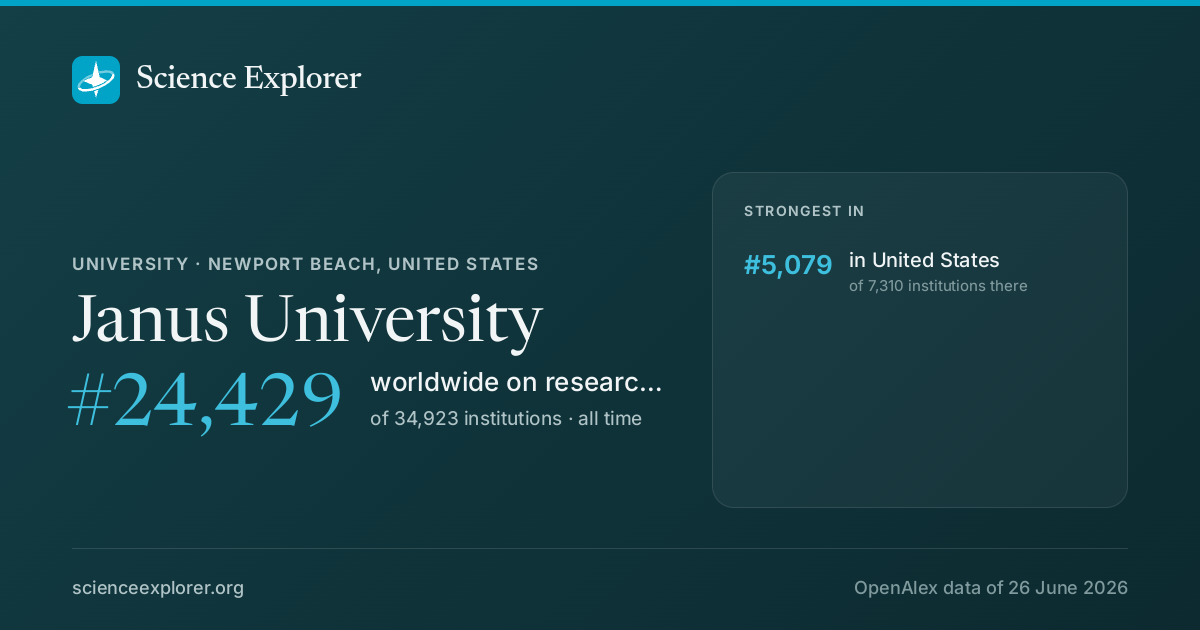
Janus University

World rank, all time
#24,429
of 34,923
Rank in United States
#5,079
of 7,310
Research works
172
▲ 13% vs 2018-21
Citations
1.9k
11.1 per fractional work
Top-10% rate
5.6%
all institutions 10.0%
vs its own fields
0.96×
1.00× is exactly expected
Open access
35%
world 40%
International
20%
world 18%

Which fields of science does Janus University work in?

In 2022-now, 35% of research at Janus University is in Health Sciences, 33% in Physical Sciences. Its largest fields are Medicine (34%), Social Sciences (10%), Engineering (9%). It does 1.3× the world's share of Health Sciences.

Health Sciences: 7 fractional works · 35.3% of its workMedicine: 7 fractional works · 33.7% of its workDermatology: 1 fractional works · 4.5% of its workNeurology: 1 fractional works · 2.9% of its workEndocrinology, Diabetes and Metabolism: 1 fractional works · 2.8% of its workEpidemiology: 1 fractional works · 2.6% of its workAnesthesiology and Pain Medicine: 0 fractional works · 2.1% of its workPublic Health, Environmental and Occupational Health: 0 fractional works · 2.1% of its workSurgery: 0 fractional works · 1.9% of its workPathology and Forensic Medicine: 0 fractional works · 1.7% of its workUrology: 0 fractional works · 1.7% of its workFamily Practice: 0 fractional works · 1.6% of its workGenetics: 0 fractional works · 1.6% of its workPharmacology: 0 fractional works · 1.6% of its workOncology: 0 fractional works · 0.9% of its workPsychiatry and Mental health: 0 fractional works · 0.9% of its workRadiology, Nuclear Medicine and Imaging: 0 fractional works · 0.8% of its workReproductive Medicine: 0 fractional works · 0.8% of its workInfectious Diseases: 0 fractional works · 0.8% of its workPediatrics, Perinatology and Child Health: 0 fractional works · 0.5% of its workRehabilitation: 0 fractional works · 0.5% of its workPulmonary and Respiratory Medicine: 0 fractional works · 0.4% of its workPhysiology: 0 fractional works · 0.3% of its workEmergency Medicine: 0 fractional works · 0.2% of its workSmaller subfields together: 0 fractional works · 0.5% of its workDentistry: 0 fractional works · 1.0% of its workOral Surgery: 0 fractional works · 0.5% of its workPeriodontics: 0 fractional works · 0.3% of its workOrthodontics: 0 fractional works · 0.2% of its workHealth Professions: 0 fractional works · 0.5% of its workOccupational Therapy: 0 fractional works · 0.3% of its workSmaller subfields together: 0 fractional works · 0.2% of its workPhysical Sciences: 7 fractional works · 32.5% of its workEngineering: 2 fractional works · 9.3% of its workMedia Technology: 1 fractional works · 4.8% of its workElectrical and Electronic Engineering: 0 fractional works · 1.7% of its workMechanical Engineering: 0 fractional works · 1.1% of its workBiomedical Engineering: 0 fractional works · 0.8% of its workControl and Systems Engineering: 0 fractional works · 0.6% of its workMechanics of Materials: 0 fractional works · 0.4% of its workEnvironmental Science: 1 fractional works · 6.4% of its workIndustrial and Manufacturing Engineering: 1 fractional works · 4.4% of its workWater Science and Technology: 0 fractional works · 1.6% of its workEcology: 0 fractional works · 0.4% of its workComputer Science: 1 fractional works · 5.6% of its workInformation Systems: 0 fractional works · 1.6% of its workArtificial Intelligence: 0 fractional works · 0.8% of its workComputational Theory and Mathematics: 0 fractional works · 0.8% of its workComputer Networks and Communications: 0 fractional works · 0.8% of its workComputer Vision and Pattern Recognition: 0 fractional works · 0.5% of its workHuman-Computer Interaction: 0 fractional works · 0.5% of its workSignal Processing: 0 fractional works · 0.5% of its workChemistry: 1 fractional works · 4.4% of its workAnalytical Chemistry: 1 fractional works · 3.6% of its workInorganic Chemistry: 0 fractional works · 0.8% of its workMaterials Science: 1 fractional works · 3.7% of its workMaterials Chemistry: 1 fractional works · 3.7% of its workEnergy: 0 fractional works · 1.6% of its workRenewable Energy, Sustainability and the Environment: 0 fractional works · 1.1% of its workEnergy Engineering and Power Technology: 0 fractional works · 0.5% of its workPhysics and Astronomy: 0 fractional works · 1.6% of its workAtomic and Molecular Physics, and Optics: 0 fractional works · 1.6% of its workSocial Sciences: 5 fractional works · 25.8% of its workSocial Sciences: 2 fractional works · 9.5% of its workSociology and Political Science: 1 fractional works · 4.9% of its workPolitical Science and International Relations: 0 fractional works · 1.6% of its workDevelopment: 0 fractional works · 1.2% of its workEducation: 0 fractional works · 0.8% of its workGender Studies: 0 fractional works · 0.8% of its workLaw: 0 fractional works · 0.3% of its workPsychology: 1 fractional works · 5.3% of its workClinical Psychology: 0 fractional works · 1.6% of its workGeneral Psychology: 0 fractional works · 1.6% of its workSocial Psychology: 0 fractional works · 1.4% of its workExperimental and Cognitive Psychology: 0 fractional works · 0.6% of its workSmaller subfields together: 0 fractional works · 0.0% of its workEconomics, Econometrics and Finance: 1 fractional works · 4.1% of its workEconomics and Econometrics: 1 fractional works · 3.1% of its workGeneral Economics, Econometrics and Finance: 0 fractional works · 0.8% of its workFinance: 0 fractional works · 0.3% of its workBusiness, Management and Accounting: 1 fractional works · 3.7% of its workOrganizational Behavior and Human Resource Management: 0 fractional works · 1.3% of its workAccounting: 0 fractional works · 1.2% of its workMarketing: 0 fractional works · 0.5% of its workManagement Information Systems: 0 fractional works · 0.4% of its workStrategy and Management: 0 fractional works · 0.2% of its workSmaller subfields together: 0 fractional works · 0.0% of its workArts and Humanities: 1 fractional works · 2.8% of its workLanguage and Linguistics: 0 fractional works · 2.0% of its workMusic: 0 fractional works · 0.8% of its workDecision Sciences: 0 fractional works · 0.4% of its workInformation Systems and Management: 0 fractional works · 0.4% of its workLife Sciences: 1 fractional works · 6.5% of its workNeuroscience: 1 fractional works · 2.8% of its workCognitive Neuroscience: 1 fractional works · 2.4% of its workEndocrine and Autonomic Systems: 0 fractional works · 0.3% of its workBiochemistry, Genetics and Molecular Biology: 0 fractional works · 2.4% of its workClinical Biochemistry: 0 fractional works · 1.2% of its workMolecular Biology: 0 fractional works · 0.8% of its workCell Biology: 0 fractional works · 0.3% of its workSmaller subfields together: 0 fractional works · 0.0% of its workAgricultural and Biological Sciences: 0 fractional works · 1.1% of its workPlant Science: 0 fractional works · 0.7% of its workInsect Science: 0 fractional works · 0.3% of its workPharmacology, Toxicology and Pharmaceutics: 0 fractional works · 0.2% of its workImmunology and Microbiology: 0 fractional works · 0.0% of its workALL ITS WORKJanus University21fractional works, 2022-now
Life Sciences6%Physical Sciences33%Health Sciences35%Social Sciences26%

Each ring splits the one inside it: the four domains of science, their fields, their subfields. Size is fractional works in 2022-now. Every slice is a page; the interactive view zooms down to single topics and colours each by how much more of it this institution does than the world.

Its 4 domains and 21 fields, with their numbers
    1. Medicine733.7%
    2. Dentistry01.0%
    3. Health Professions00.5%
    1. Engineering29.3%
    2. Environmental Science16.4%
    3. Computer Science15.6%
    4. Chemistry14.4%
    5. Materials Science13.7%
    6. Energy01.6%
    7. Physics and Astronomy01.6%
    1. Social Sciences29.5%
    2. Psychology15.3%
    3. Economics, Econometrics and Finance14.1%
    4. Business, Management and Accounting13.7%
    5. Arts and Humanities12.8%
    6. Decision Sciences00.4%
    1. Neuroscience12.8%
    2. Biochemistry, Genetics and Molecular Biology02.4%
    3. Agricultural and Biological Sciences01.1%
    4. Pharmacology, Toxicology and Pharmaceutics00.2%
    5. Immunology and Microbiology00.0%
All of science, and how each field's share has moved since 1950: the Science domain explorer

Field profile

Location quotient across every field it publishes in: outside the ring is more than an institution of this size would be expected to publish, inside it is less.

Agricultural and Biological Sciences: 0.22× its world share, 0 worksAgricultural and Bio…Biochemistry, Genetics and Molecular Biology: 0.44× its world share, 0 worksBiochemistry, Geneti…Immunology and Microbiology: 0.06× its world share, 0 worksImmunology and Micro…Neuroscience: 1.70× its world share, 1 worksNeurosciencePharmacology, Toxicology and Pharmaceutics: 0.56× its world share, 0 worksPharmacology, Toxico…Chemistry: 2.79× its world share, 1 worksChemistryComputer Science: 0.72× its world share, 1 worksComputer ScienceEnergy: 1.73× its world share, 0 worksEnergyEngineering: 0.62× its world share, 2 worksEngineeringEnvironmental Science: 1.28× its world share, 1 worksEnvironmental ScienceMaterials Science: 1.06× its world share, 1 worksMaterials SciencePhysics and Astronomy: 0.72× its world share, 0 worksPhysics and AstronomyDentistry: 2.11× its world share, 0 worksDentistryHealth Professions: 0.20× its world share, 0 worksHealth ProfessionsMedicine: 1.75× its world share, 7 worksMedicineArts and Humanities: 0.97× its world share, 1 worksArts and HumanitiesBusiness, Management and Accounting: 1.15× its world share, 1 worksBusiness, Management…Decision Sciences: 0.41× its world share, 0 worksDecision SciencesEconomics, Econometrics and Finance: 1.92× its world share, 1 worksEconomics, Econometr…Psychology: 1.72× its world share, 1 worksPsychologySocial Sciences: 0.75× its world share, 2 worksSocial Sciences1×world share
more than its size predictsabout as predictedless

Rings at 0.5×, 1× and 2×. Widest outward: Chemistry, 2.8×. Every wedge is a field page.

All 21 fields, with their numbers
  1. Chemistry2.79×1 works
  2. Dentistry2.11×0 works
  3. Economics, Econometrics and Finance1.92×1 works
  4. Medicine1.75×7 works
  5. Energy1.73×0 works
  6. Psychology1.72×1 works
  7. Neuroscience1.70×1 works
  8. Environmental Science1.28×1 works
  9. Business, Management and Accounting1.15×1 works
  10. Materials Science1.06×1 works
  11. Arts and Humanities0.97×1 works
  12. Social Sciences0.75×2 works
  13. Computer Science0.72×1 works
  14. Physics and Astronomy0.72×0 works
  15. Engineering0.62×2 works
  16. Pharmacology, Toxicology and Pharmaceutics0.56×0 works
  17. Biochemistry, Genetics and Molecular Biology0.44×0 works
  18. Decision Sciences0.41×0 works
  19. Agricultural and Biological Sciences0.22×0 works
  20. Health Professions0.20×0 works
  21. Immunology and Microbiology0.06×0 works

Who are the top researchers at Janus University?

Ranked on the quality score, Robert D. mname Arnott, Feifei Li and Katrina F. Sherrerd lead among researchers whose main affiliation is Janus University.

  1. 1 Robert D. mname Arnott United States · #2,546,485 worldwide 4.4k citations · 203 works
  2. 2 Feifei Li United States · #3,200,288 worldwide 645 citations · 56 works
  3. 3 Katrina F. Sherrerd United States · #4,015,501 worldwide 67 citations · 51 works
All ranked researchers at Janus University

What are the most cited papers from Janus University?

The most cited paper from Janus University is "Vulvar and Vaginal Atrophy in Postmenopausal Women: Findings from the REVIVE (REal Women's VIews of Treatment Options for Menopausal Vaginal ChangEs) Survey" (Sheryl A. Kingsberg, Susan Wysocki, Leslie Magnus et al., 2013), with 480 citations. Next come "Comparative versus Noncomparative Advertising: A Meta-Analysis" (285) and "Cap-Weighted Portfolios are Sub-Optimal Portfolios" (157).

Most cited papers
#PaperReleasedCitations
1 Vulvar and Vaginal Atrophy in Postmenopausal Women: Findings from the REVIVE (REal Women's VIews of Treatment Options for Menopausal Vaginal ChangEs) Survey Sheryl A. Kingsberg, Susan Wysocki, Leslie Magnus et al. · The Journal of Sexual Medicine 16 May 2013 480
2 Comparative versus Noncomparative Advertising: A Meta-Analysis Dhruv Grewal, Sukumar Kavanoor, Edward F. Fern et al. · Journal of Marketing Oct 1997 285
3 Cap-Weighted Portfolios are Sub-Optimal Portfolios Jason C. Hsu · SSRN Electronic Journal PreprintOpen access 2005 157
4 The Cinema, or The Imaginary Man Martha Blassnigg · Leonardo Apr 2006 131
5 Toward Improved Environmental Stability of Polymer:Fullerene and Polymer:Nonfullerene Organic Solar Cells: A Common Energetic Origin of Light- and Oxygen-Induced Degradation Emily M. Speller, Andrew J. Clarke, Nicholas Aristidou et al. · ACS Energy Letters Open access 12 Mar 2019 121
All 59 most cited papers, with filters and sorting

Which research topics does Janus University publish most on?

By volume in 2022-now: Experimental Learning in Engineering, Water Quality Monitoring and Analysis, Dye analysis and toxicity and Facial Rejuvenation and Surgery Techniques.

  1. 1 Experimental Learning in Engineering Media Technology 1 works
  2. 2 Water Quality Monitoring and Analysis Industrial and Manufacturing Engineering 1 works
  3. 3 Dye analysis and toxicity Analytical Chemistry 1 works
  4. 4 Facial Rejuvenation and Surgery Techniques Dermatology 1 works
  5. 5 Hormonal and reproductive studies Endocrinology, Diabetes and Metabolism 0 works
  6. 6 Qualitative Comparative Analysis Research Sociology and Political Science 0 works
  7. 7 Dermatologic Treatments and Research Dermatology 0 works
  8. 8 Botulinum Toxin and Related Neurological Disorders Neurology 0 works
  9. 9 Adsorption and biosorption for pollutant removal Water Science and Technology 0 works
  10. 10 Pain Management and Treatment Anesthesiology and Pain Medicine 0 works

How open and international is its research?

Against the world's own shares: the tick on each track. Both are shares of its output, so they sit on one scale and can be read against each other as well as against the world.

openly available35.4%not open64.6%

World: 40% of research is openly available.

with international co-authors19.7%domestic only80.3%

World: 18% is written across borders.

How has Janus University's research output changed?

Output in 2022-2025 was 13% higher than in 2018-2021.

still counting1990200020102020
grewheldshrank

The same series as a ribbon: one cell per year, darker for more. The line above answers how much; this answers when.

Its share of all research

Growing output can still be a shrinking share: all of science grows. This is Janus University as a percentage of every work published that year, 0.000078% in 2024.

still counting0.00050%0.0010%Janus University0.00010% in 202519801990200020102020

Fractional works of Janus University over all fractional works that year. How the balance of science has shifted.

Other research institutions in Newport Beach

All research institutions in Newport Beach

Share Janus University's ranking

Janus University on Science Explorer

A card with Janus University's standing and the fields it leads in, for a post or a slide. A link to this page previews as the same card.

Download the card

1200 × 630 PNG, sized for social posts, drawn from the latest snapshot.

Badges for a website1Each links back here and updates with every snapshot

Research measures only: rankings here say nothing about teaching, admissions or student experience. Comparable institutions and collaboration partners have tabs of their own, above.

Discussion

Ask a question or share a note about Janus University. Keep it to the research: no personal attacks, advertising or links. Any reader can report a post, which collapses it for everyone until it is opened.