Science Explorer Back to mapMap
Discussion
Company · Jena · Germany

Jena Bioscience (Germany)

World rank, all time
#19,803
of 34,923
Rank in Germany
#977
of 1,603
Research works
274
▲ 78% vs 2018-21
Citations
5.1k
18.6 per fractional work
Top-10% rate
9.9%
all institutions 10.0%
vs its own fields
1.00×
1.00× is exactly expected
Open access
24%
world 40%
International
19%
world 18%

Which fields of science does Jena Bioscience (Germany) work in?

In 2022-now, 30% of research at Jena Bioscience (Germany) is in Health Sciences, 25% in Social Sciences. Its largest fields are Medicine (28%), Biochemistry, Genetics and Molecular Biology (14%), Social Sciences (14%). It does 1.4× the world's share of Life Sciences.

Health Sciences: 11 fractional works · 30.2% of its workMedicine: 10 fractional works · 28.2% of its workSurgery: 2 fractional works · 4.4% of its workOncology: 1 fractional works · 3.1% of its workCardiology and Cardiovascular Medicine: 1 fractional works · 2.4% of its workEpidemiology: 1 fractional works · 2.4% of its workHematology: 1 fractional works · 2.2% of its workInfectious Diseases: 1 fractional works · 1.9% of its workPublic Health, Environmental and Occupational Health: 1 fractional works · 1.7% of its workGenetics: 1 fractional works · 1.6% of its workHepatology: 0 fractional works · 1.4% of its workPulmonary and Respiratory Medicine: 0 fractional works · 1.1% of its workObstetrics and Gynecology: 0 fractional works · 0.9% of its workRheumatology: 0 fractional works · 0.8% of its workPathology and Forensic Medicine: 0 fractional works · 0.8% of its workReproductive Medicine: 0 fractional works · 0.6% of its workPhysiology: 0 fractional works · 0.6% of its workPediatrics, Perinatology and Child Health: 0 fractional works · 0.5% of its workDermatology: 0 fractional works · 0.5% of its workAnesthesiology and Pain Medicine: 0 fractional works · 0.3% of its workGastroenterology: 0 fractional works · 0.3% of its workSmaller subfields together: 0 fractional works · 0.4% of its workHealth Professions: 0 fractional works · 1.2% of its workEmergency Medical Services: 0 fractional works · 0.9% of its workGeneral Health Professions: 0 fractional works · 0.3% of its workSmaller subfields together: 0 fractional works · 0.0% of its workVeterinary: 0 fractional works · 0.5% of its workSmall Animals: 0 fractional works · 0.5% of its workNursing: 0 fractional works · 0.3% of its workNutrition and Dietetics: 0 fractional works · 0.3% of its workSocial Sciences: 9 fractional works · 24.9% of its workSocial Sciences: 5 fractional works · 14.1% of its workSociology and Political Science: 2 fractional works · 5.4% of its workAnthropology: 1 fractional works · 2.8% of its workPolitical Science and International Relations: 0 fractional works · 1.2% of its workEducation: 0 fractional works · 1.1% of its workGeneral Social Sciences: 0 fractional works · 0.8% of its workSafety Research: 0 fractional works · 0.8% of its workUrban Studies: 0 fractional works · 0.6% of its workCommunication: 0 fractional works · 0.4% of its workCultural Studies: 0 fractional works · 0.3% of its workGeography, Planning and Development: 0 fractional works · 0.3% of its workLaw: 0 fractional works · 0.3% of its workArts and Humanities: 2 fractional works · 6.1% of its workReligious studies: 1 fractional works · 2.8% of its workHistory and Philosophy of Science: 0 fractional works · 0.9% of its workHistory: 0 fractional works · 0.6% of its workVisual Arts and Performing Arts: 0 fractional works · 0.6% of its workLiterature and Literary Theory: 0 fractional works · 0.5% of its workArcheology: 0 fractional works · 0.3% of its workPhilosophy: 0 fractional works · 0.3% of its workBusiness, Management and Accounting: 1 fractional works · 2.4% of its workOrganizational Behavior and Human Resource Management: 0 fractional works · 0.9% of its workManagement Information Systems: 0 fractional works · 0.8% of its workManagement of Technology and Innovation: 0 fractional works · 0.7% of its workDecision Sciences: 0 fractional works · 1.0% of its workManagement Science and Operations Research: 0 fractional works · 0.6% of its workInformation Systems and Management: 0 fractional works · 0.3% of its workSmaller subfields together: 0 fractional works · 0.0% of its workPsychology: 0 fractional works · 0.8% of its workExperimental and Cognitive Psychology: 0 fractional works · 0.5% of its workSmaller subfields together: 0 fractional works · 0.4% of its workEconomics, Econometrics and Finance: 0 fractional works · 0.5% of its workEconomics and Econometrics: 0 fractional works · 0.5% of its workPhysical Sciences: 8 fractional works · 23.1% of its workEngineering: 3 fractional works · 8.5% of its workBiomedical Engineering: 1 fractional works · 2.9% of its workElectrical and Electronic Engineering: 1 fractional works · 2.2% of its workIndustrial and Manufacturing Engineering: 0 fractional works · 1.1% of its workAerospace Engineering: 0 fractional works · 0.6% of its workMechanical Engineering: 0 fractional works · 0.6% of its workComputational Mechanics: 0 fractional works · 0.5% of its workAutomotive Engineering: 0 fractional works · 0.2% of its workSmaller subfields together: 0 fractional works · 0.3% of its workEnvironmental Science: 2 fractional works · 5.4% of its workEcology: 0 fractional works · 1.3% of its workEnvironmental Engineering: 0 fractional works · 1.0% of its workGlobal and Planetary Change: 0 fractional works · 1.0% of its workEnvironmental Chemistry: 0 fractional works · 0.9% of its workHealth, Toxicology and Mutagenesis: 0 fractional works · 0.5% of its workManagement, Monitoring, Policy and Law: 0 fractional works · 0.5% of its workWater Science and Technology: 0 fractional works · 0.3% of its workSmaller subfields together: 0 fractional works · 0.1% of its workComputer Science: 1 fractional works · 2.2% of its workArtificial Intelligence: 0 fractional works · 1.0% of its workInformation Systems: 0 fractional works · 0.5% of its workHardware and Architecture: 0 fractional works · 0.5% of its workSmaller subfields together: 0 fractional works · 0.3% of its workPhysics and Astronomy: 1 fractional works · 2.2% of its workAstronomy and Astrophysics: 1 fractional works · 1.9% of its workAtomic and Molecular Physics, and Optics: 0 fractional works · 0.3% of its workEarth and Planetary Sciences: 1 fractional works · 1.8% of its workAtmospheric Science: 0 fractional works · 0.8% of its workGeophysics: 0 fractional works · 0.4% of its workOceanography: 0 fractional works · 0.3% of its workPaleontology: 0 fractional works · 0.3% of its workMaterials Science: 1 fractional works · 1.5% of its workMaterials Chemistry: 0 fractional works · 1.0% of its workSmaller subfields together: 0 fractional works · 0.4% of its workChemistry: 0 fractional works · 1.3% of its workAnalytical Chemistry: 0 fractional works · 0.7% of its workPhysical and Theoretical Chemistry: 0 fractional works · 0.3% of its workSpectroscopy: 0 fractional works · 0.3% of its workSmaller subfields together: 0 fractional works · 0.0% of its workEnergy: 0 fractional works · 0.2% of its workLife Sciences: 8 fractional works · 21.9% of its workBiochemistry, Genetics and Molecular Biology: 5 fractional works · 14.3% of its workMolecular Biology: 3 fractional works · 9.2% of its workGenetics: 1 fractional works · 2.2% of its workBiophysics: 1 fractional works · 1.5% of its workCell Biology: 0 fractional works · 0.5% of its workClinical Biochemistry: 0 fractional works · 0.5% of its workSmaller subfields together: 0 fractional works · 0.3% of its workAgricultural and Biological Sciences: 2 fractional works · 5.1% of its workPlant Science: 1 fractional works · 2.5% of its workEcology, Evolution, Behavior and Systematics: 0 fractional works · 1.0% of its workInsect Science: 0 fractional works · 0.6% of its workAquatic Science: 0 fractional works · 0.3% of its workFood Science: 0 fractional works · 0.3% of its workSoil Science: 0 fractional works · 0.2% of its workSmaller subfields together: 0 fractional works · 0.2% of its workImmunology and Microbiology: 0 fractional works · 1.1% of its workVirology: 0 fractional works · 0.4% of its workImmunology: 0 fractional works · 0.4% of its workMicrobiology: 0 fractional works · 0.3% of its workNeuroscience: 0 fractional works · 0.8% of its workCognitive Neuroscience: 0 fractional works · 0.5% of its workNeurology: 0 fractional works · 0.4% of its workPharmacology, Toxicology and Pharmaceutics: 0 fractional works · 0.6% of its workPharmacology: 0 fractional works · 0.6% of its workALL ITS WORKJena Bioscience(Germany)36fractional works, 2022-now
Life Sciences22%Physical Sciences23%Health Sciences30%Social Sciences25%

Each ring splits the one inside it: the four domains of science, their fields, their subfields. Size is fractional works in 2022-now. Every slice is a page; the interactive view zooms down to single topics and colours each by how much more of it this institution does than the world.

Its 4 domains and 23 fields, with their numbers
    1. Medicine1028.2%
    2. Health Professions01.2%
    3. Veterinary00.5%
    4. Nursing00.3%
    1. Social Sciences514.1%
    2. Arts and Humanities26.1%
    3. Business, Management and Accounting12.4%
    4. Decision Sciences01.0%
    5. Psychology00.8%
    6. Economics, Econometrics and Finance00.5%
    1. Engineering38.5%
    2. Environmental Science25.4%
    3. Computer Science12.2%
    4. Physics and Astronomy12.2%
    5. Earth and Planetary Sciences11.8%
    6. Materials Science11.5%
    7. Chemistry01.3%
    8. Energy00.2%
    1. Biochemistry, Genetics and Molecular Biology514.3%
    2. Agricultural and Biological Sciences25.1%
    3. Immunology and Microbiology01.1%
    4. Neuroscience00.8%
    5. Pharmacology, Toxicology and Pharmaceutics00.6%
All of science, and how each field's share has moved since 1950: the Science domain explorer

Field profile

Location quotient across every field it publishes in: outside the ring is more than an institution of this size would be expected to publish, inside it is less.

Agricultural and Biological Sciences: 1.07× its world share, 2 worksAgricultural and Bio…Biochemistry, Genetics and Molecular Biology: 2.68× its world share, 5 worksBiochemistry, Geneti…Immunology and Microbiology: 1.11× its world share, 0 worksImmunology and Micro…Neuroscience: 0.51× its world share, 0 worksNeurosciencePharmacology, Toxicology and Pharmaceutics: 1.77× its world share, 0 worksPharmacology, Toxico…Chemistry: 0.82× its world share, 0 worksChemistryComputer Science: 0.28× its world share, 1 worksComputer ScienceEarth and Planetary Sciences: 1.17× its world share, 1 worksEarth and Planetary …Energy: 0.17× its world share, 0 worksEnergyEngineering: 0.57× its world share, 3 worksEngineeringEnvironmental Science: 1.09× its world share, 2 worksEnvironmental ScienceMaterials Science: 0.42× its world share, 0 worksMaterials SciencePhysics and Astronomy: 0.98× its world share, 1 worksPhysics and AstronomyHealth Professions: 0.45× its world share, 0 worksHealth ProfessionsMedicine: 1.47× its world share, 10 worksMedicineNursing: 0.59× its world share, 0 worksNursingVeterinary: 3.44× its world share, 0 worksVeterinaryArts and Humanities: 2.11× its world share, 2 worksArts and HumanitiesBusiness, Management and Accounting: 0.74× its world share, 1 worksBusiness, Management…Decision Sciences: 0.98× its world share, 0 worksDecision SciencesEconomics, Econometrics and Finance: 0.22× its world share, 0 worksEconomics, Econometr…Psychology: 0.28× its world share, 0 worksPsychologySocial Sciences: 1.11× its world share, 5 worksSocial Sciences1×world share
more than its size predictsabout as predictedless

Rings at 0.5×, 1× and 2×. Widest outward: Veterinary, 3.4×. Every wedge is a field page.

All 23 fields, with their numbers
  1. Veterinary3.44×0 works
  2. Biochemistry, Genetics and Molecular Biology2.68×5 works
  3. Arts and Humanities2.11×2 works
  4. Pharmacology, Toxicology and Pharmaceutics1.77×0 works
  5. Medicine1.47×10 works
  6. Earth and Planetary Sciences1.17×1 works
  7. Immunology and Microbiology1.11×0 works
  8. Social Sciences1.11×5 works
  9. Environmental Science1.09×2 works
  10. Agricultural and Biological Sciences1.07×2 works
  11. Physics and Astronomy0.98×1 works
  12. Decision Sciences0.98×0 works
  13. Chemistry0.82×0 works
  14. Business, Management and Accounting0.74×1 works
  15. Nursing0.59×0 works
  16. Engineering0.57×3 works
  17. Neuroscience0.51×0 works
  18. Health Professions0.45×0 works
  19. Materials Science0.42×0 works
  20. Computer Science0.28×1 works
  21. Psychology0.28×0 works
  22. Economics, Econometrics and Finance0.22×0 works
  23. Energy0.17×0 works

Who are the top researchers at Jena Bioscience (Germany)?

Ranked on the quality score, Walter A.G. Elger, Doris Hübler and Birgitt Schneider lead among researchers whose main affiliation is Jena Bioscience (Germany).

  1. 1 Walter A.G. Elger Germany · #1,466,009 worldwide 5.5k citations · 199 works
  2. 2 Doris Hübler Germany · #1,606,219 worldwide 1.1k citations · 25 works
  3. 3 Birgitt Schneider Germany · #2,740,550 worldwide 643 citations · 18 works
  4. 4 Reinhard Breitling Germany · #3,029,404 worldwide 1k citations · 34 works
  5. 5 F. Walter Germany · #3,502,119 worldwide 439 citations · 18 works
  6. 6 C. Moore Germany · #3,732,887 worldwide 667 citations · 23 works
  7. 7 Katrin Mittmann Germany · #3,982,716 worldwide 450 citations · 21 works
  8. 8 Michael Oettel Germany · #4,282,353 worldwide 3.6k citations · 219 works
  9. 9 Rudolf Siebert Germany · #4,437,271 worldwide 116 citations · 19 works
  10. 10 Alfred Schubert Germany · #4,778,330 worldwide 300 citations · 83 works
All ranked researchers at Jena Bioscience (Germany)

What are the most cited papers from Jena Bioscience (Germany)?

The most cited paper from Jena Bioscience (Germany) is "Associations of Stressors and Uplifts of Caregiving With Caregiver Burden and Depressive Mood: A Meta-Analysis" (Martin Pinquart, Silvia Sörensen, 2003), with 1,123 citations. Next come "Training-Induced Brain Structure Changes in the Elderly" (696) and "High-resolution multiphoton tomography of human skin with subcellular spatial resolution and picosecond time resolution" (536).

Most cited papers
#PaperReleasedCitations
1 Associations of Stressors and Uplifts of Caregiving With Caregiver Burden and Depressive Mood: A Meta-Analysis Martin Pinquart, Silvia Sörensen · The Journals of Gerontology Series B Review Mar 2003 1,123
2 Training-Induced Brain Structure Changes in the Elderly Janina Boyke, Joenna Driemeyer, Christian Gaser et al. · Journal of Neuroscience Open access 9 Jul 2008 696
3 High-resolution multiphoton tomography of human skin with subcellular spatial resolution and picosecond time resolution Karsten Koenig, Iris Riemann · Journal of Biomedical Optics Open access 2003 536
4 Novel Haloperoxidase from the Agaric Basidiomycete Agrocybe aegerita Oxidizes Aryl Alcohols and Aldehydes René Ullrich, Jörg Nüske, Katrin Scheibner et al. · Applied and Environmental Microbiology Open access Aug 2004 375
5 A Supramolecular Photocatalyst for the Production of Hydrogen and the Selective Hydrogenation of Tolane Sven Rau, Bernhard Schäfer, Dieter Gleich et al. · Angewandte Chemie International Edition 17 Aug 2006 336
All 60 most cited papers, with filters and sorting

Which keywords describe research at Jena Bioscience (Germany)?

By fractional works in 2022-now, weighted toward what it does more of than the world: Genomics, Global Christianity, Governmentality, Short-Term Missions, Neoliberalism, Globalization, Climate Change and Epidemiology.

▲ more of its work than of the world's◆ about the world's share▼ less than the world's

Size is fractional works in 2022-now in the topics tagged with each word; colour is the word's share of this institution's work against its share of the world's. The 8 words are chosen for being large and distinctive. Each links to the topic it comes from most.

All 8 words, with their numbers
  1. Globalization2▲ 2.5×6 topics
  2. Epidemiology2◆ 1.03×15 topics
  3. Climate Change1▲ 1.42×14 topics
  4. Genomics1▲ 9.9×7 topics
  5. Global Christianity1▲ 190×1 topic
  6. Governmentality1▲ 108×1 topic
  7. Neoliberalism1▲ 7.8×1 topic
  8. Short-Term Missions1▲ 190×1 topic

Which research topics does Jena Bioscience (Germany) publish most on?

By volume in 2022-now: Anthropological Studies and Insights, Christian Theology and Mission, ECG Monitoring and Analysis and Facility Location and Emergency Management.

  1. 1 Anthropological Studies and Insights Anthropology 1 works
  2. 2 Christian Theology and Mission Religious studies 1 works
  3. 3 ECG Monitoring and Analysis Cardiology and Cardiovascular Medicine 0 works
  4. 4 Facility Location and Emergency Management Organizational Behavior and Human Resource Management 0 works
  5. 5 Endometrial and Cervical Cancer Treatments Obstetrics and Gynecology 0 works
  6. 6 Plant and animal studies Ecology, Evolution, Behavior and Systematics 0 works
  7. 7 Insect and Arachnid Ecology and Behavior Genetics 0 works
  8. 8 Vehicle Routing Optimization Methods Industrial and Manufacturing Engineering 0 works
  9. 9 Islamic Studies and Radicalism Sociology and Political Science 0 works
  10. 10 Hepatocellular Carcinoma Treatment and Prognosis Hepatology 0 works

How open and international is its research?

Against the world's own shares: the tick on each track. Both are shares of its output, so they sit on one scale and can be read against each other as well as against the world.

openly available24.4%not open75.6%

World: 40% of research is openly available.

with international co-authors18.8%domestic only81.2%

World: 18% is written across borders.

How has Jena Bioscience (Germany)'s research output changed?

Output in 2022-2025 was 78% higher than in 2018-2021.

still counting1990200020102020
grewheldshrank

The same series as a ribbon: one cell per year, darker for more. The line above answers how much; this answers when.

Its share of all research

Growing output can still be a shrinking share: all of science grows. This is Jena Bioscience (Germany) as a percentage of every work published that year, 0.00016% in 2024.

still counting0.00050%0.0010%0.0015%Jena Bioscience (Germany)0.00020% in 202519801990200020102020

Fractional works of Jena Bioscience (Germany) over all fractional works that year. How the balance of science has shifted.

Other research institutions in Jena

All research institutions in Jena

Share Jena Bioscience (Germany)'s ranking
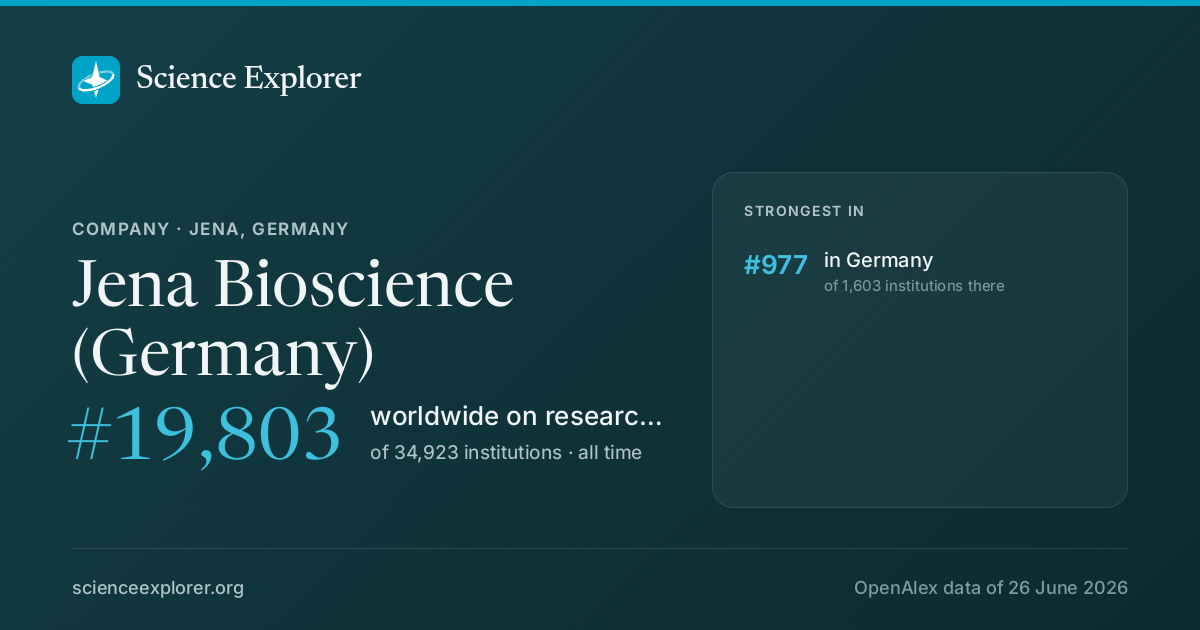
Jena Bioscience (Germany) on Science Explorer

A card with Jena Bioscience (Germany)'s standing and the fields it leads in, for a post or a slide. A link to this page previews as the same card.

Download the card

1200 × 630 PNG, sized for social posts, drawn from the latest snapshot.

Badges for a website1Each links back here and updates with every snapshot

Research measures only: rankings here say nothing about teaching, admissions or student experience. Comparable institutions and collaboration partners have tabs of their own, above.

Discussion

Ask a question or share a note about Jena Bioscience (Germany). Posts are plain text and can be reported.