Vistec Electron Beam (Germany)
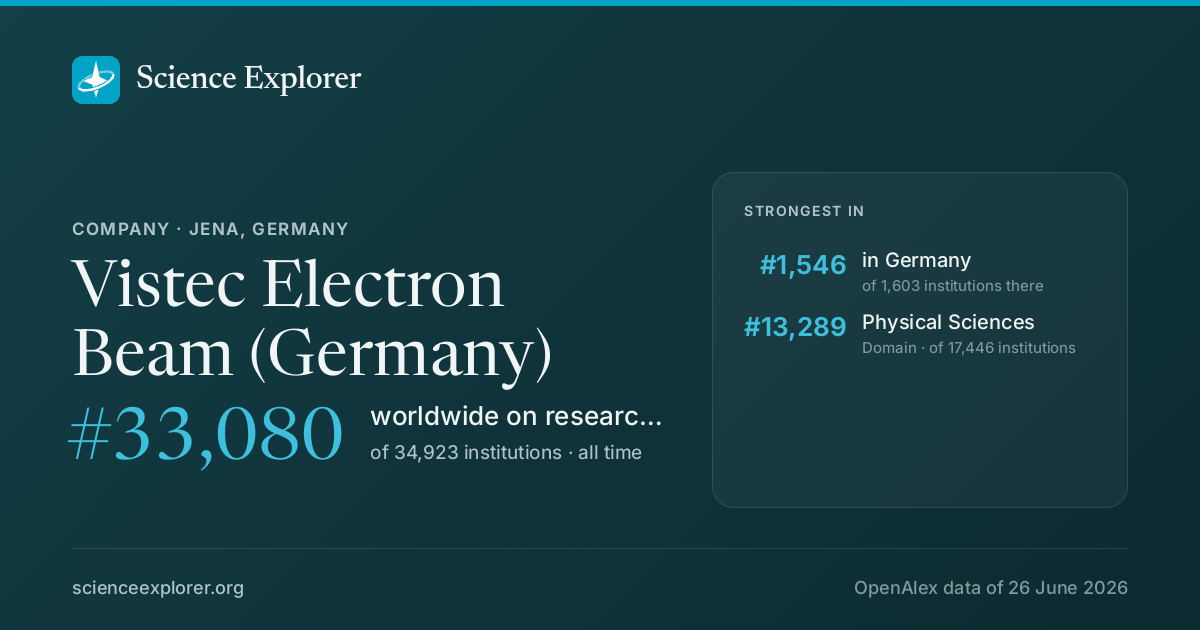
In research, Vistec Electron Beam (Germany) stands highest in Physical Sciences (#13,289 of 17,446 worldwide), over all time.
- World rank, all time
- #33,080 of 34,923
- Rank in Germany
- #1,546 of 1,603
- Research works
- 154 ▲ 20% vs 2018-21
- Citations
- 1.2k 7.8 per fractional work
- Top-10% rate
- 6.7% all institutions 10.0%
- vs its own fields
- 0.91× 1.00× is exactly expected
- Open access
- 20% world 40%
- International
- 23% world 18%
What is Vistec Electron Beam (Germany) known for in research?
The fields where it stands highest, over all time, ranked among every institution above the floor in each field.
| Field | World rank | Where that sits | Top-10% rate | Works |
|---|---|---|---|---|
| Physical SciencesDomain | #13,289 of 17,446 | 3.1% | 120 |
Each strip is that field's whole ranked pool, with the notch where Vistec Electron Beam (Germany) sits in it, in the colour of the band that rank falls in. The track under the rate is the rate itself: it carries no average mark, because the average differs by field (from about 6% in Dentistry to 21% in Economics).
Which fields of science does Vistec Electron Beam (Germany) work in?
In all years, 78% of research at Vistec Electron Beam (Germany) is in Physical Sciences, 18% in Life Sciences. Its largest fields are Engineering (54%), Biochemistry, Genetics and Molecular Biology (17%), Materials Science (14%). It does 1.9× the world's share of Physical Sciences.
Each ring splits the one inside it: the four domains of science, their fields, their subfields. Size is fractional works in all years. Every slice is a page; the interactive view zooms down to single topics and colours each by how much more of it this institution does than the world.
Its 4 domains and 18 fields, with their numbers
- Physical Sciences12078.1%
- Engineering8353.8%
- Materials Science2113.5%
- Physics and Astronomy95.6%
- Computer Science53.5%
- Chemistry21.0%
- Environmental Science10.4%
- Chemical Engineering00.1%
- Earth and Planetary Sciences00.1%
- Energy00.1%
- Life Sciences2717.7%
- Health Sciences42.9%
- Social Sciences21.3%
- Social Sciences21.0%
- Decision Sciences10.3%
Field profile
Location quotient across every field it publishes in: outside the ring is more than an institution of this size would be expected to publish, inside it is less.
Rings at 0.5×, 1× and 2×. Widest outward: Biochemistry, Genetics and Molecular Biology, 4.7×. Every wedge is a field page.
All 9 fields, with their numbers
- Biochemistry, Genetics and Molecular Biology4.74×5 works
- Materials Science3.83×2 works
- Engineering3.10×9 works
- Physics and Astronomy2.72×1 works
- Chemistry2.27×1 works
- Neuroscience0.55×0 works
- Dentistry0.53×0 works
- Computer Science0.34×0 works
- Medicine0.08×0 works
Who are the top researchers at Vistec Electron Beam (Germany)?
Ranked on the quality score, Rolf Theodor Borlinghaus, Tobias Bauer and Thomas Elster lead among researchers whose main affiliation is Vistec Electron Beam (Germany).
- 1
Rolf Theodor Borlinghaus
 Germany · #2,526,458 worldwide
53 citations · 43 works
- 2
Tobias Bauer
Germany · #2,726,798 worldwide
145 citations · 16 works
- 3
Thomas Elster
Germany · #3,686,210 worldwide
180 citations · 21 works
- 4
Juergen Gramss
Germany · #4,552,981 worldwide
13 citations · 16 works
- 4
John M. Whittey
Germany · #4,552,981 worldwide
33 citations · 16 works
- 6
Hans-Joachim Doering
Germany · #4,733,606 worldwide
64 citations · 19 works
- 7
Monika Boettcher
Germany · #4,740,290 worldwide
59 citations · 18 works
- 8
Michael Banasch
Germany · #4,821,294 worldwide
110 citations · 15 works
- 9
Jacques-Alexandre Dallery
Germany · #5,004,722 worldwide
98 citations · 19 works
- 10
Peter Hahmann
Germany · #5,005,191 worldwide
87 citations · 25 works
Which keywords describe research at Vistec Electron Beam (Germany)?
By fractional works in all years, weighted toward what it does more of than the world: Nanofabrication, High-Resolution Patterning, Electron Beam Lithography, Resolution Limits, Image Processing, X-ray Photoelectron Spectroscopy, Electron Inelastic Mean Free Paths and Scanning Electron Microscopy.
- Compound Eyes
- Single-Particle Analysis
- Cryo-Electron Microscopy
- Soft Lithography
- Microscopy
- Nanoscale Patterning
- Biosensors
- Dimensional Metrology
- Laser Voltage Probing
- Spectroscopy
- Biological Applications
- Nanostructures
- Photonic Crystals
- Fluorescent Proteins
- Material Removal Mechanism
- Super-Resolution Imaging
- Scanning Electron Microscopy
- X-ray Photoelectron Spectroscopy
- Resolution Limits
- High-Resolution Patterning
- Nanofabrication
- Electron Beam Lithography
- Image Processing
- Electron Inelastic Mean Free Paths
- Integrated Circuits
- Chemical Mechanical Planarization
- Solar Cells
- Single-Molecule Imaging
- Machine Vision
- Failure Analysis
- Antireflective Coatings
- Thin-Film Materials
- Photon Emission Microscopy
- Error Compensation
- High-Resolution Imaging
- Cancer Detection
- Nanolithography
- Optical Modulators
- Roughness Measurement
- Surface Characterization
Size is fractional works in all years in the topics tagged with each word; colour is the word's share of this institution's work against its share of the world's. The 40 words are chosen for being large and distinctive. Each links to the topic it comes from most.
All 40 words, with their numbers
- Nanofabrication29▲ 209×3 topics
- High-Resolution Patterning26▲ 438×2 topics
- Electron Beam Lithography22▲ 711×1 topic
- Resolution Limits22▲ 711×1 topic
- Image Processing12▲ 23×5 topics
- X-ray Photoelectron Spectroscopy10▲ 48×2 topics
- Electron Inelastic Mean Free Paths10▲ 114×1 topic
- Scanning Electron Microscopy10▲ 104×1 topic
- Integrated Circuits9▲ 25×2 topics
- Super-Resolution Imaging9▲ 139×2 topics
- Chemical Mechanical Planarization8▲ 85×1 topic
- Material Removal Mechanism8▲ 85×1 topic
- Solar Cells8▲ 16×6 topics
- Fluorescent Proteins7▲ 177×1 topic
- Single-Molecule Imaging7▲ 177×1 topic
- Photonic Crystals7▲ 28×4 topics
- Machine Vision6▲ 21×4 topics
- Nanostructures6▲ 8.5×3 topics
- Failure Analysis6▲ 29×2 topics
- Biological Applications6▲ 31×2 topics
- Antireflective Coatings6▲ 127×1 topic
- Spectroscopy6▲ 11×2 topics
- Thin-Film Materials6▲ 127×1 topic
- Laser Voltage Probing6▲ 72×1 topic
- Photon Emission Microscopy6▲ 72×1 topic
- Dimensional Metrology6▲ 101×1 topic
- Error Compensation6▲ 101×1 topic
- Biosensors5▲ 6.1×9 topics
- High-Resolution Imaging5▲ 51×2 topics
- Nanoscale Patterning5▲ 48×2 topics
- Cancer Detection4▲ 41×2 topics
- Microscopy4▲ 47×2 topics
- Nanolithography4▲ 146×1 topic
- Soft Lithography4▲ 146×1 topic
- Optical Modulators4▲ 12×2 topics
- Cryo-Electron Microscopy4▲ 120×1 topic
- Roughness Measurement4▲ 78×1 topic
- Single-Particle Analysis4▲ 120×1 topic
- Surface Characterization4▲ 57×1 topic
- Compound Eyes3▲ 165×1 topic
Which research topics does Vistec Electron Beam (Germany) publish most on?
By volume in 2022-now: Nanofabrication and Lithography Techniques, Advancements in Photolithography Techniques, Photonic and Optical Devices and Spectroscopy Techniques in Biomedical and Chemical Research.
Area is fractional works; colour is the subfield each topic belongs to.
- 1 Nanofabrication and Lithography Techniques Biomedical Engineering 2 works
- 2 Advancements in Photolithography Techniques Electrical and Electronic Engineering 2 works
- 3 Photonic and Optical Devices Electrical and Electronic Engineering 1 works
- 4 Spectroscopy Techniques in Biomedical and Chemical Research Biophysics 1 works
- 5 Advanced Fluorescence Microscopy Techniques Biophysics 1 works
- 6 Gold and Silver Nanoparticles Synthesis and Applications Electronic, Optical and Magnetic Materials 1 works
- 7 Optical Coatings and Gratings Surfaces, Coatings and Films 1 works
- 8 Spectroscopy and Chemometric Analyses Analytical Chemistry 1 works
- 9 Electron and X-Ray Spectroscopy Techniques Surfaces, Coatings and Films 1 works
- 10 Advanced optical system design Biomedical Engineering 0 works
How open and international is its research?
Against the world's own shares: the tick on each track. Both are shares of its output, so they sit on one scale and can be read against each other as well as against the world.
World: 40% of research is openly available.
World: 18% is written across borders.
How has Vistec Electron Beam (Germany)'s research output changed?
Output in 2022-2025 was 20% higher than in 2018-2021.
The same series as a ribbon: one cell per year, darker for more. The line above answers how much; this answers when.
Its share of all research
Growing output can still be a shrinking share: all of science grows. This is Vistec Electron Beam (Germany) as a percentage of every work published that year, 0.000080% in 2024.
Fractional works of Vistec Electron Beam (Germany) over all fractional works that year. How the balance of science has shifted.
Other research institutions in Jena
- Friedrich Schiller University Jena
- Ernst Abbe University of Applied Sciences Jena
- Jena Bioscience (Germany)
- Trimble (Germany)
- Innovent
- Jenoptik (Germany)
- Thüringer Landesanstalt für Landwirtschaft
- Brooks Automation (Germany)


Share Vistec Electron Beam (Germany)'s ranking
Badges for a website1Each links back here and updates with every snapshot

Research measures only: rankings here say nothing about teaching, admissions or student experience. Comparable institutions and collaboration partners have tabs of their own, above.
Discussion
Ask a question or share a note about Vistec Electron Beam (Germany). Posts are plain text and can be reported.