Kanazawa Technical College
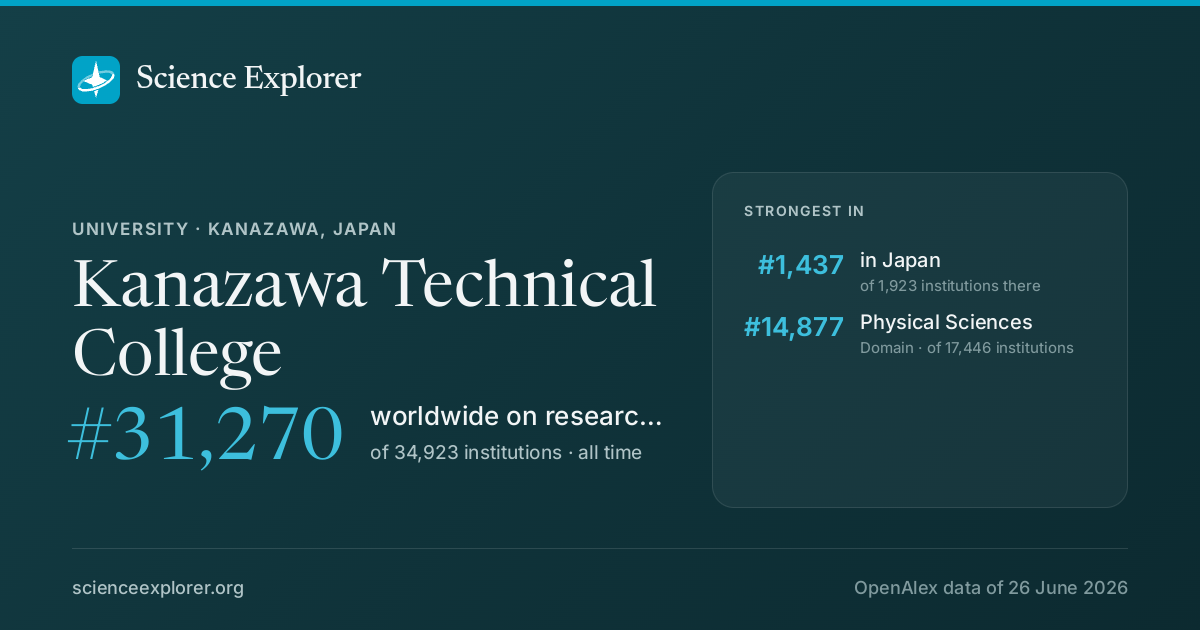
In research, Kanazawa Technical College stands highest in Physical Sciences (#14,877 of 17,446 worldwide), over all time.
- World rank, all time
- #31,270 of 34,923
- Rank in Japan
- #1,437 of 1,923
- Research works
- 189 ▼ 56% vs 2018-21
- Citations
- 571 3.0 per fractional work
- Top-10% rate
- 2.9% all institutions 10.0%
- vs its own fields
- 0.80× 1.00× is exactly expected
- Open access
- 33% world 40%
- International
- 7% world 18%
What is Kanazawa Technical College known for in research?
The fields where it stands highest, over all time, ranked among every institution above the floor in each field.
| Field | World rank | Where that sits | Top-10% rate | Works |
|---|---|---|---|---|
| Physical SciencesDomain | #14,877 of 17,446 | 4.7% | 156 |
Each strip is that field's whole ranked pool, with the notch where Kanazawa Technical College sits in it, in the colour of the band that rank falls in. The track under the rate is the rate itself: it carries no average mark, because the average differs by field (from about 6% in Dentistry to 21% in Economics).
Which fields of science does Kanazawa Technical College work in?
In all years, 83% of research at Kanazawa Technical College is in Physical Sciences, 9% in Social Sciences. Its largest fields are Engineering (48%), Computer Science (17%), Materials Science (6%). It does 2.0× the world's share of Physical Sciences.
Each ring splits the one inside it: the four domains of science, their fields, their subfields. Size is fractional works in all years. Every slice is a page; the interactive view zooms down to single topics and colours each by how much more of it this institution does than the world.
Its 4 domains and 24 fields, with their numbers
- Physical Sciences15682.8%
- Engineering9148.2%
- Computer Science3317.4%
- Materials Science126.4%
- Environmental Science105.1%
- Physics and Astronomy52.8%
- Earth and Planetary Sciences20.9%
- Mathematics20.9%
- Energy10.6%
- Chemistry00.2%
- Chemical Engineering00.2%
- Social Sciences189.3%
- Life Sciences94.8%
- Health Sciences63.2%
- Medicine42.4%
- Health Professions10.7%
- Dentistry00.1%
- Nursing00.0%
Field profile
Location quotient across every field it publishes in: outside the ring is more than an institution of this size would be expected to publish, inside it is less.
Rings at 0.5×, 1× and 2×. Widest outward: Computer Science, 4.5×. Every wedge is a field page.
All 13 fields, with their numbers
- Computer Science4.54×4 works
- Psychology2.93×1 works
- Engineering2.02×4 works
- Arts and Humanities1.88×1 works
- Neuroscience1.50×0 works
- Environmental Science0.82×0 works
- Social Sciences0.79×1 works
- Physics and Astronomy0.31×0 works
- Chemistry0.29×0 works
- Health Professions0.21×0 works
- Agricultural and Biological Sciences0.19×0 works
- Biochemistry, Genetics and Molecular Biology0.07×0 works
- Medicine0.03×0 works
- Computer Science 4.5×
- Psychology 2.9×
- Engineering 2.0×
- Arts and Humanities 1.9×
- Neuroscience 1.5×
- Environmental Science 0.8×
- Social Sciences 0.8×
- Physics and Astronomy 0.3×
- Chemistry 0.3×
- Health Professions 0.2×
- Agricultural and Biological Sciences 0.2×
- Biochemistry, Genetics and Molecular Biology 0.1×
- Medicine 0.0×
Who are the top researchers at Kanazawa Technical College?
Ranked on the quality score, Yoshisuke Uyeda, Yumi Ueda and Sh. Nakamura lead among researchers whose main affiliation is Kanazawa Technical College.
- 1
Yoshisuke Uyeda
 Japan · #2,635,839 worldwide
30 citations · 42 works
- 2
Yumi Ueda
Japan · #3,077,141 worldwide
446 citations · 35 works
- 3
Sh. Nakamura
Japan · #4,057,392 worldwide
63 citations · 20 works
- 4
Ayumu Minamide
Japan · #4,482,775 worldwide
67 citations · 17 works
- 5
Akio Imazawa
Japan · #5,383,280 worldwide
62 citations · 25 works
- 6
Nobuyuki Naoe
Japan · #6,612,661 worldwide
281 citations · 85 works
- 7
Akiyuki Minamide
Japan · #6,742,220 worldwide
121 citations · 75 works
Which keywords describe research at Kanazawa Technical College?
By fractional works in all years, weighted toward what it does more of than the world: Education, STEM Education, Composite Materials, Learning Environments, Robotics Programming, Non-Destructive Testing, Tool Wear and Thermal Analysis.
- Engineering Education
- Cavitation Erosion
- Image Processing
- Lifelong Learning
- Virtual Reality
- Chemical Mechanical Planarization
- Pulsed Thermography
- Fatigue Analysis
- Thermal Imaging
- Defect Detection
- Control Systems
- Structural Analysis
- Permanent Magnet Machines
- Neural Networks
- Electric Motor Drives
- Energy Efficiency
- Remote Sensing
- Deep Learning
- Learning Environments
- STEM Education
- Education
- Composite Materials
- Robotics Programming
- Non-Destructive Testing
- Tool Wear
- Thermal Analysis
- Material Properties
- Numerical Simulation
- Finite Element Method
- Fluid Dynamics
- Corrosion
- Infrared Thermography
- Design Optimization
- Building Diagnostics
- Machine Vision
- Material Removal Mechanism
- Depth Estimation
- Surface Modification
- Wear Behavior
- Climate
Size is fractional works in all years in the topics tagged with each word; colour is the word's share of this institution's work against its share of the world's. The 40 words are chosen for being large and distinctive. Each links to the topic it comes from most.
All 40 words, with their numbers
- Education12▲ 4.9×12 topics
- STEM Education9▲ 17×4 topics
- Composite Materials8▲ 19×4 topics
- Learning Environments8▲ 104×1 topic
- Robotics Programming8▲ 246×1 topic
- Deep Learning7▲ 1.74×18 topics
- Non-Destructive Testing7▲ 32×2 topics
- Remote Sensing6▲ 3.1×11 topics
- Tool Wear6▲ 24×3 topics
- Energy Efficiency6▲ 4.1×9 topics
- Thermal Analysis6▲ 22×2 topics
- Electric Motor Drives5▲ 71×1 topic
- Material Properties5▲ 22×2 topics
- Neural Networks5▲ 2.7×12 topics
- Numerical Simulation5▲ 8.6×3 topics
- Permanent Magnet Machines5▲ 71×1 topic
- Finite Element Method5▲ 20×2 topics
- Structural Analysis5▲ 17×2 topics
- Fluid Dynamics5▲ 17×2 topics
- Control Systems5▲ 9.6×4 topics
- Corrosion4▲ 21×3 topics
- Defect Detection4▲ 23×2 topics
- Infrared Thermography4▲ 55×2 topics
- Thermal Imaging4▲ 55×2 topics
- Design Optimization4▲ 54×1 topic
- Fatigue Analysis4▲ 56×1 topic
- Building Diagnostics4▲ 108×1 topic
- Pulsed Thermography4▲ 108×1 topic
- Machine Vision4▲ 11×4 topics
- Chemical Mechanical Planarization4▲ 37×1 topic
- Material Removal Mechanism4▲ 37×1 topic
- Virtual Reality4▲ 6.0×7 topics
- Depth Estimation4▲ 22×2 topics
- Lifelong Learning4▲ 13×5 topics
- Surface Modification4▲ 12×2 topics
- Image Processing4▲ 6.2×5 topics
- Wear Behavior3▲ 47×2 topics
- Cavitation Erosion3▲ 186×1 topic
- Climate3▲ 23×2 topics
- Engineering Education3▲ 17×4 topics
Which research topics does Kanazawa Technical College publish most on?
By volume in 2022-now: Educational Robotics and Engineering, Computational Drug Discovery Methods, IoT Networks and Protocols and Innovative Teaching and Learning Methods.
Area is fractional works; colour is the subfield each topic belongs to.
- 1 Educational Robotics and Engineering Artificial Intelligence 1 works
- 2 Computational Drug Discovery Methods Computational Theory and Mathematics 1 works
- 3 IoT Networks and Protocols Electrical and Electronic Engineering 1 works
- 4 Innovative Teaching and Learning Methods Developmental and Educational Psychology 0 works
- 5 Intelligent Tutoring Systems and Adaptive Learning Artificial Intelligence 0 works
- 6 Advanced Surface Polishing Techniques Biomedical Engineering 0 works
- 7 Engineering Education and Global Impact Development 0 works
- 8 Traffic Prediction and Management Techniques Building and Construction 0 works
- 9 Industrial Vision Systems and Defect Detection Industrial and Manufacturing Engineering 0 works
- 10 Diverse Education and Engineering Focus Education 0 works
How open and international is its research?
Against the world's own shares: the tick on each track. Both are shares of its output, so they sit on one scale and can be read against each other as well as against the world.
World: 40% of research is openly available.
World: 18% is written across borders.
How has Kanazawa Technical College's research output changed?
Output in 2022-2025 was 56% lower than in 2018-2021.
The same series as a ribbon: one cell per year, darker for more. The line above answers how much; this answers when.
Its share of all research
Growing output can still be a shrinking share: all of science grows. This is Kanazawa Technical College as a percentage of every work published that year, 0.000019% in 2024.
Fractional works of Kanazawa Technical College over all fractional works that year. How the balance of science has shifted.
Other research institutions in Kanazawa
- Kanazawa University
- Kanazawa Medical University
- Hokuriku University
- Ishikawa Prefectural Central Hospital
- Kanazawa Hospital
- Mirai Hospital
- Kanazawa Medical Center
- Asanogawa General Hospital
Share Kanazawa Technical College's ranking
Badges for a website1Each links back here and updates with every snapshot

Research measures only: rankings here say nothing about teaching, admissions or student experience. Comparable institutions and collaboration partners have tabs of their own, above.
Discussion
Ask a question or share a note about Kanazawa Technical College. Posts are plain text and can be reported.