Science Explorer Back to mapMap
Discussion
Hospital / health system · Kreischa · Germany

Klinik Bavaria

In research, Klinik Bavaria stands highest in Health Sciences (#4,388 of 16,688 worldwide) and Medicine (#4,361 of 14,558 worldwide), over all time.

World rank, all time
#20,650
of 34,923
Rank in Germany
#1,022
of 1,603
Research works
248
▲ 26% vs 2018-21
Citations
7.6k
30.7 per fractional work
Top-10% rate
7.7%
all institutions 10.0%
vs its own fields
1.15×
1.00× is exactly expected
Open access
20%
world 40%
International
11%
world 18%

What is Klinik Bavaria known for in research?

The fields where it stands highest, over all time, ranked among every institution above the floor in each field.

FieldWorld rankWhere that sitsTop-10% rateWorks
Health SciencesDomain #4,388 of 16,688 12.3%185
MedicineField #4,361 of 14,558 11.2%155

Each strip is that field's whole ranked pool, with the notch where Klinik Bavaria sits in it, in the colour of the band that rank falls in. The track under the rate is the rate itself: it carries no average mark, because the average differs by field (from about 6% in Dentistry to 21% in Economics).

Which fields of science does Klinik Bavaria work in?

In 2022-now, 64% of research at Klinik Bavaria is in Health Sciences, 15% in Life Sciences. Its largest fields are Medicine (57%), Neuroscience (10%), Arts and Humanities (8%). It does 2.1× the world's share of Health Sciences.

Health Sciences: 16 fractional works · 63.8% of its workMedicine: 14 fractional works · 57.3% of its workEpidemiology: 2 fractional works · 6.8% of its workCritical Care and Intensive Care Medicine: 1 fractional works · 5.5% of its workPublic Health, Environmental and Occupational Health: 1 fractional works · 4.7% of its workPsychiatry and Mental health: 1 fractional works · 4.6% of its workSurgery: 1 fractional works · 4.2% of its workNeurology: 1 fractional works · 3.4% of its workOncology: 1 fractional works · 3.3% of its workEndocrinology, Diabetes and Metabolism: 1 fractional works · 3.2% of its workRadiology, Nuclear Medicine and Imaging: 1 fractional works · 2.3% of its workCardiology and Cardiovascular Medicine: 1 fractional works · 2.1% of its workPhysiology: 0 fractional works · 2.1% of its workPathology and Forensic Medicine: 0 fractional works · 1.9% of its workPulmonary and Respiratory Medicine: 0 fractional works · 1.9% of its workInfectious Diseases: 0 fractional works · 1.8% of its workRehabilitation: 0 fractional works · 1.7% of its workGeriatrics and Gerontology: 0 fractional works · 1.6% of its workFamily Practice: 0 fractional works · 1.0% of its workPediatrics, Perinatology and Child Health: 0 fractional works · 1.0% of its workBiochemistry: 0 fractional works · 0.7% of its workPharmacology: 0 fractional works · 0.7% of its workGenetics: 0 fractional works · 0.5% of its workHematology: 0 fractional works · 0.5% of its workHepatology: 0 fractional works · 0.5% of its workObstetrics and Gynecology: 0 fractional works · 0.5% of its workDermatology: 0 fractional works · 0.3% of its workOphthalmology: 0 fractional works · 0.3% of its workRheumatology: 0 fractional works · 0.3% of its workHealth Professions: 2 fractional works · 6.5% of its workGeneral Health Professions: 1 fractional works · 2.3% of its workSpeech and Hearing: 0 fractional works · 1.4% of its workHealth Information Management: 0 fractional works · 1.0% of its workPhysical Therapy, Sports Therapy and Rehabilitation: 0 fractional works · 0.8% of its workRadiological and Ultrasound Technology: 0 fractional works · 0.8% of its workEmergency Medical Services: 0 fractional works · 0.2% of its workLife Sciences: 4 fractional works · 14.7% of its workNeuroscience: 2 fractional works · 9.7% of its workCognitive Neuroscience: 1 fractional works · 3.8% of its workNeurology: 1 fractional works · 2.4% of its workSensory Systems: 0 fractional works · 1.9% of its workCellular and Molecular Neuroscience: 0 fractional works · 1.6% of its workBiochemistry, Genetics and Molecular Biology: 1 fractional works · 4.4% of its workGenetics: 0 fractional works · 1.4% of its workMolecular Biology: 0 fractional works · 1.4% of its workCell Biology: 0 fractional works · 0.7% of its workClinical Biochemistry: 0 fractional works · 0.5% of its workPhysiology: 0 fractional works · 0.5% of its workSmaller subfields together: 0 fractional works · 0.0% of its workPharmacology, Toxicology and Pharmaceutics: 0 fractional works · 0.7% of its workToxicology: 0 fractional works · 0.7% of its workSocial Sciences: 3 fractional works · 12.6% of its workArts and Humanities: 2 fractional works · 8.3% of its workLanguage and Linguistics: 1 fractional works · 4.1% of its workHistory and Philosophy of Science: 0 fractional works · 1.4% of its workPhilosophy: 0 fractional works · 1.0% of its workHistory: 0 fractional works · 0.8% of its workArcheology: 0 fractional works · 0.5% of its workClassics: 0 fractional works · 0.5% of its workPsychology: 1 fractional works · 2.5% of its workClinical Psychology: 0 fractional works · 1.3% of its workSocial Psychology: 0 fractional works · 1.2% of its workSocial Sciences: 0 fractional works · 0.9% of its workSociology and Political Science: 0 fractional works · 0.9% of its workBusiness, Management and Accounting: 0 fractional works · 0.5% of its workOrganizational Behavior and Human Resource Management: 0 fractional works · 0.5% of its workEconomics, Econometrics and Finance: 0 fractional works · 0.5% of its workEconomics and Econometrics: 0 fractional works · 0.5% of its workPhysical Sciences: 2 fractional works · 8.9% of its workEngineering: 1 fractional works · 5.4% of its workElectrical and Electronic Engineering: 0 fractional works · 2.1% of its workAerospace Engineering: 0 fractional works · 1.2% of its workOcean Engineering: 0 fractional works · 1.0% of its workAutomotive Engineering: 0 fractional works · 0.7% of its workBiomedical Engineering: 0 fractional works · 0.5% of its workComputer Science: 0 fractional works · 1.7% of its workInformation Systems: 0 fractional works · 1.0% of its workArtificial Intelligence: 0 fractional works · 0.7% of its workPhysics and Astronomy: 0 fractional works · 1.4% of its workAtomic and Molecular Physics, and Optics: 0 fractional works · 0.7% of its workNuclear and High Energy Physics: 0 fractional works · 0.7% of its workEnvironmental Science: 0 fractional works · 0.5% of its workHealth, Toxicology and Mutagenesis: 0 fractional works · 0.5% of its workALL ITS WORKKlinik Bavaria24fractional works, 2022-now
Life Sciences15%Physical Sciences9%Health Sciences64%Social Sciences13%

Each ring splits the one inside it: the four domains of science, their fields, their subfields. Size is fractional works in 2022-now. Every slice is a page; the interactive view zooms down to single topics and colours each by how much more of it this institution does than the world.

Its 4 domains and 14 fields, with their numbers
    1. Medicine1457.3%
    2. Health Professions26.5%
    1. Neuroscience29.7%
    2. Biochemistry, Genetics and Molecular Biology14.4%
    3. Pharmacology, Toxicology and Pharmaceutics00.7%
    1. Arts and Humanities28.3%
    2. Psychology12.5%
    3. Social Sciences00.9%
    4. Business, Management and Accounting00.5%
    5. Economics, Econometrics and Finance00.5%
    1. Engineering15.4%
    2. Computer Science01.7%
    3. Physics and Astronomy01.4%
    4. Environmental Science00.5%
All of science, and how each field's share has moved since 1950: the Science domain explorer

Field profile

Location quotient across every field it publishes in: outside the ring is more than an institution of this size would be expected to publish, inside it is less.

Biochemistry, Genetics and Molecular Biology: 0.81× its world share, 1 worksBiochemistry, Geneti…Neuroscience: 5.98× its world share, 2 worksNeurosciencePharmacology, Toxicology and Pharmaceutics: 1.94× its world share, 0 worksPharmacology, Toxico…Computer Science: 0.22× its world share, 0 worksComputer ScienceEngineering: 0.36× its world share, 1 worksEngineeringEnvironmental Science: 0.09× its world share, 0 worksEnvironmental SciencePhysics and Astronomy: 0.62× its world share, 0 worksPhysics and AstronomyHealth Professions: 2.46× its world share, 2 worksHealth ProfessionsMedicine: 2.98× its world share, 14 worksMedicineArts and Humanities: 2.89× its world share, 2 worksArts and HumanitiesBusiness, Management and Accounting: 0.14× its world share, 0 worksBusiness, Management…Economics, Econometrics and Finance: 0.21× its world share, 0 worksEconomics, Econometr…Psychology: 0.80× its world share, 1 worksPsychologySocial Sciences: 0.07× its world share, 0 worksSocial Sciences1×world share
more than its size predictsabout as predictedless

Rings at 0.5×, 1× and 2×. Widest outward: Neuroscience, 6.0×. Every wedge is a field page.

All 14 fields, with their numbers
  1. Neuroscience5.98×2 works
  2. Medicine2.98×14 works
  3. Arts and Humanities2.89×2 works
  4. Health Professions2.46×2 works
  5. Pharmacology, Toxicology and Pharmaceutics1.94×0 works
  6. Biochemistry, Genetics and Molecular Biology0.81×1 works
  7. Psychology0.80×1 works
  8. Physics and Astronomy0.62×0 works
  9. Engineering0.36×1 works
  10. Computer Science0.22×0 works
  11. Economics, Econometrics and Finance0.21×0 works
  12. Business, Management and Accounting0.14×0 works
  13. Environmental Science0.09×0 works
  14. Social Sciences0.07×0 works

Who are the top researchers at Klinik Bavaria?

Ranked on the quality score, Marcus Pohl, Holm Thieme and Michael Adamaszek lead among researchers whose main affiliation is Klinik Bavaria.

  1. 1 Marcus Pohl Germany · #155,905 worldwide 10k citations · 139 works
  2. 2 Holm Thieme Germany · #1,761,824 worldwide 1.5k citations · 60 works
  3. 3 Michael Adamaszek Germany · #2,566,010 worldwide 1.9k citations · 52 works
  4. 4 Hugo P. Thieme Germany · #2,697,433 worldwide 29 citations · 40 works
  5. 5 Jürgen Tesak Germany · #2,923,886 worldwide 202 citations · 23 works
  6. 6 Frank Oehmichen Germany · #3,069,758 worldwide 931 citations · 32 works
  7. 7 Jan Mehrholz Germany · #3,718,738 worldwide 13k citations · 468 works
  8. 8 München Weck Germany · #4,092,402 worldwide 340 citations · 29 works
  9. 9 M. Pohl Germany · #4,977,744 worldwide 908 citations · 60 works
All ranked researchers at Klinik Bavaria

What are the most cited papers from Klinik Bavaria?

The most cited paper from Klinik Bavaria is "Interventions for improving upper limb function after stroke" (Alex Pollock, Sybil Farmer, Marian Brady et al., 2014), with 879 citations. Next come "Predictive Validity and Responsiveness of the Functional Ambulation Category in Hemiparetic Patients After Stroke" (835) and "Electromechanical and robot-assisted arm training for improving activities of daily living, arm function, and arm muscle strength after stroke" (683).

Most cited papers
#PaperReleasedCitations
1 Interventions for improving upper limb function after stroke Alex Pollock, Sybil Farmer, Marian Brady et al. · Cochrane Database of Systematic Reviews Open access 12 Nov 2014 879
2 Predictive Validity and Responsiveness of the Functional Ambulation Category in Hemiparetic Patients After Stroke Jan Mehrholz, Katja Wagner, Katja Rutte et al. · Archives of Physical Medicine and Rehabilitation Oct 2007 835
3 Electromechanical and robot-assisted arm training for improving activities of daily living, arm function, and arm muscle strength after stroke Jan Mehrholz, Marcus Pohl, Thomas Platz et al. · Cochrane Database of Systematic Reviews Open access 7 Nov 2015 683
4 Consensus Paper: Cerebellum and Emotion Michael Adamaszek, Federico D’Agata, Roberta Ferrucci et al. · The Cerebellum Open access 2 Aug 2016 600
5 Electromechanical-assisted training for walking after stroke Jan Mehrholz, Simone Thomas, Cordula Werner et al. · Cochrane Database of Systematic Reviews Open access 10 May 2017 573
All 54 most cited papers, with filters and sorting

Which keywords describe research at Klinik Bavaria?

By fractional works in 2022-now, weighted toward what it does more of than the world: Critical Care, Epidemiology, Rehabilitation, Neurological Disorders, Biomarkers, Sepsis, Septic Shock and Elderly Patients.

▲ more of its work than of the world's◆ about the world's share▼ less than the world's

Size is fractional works in 2022-now in the topics tagged with each word; colour is the word's share of this institution's work against its share of the world's. The 14 words are chosen for being large and distinctive. Each links to the topic it comes from most.

All 14 words, with their numbers
  1. Epidemiology3▲ 2.9×10 topics
  2. Critical Care2▲ 33×4 topics
  3. Rehabilitation2▲ 15×4 topics
  4. Biomarkers1▲ 8.2×2 topics
  5. Neurological Disorders1▲ 10×6 topics
  6. Sepsis1▲ 31×2 topics
  7. Elderly Patients1▲ 30×2 topics
  8. Management1▲ 6.6×1 topic
  9. Septic Shock1▲ 63×1 topic
  10. Healthcare1▲ 3.9×4 topics
  11. Intensive Care Unit1▲ 36×3 topics
  12. Mortality1▲ 8.2×4 topics
  13. Etymology1▲ 88×2 topics
  14. Linguistics1▲ 26×2 topics

Which research topics does Klinik Bavaria publish most on?

By volume in 2022-now: Sepsis Diagnosis and Treatment, Intensive Care Unit Cognitive Disorders, Hormonal and reproductive studies and Olfactory and Sensory Function Studies.

  1. 1 Sepsis Diagnosis and Treatment Epidemiology 1 works
  2. 2 Intensive Care Unit Cognitive Disorders Critical Care and Intensive Care Medicine 1 works
  3. 3 Hormonal and reproductive studies Endocrinology, Diabetes and Metabolism 1 works
  4. 4 Olfactory and Sensory Function Studies Sensory Systems 0 works
  5. 5 Vestibular and auditory disorders Neurology 0 works
  6. 6 Linguistics and Cultural Studies Language and Linguistics 0 works
  7. 7 Long-Term Effects of COVID-19 Neurology 0 works
  8. 8 Linguistics and language evolution Language and Linguistics 0 works
  9. 9 Palliative Care and End-of-Life Issues Public Health, Environmental and Occupational Health 0 works
  10. 10 Frailty in Older Adults Geriatrics and Gerontology 0 works

How open and international is its research?

Against the world's own shares: the tick on each track. Both are shares of its output, so they sit on one scale and can be read against each other as well as against the world.

openly available20.4%not open79.6%

World: 40% of research is openly available.

with international co-authors11.2%domestic only88.8%

World: 18% is written across borders.

How has Klinik Bavaria's research output changed?

Output in 2022-2025 was 26% higher than in 2018-2021.

still counting1990200020102020
grewheldshrank

The same series as a ribbon: one cell per year, darker for more. The line above answers how much; this answers when.

Its share of all research

Growing output can still be a shrinking share: all of science grows. This is Klinik Bavaria as a percentage of every work published that year, 0.000084% in 2024.

still counting0.00050%0.0010%0.0015%Klinik Bavaria0.00011% in 202519801990200020102020

Fractional works of Klinik Bavaria over all fractional works that year. How the balance of science has shifted.

Share Klinik Bavaria's ranking
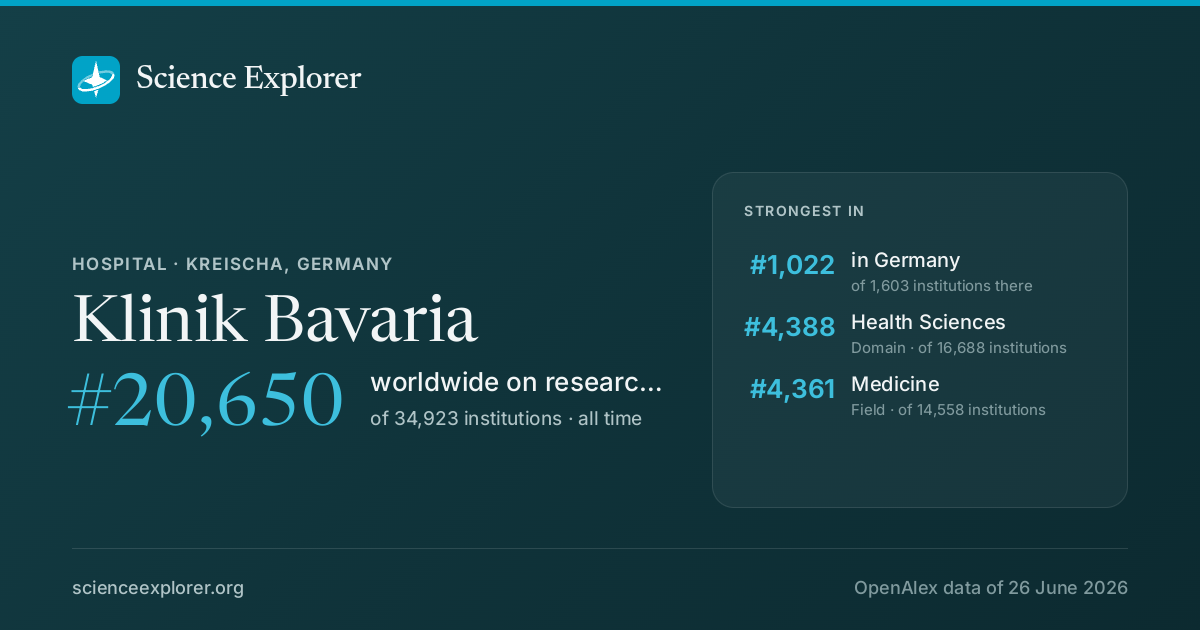
Klinik Bavaria on Science Explorer

A card with Klinik Bavaria's standing and the fields it leads in, for a post or a slide. A link to this page previews as the same card.

Download the card

1200 × 630 PNG, sized for social posts, drawn from the latest snapshot.

Badges for a website1Each links back here and updates with every snapshot

Research measures only: rankings here say nothing about teaching, admissions or student experience. Comparable institutions and collaboration partners have tabs of their own, above.

Discussion

Ask a question or share a note about Klinik Bavaria. Keep it to the research: no personal attacks, advertising or links. Any reader can report a post, which collapses it for everyone until it is opened.
