Science Explorer Back to mapMap
Discussion
Hospital / health system · Hanau · Germany

Klinikum Hanau

In research, Klinikum Hanau stands highest in Health Sciences (#4,932 of 16,688 worldwide), Medicine (#4,414 of 14,558 worldwide) and Materials Science (#2,429 of 3,771 worldwide), over all time.

World rank, 2022-now
#13,365
of 22,385 · #8,407 all time
Rank in Germany
#431
of 795
Research works
1.8k
▼ 31% vs 2018-21
Citations
21k
11.9 per fractional work
Top-10% rate
8.7%
all institutions 10.0%
vs its own fields
1.09×
1.00× is exactly expected
Open access
13%
world 40%
International
10%
world 18%

What is Klinikum Hanau known for in research?

The fields where it stands highest, over all time, ranked among every institution above the floor in each field.

FieldWorld rankWhere that sitsTop-10% rateWorks
Health SciencesDomain #4,932 of 16,688 5.3%626
MedicineField #4,414 of 14,558 5.3%556
Materials ScienceField #2,429 of 3,771 4.6%152
ChemistryField #1,987 of 2,902 12.9%143
Physical SciencesDomain #12,888 of 17,446 8.0%750
Life SciencesDomain #8,304 of 11,023 10.9%227
EngineeringField #7,450 of 9,532 9.0%305
Biochemistry, Genetics and Molecular BiologyField #4,569 of 5,801 7.2%127
Social SciencesDomain #14,007 of 14,833 4.8%186

Each strip is that field's whole ranked pool, with the notch where Klinikum Hanau sits in it, in the colour of the band that rank falls in. The track under the rate is the rate itself: it carries no average mark, because the average differs by field (from about 6% in Dentistry to 21% in Economics).

Which fields of science does Klinikum Hanau work in?

In 2022-now, 48% of research at Klinikum Hanau is in Health Sciences, 20% in Physical Sciences. Its largest fields are Medicine (39%), Arts and Humanities (12%), Engineering (9%). It does 2.0× the world's share of Health Sciences.

Health Sciences: 56 fractional works · 48.1% of its workMedicine: 45 fractional works · 38.6% of its workSurgery: 14 fractional works · 11.5% of its workPulmonary and Respiratory Medicine: 4 fractional works · 3.7% of its workOncology: 3 fractional works · 2.7% of its workPublic Health, Environmental and Occupational Health: 3 fractional works · 2.3% of its workGastroenterology: 2 fractional works · 2.0% of its workEpidemiology: 2 fractional works · 1.9% of its workObstetrics and Gynecology: 2 fractional works · 1.8% of its workEndocrinology, Diabetes and Metabolism: 2 fractional works · 1.6% of its workPhysiology: 2 fractional works · 1.4% of its workInfectious Diseases: 1 fractional works · 1.1% of its workRadiology, Nuclear Medicine and Imaging: 1 fractional works · 0.9% of its workHepatology: 1 fractional works · 0.8% of its workOrthopedics and Sports Medicine: 1 fractional works · 0.8% of its workRehabilitation: 1 fractional works · 0.7% of its workCardiology and Cardiovascular Medicine: 1 fractional works · 0.5% of its workNeurology: 1 fractional works · 0.5% of its workHematology: 1 fractional works · 0.5% of its workRheumatology: 1 fractional works · 0.5% of its workEmergency Medicine: 1 fractional works · 0.5% of its workPharmacology: 0 fractional works · 0.4% of its workPsychiatry and Mental health: 0 fractional works · 0.4% of its workPediatrics, Perinatology and Child Health: 0 fractional works · 0.4% of its workCritical Care and Intensive Care Medicine: 0 fractional works · 0.3% of its workPathology and Forensic Medicine: 0 fractional works · 0.2% of its workDermatology: 0 fractional works · 0.2% of its workTransplantation: 0 fractional works · 0.2% of its workSmaller subfields together: 1 fractional works · 0.7% of its workHealth Professions: 9 fractional works · 7.9% of its workGeneral Health Professions: 6 fractional works · 5.2% of its workSpeech and Hearing: 3 fractional works · 2.3% of its workPhysical Therapy, Sports Therapy and Rehabilitation: 0 fractional works · 0.3% of its workSmaller subfields together: 0 fractional works · 0.1% of its workNursing: 2 fractional works · 1.3% of its workNutrition and Dietetics: 2 fractional works · 1.3% of its workDentistry: 0 fractional works · 0.3% of its workPhysical Sciences: 23 fractional works · 19.9% of its workEngineering: 11 fractional works · 9.5% of its workElectrical and Electronic Engineering: 4 fractional works · 3.4% of its workAerospace Engineering: 2 fractional works · 1.4% of its workMechanical Engineering: 2 fractional works · 1.3% of its workBiomedical Engineering: 1 fractional works · 1.0% of its workIndustrial and Manufacturing Engineering: 1 fractional works · 0.7% of its workMechanics of Materials: 0 fractional works · 0.4% of its workAutomotive Engineering: 0 fractional works · 0.3% of its workBuilding and Construction: 0 fractional works · 0.3% of its workCivil and Structural Engineering: 0 fractional works · 0.3% of its workComputational Mechanics: 0 fractional works · 0.2% of its workSmaller subfields together: 0 fractional works · 0.1% of its workEnvironmental Science: 6 fractional works · 4.7% of its workHealth, Toxicology and Mutagenesis: 3 fractional works · 2.6% of its workEcology: 1 fractional works · 0.9% of its workPollution: 0 fractional works · 0.4% of its workEnvironmental Chemistry: 0 fractional works · 0.3% of its workEnvironmental Engineering: 0 fractional works · 0.3% of its workSmaller subfields together: 0 fractional works · 0.2% of its workPhysics and Astronomy: 4 fractional works · 3.1% of its workAstronomy and Astrophysics: 2 fractional works · 1.6% of its workAtomic and Molecular Physics, and Optics: 1 fractional works · 0.9% of its workStatistical and Nonlinear Physics: 1 fractional works · 0.6% of its workSmaller subfields together: 0 fractional works · 0.1% of its workComputer Science: 1 fractional works · 1.2% of its workInformation Systems: 1 fractional works · 0.6% of its workArtificial Intelligence: 0 fractional works · 0.3% of its workSmaller subfields together: 0 fractional works · 0.3% of its workEnergy: 1 fractional works · 0.5% of its workRenewable Energy, Sustainability and the Environment: 0 fractional works · 0.3% of its workSmaller subfields together: 0 fractional works · 0.1% of its workEarth and Planetary Sciences: 0 fractional works · 0.4% of its workEarth-Surface Processes: 0 fractional works · 0.3% of its workSmaller subfields together: 0 fractional works · 0.1% of its workChemistry: 0 fractional works · 0.2% of its workMaterials Science: 0 fractional works · 0.2% of its workChemical Engineering: 0 fractional works · 0.1% of its workSocial Sciences: 23 fractional works · 19.3% of its workArts and Humanities: 14 fractional works · 12.3% of its workArcheology: 5 fractional works · 4.1% of its workLanguage and Linguistics: 3 fractional works · 2.8% of its workClassics: 3 fractional works · 2.5% of its workHistory: 2 fractional works · 1.4% of its workPhilosophy: 1 fractional works · 1.1% of its workLiterature and Literary Theory: 0 fractional works · 0.3% of its workSocial Sciences: 4 fractional works · 3.5% of its workSociology and Political Science: 2 fractional works · 1.3% of its workAnthropology: 1 fractional works · 0.6% of its workEducation: 0 fractional works · 0.3% of its workLaw: 0 fractional works · 0.3% of its workLinguistics and Language: 0 fractional works · 0.3% of its workPolitical Science and International Relations: 0 fractional works · 0.3% of its workTransportation: 0 fractional works · 0.3% of its workSmaller subfields together: 0 fractional works · 0.2% of its workBusiness, Management and Accounting: 2 fractional works · 1.9% of its workStrategy and Management: 1 fractional works · 1.1% of its workManagement of Technology and Innovation: 1 fractional works · 0.7% of its workSmaller subfields together: 0 fractional works · 0.1% of its workEconomics, Econometrics and Finance: 1 fractional works · 0.7% of its workEconomics and Econometrics: 1 fractional works · 0.7% of its workDecision Sciences: 1 fractional works · 0.6% of its workStatistics, Probability and Uncertainty: 1 fractional works · 0.6% of its workPsychology: 0 fractional works · 0.3% of its workSocial Psychology: 0 fractional works · 0.3% of its workLife Sciences: 15 fractional works · 12.7% of its workImmunology and Microbiology: 6 fractional works · 4.9% of its workMicrobiology: 5 fractional works · 4.1% of its workImmunology: 1 fractional works · 0.7% of its workSmaller subfields together: 0 fractional works · 0.1% of its workPharmacology, Toxicology and Pharmaceutics: 4 fractional works · 3.7% of its workPharmacology: 4 fractional works · 3.5% of its workSmaller subfields together: 0 fractional works · 0.1% of its workBiochemistry, Genetics and Molecular Biology: 4 fractional works · 3.5% of its workMolecular Biology: 2 fractional works · 1.3% of its workCancer Research: 1 fractional works · 0.9% of its workGenetics: 1 fractional works · 0.4% of its workBiochemistry: 0 fractional works · 0.4% of its workSmaller subfields together: 1 fractional works · 0.5% of its workAgricultural and Biological Sciences: 0 fractional works · 0.4% of its workPlant Science: 0 fractional works · 0.3% of its workSmaller subfields together: 0 fractional works · 0.1% of its workNeuroscience: 0 fractional works · 0.2% of its workALL ITS WORKKlinikum Hanau117fractional works, 2022-now
Life Sciences13%Physical Sciences20%Health Sciences48%Social Sciences19%

Each ring splits the one inside it: the four domains of science, their fields, their subfields. Size is fractional works in 2022-now. Every slice is a page; the interactive view zooms down to single topics and colours each by how much more of it this institution does than the world.

Its 4 domains and 24 fields, with their numbers
    1. Medicine4538.6%
    2. Health Professions97.9%
    3. Nursing21.3%
    4. Dentistry00.3%
    1. Engineering119.5%
    2. Environmental Science64.7%
    3. Physics and Astronomy43.1%
    4. Computer Science11.2%
    5. Energy10.5%
    6. Earth and Planetary Sciences00.4%
    7. Chemistry00.2%
    8. Materials Science00.2%
    9. Chemical Engineering00.1%
    1. Arts and Humanities1412.3%
    2. Social Sciences43.5%
    3. Business, Management and Accounting21.9%
    4. Economics, Econometrics and Finance10.7%
    5. Decision Sciences10.6%
    6. Psychology00.3%
    1. Immunology and Microbiology64.9%
    2. Pharmacology, Toxicology and Pharmaceutics43.7%
    3. Biochemistry, Genetics and Molecular Biology43.5%
    4. Agricultural and Biological Sciences00.4%
    5. Neuroscience00.2%
All of science, and how each field's share has moved since 1950: the Science domain explorer

Field profile

Location quotient across every field it publishes in: outside the ring is more than an institution of this size would be expected to publish, inside it is less.

Agricultural and Biological Sciences: 0.09× its world share, 0 worksAgricultural and Bio…Biochemistry, Genetics and Molecular Biology: 0.65× its world share, 4 worksBiochemistry, Geneti…Immunology and Microbiology: 4.89× its world share, 6 worksImmunology and Micro…Neuroscience: 0.13× its world share, 0 worksNeurosciencePharmacology, Toxicology and Pharmaceutics: 10.43× its world share, 4 worksPharmacology, Toxico…Chemical Engineering: 0.41× its world share, 0 worksChemical EngineeringChemistry: 0.16× its world share, 0 worksChemistryComputer Science: 0.16× its world share, 1 worksComputer ScienceEarth and Planetary Sciences: 0.24× its world share, 0 worksEarth and Planetary …Energy: 0.53× its world share, 1 worksEnergyEngineering: 0.63× its world share, 11 worksEngineeringEnvironmental Science: 0.95× its world share, 6 worksEnvironmental ScienceMaterials Science: 0.05× its world share, 0 worksMaterials SciencePhysics and Astronomy: 1.39× its world share, 4 worksPhysics and AstronomyDentistry: 0.72× its world share, 0 worksDentistryHealth Professions: 3.00× its world share, 9 worksHealth ProfessionsMedicine: 2.01× its world share, 45 worksMedicineNursing: 2.66× its world share, 2 worksNursingArts and Humanities: 4.24× its world share, 14 worksArts and HumanitiesBusiness, Management and Accounting: 0.58× its world share, 2 worksBusiness, Management…Decision Sciences: 0.61× its world share, 1 worksDecision SciencesEconomics, Econometrics and Finance: 0.32× its world share, 1 worksEconomics, Econometr…Psychology: 0.11× its world share, 0 worksPsychologySocial Sciences: 0.28× its world share, 4 worksSocial Sciences1×world share
more than its size predictsabout as predictedless

Rings at 0.5×, 1× and 2×. Widest outward: Pharmacology, Toxicology and Pharmaceutics, 10.4×. Every wedge is a field page.

All 24 fields, with their numbers
  1. Pharmacology, Toxicology and Pharmaceutics10.43×4 works
  2. Immunology and Microbiology4.89×6 works
  3. Arts and Humanities4.24×14 works
  4. Health Professions3.00×9 works
  5. Nursing2.66×2 works
  6. Medicine2.01×45 works
  7. Physics and Astronomy1.39×4 works
  8. Environmental Science0.95×6 works
  9. Dentistry0.72×0 works
  10. Biochemistry, Genetics and Molecular Biology0.65×4 works
  11. Engineering0.63×11 works
  12. Decision Sciences0.61×1 works
  13. Business, Management and Accounting0.58×2 works
  14. Energy0.53×1 works
  15. Chemical Engineering0.41×0 works
  16. Economics, Econometrics and Finance0.32×1 works
  17. Social Sciences0.28×4 works
  18. Earth and Planetary Sciences0.24×0 works
  19. Chemistry0.16×0 works
  20. Computer Science0.16×1 works
  21. Neuroscience0.13×0 works
  22. Psychology0.11×0 works
  23. Agricultural and Biological Sciences0.09×0 works
  24. Materials Science0.05×0 works

Who are the top researchers at Klinikum Hanau?

Ranked on the quality score, Rolf Teschke, Axel Eickhoff and Oliver S. May lead among researchers whose main affiliation is Klinikum Hanau.

  1. 1 Rolf Teschke Germany · #742,455 worldwide 11k citations · 315 works
  2. 2 Axel Eickhoff Germany · #1,233,982 worldwide 3.4k citations · 135 works
  3. 3 Oliver S. May Germany · #1,867,945 worldwide 1.7k citations · 47 works
  4. 4 Albrecht Wolff Germany · #2,006,320 worldwide 1.1k citations · 22 works
  5. 5 H.M. Ockenfels Germany · #2,114,675 worldwide 2k citations · 56 works
  6. 6 Thomas Tacke Germany · #2,473,912 worldwide 2.1k citations · 34 works
  7. 7 Werner Heit Germany · #2,814,305 worldwide 297 citations · 26 works
  8. 8 Andrea Cavani Germany · #3,402,370 worldwide 488 citations · 270 works
  9. 9 Michael Schwarm Germany · #3,552,201 worldwide 1.4k citations · 24 works
  10. 10 Lukas Welsch Germany · #3,636,360 worldwide 74 citations · 33 works
All ranked researchers at Klinikum Hanau

What are the most cited papers from Klinikum Hanau?

The most cited paper from Klinikum Hanau is "RUCAM in Drug and Herb Induced Liver Injury: The Update" (Gaby Danan, Rolf Teschke, 2015), with 811 citations. Next come "Palladacycles: Efficient New Catalysts for the Heck Vinylation of Aryl Halides" (432) and "Highly Active Palladium/Activated Carbon Catalysts for Heck Reactions: Correlation of Activity, Catalyst Properties, and Pd Leaching" (388).

Most cited papers
#PaperReleasedCitations
1 RUCAM in Drug and Herb Induced Liver Injury: The Update Gaby Danan, Rolf Teschke · International Journal of Molecular Sciences Open access 24 Dec 2015 811
2 Palladacycles: Efficient New Catalysts for the Heck Vinylation of Aryl Halides Wolfgang Anton Herrmann, Christoph Broßmer, Claus‐Peter Reisinger et al. · Chemistry - A European Journal Aug 1997 432
3 Highly Active Palladium/Activated Carbon Catalysts for Heck Reactions: Correlation of Activity, Catalyst Properties, and Pd Leaching Klaus F. Köhler, Roland G. Heidenreich, Jürgen G.E. Krauter et al. · Chemistry - A European Journal Feb 2002 388
4 New developments in hydrogenation catalysis particularly in synthesis of fine and intermediate chemicals B. Chen, Uwe Dingerdissen, Juergen G. E. Krauter et al. · Applied Catalysis A General 15 Dec 2004 377
5 Ileal digestibility of amino acids in feed ingredients for broilers A. Lemme, Velmurugu Ravindran, W. L. Bryden · World s Poultry Science Journal Dec 2004 371
All 61 most cited papers, with filters and sorting

Which keywords describe research at Klinikum Hanau?

By fractional works in 2022-now, weighted toward what it does more of than the world: Infection, Sterilization, Disinfection, Endoscope, Cultural History, Liver Transplantation, Rehabilitation and Oxidative Stress.

▲ more of its work than of the world's◆ about the world's share▼ less than the world's

Size is fractional works in 2022-now in the topics tagged with each word; colour is the word's share of this institution's work against its share of the world's. The 40 words are chosen for being large and distinctive. Each links to the topic it comes from most.

All 40 words, with their numbers
  1. Epidemiology8▲ 1.77×37 topics
  2. Oxidative Stress6▲ 3.2×15 topics
  3. Infection5▲ 17×3 topics
  4. Disinfection5▲ 406×1 topic
  5. Endoscope5▲ 406×1 topic
  6. Sterilization5▲ 255×2 topics
  7. Cultural History4▲ 32×2 topics
  8. Liver Transplantation4▲ 29×4 topics
  9. Public Health4▲ 2.4×9 topics
  10. Rehabilitation4▲ 8.6×9 topics
  11. Neurological Disorders4▲ 5.7×6 topics
  12. Quality of Life4▲ 2.2×9 topics
  13. Mitochondrial Dysfunction4▲ 10×5 topics
  14. Complications3▲ 5.6×13 topics
  15. Antioxidants3▲ 6.2×2 topics
  16. Biomarkers3▲ 4.0×3 topics
  17. Elderly3▲ 11×4 topics
  18. Drug-Induced Liver Injury3▲ 96×1 topic
  19. Hepatotoxicity3▲ 55×1 topic
  20. Mortality3▲ 4.5×8 topics
  21. Guidelines3▲ 5.2×7 topics
  22. Nutritional Support3▲ 26×2 topics
  23. Linguistics3▲ 15×2 topics
  24. Middle Ages3▲ 108×2 topics
  25. Stroke3▲ 14×3 topics
  26. Dysphagia3▲ 37×1 topic
  27. Endoscopic Stenting3▲ 51×1 topic
  28. Esophageal Perforation3▲ 51×1 topic
  29. Quality Improvement3▲ 12×3 topics
  30. Swallowing3▲ 70×1 topic
  31. Health Care Costs3▲ 28×2 topics
  32. Choosing Wisely2▲ 101×1 topic
  33. Low-Value Care2▲ 101×1 topic
  34. Medieval Literature2▲ 108×1 topic
  35. Religious Practices2▲ 47×1 topic
  36. Etymology2▲ 39×1 topic
  37. Indo-European2▲ 90×1 topic
  38. Semitic Languages2▲ 44×2 topics
  39. Epidemiological Study2▲ 25×2 topics
  40. Millimeter-Wave2▲ 44×2 topics

Which research topics does Klinikum Hanau publish most on?

By volume in 2022-now: Medical Device Sterilization and Disinfection, Drug-Induced Hepatotoxicity and Protection, Esophageal and GI Pathology and Dysphagia Assessment and Management.

  1. 1 Medical Device Sterilization and Disinfection Microbiology 5 works
  2. 2 Drug-Induced Hepatotoxicity and Protection Pharmacology 3 works
  3. 3 Esophageal and GI Pathology Surgery 3 works
  4. 4 Dysphagia Assessment and Management Speech and Hearing 3 works
  5. 5 Healthcare cost, quality, practices General Health Professions 2 works
  6. 6 Historical, Literary, and Cultural Studies Classics 2 works
  7. 7 Linguistics and language evolution Language and Linguistics 2 works
  8. 8 Ancient Near East History Archeology 2 works
  9. 9 Health and Medical Studies General Health Professions 2 works
  10. 10 Healthcare and Environmental Waste Management Public Health, Environmental and Occupational Health 2 works

How open and international is its research?

Against the world's own shares: the tick on each track. Both are shares of its output, so they sit on one scale and can be read against each other as well as against the world.

openly available12.6%not open87.4%

World: 40% of research is openly available.

with international co-authors9.5%domestic only90.5%

World: 18% is written across borders.

How has Klinikum Hanau's research output changed?

Output in 2022-2025 was 31% lower than in 2018-2021.

still counting1990200020102020
grewheldshrank

The same series as a ribbon: one cell per year, darker for more. The line above answers how much; this answers when.

Its share of all research

Growing output can still be a shrinking share: all of science grows. This is Klinikum Hanau as a percentage of every work published that year, 0.00048% in 2024.

still counting0.0050%0.010%0.015%Klinikum Hanau0.00042% in 202519801990200020102020

Fractional works of Klinikum Hanau over all fractional works that year. How the balance of science has shifted.

How much of it reaches the world top 10%

Year by year, against all institutions in the same year.

still counting5%10%15%Klinikum Hanau11.0% in 2025all institutions10.0% in 2025200020102020

Of each year's output, the share that reached the world's 10% most cited for its field and year. Peak 14.5% in 1995.

Other research institutions in Hanau

All research institutions in Hanau

Share Klinikum Hanau's ranking
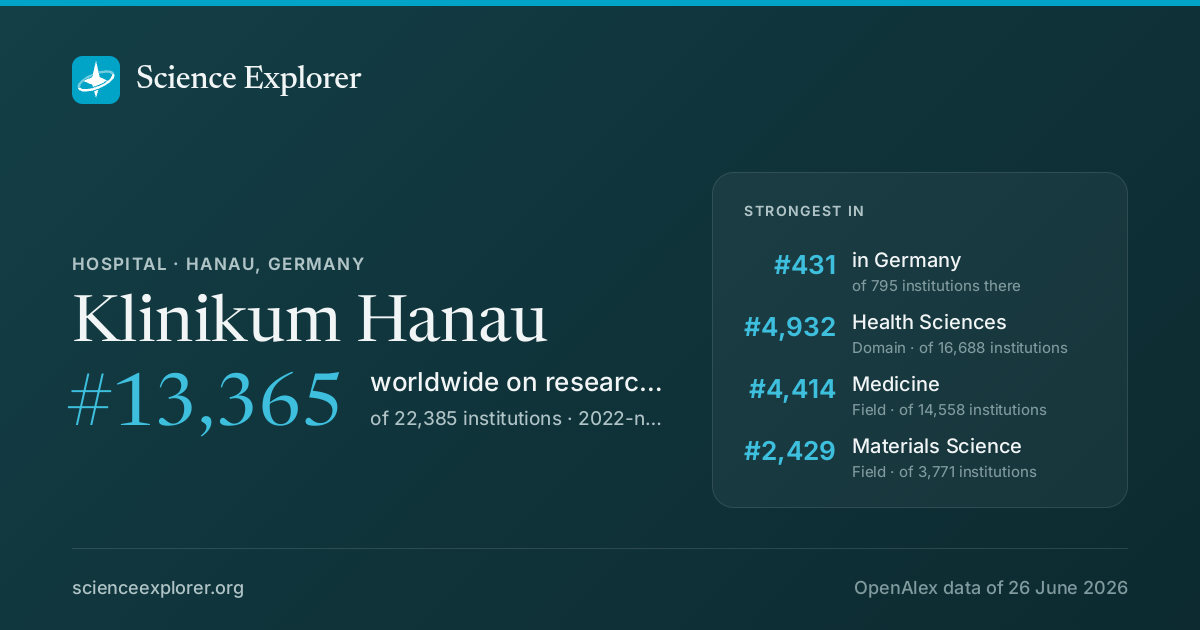
Klinikum Hanau on Science Explorer

A card with Klinikum Hanau's standing and the fields it leads in, for a post or a slide. A link to this page previews as the same card.

Download the card

1200 × 630 PNG, sized for social posts, drawn from the latest snapshot.

Badges for a website1Each links back here and updates with every snapshot

Research measures only: rankings here say nothing about teaching, admissions or student experience. Comparable institutions and collaboration partners have tabs of their own, above.

Discussion

Ask a question or share a note about Klinikum Hanau. Keep it to the research: no personal attacks, advertising or links. Any reader can report a post, which collapses it for everyone until it is opened.
