Science Explorer Back to mapMap
Discussion
University · Takarazuka · Japan

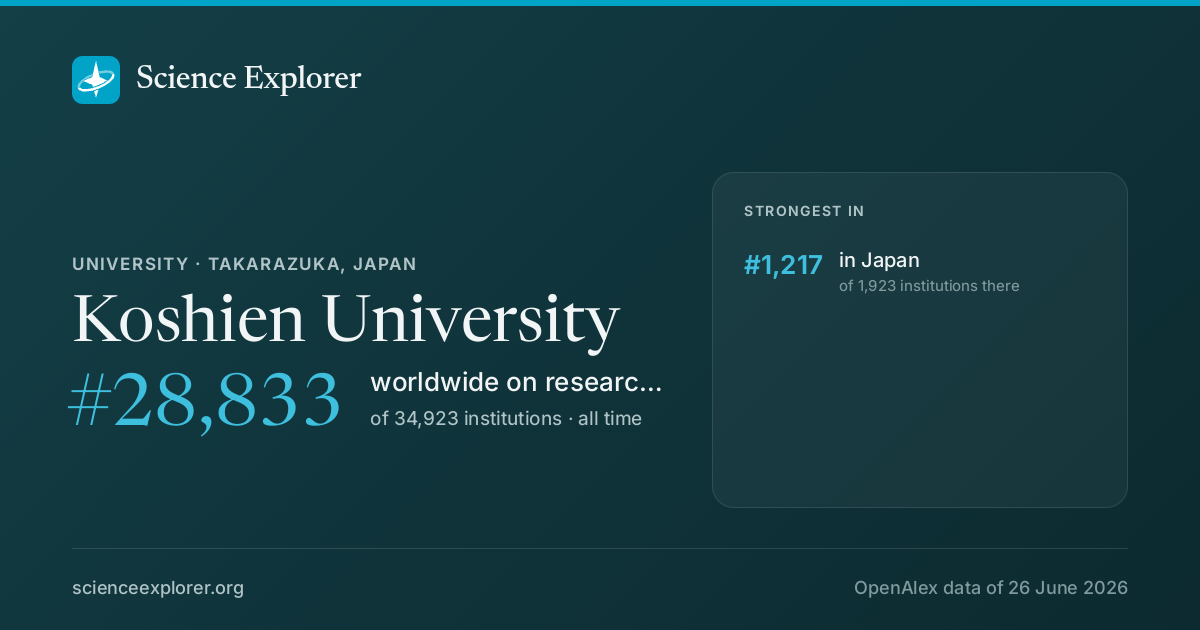
Koshien University

World rank, all time
#28,833
of 34,923
Rank in Japan
#1,217
of 1,923
Research works
243
▲ 191% vs 2018-21
Citations
3k
12.4 per fractional work
Top-10% rate
5.6%
all institutions 10.0%
vs its own fields
0.75×
1.00× is exactly expected
Open access
58%
world 40%
International
11%
world 18%

Which fields of science does Koshien University work in?

In 2022-now, 48% of research at Koshien University is in Social Sciences, 25% in Physical Sciences. Its largest fields are Social Sciences (28%), Medicine (12%), Computer Science (11%). It does 1.6× the world's share of Social Sciences.

Social Sciences: 13 fractional works · 47.6% of its workSocial Sciences: 8 fractional works · 28.4% of its workSociology and Political Science: 3 fractional works · 10.7% of its workEducation: 2 fractional works · 7.5% of its workPolitical Science and International Relations: 1 fractional works · 3.7% of its workCultural Studies: 1 fractional works · 2.7% of its workSafety Research: 0 fractional works · 1.9% of its workHealth: 0 fractional works · 1.4% of its workTransportation: 0 fractional works · 0.6% of its workArts and Humanities: 3 fractional works · 9.8% of its workLiterature and Literary Theory: 1 fractional works · 5.4% of its workVisual Arts and Performing Arts: 1 fractional works · 2.5% of its workPhilosophy: 0 fractional works · 1.2% of its workLanguage and Linguistics: 0 fractional works · 0.6% of its workPsychology: 1 fractional works · 4.8% of its workClinical Psychology: 1 fractional works · 3.5% of its workSocial Psychology: 0 fractional works · 1.3% of its workBusiness, Management and Accounting: 1 fractional works · 4.6% of its workAccounting: 1 fractional works · 3.7% of its workOrganizational Behavior and Human Resource Management: 0 fractional works · 0.4% of its workStrategy and Management: 0 fractional works · 0.4% of its workPhysical Sciences: 7 fractional works · 24.9% of its workComputer Science: 3 fractional works · 10.7% of its workComputer Vision and Pattern Recognition: 1 fractional works · 4.5% of its workComputer Networks and Communications: 1 fractional works · 2.5% of its workHuman-Computer Interaction: 0 fractional works · 1.9% of its workArtificial Intelligence: 0 fractional works · 0.6% of its workComputer Science Applications: 0 fractional works · 0.6% of its workInformation Systems: 0 fractional works · 0.6% of its workEngineering: 3 fractional works · 10.6% of its workBiomedical Engineering: 1 fractional works · 5.2% of its workAerospace Engineering: 0 fractional works · 1.9% of its workIndustrial and Manufacturing Engineering: 0 fractional works · 1.5% of its workMedia Technology: 0 fractional works · 1.2% of its workComputational Mechanics: 0 fractional works · 0.6% of its workMechanical Engineering: 0 fractional works · 0.2% of its workEnvironmental Science: 0 fractional works · 1.5% of its workHealth, Toxicology and Mutagenesis: 0 fractional works · 1.5% of its workMaterials Science: 0 fractional works · 1.2% of its workBiomaterials: 0 fractional works · 1.2% of its workChemistry: 0 fractional works · 0.4% of its workOrganic Chemistry: 0 fractional works · 0.4% of its workMathematics: 0 fractional works · 0.3% of its workApplied Mathematics: 0 fractional works · 0.3% of its workEarth and Planetary Sciences: 0 fractional works · 0.2% of its workGeochemistry and Petrology: 0 fractional works · 0.2% of its workHealth Sciences: 4 fractional works · 15.0% of its workMedicine: 3 fractional works · 12.5% of its workPublic Health, Environmental and Occupational Health: 1 fractional works · 3.0% of its workCardiology and Cardiovascular Medicine: 1 fractional works · 2.4% of its workNeurology: 0 fractional works · 1.5% of its workComplementary and alternative medicine: 0 fractional works · 1.2% of its workOncology: 0 fractional works · 1.0% of its workPhysiology: 0 fractional works · 1.0% of its workEndocrinology, Diabetes and Metabolism: 0 fractional works · 0.7% of its workNephrology: 0 fractional works · 0.4% of its workSurgery: 0 fractional works · 0.4% of its workHematology: 0 fractional works · 0.3% of its workObstetrics and Gynecology: 0 fractional works · 0.3% of its workPathology and Forensic Medicine: 0 fractional works · 0.3% of its workSmaller subfields together: 0 fractional works · 0.3% of its workHealth Professions: 0 fractional works · 1.4% of its workHealth Information Management: 0 fractional works · 1.2% of its workSmaller subfields together: 0 fractional works · 0.2% of its workNursing: 0 fractional works · 1.0% of its workNutrition and Dietetics: 0 fractional works · 1.0% of its workLife Sciences: 3 fractional works · 12.6% of its workAgricultural and Biological Sciences: 2 fractional works · 6.9% of its workFood Science: 1 fractional works · 5.0% of its workPlant Science: 0 fractional works · 1.6% of its workGeneral Agricultural and Biological Sciences: 0 fractional works · 0.3% of its workNeuroscience: 1 fractional works · 3.3% of its workSensory Systems: 1 fractional works · 2.5% of its workBehavioral Neuroscience: 0 fractional works · 0.8% of its workBiochemistry, Genetics and Molecular Biology: 0 fractional works · 1.7% of its workBiochemistry: 0 fractional works · 1.2% of its workSmaller subfields together: 0 fractional works · 0.5% of its workPharmacology, Toxicology and Pharmaceutics: 0 fractional works · 0.4% of its workPharmacology: 0 fractional works · 0.4% of its workImmunology and Microbiology: 0 fractional works · 0.3% of its workImmunology: 0 fractional works · 0.3% of its workALL ITS WORKKoshienUniversity27fractional works, 2022-now
Life Sciences13%Physical Sciences25%Health Sciences15%Social Sciences48%

Each ring splits the one inside it: the four domains of science, their fields, their subfields. Size is fractional works in 2022-now. Every slice is a page; the interactive view zooms down to single topics and colours each by how much more of it this institution does than the world.

Its 4 domains and 19 fields, with their numbers
    1. Social Sciences828.4%
    2. Arts and Humanities39.8%
    3. Psychology14.8%
    4. Business, Management and Accounting14.6%
    1. Computer Science310.7%
    2. Engineering310.6%
    3. Environmental Science01.5%
    4. Materials Science01.2%
    5. Chemistry00.4%
    6. Mathematics00.3%
    7. Earth and Planetary Sciences00.2%
    1. Medicine312.5%
    2. Health Professions01.4%
    3. Nursing01.0%
    1. Agricultural and Biological Sciences26.9%
    2. Neuroscience13.3%
    3. Biochemistry, Genetics and Molecular Biology01.7%
    4. Pharmacology, Toxicology and Pharmaceutics00.4%
    5. Immunology and Microbiology00.3%
All of science, and how each field's share has moved since 1950: the Science domain explorer

Field profile

Location quotient across every field it publishes in: outside the ring is more than an institution of this size would be expected to publish, inside it is less.

Agricultural and Biological Sciences: 1.45× its world share, 2 worksAgricultural and Bio…Biochemistry, Genetics and Molecular Biology: 0.33× its world share, 0 worksBiochemistry, Geneti…Immunology and Microbiology: 0.25× its world share, 0 worksImmunology and Micro…Neuroscience: 2.05× its world share, 1 worksNeurosciencePharmacology, Toxicology and Pharmaceutics: 1.18× its world share, 0 worksPharmacology, Toxico…Chemistry: 0.23× its world share, 0 worksChemistryComputer Science: 1.38× its world share, 3 worksComputer ScienceEarth and Planetary Sciences: 0.13× its world share, 0 worksEarth and Planetary …Engineering: 0.70× its world share, 3 worksEngineeringEnvironmental Science: 0.29× its world share, 0 worksEnvironmental ScienceMaterials Science: 0.36× its world share, 0 worksMaterials ScienceMathematics: 0.27× its world share, 0 worksMathematicsHealth Professions: 0.53× its world share, 0 worksHealth ProfessionsMedicine: 0.65× its world share, 3 worksMedicineNursing: 2.12× its world share, 0 worksNursingArts and Humanities: 3.38× its world share, 3 worksArts and HumanitiesBusiness, Management and Accounting: 1.42× its world share, 1 worksBusiness, Management…Psychology: 1.57× its world share, 1 worksPsychologySocial Sciences: 2.25× its world share, 8 worksSocial Sciences1×world share
more than its size predictsabout as predictedless

Rings at 0.5×, 1× and 2×. Widest outward: Arts and Humanities, 3.4×. Every wedge is a field page.

All 19 fields, with their numbers
  1. Arts and Humanities3.38×3 works
  2. Social Sciences2.25×8 works
  3. Nursing2.12×0 works
  4. Neuroscience2.05×1 works
  5. Psychology1.57×1 works
  6. Agricultural and Biological Sciences1.45×2 works
  7. Business, Management and Accounting1.42×1 works
  8. Computer Science1.38×3 works
  9. Pharmacology, Toxicology and Pharmaceutics1.18×0 works
  10. Engineering0.70×3 works
  11. Medicine0.65×3 works
  12. Health Professions0.53×0 works
  13. Materials Science0.36×0 works
  14. Biochemistry, Genetics and Molecular Biology0.33×0 works
  15. Environmental Science0.29×0 works
  16. Mathematics0.27×0 works
  17. Immunology and Microbiology0.25×0 works
  18. Chemistry0.23×0 works
  19. Earth and Planetary Sciences0.13×0 works

Who are the top researchers at Koshien University?

Ranked on the quality score, Kanji Omura, Yoshinori Kajiki and Masatoshi Enomoto lead among researchers whose main affiliation is Koshien University.

  1. 1 Kanji Omura Japan · #3,308,965 worldwide 2.5k citations · 80 works
  2. 2 Yoshinori Kajiki Japan · #5,369,106 worldwide 34 citations · 24 works
  3. 3 Masatoshi Enomoto Japan · #5,726,384 worldwide 157 citations · 43 works
  4. 4 Tsuyoshi Horio Japan · #5,812,656 worldwide 510 citations · 68 works
All ranked researchers at Koshien University

What are the most cited papers from Koshien University?

The most cited paper from Koshien University is "“Who Am I?” The Cultural Psychology of the Conceptual Self" (Chie Kanagawa, Susan E. Cross, Hazel Rose Markus, 2001), with 456 citations. Next come "Participation of Autophagy in Storage of Lysosomes in Neurons from Mouse Models of Neuronal Ceroid-Lipofuscinoses (Batten Disease)" (336) and "Learning What Feelings to Desire: Socialization of Ideal Affect Through Children's Storybooks" (316).

Most cited papers
#PaperReleasedCitations
1 “Who Am I?” The Cultural Psychology of the Conceptual Self Chie Kanagawa, Susan E. Cross, Hazel Rose Markus · Personality and Social Psychology Bulletin 2001 456
2 Participation of Autophagy in Storage of Lysosomes in Neurons from Mouse Models of Neuronal Ceroid-Lipofuscinoses (Batten Disease) Masato Koike, Masahiro Shibata, Satoshi Waguri et al. · American Journal Of Pathology Open access Dec 2005 336
3 Learning What Feelings to Desire: Socialization of Ideal Affect Through Children's Storybooks Jeanne L. Tsai, Jennifer Louie, Eva E. Chen et al. · Personality and Social Psychology Bulletin 18 Dec 2006 316
4 A Catechin‐rich Beverage Improves Obesity and Blood Glucose Control in Patients With Type 2 Diabetes Tomonori Nagao, Shinichi Meguro, Tadashi Hase et al. · Obesity Open access 13 Nov 2008 287
5 Effects of texture of food on chewing patterns in the human subject Tsuyoshi Horio, Yōjirō Kawamura · Journal of Oral Rehabilitation Mar 1989 245
All 60 most cited papers, with filters and sorting

Which keywords describe research at Koshien University?

By fractional works in 2022-now, weighted toward what it does more of than the world: Colonialism, Identity, Online Learning, Globalization, Technology Integration, National Identity, Google Classroom and Student Satisfaction.

▲ more of its work than of the world's◆ about the world's share▼ less than the world's

Size is fractional works in 2022-now in the topics tagged with each word; colour is the word's share of this institution's work against its share of the world's. The 19 words are chosen for being large and distinctive. Each links to the topic it comes from most.

All 19 words, with their numbers
  1. Globalization2▲ 3.6×7 topics
  2. Colonialism2▲ 13×3 topics
  3. Identity2▲ 8.8×5 topics
  4. Online Learning2▲ 6.8×3 topics
  5. E-Learning1▲ 5.2×2 topics
  6. National Identity1▲ 43×2 topics
  7. Technology Integration1▲ 16×2 topics
  8. Cosmopolitanism1▲ 40×4 topics
  9. Google Classroom1▲ 42×1 topic
  10. Literature1▲ 8.0×3 topics
  11. Student Satisfaction1▲ 24×1 topic
  12. Mega Events1▲ 119×1 topic
  13. Sport Tourism1▲ 119×1 topic
  14. Australian history1▲ 376×1 topic
  15. British imperialism1▲ 376×1 topic
  16. COVID-191▲ 2.9×2 topics
  17. Catalytic Transformation1▲ 116×1 topic
  18. Lignin Valorization1▲ 116×1 topic
  19. Politics1▲ 14×2 topics

Which research topics does Koshien University publish most on?

By volume in 2022-now: Technology-Enhanced Education Studies, Sport and Mega-Event Impacts, Lignin and Wood Chemistry and Australian History and Society.

  1. 1 Technology-Enhanced Education Studies Education 1 works
  2. 2 Sport and Mega-Event Impacts Sociology and Political Science 1 works
  3. 3 Lignin and Wood Chemistry Biomedical Engineering 1 works
  4. 4 Australian History and Society Sociology and Political Science 1 works
  5. 5 Theatre and Performance Studies Visual Arts and Performing Arts 1 works
  6. 6 Japanese History and Culture Cultural Studies 1 works
  7. 7 Olfactory and Sensory Function Studies Sensory Systems 1 works
  8. 8 Media Influence and Health Literature and Literary Theory 1 works
  9. 9 Education, Safety, and Science Studies Safety Research 0 works
  10. 10 Educational Research and Pedagogy Computer Networks and Communications 0 works

How open and international is its research?

Against the world's own shares: the tick on each track. Both are shares of its output, so they sit on one scale and can be read against each other as well as against the world.

openly available57.5%not open42.5%

World: 40% of research is openly available.

with international co-authors11.2%domestic only88.8%

World: 18% is written across borders.

How has Koshien University's research output changed?

Output in 2022-2025 was 191% higher than in 2018-2021.

still counting1990200020102020
grewheldshrank

The same series as a ribbon: one cell per year, darker for more. The line above answers how much; this answers when.

Its share of all research

Growing output can still be a shrinking share: all of science grows. This is Koshien University as a percentage of every work published that year, 0.000080% in 2024.

still counting0.00050%0.0010%0.0015%Koshien University0.00012% in 202519801990200020102020

Fractional works of Koshien University over all fractional works that year. How the balance of science has shifted.

Other research institutions in Takarazuka

All research institutions in Takarazuka

Share Koshien University's ranking

Koshien University on Science Explorer

A card with Koshien University's standing and the fields it leads in, for a post or a slide. A link to this page previews as the same card.

Download the card

1200 × 630 PNG, sized for social posts, drawn from the latest snapshot.

Badges for a website1Each links back here and updates with every snapshot

Research measures only: rankings here say nothing about teaching, admissions or student experience. Comparable institutions and collaboration partners have tabs of their own, above.

Discussion

Ask a question or share a note about Koshien University. Keep it to the research: no personal attacks, advertising or links. Any reader can report a post, which collapses it for everyone until it is opened.