Laboratory Dr. Wisplinghoff
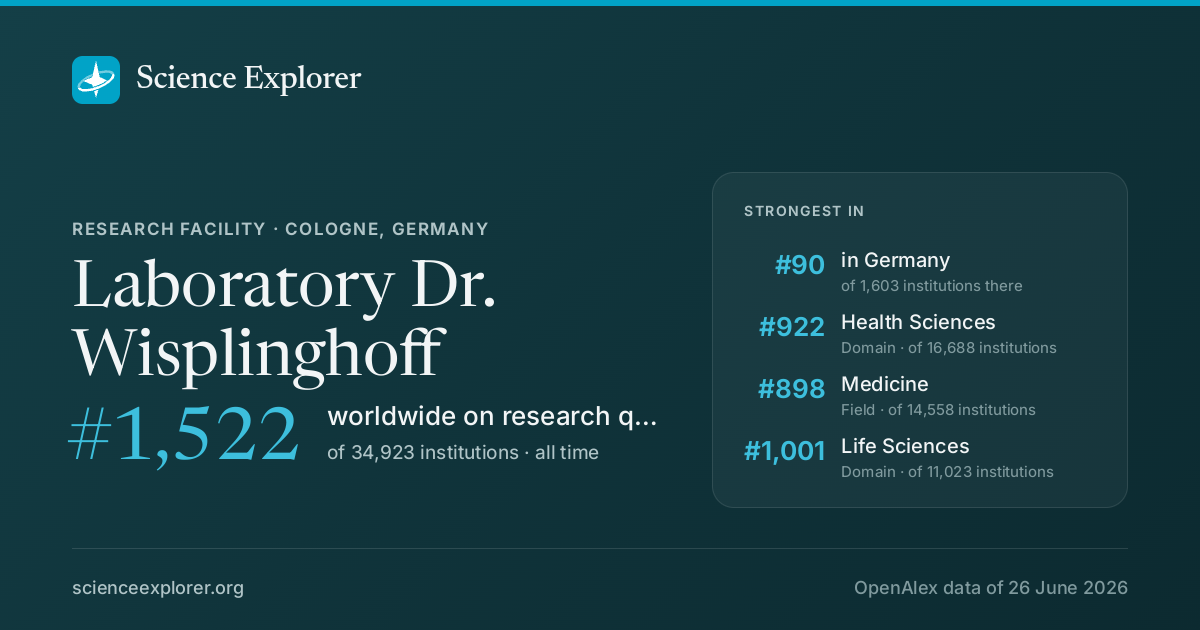
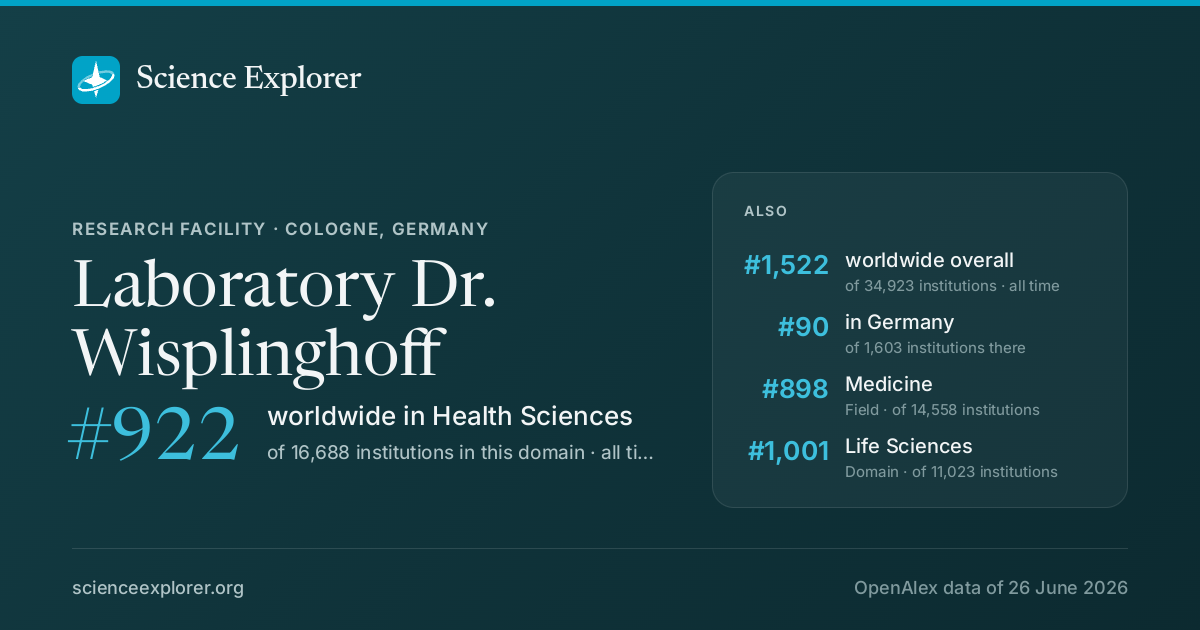
In research, Laboratory Dr. Wisplinghoff stands highest in Health Sciences (#922 of 16,688 worldwide), Medicine (#898 of 14,558 worldwide) and Life Sciences (#1,001 of 11,023 worldwide), over all time.
- World rank, all time
- #1,522 of 34,923
- Rank in Germany
- #90 of 1,603
- Research works
- 5.9k ▼ 100% vs 2018-21
- Citations
- 17k 2.8 per fractional work
- Top-10% rate
- 8.7% all institutions 10.0%
- vs its own fields
- 1.06× 1.00× is exactly expected
- Open access
- 12% world 40%
- International
- 5% world 18%
What is Laboratory Dr. Wisplinghoff known for in research?
The fields where it stands highest, over all time, ranked among every institution above the floor in each field.
| Field | World rank | Where that sits | Top-10% rate | Works |
|---|---|---|---|---|
| Health SciencesDomain | #922 of 16,688 | 1.0% | 2,739 | |
| MedicineField | #898 of 14,558 | 0.9% | 2,435 | |
| Life SciencesDomain | #1,001 of 11,023 | 0.7% | 1,719 | |
| Biochemistry, Genetics and Molecular BiologyField | #753 of 5,801 | 0.8% | 1,235 | |
| Physical SciencesDomain | #2,471 of 17,446 | 1.5% | 931 | |
| Molecular BiologySubfield | #824 of 3,729 | 1.0% | 525 | |
| Social SciencesDomain | #3,292 of 14,833 | 1.5% | 509 | |
| SurgerySubfield | #756 of 3,248 | 0.9% | 326 | |
| EngineeringField | #2,924 of 9,532 | 2.2% | 477 | |
| Immunology and MicrobiologyField | #584 of 1,587 | 0.6% | 282 |
Each strip is that field's whole ranked pool, with the notch where Laboratory Dr. Wisplinghoff sits in it, in the colour of the band that rank falls in. The track under the rate is the rate itself: it carries no average mark, because the average differs by field (from about 6% in Dentistry to 21% in Economics).
Which fields of science does Laboratory Dr. Wisplinghoff work in?
In all years, 46% of research at Laboratory Dr. Wisplinghoff is in Health Sciences, 29% in Life Sciences. Its largest fields are Medicine (41%), Biochemistry, Genetics and Molecular Biology (21%), Engineering (8%). It does 2.0× the world's share of Health Sciences.
Each ring splits the one inside it: the four domains of science, their fields, their subfields. Size is fractional works in all years. Every slice is a page; the interactive view zooms down to single topics and colours each by how much more of it this institution does than the world.
Its 4 domains and 26 fields, with their numbers
- Health Sciences2,73946.4%
- Medicine2,43541.3%
- Health Professions2374.0%
- Nursing601.0%
- Dentistry40.1%
- Veterinary40.1%
- Life Sciences1,71929.1%
- Physical Sciences93115.8%
- Engineering4778.1%
- Chemistry1933.3%
- Materials Science821.4%
- Computer Science520.9%
- Environmental Science470.8%
- Physics and Astronomy350.6%
- Mathematics210.4%
- Chemical Engineering130.2%
- Earth and Planetary Sciences80.1%
- Energy30.1%
- Social Sciences5098.6%
- Social Sciences2223.8%
- Arts and Humanities1342.3%
- Business, Management and Accounting571.0%
- Psychology510.9%
- Economics, Econometrics and Finance380.6%
- Decision Sciences80.1%
Field profile
Location quotient across every field it publishes in: outside the ring is more than an institution of this size would be expected to publish, inside it is less.
Rings at 0.5×, 1× and 2×. Widest outward: Dentistry, 4.1×. Every wedge is a field page.
All 15 fields, with their numbers
- Dentistry4.13×0 works
- Immunology and Microbiology3.57×0 works
- Medicine3.01×8 works
- Arts and Humanities2.50×1 works
- Agricultural and Biological Sciences1.52×1 works
- Biochemistry, Genetics and Molecular Biology1.42×1 works
- Mathematics0.95×0 works
- Health Professions0.95×0 works
- Environmental Science0.61×0 works
- Social Sciences0.41×1 works
- Business, Management and Accounting0.37×0 works
- Chemistry0.26×0 works
- Economics, Econometrics and Finance0.08×0 works
- Computer Science0.05×0 works
- Engineering0.04×0 works
- Dentistry 4.1×
- Immunology and Microbiology 3.6×
- Medicine 3.0×
- Arts and Humanities 2.5×
- Agricultural and Biological Sciences 1.5×
- Biochemistry, Genetics and Molecular Biology 1.4×
- Mathematics 0.9×
- Health Professions 0.9×
- Environmental Science 0.6×
- Social Sciences 0.4×
- Business, Management and Accounting 0.4×
- Chemistry 0.3×
- Economics, Econometrics and Finance 0.1×
- Computer Science 0.1×
- Engineering 0.0×
Who are the top researchers at Laboratory Dr. Wisplinghoff?
Ranked on the quality score, Axel M. Gressner, J Arnemann and Olav Axel Gressner lead among researchers whose main affiliation is Laboratory Dr. Wisplinghoff.
- 1
Axel M. Gressner
 Germany · #571,001 worldwide
27k citations · 2,282 works
- 2
J Arnemann
Germany · #753,987 worldwide
1.8k citations · 108 works
- 3
Olav Axel Gressner
Germany · #758,610 worldwide
3.4k citations · 849 works
- 4
Torsten Arndt
Germany · #1,213,078 worldwide
7.1k citations · 1,478 works
- 5
Torsten Arndt
Germany · #1,641,144 worldwide
1.8k citations · 214 works
- 6
Axel M. Gressner
Germany · #2,061,737 worldwide
1 citations · 74 works
- 7
Anne Kretzschmar
Germany · #2,129,184 worldwide
412 citations · 16 works
- 8
Axel M. Gressner
Germany · #2,280,016 worldwide
4 citations · 45 works
- 9
Axel M. Gressner
Germany · #2,544,061 worldwide
2 citations · 26 works
- 10
Axel M. Gressner
Germany · #2,604,859 worldwide
2 citations · 23 works
Which keywords describe research at Laboratory Dr. Wisplinghoff?
By fractional works in all years, weighted toward what it does more of than the world: Genetic Mutations, Vibration Analysis, Materials Science, Mathematical Modeling, Engineering, Thermal Management, Fluid Dynamics and Renewable Energy Integration.
- Autoimmune
- Carnitine
- Angiogenesis
- Healthcare Law
- Informed Consent
- End-of-Life Care
- Newborn Screening
- Tandem Mass Spectrometry
- Human Inborn Errors
- Autoantibodies
- Medical Gases
- Physiology
- Thermodynamics
- Metabolic Disorders
- Renewable Energy Integration
- Thermal Management
- Engineering
- Materials Science
- Cancer
- Genetic Mutations
- Inflammation
- Sustainability
- Vibration Analysis
- Mathematical Modeling
- Renewable Energy
- Fluid Dynamics
- Diagnosis
- Mitochondrial Function
- Chemistry
- Anaesthesia
- Immune Dysregulation
- Genetic Testing
- Primary Immunodeficiency
- Medical Ethics
- Telemedicine
- Patient Rights
- Physician Liability
- Reproductive Medicine
- Biochemical Genetics
- Bone Health
Size is fractional works in all years in the topics tagged with each word; colour is the word's share of this institution's work against its share of the world's. The 40 words are chosen for being large and distinctive. Each links to the topic it comes from most.
All 40 words, with their numbers
- Inflammation389▲ 2.8×72 topics
- Genetic Mutations273▲ 8.9×17 topics
- Sustainability271▲ 2.6×10 topics
- Cancer271▲ 3.3×47 topics
- Vibration Analysis262▲ 15×3 topics
- Materials Science262▲ 55×3 topics
- Mathematical Modeling261▲ 40×2 topics
- Engineering261▲ 46×2 topics
- Renewable Energy261▲ 4.4×3 topics
- Thermal Management260▲ 15×2 topics
- Fluid Dynamics260▲ 29×1 topic
- Renewable Energy Integration260▲ 17×1 topic
- Diagnosis217▲ 3.6×32 topics
- Metabolic Disorders200▲ 18×4 topics
- Mitochondrial Function159▲ 17×5 topics
- Thermodynamics154▲ 27×3 topics
- Chemistry154▲ 21×5 topics
- Physiology153▲ 49×3 topics
- Anaesthesia150▲ 130×1 topic
- Medical Gases150▲ 130×1 topic
- Immune Dysregulation148▲ 31×2 topics
- Autoantibodies145▲ 10×8 topics
- Genetic Testing143▲ 15×4 topics
- Human Inborn Errors142▲ 60×1 topic
- Primary Immunodeficiency142▲ 60×1 topic
- Tandem Mass Spectrometry142▲ 24×2 topics
- Medical Ethics140▲ 14×5 topics
- Newborn Screening138▲ 21×2 topics
- Telemedicine133▲ 21×2 topics
- End-of-Life Care131▲ 15×2 topics
- Patient Rights131▲ 23×2 topics
- Informed Consent130▲ 25×2 topics
- Physician Liability130▲ 38×2 topics
- Healthcare Law130▲ 88×1 topic
- Reproductive Medicine130▲ 88×1 topic
- Angiogenesis127▲ 5.2×14 topics
- Biochemical Genetics120▲ 26×1 topic
- Carnitine120▲ 26×1 topic
- Bone Health112▲ 17×4 topics
- Autoimmune103▲ 34×2 topics
Which research topics does Laboratory Dr. Wisplinghoff publish most on?
By volume in 2022-now: Agriculture and Farm Safety, Medical and Health Sciences Research, Art, Aesthetics, and Perception and Reproductive Health and Contraception.
Area is fractional works; colour is the subfield each topic belongs to.
- 1 Agriculture and Farm Safety Plant Science 1 works
- 2 Medical and Health Sciences Research Public Health, Environmental and Occupational Health 0 works
- 3 Art, Aesthetics, and Perception Visual Arts and Performing Arts 0 works
- 4 Reproductive Health and Contraception Public Health, Environmental and Occupational Health 0 works
- 5 Technology, Environment, Urban Planning Philosophy 0 works
- 6 Libraries and Information Services Museology 0 works
- 7 Pharmaceutical studies and practices Pediatrics, Perinatology and Child Health 0 works
- 8 Orthopedic Infections and Treatments Surgery 0 works
- 9 Gut microbiota and health Molecular Biology 0 works
- 10 Urinary Tract Infections Management Epidemiology 0 works
How open and international is its research?
Against the world's own shares: the tick on each track. Both are shares of its output, so they sit on one scale and can be read against each other as well as against the world.
World: 40% of research is openly available.
World: 18% is written across borders.
How has Laboratory Dr. Wisplinghoff's research output changed?
Output in 2022-2025 was 100% lower than in 2018-2021.
The same series as a ribbon: one cell per year, darker for more. The line above answers how much; this answers when.
Its share of all research
Growing output can still be a shrinking share: all of science grows. This is Laboratory Dr. Wisplinghoff as a percentage of every work published that year, 0.000059% in 2024.
Fractional works of Laboratory Dr. Wisplinghoff over all fractional works that year. How the balance of science has shifted.
Other research institutions in Cologne
- University of Cologne
- LVR-Klinik Köln
- German Sport University Cologne
- Klinik und Poliklinik für Neurologie
- TH Köln - University of Applied Sciences
- Klinik und Poliklinik für Nuklearmedizin
- Kliniken der Stadt Köln
- Klinik und Poliklinik für Psychosomatik und Psychotherapie


Share Laboratory Dr. Wisplinghoff's ranking


Research measures only: rankings here say nothing about teaching, admissions or student experience. Comparable institutions and collaboration partners have tabs of their own, above.
Discussion
Ask a question or share a note about Laboratory Dr. Wisplinghoff. Posts are plain text and can be reported.