Science Explorer Back to mapMap
Discussion
Company · Ismaning · Germany

LETI Pharma (Germany)

World rank, all time
#34,559
of 34,923
Rank in Germany
#1,595
of 1,603
Research works
136
▲ 84% vs 2018-21
Citations
2.1k
15.7 per fractional work
Top-10% rate
2.6%
all institutions 10.0%
vs its own fields
0.84×
1.00× is exactly expected
Open access
35%
world 40%
International
30%
world 18%

Which fields of science does LETI Pharma (Germany) work in?

In all years, 67% of research at LETI Pharma (Germany) is in Health Sciences, 23% in Life Sciences. Its largest fields are Medicine (65%), Biochemistry, Genetics and Molecular Biology (12%), Agricultural and Biological Sciences (6%). It does 2.7× the world's share of Health Sciences.

Health Sciences: 91 fractional works · 66.7% of its workMedicine: 88 fractional works · 65.1% of its workImmunology and Allergy: 35 fractional works · 25.7% of its workDermatology: 14 fractional works · 10.1% of its workPhysiology: 5 fractional works · 4.0% of its workPharmacology: 5 fractional works · 3.5% of its workCardiology and Cardiovascular Medicine: 4 fractional works · 3.1% of its workPublic Health, Environmental and Occupational Health: 4 fractional works · 3.0% of its workEpidemiology: 3 fractional works · 2.4% of its workHematology: 2 fractional works · 1.5% of its workPulmonary and Respiratory Medicine: 2 fractional works · 1.4% of its workRadiology, Nuclear Medicine and Imaging: 2 fractional works · 1.1% of its workGenetics: 1 fractional works · 1.0% of its workPediatrics, Perinatology and Child Health: 1 fractional works · 0.9% of its workEndocrinology, Diabetes and Metabolism: 1 fractional works · 0.9% of its workInfectious Diseases: 1 fractional works · 0.9% of its workPathology and Forensic Medicine: 1 fractional works · 0.8% of its workPsychiatry and Mental health: 1 fractional works · 0.7% of its workOncology: 1 fractional works · 0.7% of its workSurgery: 1 fractional works · 0.5% of its workNephrology: 1 fractional works · 0.5% of its workOtorhinolaryngology: 1 fractional works · 0.4% of its workComplementary and alternative medicine: 0 fractional works · 0.3% of its workEmergency Medicine: 0 fractional works · 0.3% of its workRheumatology: 0 fractional works · 0.3% of its workHepatology: 0 fractional works · 0.3% of its workReproductive Medicine: 0 fractional works · 0.2% of its workSmaller subfields together: 1 fractional works · 0.4% of its workVeterinary: 1 fractional works · 0.6% of its workSmall Animals: 1 fractional works · 0.6% of its workNursing: 1 fractional works · 0.5% of its workNutrition and Dietetics: 1 fractional works · 0.5% of its workHealth Professions: 1 fractional works · 0.4% of its workEmergency Medical Services: 0 fractional works · 0.4% of its workSmaller subfields together: 0 fractional works · 0.1% of its workLife Sciences: 31 fractional works · 23.2% of its workBiochemistry, Genetics and Molecular Biology: 16 fractional works · 11.8% of its workMolecular Biology: 10 fractional works · 7.4% of its workBiotechnology: 2 fractional works · 1.6% of its workBiochemistry: 1 fractional works · 0.9% of its workCell Biology: 1 fractional works · 0.6% of its workCancer Research: 1 fractional works · 0.6% of its workGenetics: 1 fractional works · 0.4% of its workClinical Biochemistry: 0 fractional works · 0.3% of its workAgricultural and Biological Sciences: 8 fractional works · 5.9% of its workInsect Science: 2 fractional works · 1.8% of its workPlant Science: 2 fractional works · 1.8% of its workEcology, Evolution, Behavior and Systematics: 2 fractional works · 1.5% of its workFood Science: 1 fractional works · 0.6% of its workAnimal Science and Zoology: 0 fractional works · 0.2% of its workSmaller subfields together: 0 fractional works · 0.0% of its workImmunology and Microbiology: 3 fractional works · 2.5% of its workImmunology: 3 fractional works · 2.1% of its workParasitology: 0 fractional works · 0.3% of its workSmaller subfields together: 0 fractional works · 0.1% of its workNeuroscience: 2 fractional works · 1.8% of its workNeurology: 1 fractional works · 1.0% of its workCellular and Molecular Neuroscience: 1 fractional works · 0.6% of its workSmaller subfields together: 0 fractional works · 0.2% of its workPharmacology, Toxicology and Pharmaceutics: 2 fractional works · 1.1% of its workPharmaceutical Science: 1 fractional works · 0.7% of its workPharmacology: 1 fractional works · 0.4% of its workPhysical Sciences: 13 fractional works · 9.5% of its workChemistry: 7 fractional works · 5.5% of its workOrganic Chemistry: 6 fractional works · 4.5% of its workAnalytical Chemistry: 1 fractional works · 0.7% of its workSpectroscopy: 0 fractional works · 0.2% of its workEnvironmental Science: 2 fractional works · 1.4% of its workHealth, Toxicology and Mutagenesis: 2 fractional works · 1.2% of its workSmaller subfields together: 0 fractional works · 0.2% of its workEngineering: 2 fractional works · 1.3% of its workMechanical Engineering: 2 fractional works · 1.2% of its workSmaller subfields together: 0 fractional works · 0.1% of its workMaterials Science: 1 fractional works · 0.7% of its workBiomaterials: 0 fractional works · 0.4% of its workMaterials Chemistry: 0 fractional works · 0.2% of its workSmaller subfields together: 0 fractional works · 0.1% of its workComputer Science: 1 fractional works · 0.6% of its workComputational Theory and Mathematics: 0 fractional works · 0.4% of its workInformation Systems: 0 fractional works · 0.2% of its workSocial Sciences: 1 fractional works · 0.6% of its workSocial Sciences: 0 fractional works · 0.4% of its workArts and Humanities: 0 fractional works · 0.1% of its workBusiness, Management and Accounting: 0 fractional works · 0.1% of its workALL ITS WORKLETI Pharma(Germany)136fractional works, all years
Life Sciences23%Physical Sciences10%Health Sciences67%Social Sciences1%

Each ring splits the one inside it: the four domains of science, their fields, their subfields. Size is fractional works in all years. Every slice is a page; the interactive view zooms down to single topics and colours each by how much more of it this institution does than the world.

Its 4 domains and 17 fields, with their numbers
    1. Medicine8865.1%
    2. Veterinary10.6%
    3. Nursing10.5%
    4. Health Professions10.4%
    1. Biochemistry, Genetics and Molecular Biology1611.8%
    2. Agricultural and Biological Sciences85.9%
    3. Immunology and Microbiology32.5%
    4. Neuroscience21.8%
    5. Pharmacology, Toxicology and Pharmaceutics21.1%
    1. Chemistry75.5%
    2. Environmental Science21.4%
    3. Engineering21.3%
    4. Materials Science10.7%
    5. Computer Science10.6%
    1. Social Sciences00.4%
    2. Arts and Humanities00.1%
    3. Business, Management and Accounting00.1%
All of science, and how each field's share has moved since 1950: the Science domain explorer

Field profile

Location quotient across every field it publishes in: outside the ring is more than an institution of this size would be expected to publish, inside it is less.

Agricultural and Biological Sciences: 2.17× its world share, 2 worksAgricultural and Bio…Biochemistry, Genetics and Molecular Biology: 1.75× its world share, 2 worksBiochemistry, Geneti…Immunology and Microbiology: 0.46× its world share, 0 worksImmunology and Micro…Computer Science: 0.24× its world share, 0 worksComputer ScienceEngineering: 0.31× its world share, 1 worksEngineeringHealth Professions: 0.68× its world share, 0 worksHealth ProfessionsMedicine: 3.67× its world share, 13 worksMedicineNursing: 1.91× its world share, 0 worksNursing1×world share
more than its size predictsabout as predictedless

Rings at 0.5×, 1× and 2×. Widest outward: Medicine, 3.7×. Every wedge is a field page.

All 8 fields, with their numbers
  1. Medicine3.67×13 works
  2. Agricultural and Biological Sciences2.17×2 works
  3. Nursing1.91×0 works
  4. Biochemistry, Genetics and Molecular Biology1.75×2 works
  5. Health Professions0.68×0 works
  6. Immunology and Microbiology0.46×0 works
  7. Engineering0.31×1 works
  8. Computer Science0.24×0 works

Who are the top researchers at LETI Pharma (Germany)?

Ranked on the quality score, Raquel Moya, Angelika Sager and AVINAASH RAJA SAGER lead among researchers whose main affiliation is LETI Pharma (Germany).

  1. 1 Raquel Moya Germany · #3,216,829 worldwide 924 citations · 42 works
  2. 2 Angelika Sager Germany · #3,962,024 worldwide 381 citations · 29 works
  3. 3 AVINAASH RAJA SAGER Germany · #4,292,740 worldwide 328 citations · 15 works
  4. 4 María Angeles López-Matas Germany · #6,734,586 worldwide 1.1k citations · 76 works
  5. 5 Victor Miguel Iraola Germany · #6,991,007 worldwide 855 citations · 85 works
  6. 6 Jerónimo Carnés Germany · #7,344,342 worldwide 2.5k citations · 204 works
All ranked researchers at LETI Pharma (Germany)

What are the most cited papers from LETI Pharma (Germany)?

The most cited paper from LETI Pharma (Germany) is "Prevalencia de osteoporosis determinada por densitometría en la población femenina española" (Díaz Curiel M, Javier Garcia, José Luís Carrasco et al., 2001), with 169 citations. Next come "Efficacy and safety of subcutaneous allergen-specific immunotherapy with depigmented polymerized mite extract in atopic dermatitis" (115) and "Clinical improvement and immunological changes in atopic dermatitis patients undergoing subcutaneous immunotherapy with a house dust mite allergoid: a pilot study" (106).

Most cited papers
#PaperReleasedCitations
1 Prevalencia de osteoporosis determinada por densitometría en la población femenina española Díaz Curiel M, Javier Garcia, José Luís Carrasco et al. · Medicina Clínica 2001 169
2 Efficacy and safety of subcutaneous allergen-specific immunotherapy with depigmented polymerized mite extract in atopic dermatitis Natalija Novak, Thomas R.M. Bieber, Matthias Hoffmann et al. · Journal of Allergy and Clinical Immunology Open access Sep 2012 115
3 Clinical improvement and immunological changes in atopic dermatitis patients undergoing subcutaneous immunotherapy with a house dust mite allergoid: a pilot study Caroline Bußmann, Laura Maintz, Juana Hart et al. · Clinical & Experimental Allergy 25 Jul 2007 106
4 Successful management of mite-allergic asthma with modified extracts of Dermatophagoides pteronyssinus and Dermatophagoides farinae in a double-blind, placebo-controlled study J C García-Robaina, I SANCHEZ, Fernando de la Torre et al. · Journal of Allergy and Clinical Immunology 19 Sep 2006 102
5 Sublingual immunotherapy with a standardized cat dander extract: evaluation of efficacy in a double blind placebo controlled study E. Álvarez‐Cuesta, Pilar Berges-Gimeno, Eloína González Mancebo et al. · Allergy 15 Jun 2007 79
All 61 most cited papers, with filters and sorting

Which keywords describe research at LETI Pharma (Germany)?

By fractional works in all years, weighted toward what it does more of than the world: Epidemiology, Asthma, Quality of Life, Climate Change, Allergen-specific Immunotherapy, Pollen Allergy, Diagnosis and Management.

▲ more of its work than of the world's◆ about the world's share▼ less than the world's

Size is fractional works in all years in the topics tagged with each word; colour is the word's share of this institution's work against its share of the world's. The 40 words are chosen for being large and distinctive. Each links to the topic it comes from most.

All 40 words, with their numbers
  1. Epidemiology57▲ 11×27 topics
  2. Asthma28▲ 165×2 topics
  3. Climate Change25▲ 7.0×5 topics
  4. Quality of Life25▲ 14×6 topics
  5. Allergen-specific Immunotherapy23▲ 429×1 topic
  6. Pollen Allergy23▲ 429×1 topic
  7. Diagnosis15▲ 11×10 topics
  8. Inflammation12▲ 3.9×19 topics
  9. Management12▲ 11×5 topics
  10. Children11▲ 33×2 topics
  11. Anaphylaxis11▲ 299×1 topic
  12. Food Allergy11▲ 299×1 topic
  13. Risk Assessment10▲ 12×3 topics
  14. Contact Allergy9▲ 231×1 topic
  15. Skin Sensitization9▲ 231×1 topic
  16. Treatment7▲ 3.9×8 topics
  17. Genetics5▲ 5.1×2 topics
  18. Allergic Diseases5▲ 47×1 topic
  19. Eosinophils5▲ 47×1 topic
  20. Immune Dysregulation5▲ 42×2 topics
  21. Staphylococcus aureus4▲ 43×2 topics
  22. Filaggrin4▲ 74×1 topic
  23. Skin Microbiome4▲ 74×1 topic
  24. Cardiovascular Disease4▲ 2.3×12 topics
  25. Drug Discovery3▲ 5.8×4 topics
  26. Clinical Trials3▲ 3.5×6 topics
  27. Hypertension3▲ 6.2×4 topics
  28. Endophytic Fungi2▲ 17×2 topics
  29. Mycobacterium tuberculosis2▲ 28×2 topics
  30. Pharmacology2▲ 5.7×6 topics
  31. Secondary Metabolites2▲ 18×3 topics
  32. Industrial Applications2▲ 10×2 topics
  33. Marine Natural Products2▲ 30×2 topics
  34. Microbial Transformation2▲ 72×1 topic
  35. Steroid Degradation2▲ 143×1 topic
  36. Natural Products2▲ 8.9×2 topics
  37. Antibiotics2▲ 19×1 topic
  38. Microbial Metabolites2▲ 35×1 topic
  39. Dry Eye Disease2▲ 41×1 topic
  40. Ocular Surface2▲ 41×1 topic

Which research topics does LETI Pharma (Germany) publish most on?

By volume in 2022-now: Allergic Rhinitis and Sensitization, Food Allergy and Anaphylaxis Research, Asthma and respiratory diseases and Dermatology and Skin Diseases.

  1. 1 Allergic Rhinitis and Sensitization Immunology and Allergy 5 works
  2. 2 Food Allergy and Anaphylaxis Research Immunology and Allergy 2 works
  3. 3 Asthma and respiratory diseases Physiology 1 works
  4. 4 Dermatology and Skin Diseases Dermatology 1 works
  5. 5 Ocular Surface and Contact Lens Public Health, Environmental and Occupational Health 1 works
  6. 6 Contact Dermatitis and Allergies Dermatology 1 works
  7. 7 Research on Leishmaniasis Studies Public Health, Environmental and Occupational Health 0 works
  8. 8 Mycotoxins in Agriculture and Food Plant Science 0 works
  9. 9 Insect and Arachnid Ecology and Behavior Genetics 0 works
  10. 10 Carbon Dioxide Capture Technologies Mechanical Engineering 0 works

How open and international is its research?

Against the world's own shares: the tick on each track. Both are shares of its output, so they sit on one scale and can be read against each other as well as against the world.

openly available35.0%not open65.0%

World: 40% of research is openly available.

with international co-authors30.5%domestic only69.5%

World: 18% is written across borders.

How has LETI Pharma (Germany)'s research output changed?

Output in 2022-2025 was 84% higher than in 2018-2021.

still counting1990200020102020
grewheldshrank

The same series as a ribbon: one cell per year, darker for more. The line above answers how much; this answers when.

Its share of all research

Growing output can still be a shrinking share: all of science grows. This is LETI Pharma (Germany) as a percentage of every work published that year, 0.000063% in 2024.

still counting0.00050%0.0010%LETI Pharma (Germany)0.000064% in 202519801990200020102020

Fractional works of LETI Pharma (Germany) over all fractional works that year. How the balance of science has shifted.

Other research institutions in Ismaning

All research institutions in Ismaning

Share LETI Pharma (Germany)'s ranking
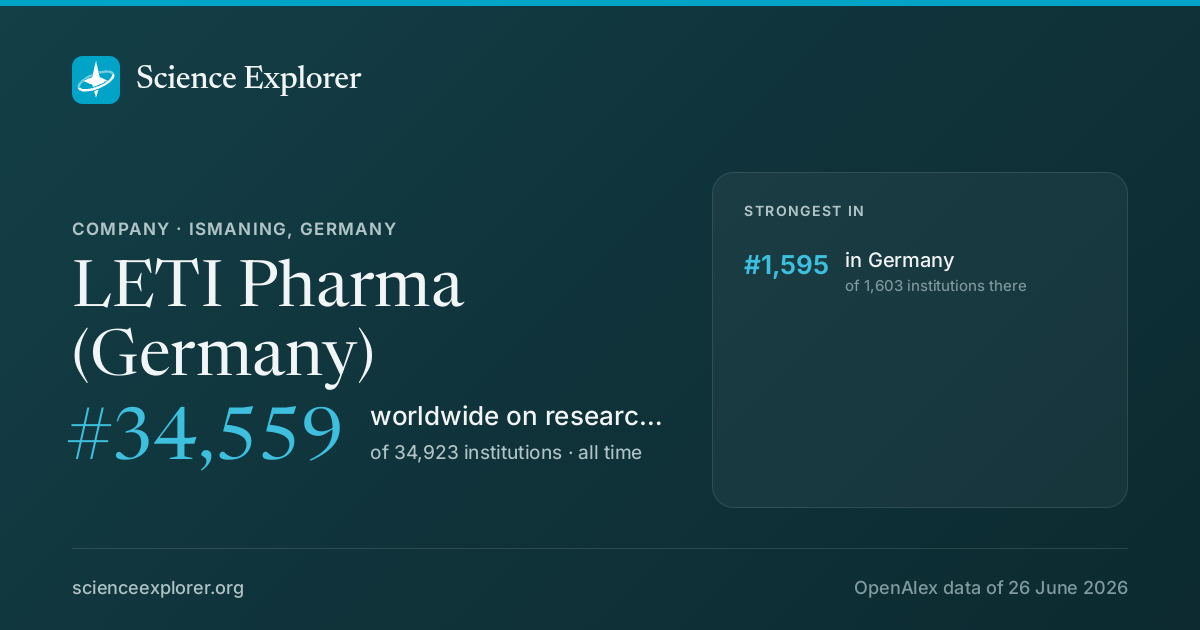
LETI Pharma (Germany) on Science Explorer

A card with LETI Pharma (Germany)'s standing and the fields it leads in, for a post or a slide. A link to this page previews as the same card.

Download the card

1200 × 630 PNG, sized for social posts, drawn from the latest snapshot.

Badges for a website1Each links back here and updates with every snapshot

Research measures only: rankings here say nothing about teaching, admissions or student experience. Comparable institutions and collaboration partners have tabs of their own, above.

Discussion

Ask a question or share a note about LETI Pharma (Germany). Keep it to the research: no personal attacks, advertising or links. Any reader can report a post, which collapses it for everyone until it is opened.
