Science Explorer Back to mapMap
Discussion

M Corp (United States)

In research, M Corp (United States) stands highest in Physical Sciences (#13,341 of 17,446 worldwide), over all time.

World rank, all time
#32,381
of 34,923
Rank in United States
#6,808
of 7,310
Research works
163
▼ 53% vs 2018-21
Citations
1.5k
9.0 per fractional work
Top-10% rate
6.0%
all institutions 10.0%
vs its own fields
0.87×
1.00× is exactly expected
Open access
8%
world 40%
International
2%
world 18%

What is M Corp (United States) known for in research?

The fields where it stands highest, over all time, ranked among every institution above the floor in each field.

FieldWorld rankWhere that sitsTop-10% rateWorks
Physical SciencesDomain #13,341 of 17,446 3.8%141

Each strip is that field's whole ranked pool, with the notch where M Corp (United States) sits in it, in the colour of the band that rank falls in. The track under the rate is the rate itself: it carries no average mark, because the average differs by field (from about 6% in Dentistry to 21% in Economics).

Which fields of science does M Corp (United States) work in?

In all years, 86% of research at M Corp (United States) is in Physical Sciences, 9% in Social Sciences. Its largest fields are Engineering (46%), Computer Science (21%), Physics and Astronomy (9%). It does 2.1× the world's share of Physical Sciences.

Physical Sciences: 141 fractional works · 86.3% of its workEngineering: 75 fractional works · 46.2% of its workElectrical and Electronic Engineering: 32 fractional works · 19.6% of its workAerospace Engineering: 7 fractional works · 4.6% of its workControl and Systems Engineering: 6 fractional works · 3.9% of its workIndustrial and Manufacturing Engineering: 6 fractional works · 3.8% of its workMechanical Engineering: 6 fractional works · 3.7% of its workMechanics of Materials: 5 fractional works · 2.8% of its workComputational Mechanics: 4 fractional works · 2.5% of its workCivil and Structural Engineering: 2 fractional works · 1.5% of its workBiomedical Engineering: 2 fractional works · 1.5% of its workMedia Technology: 1 fractional works · 0.7% of its workSafety, Risk, Reliability and Quality: 1 fractional works · 0.7% of its workOcean Engineering: 1 fractional works · 0.5% of its workArchitecture: 0 fractional works · 0.2% of its workComputer Science: 34 fractional works · 20.8% of its workArtificial Intelligence: 8 fractional works · 4.7% of its workComputer Networks and Communications: 7 fractional works · 4.5% of its workHardware and Architecture: 4 fractional works · 2.8% of its workComputational Theory and Mathematics: 4 fractional works · 2.6% of its workComputer Vision and Pattern Recognition: 4 fractional works · 2.1% of its workInformation Systems: 3 fractional works · 1.8% of its workSignal Processing: 2 fractional works · 1.2% of its workComputer Graphics and Computer-Aided Design: 1 fractional works · 0.5% of its workHuman-Computer Interaction: 0 fractional works · 0.3% of its workSoftware: 0 fractional works · 0.2% of its workPhysics and Astronomy: 15 fractional works · 9.4% of its workAtomic and Molecular Physics, and Optics: 8 fractional works · 4.6% of its workAstronomy and Astrophysics: 5 fractional works · 2.9% of its workInstrumentation: 1 fractional works · 0.8% of its workStatistical and Nonlinear Physics: 1 fractional works · 0.5% of its workNuclear and High Energy Physics: 1 fractional works · 0.4% of its workRadiation: 1 fractional works · 0.3% of its workMaterials Science: 7 fractional works · 4.5% of its workMaterials Chemistry: 2 fractional works · 1.4% of its workCeramics and Composites: 2 fractional works · 1.1% of its workElectronic, Optical and Magnetic Materials: 2 fractional works · 0.9% of its workSurfaces, Coatings and Films: 1 fractional works · 0.8% of its workSmaller subfields together: 0 fractional works · 0.3% of its workEarth and Planetary Sciences: 4 fractional works · 2.2% of its workAtmospheric Science: 1 fractional works · 0.9% of its workOceanography: 1 fractional works · 0.7% of its workEarth-Surface Processes: 0 fractional works · 0.2% of its workGeochemistry and Petrology: 0 fractional works · 0.2% of its workSmaller subfields together: 0 fractional works · 0.3% of its workEnvironmental Science: 2 fractional works · 1.3% of its workGlobal and Planetary Change: 2 fractional works · 1.0% of its workWater Science and Technology: 0 fractional works · 0.2% of its workSmaller subfields together: 0 fractional works · 0.2% of its workMathematics: 1 fractional works · 0.8% of its workApplied Mathematics: 0 fractional works · 0.3% of its workStatistics and Probability: 0 fractional works · 0.2% of its workSmaller subfields together: 0 fractional works · 0.3% of its workEnergy: 1 fractional works · 0.5% of its workRenewable Energy, Sustainability and the Environment: 1 fractional works · 0.5% of its workChemistry: 1 fractional works · 0.4% of its workOrganic Chemistry: 0 fractional works · 0.2% of its workSmaller subfields together: 0 fractional works · 0.2% of its workChemical Engineering: 0 fractional works · 0.1% of its workSocial Sciences: 15 fractional works · 9.0% of its workPsychology: 4 fractional works · 2.3% of its workSocial Psychology: 2 fractional works · 1.4% of its workExperimental and Cognitive Psychology: 1 fractional works · 0.6% of its workSmaller subfields together: 0 fractional works · 0.3% of its workDecision Sciences: 4 fractional works · 2.3% of its workStatistics, Probability and Uncertainty: 2 fractional works · 1.4% of its workManagement Science and Operations Research: 1 fractional works · 0.8% of its workSmaller subfields together: 0 fractional works · 0.1% of its workSocial Sciences: 3 fractional works · 2.1% of its workPolitical Science and International Relations: 1 fractional works · 0.8% of its workSociology and Political Science: 1 fractional works · 0.8% of its workDevelopment: 1 fractional works · 0.4% of its workSmaller subfields together: 0 fractional works · 0.1% of its workBusiness, Management and Accounting: 2 fractional works · 1.3% of its workManagement Information Systems: 2 fractional works · 0.9% of its workStrategy and Management: 0 fractional works · 0.2% of its workSmaller subfields together: 0 fractional works · 0.2% of its workEconomics, Econometrics and Finance: 1 fractional works · 0.8% of its workEconomics and Econometrics: 1 fractional works · 0.8% of its workArts and Humanities: 0 fractional works · 0.2% of its workVisual Arts and Performing Arts: 0 fractional works · 0.2% of its workHealth Sciences: 4 fractional works · 2.7% of its workHealth Professions: 2 fractional works · 1.4% of its workHealth Information Management: 1 fractional works · 0.6% of its workRadiological and Ultrasound Technology: 1 fractional works · 0.5% of its workMedical Laboratory Technology: 0 fractional works · 0.3% of its workMedicine: 2 fractional works · 1.3% of its workOphthalmology: 1 fractional works · 0.4% of its workPulmonary and Respiratory Medicine: 1 fractional works · 0.4% of its workRadiology, Nuclear Medicine and Imaging: 0 fractional works · 0.2% of its workPublic Health, Environmental and Occupational Health: 0 fractional works · 0.2% of its workSmaller subfields together: 0 fractional works · 0.2% of its workLife Sciences: 3 fractional works · 1.9% of its workBiochemistry, Genetics and Molecular Biology: 2 fractional works · 1.1% of its workMolecular Biology: 1 fractional works · 0.8% of its workSmaller subfields together: 0 fractional works · 0.3% of its workNeuroscience: 1 fractional works · 0.4% of its workCognitive Neuroscience: 1 fractional works · 0.4% of its workAgricultural and Biological Sciences: 0 fractional works · 0.2% of its workAgronomy and Crop Science: 0 fractional works · 0.2% of its workImmunology and Microbiology: 0 fractional works · 0.2% of its workMicrobiology: 0 fractional works · 0.2% of its workALL ITS WORKM Corp (UnitedStates)163fractional works, all years
Life Sciences2%Physical Sciences86%Health Sciences3%Social Sciences9%

Each ring splits the one inside it: the four domains of science, their fields, their subfields. Size is fractional works in all years. Every slice is a page; the interactive view zooms down to single topics and colours each by how much more of it this institution does than the world.

Its 4 domains and 22 fields, with their numbers
    1. Engineering7546.2%
    2. Computer Science3420.8%
    3. Physics and Astronomy159.4%
    4. Materials Science74.5%
    5. Earth and Planetary Sciences42.2%
    6. Environmental Science21.3%
    7. Mathematics10.8%
    8. Energy10.5%
    9. Chemistry10.4%
    10. Chemical Engineering00.1%
    1. Psychology42.3%
    2. Decision Sciences42.3%
    3. Social Sciences32.1%
    4. Business, Management and Accounting21.3%
    5. Economics, Econometrics and Finance10.8%
    6. Arts and Humanities00.2%
    1. Health Professions21.4%
    2. Medicine21.3%
    1. Biochemistry, Genetics and Molecular Biology21.1%
    2. Neuroscience10.4%
    3. Agricultural and Biological Sciences00.2%
    4. Immunology and Microbiology00.2%
All of science, and how each field's share has moved since 1950: the Science domain explorer

Field profile

Location quotient across every field it publishes in: outside the ring is more than an institution of this size would be expected to publish, inside it is less.

Who are the top researchers at M Corp (United States)?

Ranked on the quality score, K. W. Bills and Joseph S. Hofstra lead among researchers whose main affiliation is M Corp (United States).

  1. 1 K. W. Bills United States · #4,005,302 worldwide 225 citations · 27 works
  2. 2 Joseph S. Hofstra United States · #5,533,988 worldwide 222 citations · 55 works
All ranked researchers at M Corp (United States)

What are the most cited papers from M Corp (United States)?

The most cited paper from M Corp (United States) is "A Model of Marine Aerosol Generation Via Whitecaps and Wave Disruption" (Edward C. Monahan, Donald E. Spiel, K. L. Davidson, 1986), with 965 citations. Next come "Analysis of Covariance Structures" (328) and "Observed inter‐relations between 10m winds, ocean whitecaps and marine aerosols" (217).

Most cited papers
#PaperReleasedCitations
1 A Model of Marine Aerosol Generation Via Whitecaps and Wave Disruption Edward C. Monahan, Donald E. Spiel, K. L. Davidson · Oceanographic sciences library Book chapter 1986 965
2 Analysis of Covariance Structures R. Darrell Bock, Rolf E. Bargmann · Psychometrika Dec 1966 328
3 Observed inter‐relations between 10m winds, ocean whitecaps and marine aerosols Edward C. Monahan, C. W. Fairall, K. L. Davidson et al. · Quarterly Journal of the Royal Meteorological Society Apr 1983 217
4 Robustness of the linear and quadratic discriminant function to certain types of non‐normality Peter A. Lachenbruch, Cheryl Sneeringer, Lawrence T. Revo · Communications in Statistics 1973 189
5 Martensite lattice changes during tempering P. C. Chen, P. G. Winchell · Metallurgical Transactions A Aug 1980 78
All 59 most cited papers, with filters and sorting

Which keywords describe research at M Corp (United States)?

By fractional works in all years, weighted toward what it does more of than the world: Semiconductor Lasers, Integrated Circuits, Optical Interconnects, Vertical-Cavity Surface-Emitting Lasers (VCSELs), Frequency Conversion, Optical Modulators, Parallel Computing and Machine Vision.

▲ more of its work than of the world's◆ about the world's share▼ less than the world's

Size is fractional works in all years in the topics tagged with each word; colour is the word's share of this institution's work against its share of the world's. The 40 words are chosen for being large and distinctive. Each links to the topic it comes from most.

All 40 words, with their numbers
  1. Semiconductor Lasers8▲ 49×2 topics
  2. Deep Learning6▲ 1.89×8 topics
  3. Integrated Circuits6▲ 16×2 topics
  4. Machine Learning6▲ 1.70×9 topics
  5. Neural Networks6▲ 3.5×8 topics
  6. Optical Interconnects6▲ 44×1 topic
  7. Vertical-Cavity Surface-Emitting Lasers (VCSELs)6▲ 44×1 topic
  8. Frequency Conversion5▲ 29×3 topics
  9. Machine Vision5▲ 15×3 topics
  10. Optical Modulators5▲ 14×2 topics
  11. Parallel Computing5▲ 16×3 topics
  12. Fault Localization4▲ 29×2 topics
  13. High-Performance Computing4▲ 16×2 topics
  14. Artificial Neural Networks4▲ 5.5×3 topics
  15. Raman Lasers4▲ 13×2 topics
  16. Distributed Systems3▲ 8.4×5 topics
  17. Silicon Photonics3▲ 13×2 topics
  18. Simulation3▲ 6.2×5 topics
  19. Failure Analysis3▲ 14×1 topic
  20. Image Processing3▲ 5.7×4 topics
  21. Photon Emission Microscopy3▲ 37×1 topic
  22. Microcavities3▲ 12×1 topic
  23. Nanophotonic Waveguides3▲ 13×1 topic
  24. Nonlinear Dynamics3▲ 6.9×2 topics
  25. CMOS Technology3▲ 14×3 topics
  26. Genetic Algorithms3▲ 11×5 topics
  27. Nanofabrication3▲ 18×2 topics
  28. Texture Analysis3▲ 11×2 topics
  29. Air Quality2▲ 8.2×3 topics
  30. GPU Computing2▲ 22×1 topic
  31. Performance Optimization2▲ 15×1 topic
  32. Electric Discharge2▲ 41×1 topic
  33. Fabric Defect Detection2▲ 34×1 topic
  34. High-Resolution Patterning2▲ 38×2 topics
  35. Laser Oscillation2▲ 41×1 topic
  36. Semiconductor Manufacturing2▲ 34×1 topic
  37. Electron Beam Lithography2▲ 69×1 topic
  38. Microresonators2▲ 11×3 topics
  39. Nonlinear Optics2▲ 8.2×3 topics
  40. Resolution Limits2▲ 69×1 topic

Which research topics does M Corp (United States) publish most on?

By volume in 2022-now: Electrocatalysts for Energy Conversion, Manufacturing Process and Optimization, Fuel Cells and Related Materials and Advanced Surface Polishing Techniques.

Electrocatalysts for Energy Conversion: 0 fractional worksManufacturing Process and Optimization: 0 fractional worksFuel Cells and Related Materials: 0 fractional worksAdvanced Surface Polishing Techniques: 0 fractional worksMetal Forming Simulation Techniques: 0 fractional works
Renewable Energy, Sustainability and the EnvironmentIndustrial and Manufacturing EngineeringElectrical and Electronic EngineeringBiomedical Engineering1 others

Area is fractional works; colour is the subfield each topic belongs to.

  1. 1 Electrocatalysts for Energy Conversion Renewable Energy, Sustainability and the Environment 0 works
  2. 2 Manufacturing Process and Optimization Industrial and Manufacturing Engineering 0 works
  3. 3 Fuel Cells and Related Materials Electrical and Electronic Engineering 0 works
  4. 4 Advanced Surface Polishing Techniques Biomedical Engineering 0 works
  5. 5 Metal Forming Simulation Techniques Mechanical Engineering 0 works

How open and international is its research?

Against the world's own shares: the tick on each track. Both are shares of its output, so they sit on one scale and can be read against each other as well as against the world.

openly available7.5%not open92.5%

World: 40% of research is openly available.

with international co-authors1.6%domestic only98.4%

World: 18% is written across borders.

How has M Corp (United States)'s research output changed?

Output in 2022-2025 was 53% lower than in 2018-2021.

1990200020102020
grewheldshrank

The same series as a ribbon: one cell per year, darker for more. The line above answers how much; this answers when.

Its share of all research

Growing output can still be a shrinking share: all of science grows. This is M Corp (United States) as a percentage of every work published that year, 0.0000061% in 2023.

0.0020%0.0040%0.0060%M Corp (United States)0.0000090% in 202419801990200020102020

Fractional works of M Corp (United States) over all fractional works that year. How the balance of science has shifted.

Other research institutions in Sacramento

All research institutions in Sacramento

Share M Corp (United States)'s ranking
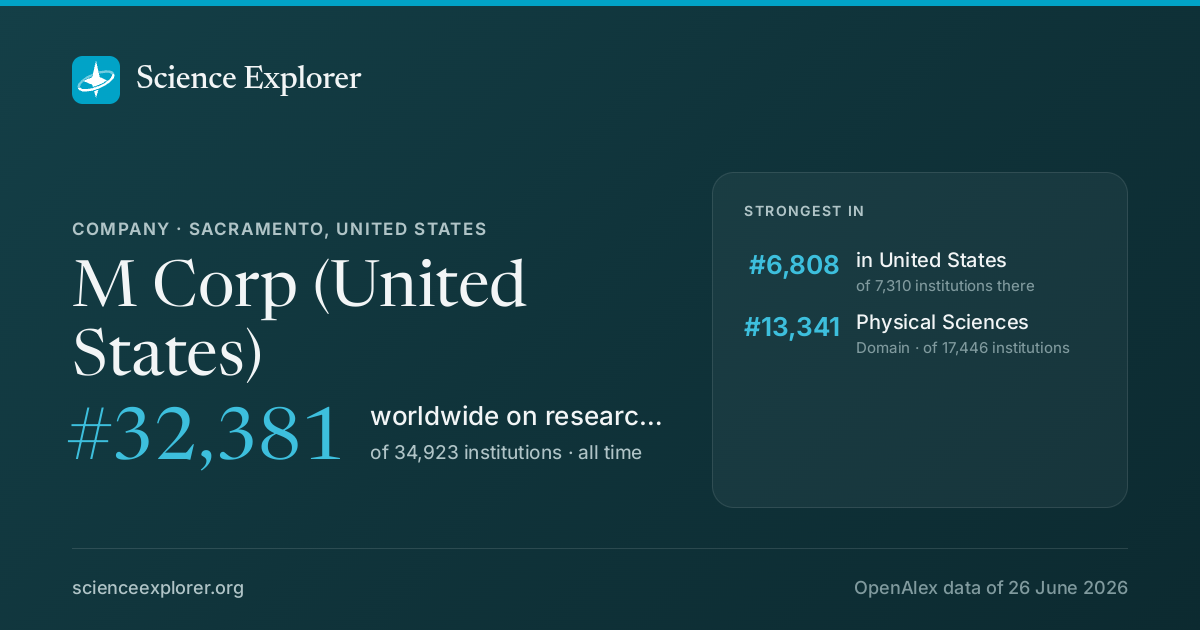
M Corp (United States) on Science Explorer

A card with M Corp (United States)'s standing and the fields it leads in, for a post or a slide. A link to this page previews as the same card.

Download the card

1200 × 630 PNG, sized for social posts, drawn from the latest snapshot.

Badges for a website1Each links back here and updates with every snapshot

Research measures only: rankings here say nothing about teaching, admissions or student experience. Comparable institutions and collaboration partners have tabs of their own, above.

Discussion

Ask a question or share a note about M Corp (United States). Keep it to the research: no personal attacks, advertising or links. Any reader can report a post, which collapses it for everyone until it is opened.
