Mech-Sense
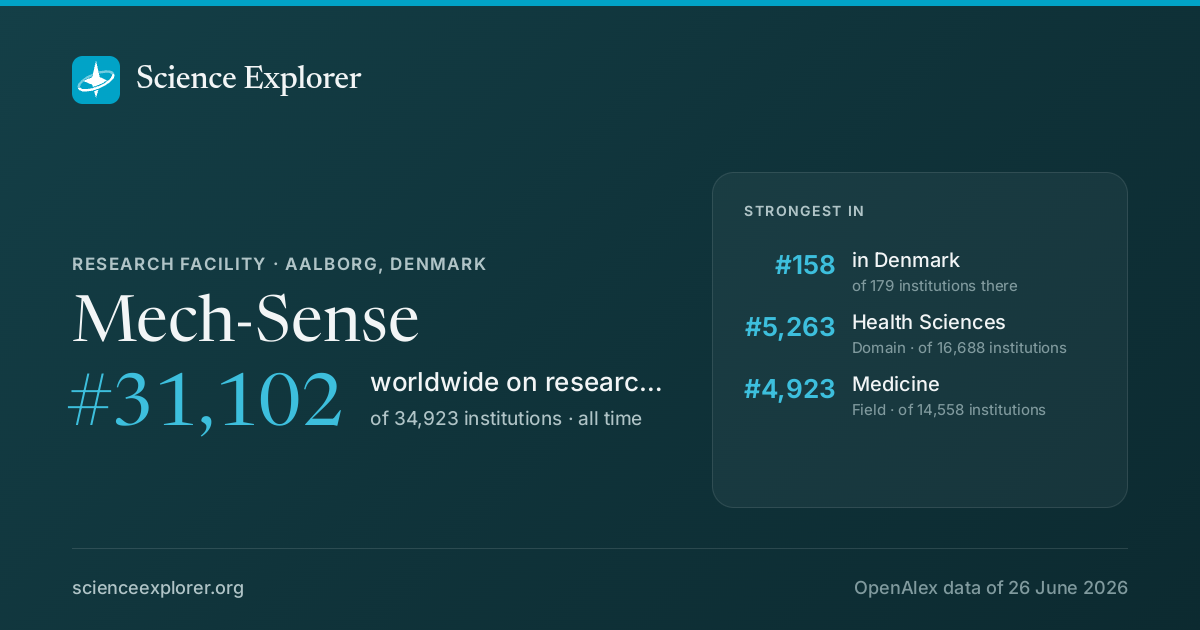
In research, Mech-Sense stands highest in Health Sciences (#5,263 of 16,688 worldwide) and Medicine (#4,923 of 14,558 worldwide), over all time.
- World rank, all time
- #31,102 of 34,923
- Rank in Denmark
- #158 of 179
- Research works
- 175 ▲ 60% vs 2018-21
- Citations
- 4.2k 23.8 per fractional work
- Top-10% rate
- 17.0% all institutions 10.0%
- vs its own fields
- 1.05× 1.00× is exactly expected
- Open access
- 56% world 40%
- International
- 51% world 18%
What is Mech-Sense known for in research?
The fields where it stands highest, over all time, ranked among every institution above the floor in each field.
| Field | World rank | Where that sits | Top-10% rate | Works |
|---|---|---|---|---|
| Health SciencesDomain | #5,263 of 16,688 | 15.3% | 144 | |
| MedicineField | #4,923 of 14,558 | 15.6% | 139 |
Each strip is that field's whole ranked pool, with the notch where Mech-Sense sits in it, in the colour of the band that rank falls in. The track under the rate is the rate itself: it carries no average mark, because the average differs by field (from about 6% in Dentistry to 21% in Economics).
Which fields of science does Mech-Sense work in?
In 2022-now, 86% of research at Mech-Sense is in Health Sciences, 11% in Life Sciences. Its largest fields are Medicine (83%), Neuroscience (7%), Biochemistry, Genetics and Molecular Biology (3%). It does 3.2× the world's share of Health Sciences.
Each ring splits the one inside it: the four domains of science, their fields, their subfields. Size is fractional works in 2022-now. Every slice is a page; the interactive view zooms down to single topics and colours each by how much more of it this institution does than the world.
Its 4 domains and 15 fields, with their numbers
- Health Sciences5185.8%
- Medicine4982.8%
- Health Professions11.3%
- Dentistry00.7%
- Nursing00.7%
- Veterinary00.2%
- Life Sciences711.1%
- Social Sciences22.6%
- Psychology12.1%
- Decision Sciences00.3%
- Social Sciences00.2%
- Physical Sciences00.6%
- Engineering00.4%
- Energy00.1%
- Computer Science00.0%
Field profile
Location quotient across every field it publishes in: outside the ring is more than an institution of this size would be expected to publish, inside it is less.
Rings at 0.5×, 1× and 2×. Widest outward: Neuroscience, 4.4×. Every wedge is a field page.
All 14 fields, with their numbers
- Neuroscience4.37×4 works
- Medicine4.30×49 works
- Veterinary1.79×0 works
- Pharmacology, Toxicology and Pharmaceutics1.55×0 works
- Dentistry1.50×0 works
- Nursing1.43×0 works
- Psychology0.70×1 works
- Biochemistry, Genetics and Molecular Biology0.57×2 works
- Health Professions0.50×1 works
- Immunology and Microbiology0.38×0 works
- Decision Sciences0.29×0 works
- Energy0.12×0 works
- Engineering0.03×0 works
- Social Sciences0.01×0 works
- Neuroscience 4.4×
- Medicine 4.3×
- Veterinary 1.8×
- Pharmacology, Toxicology and Pharmaceutics 1.6×
- Dentistry 1.5×
- Nursing 1.4×
- Psychology 0.7×
- Biochemistry, Genetics and Molecular Biology 0.6×
- Health Professions 0.5×
- Immunology and Microbiology 0.4×
- Decision Sciences 0.3×
- Energy 0.1×
- Engineering 0.0×
- Social Sciences 0.0×
Which keywords describe research at Mech-Sense?
By fractional works in 2022-now, weighted toward what it does more of than the world: Chronic Pain, Epidemiology, Central Sensitization, Neuropathic Pain, Inflammation, Neuroinflammation, Nociception and Glial Activation.
- Perioperative Care
- Neoadjuvant Therapy
- Diagnostic Criteria
- Cognitive Impairment
- Epilepsy Treatment
- Measurement Properties
- Elderly Patients
- Low Back Pain
- Treatment
- Global Burden
- Gastrointestinal Disorders
- Intestinal Permeability
- Pain Assessment Tools
- Acute Pancreatitis
- Nutritional Support
- Pain Management
- Glial Activation
- Neuroinflammation
- Central Sensitization
- Chronic Pain
- Epidemiology
- Inflammation
- Neuropathic Pain
- Nociception
- Pain Modulation
- Quality of Life
- Psychological Factors
- Chronic Pancreatitis
- Postoperative Pain
- Enteric Nervous System
- Irritable Bowel Syndrome
- Clinical Trials
- Cardiovascular Disease
- Neurological Disorders
- Disability
- Management
- Cancer Pain
- Opioid Analgesics
- Emotion Regulation
- Neuropathology
Size is fractional works in 2022-now in the topics tagged with each word; colour is the word's share of this institution's work against its share of the world's. The 40 words are chosen for being large and distinctive. Each links to the topic it comes from most.
All 40 words, with their numbers
- Epidemiology12▲ 5.1×28 topics
- Chronic Pain10▲ 78×4 topics
- Inflammation7▲ 5.4×25 topics
- Central Sensitization7▲ 179×2 topics
- Neuropathic Pain6▲ 155×3 topics
- Neuroinflammation6▲ 32×3 topics
- Nociception6▲ 201×2 topics
- Glial Activation6▲ 150×1 topic
- Pain Modulation6▲ 261×1 topic
- Pain Management5▲ 36×6 topics
- Quality of Life4▲ 4.9×16 topics
- Nutritional Support4▲ 69×3 topics
- Psychological Factors4▲ 31×3 topics
- Acute Pancreatitis4▲ 142×1 topic
- Chronic Pancreatitis4▲ 142×1 topic
- Pain Assessment Tools3▲ 93×2 topics
- Postoperative Pain3▲ 58×3 topics
- Intestinal Permeability3▲ 101×2 topics
- Enteric Nervous System3▲ 106×2 topics
- Gastrointestinal Disorders3▲ 80×1 topic
- Irritable Bowel Syndrome3▲ 138×1 topic
- Global Burden3▲ 8.6×2 topics
- Clinical Trials3▲ 6.8×5 topics
- Treatment3▲ 3.8×13 topics
- Cardiovascular Disease3▲ 3.8×12 topics
- Low Back Pain3▲ 26×3 topics
- Neurological Disorders3▲ 7.6×9 topics
- Elderly Patients2▲ 24×3 topics
- Disability2▲ 36×1 topic
- Measurement Properties2▲ 52×1 topic
- Management2▲ 4.4×11 topics
- Epilepsy Treatment2▲ 35×2 topics
- Cancer Pain2▲ 116×1 topic
- Cognitive Impairment2▲ 13×4 topics
- Opioid Analgesics2▲ 116×1 topic
- Diagnostic Criteria2▲ 14×5 topics
- Emotion Regulation2▲ 9.3×4 topics
- Neoadjuvant Therapy2▲ 13×3 topics
- Neuropathology2▲ 24×2 topics
- Perioperative Care2▲ 23×2 topics
Which research topics does Mech-Sense publish most on?
By volume in 2022-now: Pain Mechanisms and Treatments, Pancreatitis Pathology and Treatment, Gastrointestinal motility and disorders and Musculoskeletal pain and rehabilitation.
Area is fractional works; colour is the subfield each topic belongs to.
- 1 Pain Mechanisms and Treatments Physiology 6 works
- 2 Pancreatitis Pathology and Treatment Surgery 4 works
- 3 Gastrointestinal motility and disorders Gastroenterology 3 works
- 4 Musculoskeletal pain and rehabilitation Pharmacology 2 works
- 5 Pain Management and Opioid Use Anesthesiology and Pain Medicine 2 works
- 6 Long-Term Effects of COVID-19 Neurology 2 works
- 7 Pancreatic and Hepatic Oncology Research Oncology 2 works
- 8 Heart Rate Variability and Autonomic Control Cardiology and Cardiovascular Medicine 2 works
- 9 Vagus Nerve Stimulation Research Neurology 1 works
- 10 Pediatric Pain Management Techniques Pediatrics, Perinatology and Child Health 1 works
How open and international is its research?
Against the world's own shares: the tick on each track. Both are shares of its output, so they sit on one scale and can be read against each other as well as against the world.
World: 40% of research is openly available.
World: 18% is written across borders.
How has Mech-Sense's research output changed?
Output in 2022-2025 was 60% higher than in 2018-2021.
The same series as a ribbon: one cell per year, darker for more. The line above answers how much; this answers when.
Its share of all research
Growing output can still be a shrinking share: all of science grows. This is Mech-Sense as a percentage of every work published that year, 0.00023% in 2024.
Fractional works of Mech-Sense over all fractional works that year. How the balance of science has shifted.
Other research institutions in Aalborg
- Aalborg University
- University College of Northern Denmark
- North Denmark Region
- Aalborg Portland (Denmark)
- Nordic Transport Development
- 2.-0 LCA Consultants (Denmark)
- Steno Diabetes Center North Jutland
- Hugin Expert (Denmark)
Share Mech-Sense's ranking
Badges for a website1Each links back here and updates with every snapshot

Research measures only: rankings here say nothing about teaching, admissions or student experience. Comparable institutions and collaboration partners have tabs of their own, above.
Discussion
Ask a question or share a note about Mech-Sense. Posts are plain text and can be reported.