Middlesex University Dubai
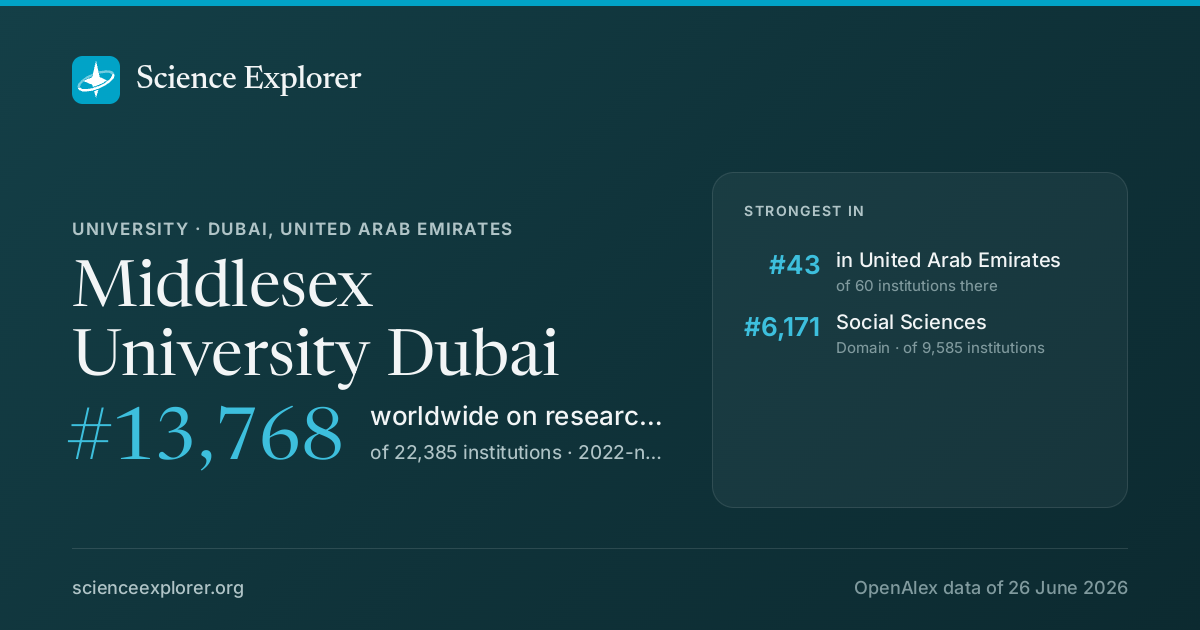
In research, Middlesex University Dubai stands highest in Social Sciences (#6,171 of 9,585 worldwide), 2022-now.
- World rank, 2022-now
- #13,768 of 22,385 · #19,966 all time
- Rank in United Arab Emirates
- #43 of 60
- Research works
- 310 ◆ 2% vs 2018-21
- Citations
- 5.6k 18.2 per fractional work
- Top-10% rate
- 15.2% all institutions 10.0%
- vs its own fields
- 1.04× 1.00× is exactly expected
- Open access
- 39% world 40%
- International
- 36% world 18%
What is Middlesex University Dubai known for in research?
The fields where it stands highest, 2022-now, ranked among every institution above the floor in each field.
| Field | World rank | Where that sits | Top-10% rate | Works | All time |
|---|---|---|---|---|---|
| Social SciencesDomain | #6,171 of 9,585 | 21.3% | 62 | #6270 |
Each strip is that field's whole ranked pool, with the notch where Middlesex University Dubai sits in it, in the colour of the band that rank falls in. The track under the rate is the rate itself: it carries no average mark, because the average differs by field (from about 6% in Dentistry to 21% in Economics).
Which fields of science does Middlesex University Dubai work in?
In 2022-now, 59% of research at Middlesex University Dubai is in Social Sciences, 33% in Physical Sciences. Its largest fields are Social Sciences (24%), Computer Science (16%), Psychology (14%). It does 2.3× the world's share of Social Sciences.
Each ring splits the one inside it: the four domains of science, their fields, their subfields. Size is fractional works in 2022-now. Every slice is a page; the interactive view zooms down to single topics and colours each by how much more of it this institution does than the world.
Its 4 domains and 22 fields, with their numbers
- Social Sciences7059.1%
- Social Sciences2823.6%
- Psychology1613.9%
- Business, Management and Accounting1412.2%
- Economics, Econometrics and Finance75.8%
- Decision Sciences32.8%
- Arts and Humanities10.8%
- Physical Sciences3932.9%
- Computer Science1916.1%
- Engineering1412.0%
- Environmental Science32.4%
- Physics and Astronomy10.8%
- Energy10.6%
- Earth and Planetary Sciences10.5%
- Mathematics00.4%
- Chemistry00.1%
- Materials Science00.1%
- Health Sciences75.9%
- Medicine54.5%
- Health Professions21.4%
- Veterinary00.0%
- Life Sciences22.1%
Field profile
Location quotient across every field it publishes in: outside the ring is more than an institution of this size would be expected to publish, inside it is less.
Rings at 0.5×, 1× and 2×. Widest outward: Psychology, 4.6×. Every wedge is a field page.
All 22 fields, with their numbers
- Psychology4.57×16 works
- Business, Management and Accounting3.78×14 works
- Decision Sciences2.88×3 works
- Economics, Econometrics and Finance2.73×7 works
- Computer Science2.07×19 works
- Social Sciences1.86×28 works
- Engineering0.80×14 works
- Energy0.62×1 works
- Health Professions0.54×2 works
- Neuroscience0.52×1 works
- Environmental Science0.49×3 works
- Pharmacology, Toxicology and Pharmaceutics0.40×0 works
- Physics and Astronomy0.38×1 works
- Earth and Planetary Sciences0.33×1 works
- Mathematics0.32×0 works
- Arts and Humanities0.27×1 works
- Medicine0.23×5 works
- Agricultural and Biological Sciences0.18×1 works
- Veterinary0.13×0 works
- Chemistry0.06×0 works
- Biochemistry, Genetics and Molecular Biology0.04×0 works
- Materials Science0.03×0 works
- Psychology 4.6×
- Business, Management and Accounting 3.8×
- Decision Sciences 2.9×
- Economics, Econometrics and Finance 2.7×
- Computer Science 2.1×
- Social Sciences 1.9×
- Engineering 0.8×
- Energy 0.6×
- Health Professions 0.5×
- Neuroscience 0.5×
- Environmental Science 0.5×
- Pharmacology, Toxicology and Pharmaceutics 0.4×
- Physics and Astronomy 0.4×
- Earth and Planetary Sciences 0.3×
- Mathematics 0.3×
- Arts and Humanities 0.3×
- Medicine 0.2×
- Agricultural and Biological Sciences 0.2×
- Veterinary 0.1×
- Chemistry 0.1×
- Biochemistry, Genetics and Molecular Biology 0.0×
- Materials Science 0.0×
Who are the top researchers at Middlesex University Dubai?
Ranked on the quality score, Sreejith Balasubramanian, Nishtha Lamba and Krishnadas Nanath lead among researchers whose main affiliation is Middlesex University Dubai.
- 1
Sreejith Balasubramanian
 United Arab Emirates · #278,278 worldwide
2.4k citations · 104 works
- 2
Nishtha Lamba
United Arab Emirates · #426,938 worldwide
710 citations · 46 works
- 3
Krishnadas Nanath
United Arab Emirates · #691,212 worldwide
531 citations · 33 works
- 4
Cody Morris Paris
United Arab Emirates · #843,491 worldwide
2.3k citations · 100 works
- 5
Anita Shrivastava
United Arab Emirates · #1,023,415 worldwide
440 citations · 26 works
- 6
Jeongsoo Han
United Arab Emirates · #1,370,208 worldwide
343 citations · 35 works
- 7
Sudipa Majumdar
United Arab Emirates · #1,752,717 worldwide
415 citations · 52 works
- 8
Hameedah Sayani
United Arab Emirates · #1,903,462 worldwide
297 citations · 20 works
- 9
Kay Sanderson
United Arab Emirates · #1,924,447 worldwide
798 citations · 25 works
- 10
Pallavi Kishore
United Arab Emirates · #1,978,062 worldwide
496 citations · 26 works
Which keywords describe research at Middlesex University Dubai?
By fractional works in 2022-now, weighted toward what it does more of than the world: Machine Learning, Leadership, Mental Health, Big Data, Supply Chain Management, Artificial Intelligence, Social Media and Well-being.
- Electronic Word-of-Mouth
- Consumer Engagement
- MOOCs
- Cultural Intelligence
- Mediation Analysis
- Work Engagement
- Organizational Behavior
- Social Interaction
- Resilience
- Smart Cities
- Student Engagement
- Psychological Impact
- Human Resource Management
- Organizational Performance
- Well-being
- Consumer Behavior
- Supply Chain Management
- Social Media
- Sustainability
- Deep Learning
- Machine Learning
- Mental Health
- Artificial Intelligence
- Big Data
- Leadership
- Healthcare
- Internet of Things
- Job Satisfaction
- Digital Transformation
- Stress
- IoT
- Motivation
- Environmental Management
- Customer Satisfaction
- Positive Emotions
- Job Demands-Resources Model
- Social Networks
- Intercultural Competence
- Monetary Policy
- Educational Data Mining
Size is fractional works in 2022-now in the topics tagged with each word; colour is the word's share of this institution's work against its share of the world's. The 40 words are chosen for being large and distinctive. Each links to the topic it comes from most.
All 40 words, with their numbers
- Machine Learning12▲ 2.9×24 topics
- Deep Learning7▲ 1.82×23 topics
- Mental Health7▲ 3.9×16 topics
- Sustainability6▲ 2.2×14 topics
- Artificial Intelligence6▲ 3.6×9 topics
- Social Media6▲ 3.6×11 topics
- Big Data6▲ 5.0×8 topics
- Supply Chain Management5▲ 5.0×10 topics
- Leadership5▲ 8.8×10 topics
- Consumer Behavior4▲ 5.4×5 topics
- Healthcare4▲ 2.9×6 topics
- Well-being4▲ 8.6×10 topics
- Internet of Things4▲ 3.7×6 topics
- Organizational Performance4▲ 12×7 topics
- Job Satisfaction3▲ 6.6×6 topics
- Human Resource Management3▲ 18×3 topics
- Digital Transformation3▲ 5.1×7 topics
- Psychological Impact3▲ 7.5×5 topics
- Stress3▲ 6.4×4 topics
- Student Engagement3▲ 6.0×3 topics
- IoT3▲ 6.0×6 topics
- Smart Cities3▲ 8.4×2 topics
- Motivation2▲ 5.0×6 topics
- Resilience2▲ 4.3×6 topics
- Environmental Management2▲ 5.1×2 topics
- Social Interaction2▲ 5.3×4 topics
- Customer Satisfaction2▲ 6.2×3 topics
- Organizational Behavior2▲ 13×2 topics
- Positive Emotions2▲ 17×2 topics
- Work Engagement2▲ 21×2 topics
- Job Demands-Resources Model2▲ 30×1 topic
- Mediation Analysis2▲ 23×1 topic
- Social Networks2▲ 6.8×4 topics
- Cultural Intelligence2▲ 81×1 topic
- Intercultural Competence2▲ 50×1 topic
- MOOCs2▲ 19×2 topics
- Monetary Policy2▲ 7.1×4 topics
- Consumer Engagement2▲ 13×1 topic
- Educational Data Mining2▲ 18×1 topic
- Electronic Word-of-Mouth2▲ 13×1 topic
Which research topics does Middlesex University Dubai publish most on?
By volume in 2022-now: Job Satisfaction and Organizational Behavior, International Student and Expatriate Challenges, Online Learning and Analytics and Digital Marketing and Social Media.
Area is fractional works; colour is the subfield each topic belongs to.
- 1 Job Satisfaction and Organizational Behavior Organizational Behavior and Human Resource Management 2 works
- 2 International Student and Expatriate Challenges Communication 2 works
- 3 Online Learning and Analytics Computer Science Applications 2 works
- 4 Digital Marketing and Social Media Sociology and Political Science 2 works
- 5 Organizational and Employee Performance Artificial Intelligence 2 works
- 6 Environmental Sustainability in Business Marketing 2 works
- 7 COVID-19 and Mental Health Clinical Psychology 1 works
- 8 Recommender Systems and Techniques Information Systems 1 works
- 9 Resilience and Mental Health Clinical Psychology 1 works
- 10 Consumer Behavior in Brand Consumption and Identification Marketing 1 works
How open and international is its research?
Against the world's own shares: the tick on each track. Both are shares of its output, so they sit on one scale and can be read against each other as well as against the world.
World: 40% of research is openly available.
World: 18% is written across borders.
How has Middlesex University Dubai's research output changed?
Output in 2022-2025 was 2% lower than in 2018-2021.
The same series as a ribbon: one cell per year, darker for more. The line above answers how much; this answers when.
Its share of all research
Growing output can still be a shrinking share: all of science grows. This is Middlesex University Dubai as a percentage of every work published that year, 0.00045% in 2024.
Fractional works of Middlesex University Dubai over all fractional works that year. How the balance of science has shifted.
How much of it reaches the world top 10%
Year by year, against all institutions in the same year.
Of each year's output, the share that reached the world's 10% most cited for its field and year. Peak 18.5% in 2023.
Other research institutions in Dubai
- Central Veterinary Research Laboratory
- University of Dubai
- Dubai Hospital
- University of Modern Sciences
- British University in Dubai
- Dubai Health Authority
- Mohammed Bin Rashid University of Medicine and Health Sciences
- Canadian University of Dubai
Share Middlesex University Dubai's ranking
Badges for a website1Each links back here and updates with every snapshot

Research measures only: rankings here say nothing about teaching, admissions or student experience. Comparable institutions and collaboration partners have tabs of their own, above.
Discussion
Ask a question or share a note about Middlesex University Dubai. Posts are plain text and can be reported.