Science Explorer Back to mapMap
University · Newberry · United States

Newberry College

World rank, all time
#21,553
of 34,923
Rank in United States
#4,470
of 7,310
Research works
241
▼ 3% vs 2018-21
Citations
2.3k
9.7 per fractional work
Top-10% rate
3.4%
all institutions 10.0%
vs its own fields
0.94×
1.00× is exactly expected
Open access
27%
world 40%
International
8%
world 18%

Which fields of science does Newberry College work in?

In 2022-now, 38% of research at Newberry College is in Social Sciences, 28% in Health Sciences. Its largest fields are Social Sciences (23%), Medicine (20%), Agricultural and Biological Sciences (11%). It does 1.4× the world's share of Social Sciences.

Social Sciences: 16 fractional works · 37.9% of its workSocial Sciences: 10 fractional works · 22.7% of its workDemography: 5 fractional works · 10.7% of its workSociology and Political Science: 3 fractional works · 5.8% of its workAnthropology: 1 fractional works · 2.3% of its workHealth: 1 fractional works · 1.5% of its workLaw: 0 fractional works · 1.2% of its workTransportation: 0 fractional works · 0.4% of its workCommunication: 0 fractional works · 0.3% of its workEducation: 0 fractional works · 0.3% of its workGender Studies: 0 fractional works · 0.3% of its workPsychology: 3 fractional works · 6.2% of its workClinical Psychology: 2 fractional works · 3.7% of its workSocial Psychology: 0 fractional works · 1.1% of its workDevelopmental and Educational Psychology: 0 fractional works · 0.8% of its workApplied Psychology: 0 fractional works · 0.3% of its workExperimental and Cognitive Psychology: 0 fractional works · 0.3% of its workBusiness, Management and Accounting: 2 fractional works · 5.5% of its workMarketing: 2 fractional works · 3.6% of its workTourism, Leisure and Hospitality Management: 1 fractional works · 1.5% of its workOrganizational Behavior and Human Resource Management: 0 fractional works · 0.4% of its workArts and Humanities: 2 fractional works · 3.5% of its workArcheology: 0 fractional works · 1.2% of its workLiterature and Literary Theory: 0 fractional works · 0.8% of its workPhilosophy: 0 fractional works · 0.8% of its workVisual Arts and Performing Arts: 0 fractional works · 0.8% of its workSmaller subfields together: 0 fractional works · 0.0% of its workEconomics, Econometrics and Finance: 0 fractional works · 0.1% of its workHealth Sciences: 12 fractional works · 27.6% of its workMedicine: 9 fractional works · 19.8% of its workPublic Health, Environmental and Occupational Health: 2 fractional works · 4.0% of its workEmergency Medicine: 1 fractional works · 3.1% of its workPediatrics, Perinatology and Child Health: 1 fractional works · 2.9% of its workRadiology, Nuclear Medicine and Imaging: 1 fractional works · 2.3% of its workSurgery: 1 fractional works · 2.1% of its workCritical Care and Intensive Care Medicine: 0 fractional works · 1.0% of its workCardiology and Cardiovascular Medicine: 0 fractional works · 0.8% of its workPulmonary and Respiratory Medicine: 0 fractional works · 0.6% of its workEpidemiology: 0 fractional works · 0.6% of its workPhysiology: 0 fractional works · 0.6% of its workEndocrinology, Diabetes and Metabolism: 0 fractional works · 0.4% of its workHepatology: 0 fractional works · 0.4% of its workOrthopedics and Sports Medicine: 0 fractional works · 0.4% of its workRheumatology: 0 fractional works · 0.3% of its workHealth Informatics: 0 fractional works · 0.2% of its workSmaller subfields together: 0 fractional works · 0.1% of its workHealth Professions: 3 fractional works · 6.2% of its workGeneral Health Professions: 1 fractional works · 3.1% of its workEmergency Medical Services: 0 fractional works · 0.8% of its workOccupational Therapy: 0 fractional works · 0.8% of its workPhysical Therapy, Sports Therapy and Rehabilitation: 0 fractional works · 0.8% of its workRadiological and Ultrasound Technology: 0 fractional works · 0.8% of its workNursing: 1 fractional works · 1.6% of its workIssues, ethics and legal aspects: 0 fractional works · 1.0% of its workResearch and Theory: 0 fractional works · 0.6% of its workSmaller subfields together: 0 fractional works · 0.0% of its workPhysical Sciences: 8 fractional works · 19.3% of its workEngineering: 2 fractional works · 4.6% of its workBiomedical Engineering: 0 fractional works · 1.2% of its workCivil and Structural Engineering: 0 fractional works · 0.8% of its workElectrical and Electronic Engineering: 0 fractional works · 0.8% of its workControl and Systems Engineering: 0 fractional works · 0.6% of its workOcean Engineering: 0 fractional works · 0.6% of its workBuilding and Construction: 0 fractional works · 0.4% of its workMechanical Engineering: 0 fractional works · 0.4% of its workComputer Science: 2 fractional works · 4.1% of its workComputer Science Applications: 1 fractional works · 2.3% of its workComputer Networks and Communications: 0 fractional works · 1.2% of its workComputational Theory and Mathematics: 0 fractional works · 0.6% of its workEarth and Planetary Sciences: 2 fractional works · 3.8% of its workEarth-Surface Processes: 1 fractional works · 1.5% of its workAtmospheric Science: 0 fractional works · 0.8% of its workGeology: 0 fractional works · 0.8% of its workPaleontology: 0 fractional works · 0.8% of its workSmaller subfields together: 0 fractional works · 0.0% of its workEnvironmental Science: 2 fractional works · 3.5% of its workPollution: 1 fractional works · 1.3% of its workEcology: 0 fractional works · 0.8% of its workEnvironmental Engineering: 0 fractional works · 0.8% of its workEnvironmental Chemistry: 0 fractional works · 0.4% of its workSmaller subfields together: 0 fractional works · 0.3% of its workMaterials Science: 1 fractional works · 3.1% of its workMaterials Chemistry: 1 fractional works · 2.3% of its workBiomaterials: 0 fractional works · 0.8% of its workChemical Engineering: 0 fractional works · 0.2% of its workMathematics: 0 fractional works · 0.0% of its workLife Sciences: 7 fractional works · 15.2% of its workAgricultural and Biological Sciences: 5 fractional works · 10.6% of its workFood Science: 2 fractional works · 3.5% of its workPlant Science: 1 fractional works · 3.4% of its workEcology, Evolution, Behavior and Systematics: 1 fractional works · 2.9% of its workInsect Science: 0 fractional works · 0.8% of its workSmaller subfields together: 0 fractional works · 0.1% of its workBiochemistry, Genetics and Molecular Biology: 2 fractional works · 4.3% of its workMolecular Biology: 1 fractional works · 2.0% of its workGenetics: 1 fractional works · 1.6% of its workPhysiology: 0 fractional works · 0.4% of its workCancer Research: 0 fractional works · 0.3% of its workNeuroscience: 0 fractional works · 0.3% of its workCognitive Neuroscience: 0 fractional works · 0.3% of its workImmunology and Microbiology: 0 fractional works · 0.0% of its workALL ITS WORKNewberry College43fractional works, 2022-now
Life Sciences15%Physical Sciences19%Health Sciences28%Social Sciences38%

Each ring splits the one inside it: the four domains of science, their fields, their subfields. Size is fractional works in 2022-now. Every slice is a page; the interactive view zooms down to single topics and colours each by how much more of it this institution does than the world.

Its 4 domains and 19 fields, with their numbers
    1. Social Sciences1022.7%
    2. Psychology36.2%
    3. Business, Management and Accounting25.5%
    4. Arts and Humanities23.5%
    5. Economics, Econometrics and Finance00.1%
    1. Medicine919.8%
    2. Health Professions36.2%
    3. Nursing11.6%
    1. Engineering24.6%
    2. Computer Science24.1%
    3. Earth and Planetary Sciences23.8%
    4. Environmental Science23.5%
    5. Materials Science13.1%
    6. Chemical Engineering00.2%
    7. Mathematics00.0%
    1. Agricultural and Biological Sciences510.6%
    2. Biochemistry, Genetics and Molecular Biology24.3%
    3. Neuroscience00.3%
    4. Immunology and Microbiology00.0%
All of science, and how each field's share has moved since 1950: the Science domain explorer

Field profile

Location quotient across every field it publishes in: outside the ring is more than an institution of this size would be expected to publish, inside it is less.

Agricultural and Biological Sciences: 2.23× its world share, 5 worksAgricultural and Bio…Biochemistry, Genetics and Molecular Biology: 0.81× its world share, 2 worksBiochemistry, Geneti…Immunology and Microbiology: 0.02× its world share, 0 worksImmunology and Micro…Neuroscience: 0.16× its world share, 0 worksNeuroscienceChemical Engineering: 0.44× its world share, 0 worksChemical EngineeringComputer Science: 0.52× its world share, 2 worksComputer ScienceEarth and Planetary Sciences: 2.45× its world share, 2 worksEarth and Planetary …Engineering: 0.31× its world share, 2 worksEngineeringEnvironmental Science: 0.71× its world share, 2 worksEnvironmental ScienceMaterials Science: 0.88× its world share, 1 worksMaterials ScienceMathematics: 0.03× its world share, 0 worksMathematicsHealth Professions: 2.35× its world share, 3 worksHealth ProfessionsMedicine: 1.03× its world share, 9 worksMedicineNursing: 3.31× its world share, 1 worksNursingArts and Humanities: 1.20× its world share, 2 worksArts and HumanitiesBusiness, Management and Accounting: 1.71× its world share, 2 worksBusiness, Management…Economics, Econometrics and Finance: 0.03× its world share, 0 worksEconomics, Econometr…Psychology: 2.03× its world share, 3 worksPsychologySocial Sciences: 1.79× its world share, 10 worksSocial Sciences1×world share
more than its size predictsabout as predictedless

Rings at 0.5×, 1× and 2×. Widest outward: Nursing, 3.3×. Every wedge is a field page.

All 19 fields, with their numbers
  1. Nursing3.31×1 works
  2. Earth and Planetary Sciences2.45×2 works
  3. Health Professions2.35×3 works
  4. Agricultural and Biological Sciences2.23×5 works
  5. Psychology2.03×3 works
  6. Social Sciences1.79×10 works
  7. Business, Management and Accounting1.71×2 works
  8. Arts and Humanities1.20×2 works
  9. Medicine1.03×9 works
  10. Materials Science0.88×1 works
  11. Biochemistry, Genetics and Molecular Biology0.81×2 works
  12. Environmental Science0.71×2 works
  13. Computer Science0.52×2 works
  14. Chemical Engineering0.44×0 works
  15. Engineering0.31×2 works
  16. Neuroscience0.16×0 works
  17. Mathematics0.03×0 works
  18. Economics, Econometrics and Finance0.03×0 works
  19. Immunology and Microbiology0.02×0 works

Who are the top researchers at Newberry College?

Ranked on the quality score, Charles N. Horn, Deb M. Newberry and David C. Reames lead among researchers whose main affiliation is Newberry College.

  1. 1 Charles N. Horn United States · #3,404,540 worldwide 152 citations · 30 works
  2. 2 Deb M. Newberry United States · #4,284,324 worldwide 111 citations · 53 works
  3. 3 David C. Reames United States · #4,979,385 worldwide 235 citations · 20 works
  4. 4 Ronda M. Sandifer United States · #5,088,452 worldwide 258 citations · 22 works
  5. 5 Betsy M. McDowell United States · #5,948,700 worldwide 166 citations · 45 works
All ranked researchers at Newberry College

What are the most cited papers from Newberry College?

The most cited paper from Newberry College is "The structure of cranberry proanthocyanidins which inhibit adherence of uropathogenic P-fimbriated Escherichia coli in vitro" (Lai Yeap Foo, Yinrong Lu, Amy B. Howell et al., 2000), with 438 citations. Next come "The Significance of Hardware Failure in Anterior Cervical Plate Fixation" (268) and "Training Machine Learning Surrogate Models From a High‐Fidelity Physics‐Based Model: Application for Real‐Time Street‐Scale Flood Prediction in an Urban Coastal Community" (200).

Most cited papers
#PaperReleasedCitations
1 The structure of cranberry proanthocyanidins which inhibit adherence of uropathogenic P-fimbriated Escherichia coli in vitro Lai Yeap Foo, Yinrong Lu, Amy B. Howell et al. · Phytochemistry May 2000 438
2 The Significance of Hardware Failure in Anterior Cervical Plate Fixation Gary L. Lowery, Richard F. McDonough · Spine 1998 268
3 Training Machine Learning Surrogate Models From a High‐Fidelity Physics‐Based Model: Application for Real‐Time Street‐Scale Flood Prediction in an Urban Coastal Community Faria Tuz Zahura, Jonathan L. Goodall, Jeffrey M. Sadler et al. · Water Resources Research Open access 24 Sep 2020 200
4 A Case Study of a Highly Effective, Inclusive Elementary School James McLeskey, Nancy L. Waldron, Lacy Redd · The Journal of Special Education 27 Mar 2012 174
5 Chiral discrimination using piezoelectric and optical gas sensors K. Bodenhöfer, Andreas R. Hierlemann, Jens Seemann et al. · Nature Jun 1997 150
All 62 most cited papers, with filters and sorting

Which keywords describe research at Newberry College?

By fractional works in 2022-now, weighted toward what it does more of than the world: Psychological Impact, Mortality Risk, Risk Factors, Prevalence, Elder Abuse, Neglect, Global Burden and Child Injury.

▲ more of its work than of the world's◆ about the world's share▼ less than the world's

Size is fractional works in 2022-now in the topics tagged with each word; colour is the word's share of this institution's work against its share of the world's. The 36 words are chosen for being large and distinctive. Each links to the topic it comes from most.

All 36 words, with their numbers
  1. Psychological Impact5▲ 37×3 topics
  2. Mortality Risk5▲ 48×2 topics
  3. Risk Factors5▲ 10×3 topics
  4. Elder Abuse5▲ 844×1 topic
  5. Neglect5▲ 844×1 topic
  6. Prevalence5▲ 27×2 topics
  7. Mental Health2▲ 3.5×9 topics
  8. Environmental Impact2▲ 2.8×7 topics
  9. Epidemiology2◆ 1.13×5 topics
  10. Global Burden2▲ 7.7×2 topics
  11. Sustainability2▲ 1.73×4 topics
  12. Child Injury2▲ 138×1 topic
  13. Climate Change2▲ 1.47×5 topics
  14. Consumer Behavior2▲ 6.4×4 topics
  15. Globalization2▲ 1.95×3 topics
  16. Unintentional Injuries2▲ 138×1 topic
  17. Customer Experience1▲ 19×1 topic
  18. Ethical Considerations1▲ 8.9×4 topics
  19. Multichannel Retailing1▲ 57×1 topic
  20. Nanoparticles1▲ 2.4×2 topics
  21. Public Health1▲ 1.99×5 topics
  22. Biodiversity1▲ 3.7×4 topics
  23. Identity1▲ 3.7×2 topics
  24. Toxicity1▲ 6.2×2 topics
  25. Ecosystem Services1▲ 6.7×3 topics
  26. Neoliberalism1▲ 7.1×2 topics
  27. Pain Management1▲ 11×2 topics
  28. User-Generated Content1▲ 19×2 topics
  29. Antimicrobial1▲ 8.1×1 topic
  30. Ethnography1▲ 13×1 topic
  31. Governmentality1▲ 88×1 topic
  32. Innovation1▲ 2.2×1 topic
  33. Open Source Software1▲ 61×1 topic
  34. Post-mortem Imaging1▲ 188×1 topic
  35. Silver1▲ 31×1 topic
  36. Virtual Autopsy1▲ 188×1 topic

Which research topics does Newberry College publish most on?

By volume in 2022-now: Elder Abuse and Neglect, Injury Epidemiology and Prevention, Consumer Retail Behavior Studies and Nanoparticles: synthesis and applications.

  1. 1 Elder Abuse and Neglect Demography 5 works
  2. 2 Injury Epidemiology and Prevention Public Health, Environmental and Occupational Health 2 works
  3. 3 Consumer Retail Behavior Studies Marketing 1 works
  4. 4 Nanoparticles: synthesis and applications Materials Chemistry 1 works
  5. 5 Anthropological Studies and Insights Anthropology 1 works
  6. 6 Open Source Software Innovations Computer Science Applications 1 works
  7. 7 Autopsy Techniques and Outcomes Radiology, Nuclear Medicine and Imaging 1 works
  8. 8 Culinary Culture and Tourism Food Science 1 works
  9. 9 Pediatric Pain Management Techniques Pediatrics, Perinatology and Child Health 1 works
  10. 10 Sensory Analysis and Statistical Methods Food Science 1 works

How open and international is its research?

Against the world's own shares: the tick on each track. Both are shares of its output, so they sit on one scale and can be read against each other as well as against the world.

openly available26.8%not open73.2%

World: 40% of research is openly available.

with international co-authors7.6%domestic only92.4%

World: 18% is written across borders.

How has Newberry College's research output changed?

Output in 2022-2025 was 3% lower than in 2018-2021.

still counting1990200020102020
grewheldshrank

The same series as a ribbon: one cell per year, darker for more. The line above answers how much; this answers when.

Its share of all research

Growing output can still be a shrinking share: all of science grows. This is Newberry College as a percentage of every work published that year, 0.00019% in 2024.

still counting0.0010%0.0020%Newberry College0.00019% in 202519801990200020102020

Fractional works of Newberry College over all fractional works that year. How the balance of science has shifted.

Other research institutions in Newberry

All research institutions in Newberry

Share Newberry College's ranking
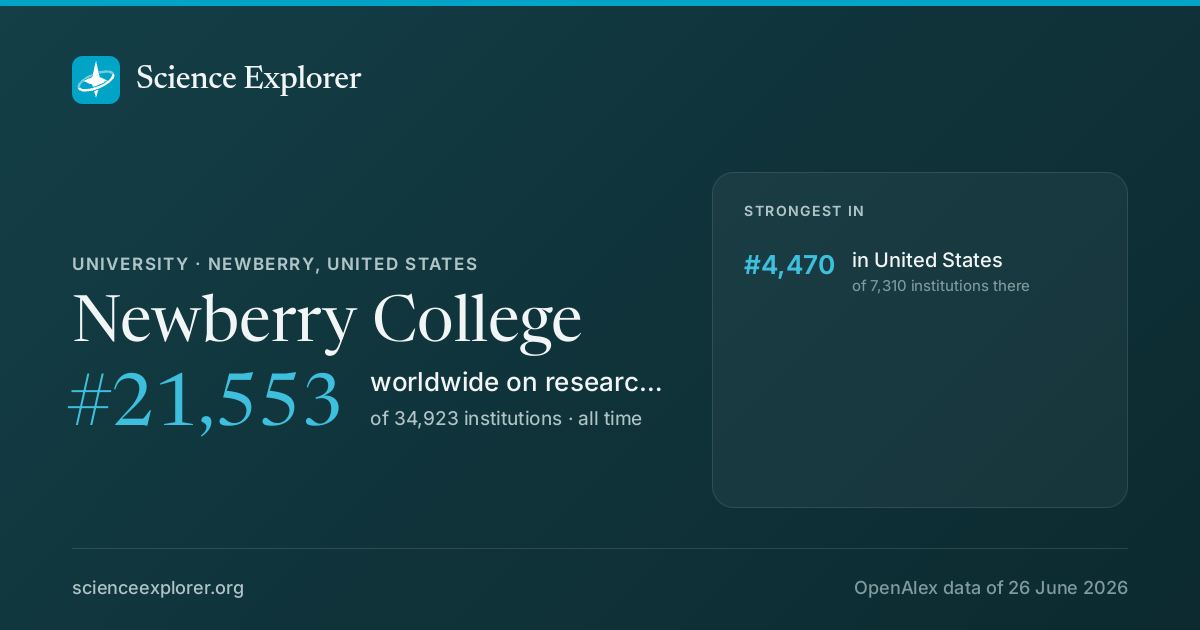
Newberry College on Science Explorer

A card with Newberry College's standing and the fields it leads in, for a post or a slide. A link to this page previews as the same card.

Download the card

1200 × 630 PNG, sized for social posts, drawn from the latest snapshot.

Badges for a website1Each links back here and updates with every snapshot

Research measures only: rankings here say nothing about teaching, admissions or student experience. Comparable institutions and collaboration partners have tabs of their own, above.

Discussion

Ask a question or share a note about Newberry College. Keep it to the research: no personal attacks, advertising or links. Any reader can report a post, which collapses it for everyone until it is opened.
