Novozymes (Denmark)
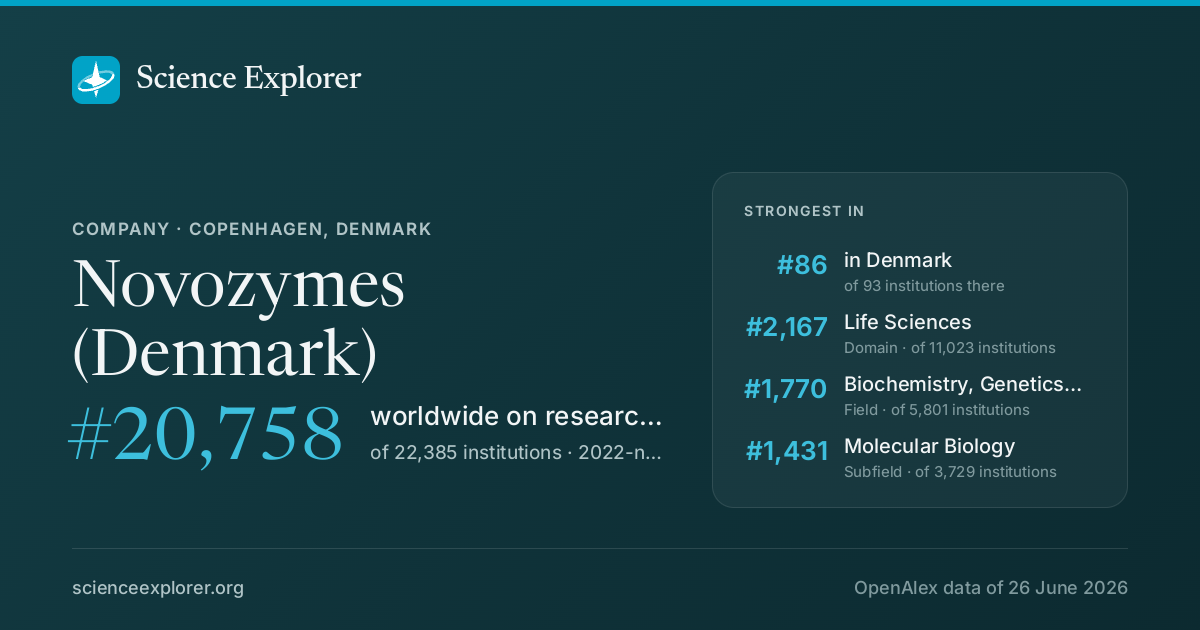
In research, Novozymes (Denmark) stands highest in Life Sciences (#2,167 of 11,023 worldwide), Biochemistry, Genetics and Molecular Biology (#1,770 of 5,801 worldwide) and Molecular Biology (#1,431 of 3,729 worldwide), over all time.
- World rank, 2022-now
- #20,758 of 22,385 · #7,816 all time
- Rank in Denmark
- #86 of 93
- Research works
- 726 ▼ 33% vs 2018-21
- Citations
- 32k 43.7 per fractional work
- Top-10% rate
- 10.1% all institutions 10.0%
- vs its own fields
- 0.99× 1.00× is exactly expected
- Open access
- 35% world 40%
- International
- 40% world 18%
What is Novozymes (Denmark) known for in research?
The fields where it stands highest, over all time, ranked among every institution above the floor in each field.
| Field | World rank | Where that sits | Top-10% rate | Works |
|---|---|---|---|---|
| Life SciencesDomain | #2,167 of 11,023 | 12.7% | 380 | |
| Biochemistry, Genetics and Molecular BiologyField | #1,770 of 5,801 | 12.4% | 255 | |
| Molecular BiologySubfield | #1,431 of 3,729 | 12.3% | 171 | |
| Physical SciencesDomain | #8,894 of 17,446 | 9.8% | 222 |
Each strip is that field's whole ranked pool, with the notch where Novozymes (Denmark) sits in it, in the colour of the band that rank falls in. The track under the rate is the rate itself: it carries no average mark, because the average differs by field (from about 6% in Dentistry to 21% in Economics).
Which fields of science does Novozymes (Denmark) work in?
In 2022-now, 47% of research at Novozymes (Denmark) is in Life Sciences, 32% in Physical Sciences. Its largest fields are Biochemistry, Genetics and Molecular Biology (31%), Agricultural and Biological Sciences (14%), Environmental Science (11%). It does 2.9× the world's share of Life Sciences.
Each ring splits the one inside it: the four domains of science, their fields, their subfields. Size is fractional works in 2022-now. Every slice is a page; the interactive view zooms down to single topics and colours each by how much more of it this institution does than the world.
Its 4 domains and 22 fields, with their numbers
- Life Sciences3146.9%
- Physical Sciences2131.9%
- Environmental Science711.5%
- Engineering711.2%
- Materials Science34.1%
- Chemistry22.8%
- Computer Science10.8%
- Chemical Engineering00.8%
- Energy00.7%
- Health Sciences1117.0%
- Medicine69.6%
- Dentistry34.1%
- Nursing12.2%
- Health Professions00.5%
- Veterinary00.5%
- Social Sciences34.2%
- Social Sciences22.6%
- Economics, Econometrics and Finance00.8%
- Decision Sciences00.5%
- Arts and Humanities00.3%
- Psychology00.1%
Field profile
Location quotient across every field it publishes in: outside the ring is more than an institution of this size would be expected to publish, inside it is less.
Rings at 0.5×, 1× and 2×. Widest outward: Dentistry, 8.5×. Every wedge is a field page.
All 22 fields, with their numbers
- Dentistry8.46×3 works
- Biochemistry, Genetics and Molecular Biology5.81×20 works
- Nursing4.45×1 works
- Veterinary3.76×0 works
- Agricultural and Biological Sciences3.04×9 works
- Environmental Science2.31×8 works
- Chemical Engineering2.19×0 works
- Chemistry1.80×2 works
- Materials Science1.17×3 works
- Immunology and Microbiology0.98×1 works
- Engineering0.75×7 works
- Energy0.71×0 works
- Pharmacology, Toxicology and Pharmaceutics0.58×0 works
- Medicine0.50×6 works
- Decision Sciences0.48×0 works
- Economics, Econometrics and Finance0.36×0 works
- Neuroscience0.22×0 works
- Social Sciences0.21×2 works
- Health Professions0.20×0 works
- Computer Science0.10×0 works
- Arts and Humanities0.09×0 works
- Psychology0.02×0 works
- Dentistry 8.5×
- Biochemistry, Genetics and Molecular Biology 5.8×
- Nursing 4.5×
- Veterinary 3.8×
- Agricultural and Biological Sciences 3.0×
- Environmental Science 2.3×
- Chemical Engineering 2.2×
- Chemistry 1.8×
- Materials Science 1.2×
- Immunology and Microbiology 1.0×
- Engineering 0.8×
- Energy 0.7×
- Pharmacology, Toxicology and Pharmaceutics 0.6×
- Medicine 0.5×
- Decision Sciences 0.5×
- Economics, Econometrics and Finance 0.4×
- Neuroscience 0.2×
- Social Sciences 0.2×
- Health Professions 0.2×
- Computer Science 0.1×
- Arts and Humanities 0.1×
- Psychology 0.0×
Who are the top researchers at Novozymes (Denmark)?
Ranked on the quality score, Kenneth Jensen, Sjef Cornelissen and Kristian B. R. M. Krogh lead among researchers whose main affiliation is Novozymes (Denmark).
- 1
Kenneth Jensen
 Denmark · #397,008 worldwide
3.1k citations · 97 works
- 2
Sjef Cornelissen
Denmark · #554,026 worldwide
1.6k citations · 18 works
- 3
Kristian B. R. M. Krogh
Denmark · #626,213 worldwide
3.4k citations · 73 works
- 4
Morten Tovborg
Denmark · #840,140 worldwide
2.4k citations · 21 works
- 5
Jesper Brask
Denmark · #904,892 worldwide
2.5k citations · 80 works
- 6
Torben Vedel Borchert
Denmark · #933,698 worldwide
4.2k citations · 44 works
- 7
Carsten Hjort
Denmark · #1,053,296 worldwide
1k citations · 25 works
- 8
Kim Borch
Denmark · #1,064,341 worldwide
3.2k citations · 90 works
- 9
Sven Pedersen
Denmark · #1,100,610 worldwide
2.1k citations · 50 works
- 10
Mary A. Stringer
Denmark · #1,177,658 worldwide
1.6k citations · 22 works
Which keywords describe research at Novozymes (Denmark)?
By fractional works in 2022-now, weighted toward what it does more of than the world: Enzymatic Hydrolysis, Biomedical Applications, Industrial Applications, Biotechnological Applications, Microbial Enzymes, Lignocellulosic Biomass, Pretreatment and Green Chemistry.
- Microbiota
- Glycosylation
- Pollution
- Oral Microbiome
- Diabetes Mellitus
- Waste Management
- Dietary Fiber
- Genomics
- Probiotics
- Constraint-Based Models
- Synthetic Biology
- Microbial Ecology
- Dental Caries
- Gut Microbiota
- Biocatalysis
- Pretreatment
- Health Benefits
- Environmental Impact
- Biotechnological Applications
- Enzymatic Hydrolysis
- Biomedical Applications
- Industrial Applications
- Microbial Enzymes
- Green Chemistry
- Lignocellulosic Biomass
- Metabolic Engineering
- Enzyme Immobilization
- Nanoparticles
- Microbial Communities
- Prebiotics
- Bacterial Diversity
- Genome-Scale Models
- Antioxidant Activity
- Recycling
- Molecular Structure
- Biosynthesis
- Metabolic Health
- Periodontal Diseases
- Fermentation
- Marine Environment
Size is fractional works in 2022-now in the topics tagged with each word; colour is the word's share of this institution's work against its share of the world's. The 40 words are chosen for being large and distinctive. Each links to the topic it comes from most.
All 40 words, with their numbers
- Biomedical Applications4▲ 4.8×12 topics
- Enzymatic Hydrolysis3▲ 50×2 topics
- Industrial Applications3▲ 46×2 topics
- Biotechnological Applications3▲ 157×1 topic
- Microbial Enzymes3▲ 157×1 topic
- Environmental Impact2▲ 2.2×9 topics
- Green Chemistry2▲ 22×2 topics
- Health Benefits2▲ 12×5 topics
- Lignocellulosic Biomass2▲ 39×1 topic
- Pretreatment2▲ 72×1 topic
- Metabolic Engineering2▲ 38×4 topics
- Biocatalysis2▲ 56×1 topic
- Enzyme Immobilization2▲ 116×1 topic
- Gut Microbiota2▲ 9.1×4 topics
- Nanoparticles2▲ 2.6×8 topics
- Dental Caries2▲ 30×2 topics
- Microbial Communities2▲ 7.2×5 topics
- Microbial Ecology2▲ 17×3 topics
- Prebiotics2▲ 31×2 topics
- Synthetic Biology2▲ 48×2 topics
- Bacterial Diversity2▲ 24×2 topics
- Constraint-Based Models2▲ 67×1 topic
- Genome-Scale Models2▲ 67×1 topic
- Probiotics2▲ 12×5 topics
- Antioxidant Activity2▲ 4.3×8 topics
- Genomics2▲ 9.0×6 topics
- Recycling2▲ 6.1×3 topics
- Dietary Fiber1▲ 20×2 topics
- Molecular Structure1▲ 20×2 topics
- Waste Management1▲ 5.5×4 topics
- Biosynthesis1▲ 12×4 topics
- Diabetes Mellitus1▲ 9.9×2 topics
- Metabolic Health1▲ 9.7×2 topics
- Oral Microbiome1▲ 33×1 topic
- Periodontal Diseases1▲ 33×1 topic
- Pollution1▲ 10×2 topics
- Fermentation1▲ 14×5 topics
- Glycosylation1▲ 17×3 topics
- Marine Environment1▲ 13×2 topics
- Microbiota1▲ 8.7×2 topics
Which research topics does Novozymes (Denmark) publish most on?
By volume in 2022-now: Enzyme Production and Characterization, Biofuel production and bioconversion, Enzyme Catalysis and Immobilization and Microbial Metabolic Engineering and Bioproduction.
Area is fractional works; colour is the subfield each topic belongs to.
- 1 Enzyme Production and Characterization Biotechnology 3 works
- 2 Biofuel production and bioconversion Biomedical Engineering 2 works
- 3 Enzyme Catalysis and Immobilization Molecular Biology 2 works
- 4 Microbial Metabolic Engineering and Bioproduction Molecular Biology 2 works
- 5 Oral microbiology and periodontitis research Periodontics 1 works
- 6 Microplastics and Plastic Pollution Pollution 1 works
- 7 Polysaccharides and Plant Cell Walls Plant Science 1 works
- 8 Probiotics and Fermented Foods Food Science 1 works
- 9 biodegradable polymer synthesis and properties Biomaterials 1 works
- 10 Sports and Physical Education Studies Life-span and Life-course Studies 1 works
How open and international is its research?
Against the world's own shares: the tick on each track. Both are shares of its output, so they sit on one scale and can be read against each other as well as against the world.
World: 40% of research is openly available.
World: 18% is written across borders.
How has Novozymes (Denmark)'s research output changed?
Output in 2022-2025 was 33% lower than in 2018-2021.
The same series as a ribbon: one cell per year, darker for more. The line above answers how much; this answers when.
Its share of all research
Growing output can still be a shrinking share: all of science grows. This is Novozymes (Denmark) as a percentage of every work published that year, 0.00025% in 2024.
Fractional works of Novozymes (Denmark) over all fractional works that year. How the balance of science has shifted.
How much of it reaches the world top 10%
Year by year, against all institutions in the same year.
Of each year's output, the share that reached the world's 10% most cited for its field and year. Peak 19.0% in 2018.
Other research institutions in Copenhagen
- University of Copenhagen
- Rigshospitalet
- Copenhagen Business School
- Novo Nordisk (Denmark)
- Statens Serum Institut
- IT University of Copenhagen
- Geological Survey of Denmark and Greenland
- Schools of Visual Arts, The Royal Danish Academy of Fine Arts

Share Novozymes (Denmark)'s ranking
Badges for a website1Each links back here and updates with every snapshot

Research measures only: rankings here say nothing about teaching, admissions or student experience. Comparable institutions and collaboration partners have tabs of their own, above.
Discussion
Ask a question or share a note about Novozymes (Denmark). Posts are plain text and can be reported.