Pasadena City College
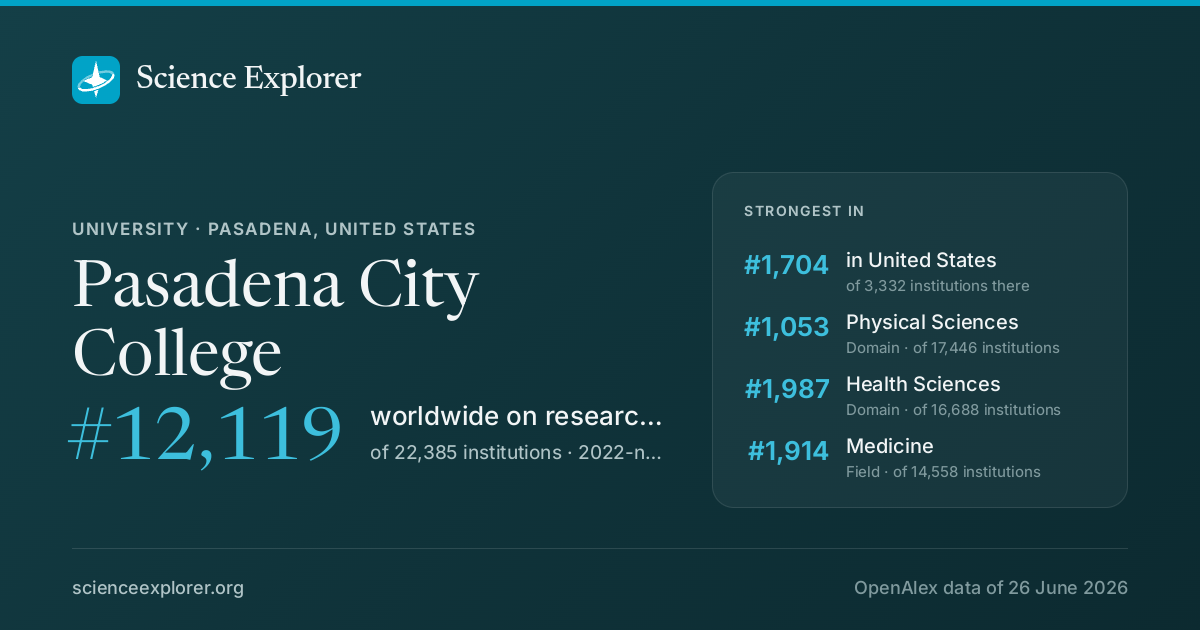
In research, Pasadena City College stands highest in Physical Sciences (#1,053 of 17,446 worldwide), Health Sciences (#1,987 of 16,688 worldwide) and Medicine (#1,914 of 14,558 worldwide), over all time.
- World rank, 2022-now
- #12,119 of 22,385 · #1,496 all time
- Rank in United States
- #1,704 of 3,332
- Research works
- 1.3k ▼ 27% vs 2018-21
- Citations
- 23k 17.7 per fractional work
- Top-10% rate
- 5.7% all institutions 10.0%
- vs its own fields
- 0.90× 1.00× is exactly expected
- Open access
- 22% world 40%
- International
- 8% world 18%
What is Pasadena City College known for in research?
The fields where it stands highest, over all time, ranked among every institution above the floor in each field.
| Field | World rank | Where that sits | Top-10% rate | Works |
|---|---|---|---|---|
| Physical SciencesDomain | #1,053 of 17,446 | 10.7% | 496 | |
| Health SciencesDomain | #1,987 of 16,688 | 8.9% | 300 | |
| MedicineField | #1,914 of 14,558 | 8.8% | 237 | |
| Social SciencesDomain | #2,610 of 14,833 | 6.5% | 381 | |
| EngineeringField | #1,803 of 9,532 | 11.2% | 147 | |
| Social SciencesField | #3,312 of 9,330 | 4.8% | 152 |
Each strip is that field's whole ranked pool, with the notch where Pasadena City College sits in it, in the colour of the band that rank falls in. The track under the rate is the rate itself: it carries no average mark, because the average differs by field (from about 6% in Dentistry to 21% in Economics).
Which fields of science does Pasadena City College work in?
In 2022-now, 43% of research at Pasadena City College is in Physical Sciences, 30% in Social Sciences. Its largest fields are Engineering (14%), Medicine (14%), Social Sciences (12%).
Each ring splits the one inside it: the four domains of science, their fields, their subfields. Size is fractional works in 2022-now. Every slice is a page; the interactive view zooms down to single topics and colours each by how much more of it this institution does than the world.
Its 4 domains and 22 fields, with their numbers
- Physical Sciences6642.7%
- Engineering2214.4%
- Physics and Astronomy117.2%
- Computer Science116.9%
- Environmental Science63.9%
- Chemistry53.3%
- Materials Science53.1%
- Earth and Planetary Sciences32.1%
- Mathematics31.6%
- Energy00.3%
- Social Sciences4730.3%
- Social Sciences1811.7%
- Arts and Humanities127.5%
- Psychology64.2%
- Business, Management and Accounting53.4%
- Economics, Econometrics and Finance42.4%
- Decision Sciences21.1%
- Health Sciences2516.1%
- Medicine2113.7%
- Health Professions32.1%
- Dentistry00.3%
- Life Sciences1711.0%
Field profile
Location quotient across every field it publishes in: outside the ring is more than an institution of this size would be expected to publish, inside it is less.
Rings at 0.5×, 1× and 2×. Widest outward: Physics and Astronomy, 3.2×. Every wedge is a field page.
All 22 fields, with their numbers
- Physics and Astronomy3.23×11 works
- Arts and Humanities2.60×12 works
- Chemistry2.07×5 works
- Mathematics1.40×2 works
- Psychology1.38×6 works
- Earth and Planetary Sciences1.33×3 works
- Biochemistry, Genetics and Molecular Biology1.16×10 works
- Decision Sciences1.14×2 works
- Economics, Econometrics and Finance1.14×4 works
- Business, Management and Accounting1.04×5 works
- Engineering0.96×22 works
- Neuroscience0.93×2 works
- Social Sciences0.92×18 works
- Computer Science0.89×11 works
- Materials Science0.89×5 works
- Health Professions0.80×3 works
- Environmental Science0.78×6 works
- Medicine0.71×21 works
- Agricultural and Biological Sciences0.61×4 works
- Dentistry0.52×0 works
- Immunology and Microbiology0.43×1 works
- Energy0.29×0 works
- Physics and Astronomy 3.2×
- Arts and Humanities 2.6×
- Chemistry 2.1×
- Mathematics 1.4×
- Psychology 1.4×
- Earth and Planetary Sciences 1.3×
- Biochemistry, Genetics and Molecular Biology 1.2×
- Decision Sciences 1.1×
- Economics, Econometrics and Finance 1.1×
- Business, Management and Accounting 1.0×
- Engineering 1.0×
- Neuroscience 0.9×
- Social Sciences 0.9×
- Computer Science 0.9×
- Materials Science 0.9×
- Health Professions 0.8×
- Environmental Science 0.8×
- Medicine 0.7×
- Agricultural and Biological Sciences 0.6×
- Dentistry 0.5×
- Immunology and Microbiology 0.4×
- Energy 0.3×
Who are the top researchers at Pasadena City College?
Ranked on the quality score, Donald H. Rapp, Paul Popenoe and Joseph C. Risser lead among researchers whose main affiliation is Pasadena City College.
- 1
Donald H. Rapp
 United States · #572,788 worldwide
7.3k citations · 190 works
- 2
Paul Popenoe
United States · #1,454,399 worldwide
565 citations · 151 works
- 3
Joseph C. Risser
United States · #1,634,712 worldwide
680 citations · 17 works
- 4
Charles Frederick Holder
United States · #1,800,886 worldwide
84 citations · 140 works
- 5
A. J. van Rossem
United States · #1,812,785 worldwide
511 citations · 136 works
- 6
R.E. Hope Simpson
United States · #1,872,658 worldwide
478 citations · 15 works
- 7
Nicanor G. Isse
United States · #2,012,861 worldwide
788 citations · 29 works
- 8
Maria A. Gwynn
United States · #2,039,186 worldwide
50 citations · 21 works
- 9
Jared M. Ashcroft
United States · #2,071,967 worldwide
671 citations · 46 works
- 10
Henry Clinton Fall
United States · #2,165,584 worldwide
328 citations · 86 works
Which keywords describe research at Pasadena City College?
By fractional works in 2022-now, weighted toward what it does more of than the world: Solar Wind, Big Data, Divine Providence, Empire, Medicine, Railway Bridges, Structural-Phase Transformations and Education.
- Solar Dynamics Observatory
- Cryogenic Storage
- Collaborative Learning
- Type 1 Diabetes
- Organic Synthesis
- Market Dynamics
- Gold Nanoparticles
- Thermodynamic Modeling
- Terrestrial Planets
- Metacognition
- Ionosphere
- Structural-Phase Transformations
- Railway Bridges
- Medicine
- Empire
- Divine Providence
- Smart Grid
- Energy Efficiency
- Education
- Machine Learning
- Deep Learning
- Big Data
- Solar Wind
- Meta-Analysis
- Student Engagement
- Ethics
- Motivation
- Cloud Computing
- Self-Regulation
- Cultural Transmission
- Magnetosphere
- Solar System Abundances
- Astrobiology
- Avicenna
- Maimonides
- Metaphysics
- Polymerization
- Virtue Ethics
- Coronal Mass Ejections
- Scaffolding
Size is fractional works in 2022-now in the topics tagged with each word; colour is the word's share of this institution's work against its share of the world's. The 40 words are chosen for being large and distinctive. Each links to the topic it comes from most.
All 40 words, with their numbers
- Deep Learning5◆ 1.01×18 topics
- Machine Learning5◆ 1.00×21 topics
- Big Data4▲ 2.8×10 topics
- Education4▲ 1.55×14 topics
- Solar Wind3▲ 21×2 topics
- Energy Efficiency3▲ 1.94×5 topics
- Meta-Analysis2▲ 2.5×7 topics
- Smart Grid2▲ 4.1×6 topics
- Student Engagement2▲ 3.8×6 topics
- Divine Providence2▲ 100×2 topics
- Ethics2▲ 2.7×6 topics
- Empire2▲ 15×3 topics
- Motivation2▲ 3.1×4 topics
- Medicine2▲ 15×4 topics
- Cloud Computing2▲ 4.0×4 topics
- Railway Bridges2▲ 32×1 topic
- Self-Regulation2▲ 6.3×2 topics
- Structural-Phase Transformations2▲ 198×1 topic
- Cultural Transmission2▲ 14×3 topics
- Ionosphere2▲ 20×1 topic
- Magnetosphere2▲ 20×1 topic
- Metacognition2▲ 6.7×2 topics
- Solar System Abundances2▲ 21×1 topic
- Terrestrial Planets2▲ 21×1 topic
- Astrobiology2▲ 31×2 topics
- Thermodynamic Modeling2▲ 8.8×2 topics
- Avicenna1▲ 48×1 topic
- Gold Nanoparticles1▲ 11×2 topics
- Maimonides1▲ 84×1 topic
- Market Dynamics1▲ 11×2 topics
- Metaphysics1▲ 20×2 topics
- Organic Synthesis1▲ 7.4×2 topics
- Polymerization1▲ 9.0×2 topics
- Type 1 Diabetes1▲ 10×2 topics
- Virtue Ethics1▲ 42×2 topics
- Collaborative Learning1▲ 12×1 topic
- Coronal Mass Ejections1▲ 22×1 topic
- Cryogenic Storage1▲ 29×1 topic
- Scaffolding1▲ 17×1 topic
- Solar Dynamics Observatory1▲ 22×1 topic
Which research topics does Pasadena City College publish most on?
By volume in 2022-now: Material Science and Thermodynamics, Ionosphere and magnetosphere dynamics, Astro and Planetary Science and Medieval and Classical Philosophy.
Area is fractional works; colour is the subfield each topic belongs to.
- 1 Material Science and Thermodynamics Mechanical Engineering 2 works
- 2 Ionosphere and magnetosphere dynamics Astronomy and Astrophysics 2 works
- 3 Astro and Planetary Science Astronomy and Astrophysics 2 works
- 4 Medieval and Classical Philosophy Philosophy 1 works
- 5 Innovative Teaching and Learning Methods Developmental and Educational Psychology 1 works
- 6 Solar and Space Plasma Dynamics Astronomy and Astrophysics 1 works
- 7 Spacecraft and Cryogenic Technologies Aerospace Engineering 1 works
- 8 Theology and Philosophy of Evil Philosophy 1 works
- 9 Medieval Philosophy and Theology Philosophy 1 works
- 10 Planetary Science and Exploration Astronomy and Astrophysics 1 works
How open and international is its research?
Against the world's own shares: the tick on each track. Both are shares of its output, so they sit on one scale and can be read against each other as well as against the world.
World: 40% of research is openly available.
World: 18% is written across borders.
How has Pasadena City College's research output changed?
Output in 2022-2025 was 27% lower than in 2018-2021.
The same series as a ribbon: one cell per year, darker for more. The line above answers how much; this answers when.
Its share of all research
Growing output can still be a shrinking share: all of science grows. This is Pasadena City College as a percentage of every work published that year, 0.00050% in 2024.
Fractional works of Pasadena City College over all fractional works that year. How the balance of science has shifted.
How much of it reaches the world top 10%
Year by year, against all institutions in the same year.
Of each year's output, the share that reached the world's 10% most cited for its field and year. Peak 18.0% in 2015.
Other research institutions in Pasadena
- California Institute of Technology
- Fuller Theological Seminary
- Tetra Tech (United States)
- Department of Public Health
- Huntington Medical Research Institutes
- TMT Observatory
- Lotus Clinical Research
- Materia (United States)

Share Pasadena City College's ranking



Research measures only: rankings here say nothing about teaching, admissions or student experience. Comparable institutions and collaboration partners have tabs of their own, above.
Discussion
Ask a question or share a note about Pasadena City College. Posts are plain text and can be reported.