Science Explorer Back to mapMap
Discussion
University · Pokhara · Nepal

Pokhara University

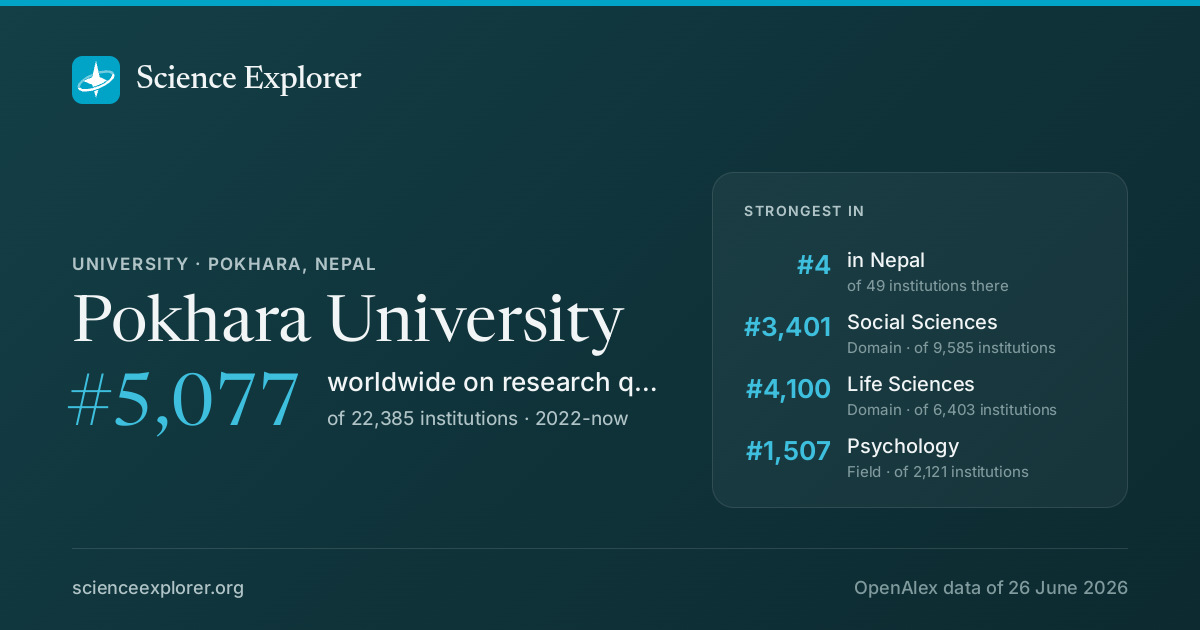
In research, Pokhara University stands highest in Social Sciences (#3,401 of 9,585 worldwide), Life Sciences (#4,100 of 6,403 worldwide) and Psychology (#1,507 of 2,121 worldwide), 2022-now. Relative to its size it is most specialised in Accounting and Management Science and Operations Research (Accounting is 5.4× its share of world research).

World rank, 2022-now
#5,077
of 22,385 · #10,384 all time
Rank in Nepal
#4
of 49
Research works
3.1k
▲ 83% vs 2018-21
Citations
17k
5.5 per fractional work
Top-10% rate
5.5%
all institutions 10.0%
vs its own fields
0.59×
1.00× is exactly expected
Open access
89%
world 40%
International
19%
world 18%

What is Pokhara University known for in research?

The fields where it stands highest, 2022-now, ranked among every institution above the floor in each field.

FieldWorld rankWhere that sitsTop-10% rateWorksAll time
Social SciencesDomain #3,401 of 9,585 4.8%684 #7346
Life SciencesDomain #4,100 of 6,403 9.5%141 #7630
PsychologyField #1,507 of 2,121 6.7%68 #2801
Health ProfessionsField #1,418 of 1,895 6.5%69 #2896
Health SciencesDomain #7,479 of 9,902 4.9%376 #13445
Agricultural and Biological SciencesField #2,397 of 3,157 10.6%84 #3624
Social SciencesField #4,703 of 5,988 5.5%247 #7358
MedicineField #6,748 of 8,541 4.7%281 #12050
Physical SciencesDomain #8,732 of 10,670 4.9%395 #12989
Business, Management and AccountingField #2,144 of 2,581 2.6%156 #3441

Each strip is that field's whole ranked pool, with the notch where Pokhara University sits in it, in the colour of the band that rank falls in. The track under the rate is the rate itself: it carries no average mark, because the average differs by field (from about 6% in Dentistry to 21% in Economics).

Which of those standings moved

The same fields on both windows: where it stood over the whole record, and where it stands in 2022-now. The distance is the story, and it is the one thing the two rank columns above cannot show.

  1. Social Sciences#7,346 #3,401
  2. Life Sciences#7,630 #4,100
  3. Psychology#2,801 #1,507
  4. Health Professions#2,896 #1,418
  5. Health Sciences#13,445 #7,479
  6. Agricultural and Biological Sciences#3,624 #2,397
  7. Social Sciences#7,358 #4,703
  8. Medicine#12,050 #6,748
  9. Physical Sciences#12,989 #8,732
  10. Business, Management and Accounting#3,441 #2,144
all time2022-now, better2022-now, worse

A dot further right is a better standing. Fields it was not ranked in over the whole record are left out.

Which fields of science does Pokhara University work in?

In 2022-now, 42% of research at Pokhara University is in Social Sciences, 25% in Physical Sciences. Its largest fields are Medicine (18%), Social Sciences (15%), Engineering (10%). It does 1.7× the world's share of Social Sciences.

Social Sciences: 736 fractional works · 41.7% of its workSocial Sciences: 273 fractional works · 15.5% of its workSociology and Political Science: 96 fractional works · 5.5% of its workEducation: 57 fractional works · 3.2% of its workDemography: 33 fractional works · 1.9% of its workPolitical Science and International Relations: 21 fractional works · 1.2% of its workGender Studies: 15 fractional works · 0.9% of its workTransportation: 10 fractional works · 0.6% of its workCultural Studies: 6 fractional works · 0.4% of its workHealth: 6 fractional works · 0.3% of its workCommunication: 5 fractional works · 0.3% of its workSafety Research: 5 fractional works · 0.3% of its workUrban Studies: 4 fractional works · 0.2% of its workHuman Factors and Ergonomics: 4 fractional works · 0.2% of its workSmaller subfields together: 10 fractional works · 0.6% of its workBusiness, Management and Accounting: 166 fractional works · 9.4% of its workAccounting: 58 fractional works · 3.3% of its workStrategy and Management: 30 fractional works · 1.7% of its workOrganizational Behavior and Human Resource Management: 26 fractional works · 1.4% of its workMarketing: 21 fractional works · 1.2% of its workManagement of Technology and Innovation: 13 fractional works · 0.7% of its workManagement Information Systems: 10 fractional works · 0.6% of its workBusiness and International Management: 7 fractional works · 0.4% of its workEconomics, Econometrics and Finance: 104 fractional works · 5.9% of its workEconomics and Econometrics: 80 fractional works · 4.5% of its workFinance: 18 fractional works · 1.0% of its workGeneral Economics, Econometrics and Finance: 6 fractional works · 0.3% of its workPsychology: 73 fractional works · 4.1% of its workClinical Psychology: 32 fractional works · 1.8% of its workSocial Psychology: 24 fractional works · 1.3% of its workExperimental and Cognitive Psychology: 6 fractional works · 0.3% of its workDevelopmental and Educational Psychology: 6 fractional works · 0.3% of its workApplied Psychology: 4 fractional works · 0.2% of its workSmaller subfields together: 1 fractional works · 0.1% of its workArts and Humanities: 63 fractional works · 3.6% of its workLiterature and Literary Theory: 22 fractional works · 1.3% of its workPhilosophy: 15 fractional works · 0.8% of its workVisual Arts and Performing Arts: 8 fractional works · 0.5% of its workLanguage and Linguistics: 8 fractional works · 0.5% of its workSmaller subfields together: 10 fractional works · 0.6% of its workDecision Sciences: 56 fractional works · 3.2% of its workManagement Science and Operations Research: 34 fractional works · 1.9% of its workInformation Systems and Management: 19 fractional works · 1.1% of its workSmaller subfields together: 3 fractional works · 0.2% of its workPhysical Sciences: 449 fractional works · 25.5% of its workEngineering: 177 fractional works · 10.0% of its workCivil and Structural Engineering: 64 fractional works · 3.6% of its workBuilding and Construction: 27 fractional works · 1.5% of its workElectrical and Electronic Engineering: 20 fractional works · 1.1% of its workMechanical Engineering: 12 fractional works · 0.7% of its workBiomedical Engineering: 9 fractional works · 0.5% of its workMedia Technology: 8 fractional works · 0.4% of its workControl and Systems Engineering: 7 fractional works · 0.4% of its workAerospace Engineering: 6 fractional works · 0.4% of its workOcean Engineering: 6 fractional works · 0.3% of its workSafety, Risk, Reliability and Quality: 5 fractional works · 0.3% of its workAutomotive Engineering: 4 fractional works · 0.2% of its workMechanics of Materials: 4 fractional works · 0.2% of its workSmaller subfields together: 6 fractional works · 0.3% of its workEnvironmental Science: 111 fractional works · 6.3% of its workManagement, Monitoring, Policy and Law: 23 fractional works · 1.3% of its workGlobal and Planetary Change: 23 fractional works · 1.3% of its workWater Science and Technology: 13 fractional works · 0.7% of its workIndustrial and Manufacturing Engineering: 11 fractional works · 0.6% of its workEcology: 11 fractional works · 0.6% of its workEnvironmental Engineering: 9 fractional works · 0.5% of its workPollution: 6 fractional works · 0.4% of its workHealth, Toxicology and Mutagenesis: 5 fractional works · 0.3% of its workNature and Landscape Conservation: 4 fractional works · 0.2% of its workSmaller subfields together: 6 fractional works · 0.3% of its workComputer Science: 90 fractional works · 5.1% of its workArtificial Intelligence: 36 fractional works · 2.0% of its workInformation Systems: 25 fractional works · 1.4% of its workComputer Vision and Pattern Recognition: 9 fractional works · 0.5% of its workComputer Networks and Communications: 7 fractional works · 0.4% of its workComputer Science Applications: 4 fractional works · 0.2% of its workSmaller subfields together: 9 fractional works · 0.5% of its workMathematics: 19 fractional works · 1.1% of its workApplied Mathematics: 8 fractional works · 0.5% of its workModeling and Simulation: 4 fractional works · 0.2% of its workSmaller subfields together: 7 fractional works · 0.4% of its workMaterials Science: 19 fractional works · 1.1% of its workMaterials Chemistry: 9 fractional works · 0.5% of its workPolymers and Plastics: 4 fractional works · 0.2% of its workSmaller subfields together: 6 fractional works · 0.3% of its workEarth and Planetary Sciences: 14 fractional works · 0.8% of its workAtmospheric Science: 9 fractional works · 0.5% of its workSmaller subfields together: 5 fractional works · 0.3% of its workChemistry: 9 fractional works · 0.5% of its workEnergy: 5 fractional works · 0.3% of its workRenewable Energy, Sustainability and the Environment: 4 fractional works · 0.2% of its workSmaller subfields together: 2 fractional works · 0.1% of its workPhysics and Astronomy: 3 fractional works · 0.2% of its workChemical Engineering: 1 fractional works · 0.1% of its workHealth Sciences: 424 fractional works · 24.1% of its workMedicine: 321 fractional works · 18.2% of its workPublic Health, Environmental and Occupational Health: 47 fractional works · 2.7% of its workSurgery: 35 fractional works · 2.0% of its workEpidemiology: 28 fractional works · 1.6% of its workPediatrics, Perinatology and Child Health: 27 fractional works · 1.5% of its workInfectious Diseases: 18 fractional works · 1.0% of its workEndocrinology, Diabetes and Metabolism: 17 fractional works · 1.0% of its workOncology: 13 fractional works · 0.8% of its workPulmonary and Respiratory Medicine: 13 fractional works · 0.7% of its workCardiology and Cardiovascular Medicine: 11 fractional works · 0.6% of its workRadiology, Nuclear Medicine and Imaging: 9 fractional works · 0.5% of its workPhysiology: 9 fractional works · 0.5% of its workEmergency Medicine: 6 fractional works · 0.4% of its workPharmacology: 6 fractional works · 0.4% of its workNeurology: 6 fractional works · 0.3% of its workObstetrics and Gynecology: 5 fractional works · 0.3% of its workComplementary and alternative medicine: 5 fractional works · 0.3% of its workDermatology: 5 fractional works · 0.3% of its workOphthalmology: 5 fractional works · 0.3% of its workPathology and Forensic Medicine: 5 fractional works · 0.3% of its workPsychiatry and Mental health: 5 fractional works · 0.3% of its workRheumatology: 4 fractional works · 0.3% of its workBiochemistry: 4 fractional works · 0.2% of its workGeriatrics and Gerontology: 4 fractional works · 0.2% of its workSmaller subfields together: 32 fractional works · 1.8% of its workHealth Professions: 75 fractional works · 4.3% of its workGeneral Health Professions: 38 fractional works · 2.2% of its workRadiological and Ultrasound Technology: 10 fractional works · 0.6% of its workHealth Information Management: 8 fractional works · 0.5% of its workEmergency Medical Services: 7 fractional works · 0.4% of its workPhysical Therapy, Sports Therapy and Rehabilitation: 4 fractional works · 0.2% of its workSmaller subfields together: 8 fractional works · 0.4% of its workNursing: 17 fractional works · 1.0% of its workNutrition and Dietetics: 15 fractional works · 0.9% of its workSmaller subfields together: 2 fractional works · 0.1% of its workDentistry: 10 fractional works · 0.6% of its workPeriodontics: 5 fractional works · 0.3% of its workSmaller subfields together: 5 fractional works · 0.3% of its workVeterinary: 1 fractional works · 0.1% of its workLife Sciences: 155 fractional works · 8.8% of its workAgricultural and Biological Sciences: 91 fractional works · 5.1% of its workPlant Science: 31 fractional works · 1.7% of its workFood Science: 16 fractional works · 0.9% of its workGeneral Agricultural and Biological Sciences: 10 fractional works · 0.6% of its workSoil Science: 10 fractional works · 0.6% of its workEcology, Evolution, Behavior and Systematics: 10 fractional works · 0.6% of its workForestry: 4 fractional works · 0.2% of its workSmaller subfields together: 10 fractional works · 0.6% of its workBiochemistry, Genetics and Molecular Biology: 33 fractional works · 1.9% of its workMolecular Biology: 14 fractional works · 0.8% of its workGenetics: 7 fractional works · 0.4% of its workMolecular Medicine: 4 fractional works · 0.2% of its workSmaller subfields together: 8 fractional works · 0.5% of its workImmunology and Microbiology: 11 fractional works · 0.6% of its workImmunology: 4 fractional works · 0.2% of its workSmaller subfields together: 7 fractional works · 0.4% of its workPharmacology, Toxicology and Pharmaceutics: 11 fractional works · 0.6% of its workPharmacology: 6 fractional works · 0.3% of its workSmaller subfields together: 5 fractional works · 0.3% of its workNeuroscience: 9 fractional works · 0.5% of its workCognitive Neuroscience: 4 fractional works · 0.2% of its workNeurology: 4 fractional works · 0.2% of its workSmaller subfields together: 2 fractional works · 0.1% of its workALL ITS WORKPokharaUniversity1,764fractional works, 2022-now
Life Sciences9%Physical Sciences25%Health Sciences24%Social Sciences42%

Each ring splits the one inside it: the four domains of science, their fields, their subfields. Size is fractional works in 2022-now. Every slice is a page; the interactive view zooms down to single topics and colours each by how much more of it this institution does than the world.

Its 4 domains and 26 fields, with their numbers
    1. Social Sciences27315.5%
    2. Business, Management and Accounting1669.4%
    3. Economics, Econometrics and Finance1045.9%
    4. Psychology734.1%
    5. Arts and Humanities633.6%
    6. Decision Sciences563.2%
    1. Engineering17710.0%
    2. Environmental Science1116.3%
    3. Computer Science905.1%
    4. Mathematics191.1%
    5. Materials Science191.1%
    6. Earth and Planetary Sciences140.8%
    7. Chemistry90.5%
    8. Energy50.3%
    9. Physics and Astronomy30.2%
    10. Chemical Engineering10.1%
    1. Medicine32118.2%
    2. Health Professions754.3%
    3. Nursing171.0%
    4. Dentistry100.6%
    5. Veterinary10.1%
    1. Agricultural and Biological Sciences915.1%
    2. Biochemistry, Genetics and Molecular Biology331.9%
    3. Immunology and Microbiology110.6%
    4. Pharmacology, Toxicology and Pharmaceutics110.6%
    5. Neuroscience90.5%
All of science, and how each field's share has moved since 1950: the Science domain explorer

What does Pokhara University specialise in?

Where its research is concentrated relative to its size: Accounting takes 5.4× the share of its output that it takes of world research.

  1. AccountingSubfield · 58.3 works5.4×
  2. Management Science and Operations ResearchSubfield · 34.0 works3.9×
← less than its size predicts1×more →

Location quotient, a volume reading rather than an impact one. It surfaces small, lopsided specialities.

Field profile

Location quotient across every field it publishes in: outside the ring is more than an institution of this size would be expected to publish, inside it is less.

Agricultural and Biological Sciences: 1.08× its world share, 90 worksAgricultural and Bio…Biochemistry, Genetics and Molecular Biology: 0.35× its world share, 33 worksBiochemistry, Geneti…Immunology and Microbiology: 0.63× its world share, 11 worksImmunology and Micro…Neuroscience: 0.32× its world share, 9 worksNeurosciencePharmacology, Toxicology and Pharmaceutics: 1.78× its world share, 11 worksPharmacology, Toxico…Chemical Engineering: 0.15× its world share, 1 worksChemical EngineeringChemistry: 0.32× its world share, 9 worksChemistryComputer Science: 0.66× its world share, 90 worksComputer ScienceEarth and Planetary Sciences: 0.50× its world share, 14 worksEarth and Planetary …Energy: 0.34× its world share, 6 worksEnergyEngineering: 0.67× its world share, 177 worksEngineeringEnvironmental Science: 1.27× its world share, 111 worksEnvironmental ScienceMaterials Science: 0.30× its world share, 19 worksMaterials ScienceMathematics: 0.93× its world share, 19 worksMathematicsPhysics and Astronomy: 0.08× its world share, 3 worksPhysics and AstronomyDentistry: 1.22× its world share, 10 worksDentistryHealth Professions: 1.62× its world share, 75 worksHealth ProfessionsMedicine: 0.95× its world share, 321 worksMedicineNursing: 1.97× its world share, 17 worksNursingVeterinary: 0.39× its world share, 1 worksVeterinaryArts and Humanities: 1.24× its world share, 63 worksArts and HumanitiesBusiness, Management and Accounting: 2.92× its world share, 166 worksBusiness, Management…Decision Sciences: 3.30× its world share, 56 worksDecision SciencesEconomics, Econometrics and Finance: 2.75× its world share, 104 worksEconomics, Econometr…Psychology: 1.35× its world share, 73 worksPsychologySocial Sciences: 1.22× its world share, 273 worksSocial Sciences1×world share
more than its size predictsabout as predictedless

Rings at 0.5×, 1× and 2×. Widest outward: Decision Sciences, 3.3×. Every wedge is a field page.

All 26 fields, with their numbers
  1. Decision Sciences3.30×56 works
  2. Business, Management and Accounting2.92×166 works
  3. Economics, Econometrics and Finance2.75×104 works
  4. Nursing1.97×17 works
  5. Pharmacology, Toxicology and Pharmaceutics1.78×11 works
  6. Health Professions1.62×75 works
  7. Psychology1.35×73 works
  8. Environmental Science1.27×111 works
  9. Arts and Humanities1.24×63 works
  10. Dentistry1.22×10 works
  11. Social Sciences1.22×273 works
  12. Agricultural and Biological Sciences1.08×90 works
  13. Medicine0.95×321 works
  14. Mathematics0.93×19 works
  15. Engineering0.67×177 works
  16. Computer Science0.66×90 works
  17. Immunology and Microbiology0.63×11 works
  18. Earth and Planetary Sciences0.50×14 works
  19. Veterinary0.39×1 works
  20. Biochemistry, Genetics and Molecular Biology0.35×33 works
  21. Energy0.34×6 works
  22. Neuroscience0.32×9 works
  23. Chemistry0.32×9 works
  24. Materials Science0.30×19 works
  25. Chemical Engineering0.15×1 works
  26. Physics and Astronomy0.08×3 works

Who are the top researchers at Pokhara University?

Ranked on the quality score, Santosh Kumar Gurung, Ghanashyam Khanal and Ashmin Hari Bhattarai lead among researchers whose main affiliation is Pokhara University.

  1. 1 Santosh Kumar Gurung Nepal · #1,152,352 worldwide 906 citations · 53 works
  2. 2 Ghanashyam Khanal Nepal · #1,189,745 worldwide 393 citations · 39 works
  3. 3 Ashmin Hari Bhattarai Nepal · #1,367,786 worldwide 286 citations · 19 works
  4. 4 Krishna Bikram Shah Nepal · #2,052,696 worldwide 552 citations · 36 works
  5. 5 Bipindra Pandey Nepal · #2,077,942 worldwide 248 citations · 52 works
  6. 6 Namraj Dhami Nepal · #2,080,267 worldwide 673 citations · 27 works
  7. 7 Biplov Paneru Nepal · #2,087,698 worldwide 404 citations · 96 works
  8. 8 Shishir Paudel Nepal · #2,116,762 worldwide 467 citations · 67 works
  9. 9 Yagyanath Rimal Nepal · #2,138,576 worldwide 405 citations · 47 works
  10. 10 Shalik Ram Dhital Nepal · #2,148,252 worldwide 280 citations · 36 works
All ranked researchers at Pokhara University

What are the most cited papers from Pokhara University?

The most cited paper from Pokhara University is "Method of delivery and pregnancy outcomes in Asia: the WHO global survey on maternal and perinatal health 2007–08" (Pisake Lumbiganon et al., 2010), with 1,124 citations. Next come "Moving beyond essential interventions for reduction of maternal mortality (the WHO Multicountry Survey on Maternal and Newborn Health): a cross-sectional study" (768) and "Water Security in a Changing Environment: Concept, Challenges and Solutions" (585).

Most cited papers
#PaperReleasedCitations
1 Method of delivery and pregnancy outcomes in Asia: the WHO global survey on maternal and perinatal health 2007–08 Pisake Lumbiganon et al. · The Lancet 12 Jan 2010 1,124
2 Moving beyond essential interventions for reduction of maternal mortality (the WHO Multicountry Survey on Maternal and Newborn Health): a cross-sectional study João Paulo Souza et al. · The Lancet Open access May 2013 768
3 Water Security in a Changing Environment: Concept, Challenges and Solutions Binaya Kumar Mishra, Pankaj Kumar, Chitresh Saraswat et al. · Water Open access 14 Feb 2021 585
4 Flood Hazard Mapping and Risk Assessment in Narayani River Basin, Nepal Anil Pangeni, Umesh Bhurtyal, Madan Pokhrel et al. · International Journal of Innovative Science and Research Technology (IJISRT) Open access 15 Dec 2023 447
5 Reactive Oxygen Species: A Key Hallmark of Cardiovascular Disease Nisha Panth, Keshav Raj Paudel, Kalpana Parajuli · Advances in Medicine Open access 2016 407
All 60 most cited papers, with filters and sorting

Which keywords describe research at Pokhara University?

By fractional works in 2022-now, weighted toward what it does more of than the world: Risk Management, Sustainability, Climate Change, Economic Growth, Globalization, Epidemiology, Consumer Behavior and Sustainable Development.

▲ more of its work than of the world's◆ about the world's share▼ less than the world's

Size is fractional works in 2022-now in the topics tagged with each word; colour is the word's share of this institution's work against its share of the world's. The 40 words are chosen for being large and distinctive. Each links to the topic it comes from most.

All 40 words, with their numbers
  1. Sustainability90▲ 2.1×59 topics
  2. Climate Change86▲ 1.79×71 topics
  3. Epidemiology85▲ 1.21×10⁷ topics
  4. Globalization69▲ 1.98×54 topics
  5. Machine Learning67◆ 1.14×63 topics
  6. Risk Management63▲ 7.5×10 topics
  7. Sustainable Development56▲ 2.0×44 topics
  8. Economic Growth54▲ 3.7×24 topics
  9. COVID-1951▲ 2.2×20 topics
  10. Education45▲ 1.49×37 topics
  11. Pandemic43▲ 2.5×10 topics
  12. Environmental Impact43▲ 1.42×36 topics
  13. Supply Chain Management42▲ 2.6×17 topics
  14. Consumer Behavior41▲ 3.7×12 topics
  15. Corporate Governance39▲ 3.0×17 topics
  16. Social Media38▲ 1.56×21 topics
  17. Social Capital35▲ 3.8×14 topics
  18. Innovation34▲ 1.89×27 topics
  19. Economic Development33▲ 2.4×18 topics
  20. Depression33▲ 2.1×17 topics
  21. Financial Performance33▲ 3.3×13 topics
  22. Digital Transformation31▲ 3.2×14 topics
  23. Entrepreneurship28▲ 4.1×11 topics
  24. Conflict25▲ 8.8×7 topics
  25. Customer Satisfaction24▲ 4.3×7 topics
  26. Social Impact24▲ 3.5×9 topics
  27. Financial Stability23▲ 6.8×5 topics
  28. Poverty23▲ 14×4 topics
  29. Technology Acceptance Model22▲ 8.1×2 topics
  30. Finance21▲ 6.4×2 topics
  31. User Satisfaction19▲ 5.6×4 topics
  32. Leadership Style19▲ 7.8×2 topics
  33. COVID-19 Impact18▲ 6.2×6 topics
  34. Financial Markets18▲ 8.4×3 topics
  35. Financial Constraints18▲ 9.7×2 topics
  36. Poverty Reduction17▲ 7.6×5 topics
  37. Construction Projects17▲ 22×2 topics
  38. Investment Decisions17▲ 7.9×2 topics
  39. Consumer Trust17▲ 10×1 topic
  40. Partial Least Squares17▲ 10×1 topic

Which research topics does Pokhara University publish most on?

By volume in 2022-now: Technology Adoption and User Behaviour, COVID-19 Pandemic Impacts, Construction Project Management and Performance and Islamic Finance and Banking Studies.

  1. 1 Technology Adoption and User Behaviour Information Systems and Management 17 works
  2. 2 COVID-19 Pandemic Impacts Economics and Econometrics 16 works
  3. 3 Construction Project Management and Performance Management Science and Operations Research 16 works
  4. 4 Islamic Finance and Banking Studies Accounting 15 works
  5. 5 Microfinance and Financial Inclusion Economics and Econometrics 15 works
  6. 6 Sociopolitical Dynamics in Nepal Demography 14 works
  7. 7 Digital Marketing and Social Media Sociology and Political Science 14 works
  8. 8 Global Maternal and Child Health Pediatrics, Perinatology and Child Health 13 works
  9. 9 Child Nutrition and Water Access Nutrition and Dietetics 12 works
  10. 10 Health and Well-being Studies Clinical Psychology 12 works

How open and international is its research?

Against the world's own shares: the tick on each track. Both are shares of its output, so they sit on one scale and can be read against each other as well as against the world.

openly available88.9%not open11.1%

World: 40% of research is openly available.

with international co-authors18.9%domestic only81.1%

World: 18% is written across borders.

How has Pokhara University's research output changed?

Output in 2022-2025 was 83% higher than in 2018-2021.

still counting1990200020102020
grewheldshrank

The same series as a ribbon: one cell per year, darker for more. The line above answers how much; this answers when.

Its share of all research

Growing output can still be a shrinking share: all of science grows. This is Pokhara University as a percentage of every work published that year, 0.0077% in 2024.

still counting0.0050%0.010%Pokhara University0.0095% in 202519801990200020102020

Fractional works of Pokhara University over all fractional works that year. How the balance of science has shifted.

How much of it reaches the world top 10%

Year by year, against all institutions in the same year.

still counting5%10%15%all institutions10.0% in 2025Pokhara University4.5% in 20252020

Of each year's output, the share that reached the world's 10% most cited for its field and year. Peak 8.7% in 2014.

Other research institutions in Pokhara

All research institutions in Pokhara

Share Pokhara University's ranking

Pokhara University on Science Explorer

A card with Pokhara University's standing and the fields it leads in, for a post or a slide. A link to this page previews as the same card.

Download the card

1200 × 630 PNG, sized for social posts, drawn from the latest snapshot.

Badges for a website1Each links back here and updates with every snapshot

Research measures only: rankings here say nothing about teaching, admissions or student experience. Comparable institutions and collaboration partners have tabs of their own, above.

Discussion

Ask a question or share a note about Pokhara University. Posts are plain text and can be reported.