 Science in Nepal
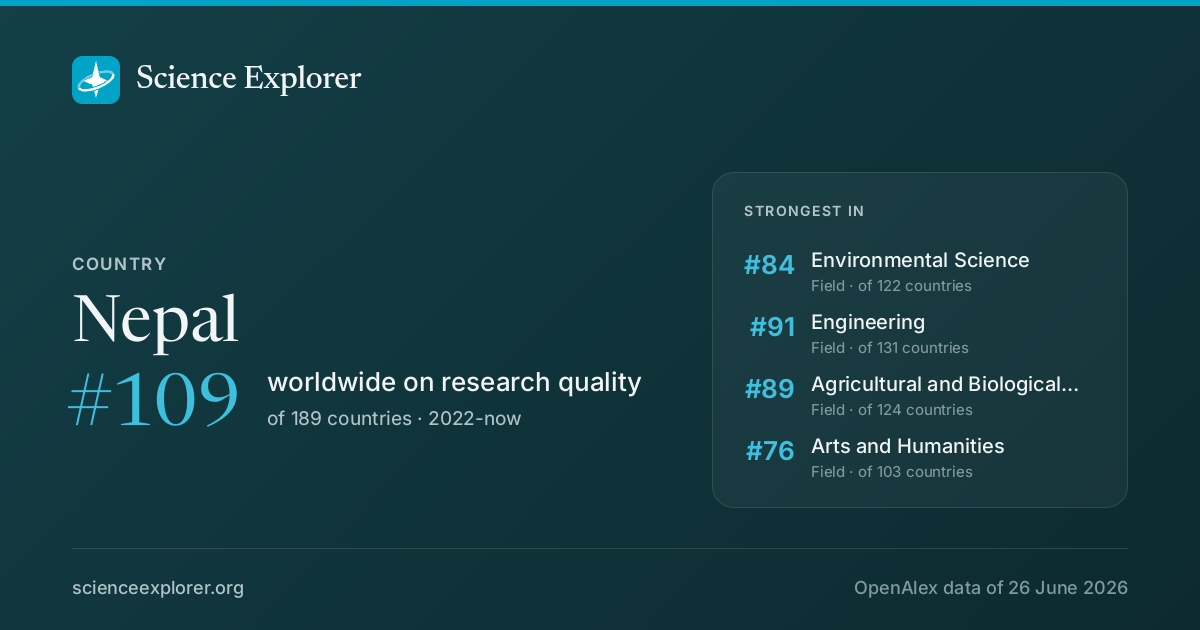
Nepal ranks #109 of 189 countries on research quality in 2022-now (#89 all time), with 33k research works and 4.8% of them in the world's top 10%.
- World rank, 2022-now
- #109 of 189 · #89 all time
- Works, 2022-now
- 33k ▲ 54% vs 2018-21
- Citations
- 597k 7.2 per fractional work, all time
- Top-10% rate
- 4.8% all institutions 10.0%
- vs its own fields
- 0.42× 1.00× is exactly expected
- In the world top 100
- 0 0 in the top 1,000
- Open access
- 76% world 40%
- International
- 25% world 18%
NepalWhat is Nepal strongest at in science?
On research quality in 2022-now, Nepal ranks highest in Environmental Science (#84 of 122), Engineering (#91 of 131) and Agricultural and Biological Sciences (#89 of 124). Relative to its size it is most specialised in Drug Discovery, Applied Microbiology and Biotechnology and General Dentistry.
| Field | World rank | Where that sits | Top-10% rate | Works | All time | Institutions |
|---|---|---|---|---|---|---|
| Environmental ScienceField | #84 of 122 | 5.1% | 1,912 | #77 | Institutions | |
| EngineeringField | #91 of 131 | 4.5% | 3,089 | #87 | Institutions | |
| Agricultural and Biological SciencesField | #89 of 124 | 5.5% | 2,755 | #85 | Institutions | |
| Arts and HumanitiesField | #76 of 103 | 6.8% | 990 | #86 | Institutions | |
| Materials ScienceField | #66 of 87 | 6.2% | 494 | #73 | Institutions | |
| ChemistryField | #54 of 71 | 9.4% | 245 | #56 | Institutions | |
| Biochemistry, Genetics and Molecular BiologyField | #82 of 105 | 4.9% | 1,008 | #74 | Institutions | |
| Health ProfessionsField | #84 of 106 | 6.7% | 1,182 | #78 | Institutions | |
| EducationSubfield | #90 of 112 | 7.5% | 1,050 | #84 | Institutions | |
| OphthalmologySubfield | #35 of 43 | 2.8% | 206 | - | ||
| Decision SciencesField | #62 of 76 | 4.9% | 458 | - | Institutions | |
| Earth and Planetary SciencesField | #64 of 78 | 6.0% | 253 | #59 | Institutions |
Where its research is concentrated
Location quotient: how much more (or less) of each node it does than its size predicts. Drawn around 1×, where "twice the world share" and "half of it" are the same distance apart in opposite directions. A volume reading, which on a country axis is largely population and industrial structure.
- Drug DiscoverySubfield · 28.7 works · #11 of 152 active here9.1×
- Applied Microbiology and BiotechnologySubfield · 87.2 works · #32 of 202 active here4.7×
- General DentistrySubfield · 64.1 works · #32 of 177 active here4.0×
- MicrobiologySubfield · 6.6 works · #35 of 137 active here3.0×
- Agronomy and Crop ScienceSubfield · 250.7 works · #37 of 206 active here2.9×
- PeriodonticsSubfield · 140.4 works · #40 of 194 active here2.8×
- Emergency MedicineSubfield · 224.9 works · #45 of 212 active here2.5×
- Ecological ModelingSubfield · 68.9 works · #41 of 210 active here2.4×
The whole field profile
All 26 fields at once. A specialist and a generalist produce the same ranked list and a completely different shape.
Rings at 0.5×, 1× and 2×. Widest outward: Dentistry, 2.4×. Every wedge is a field page.
All 26 fields, with their numbers
- Dentistry2.37×426 works
- Agricultural and Biological Sciences1.76×3,092 works
- Nursing1.74×316 works
- Economics, Econometrics and Finance1.57×1,249 works
- Decision Sciences1.42×509 works
- Medicine1.35×9,635 works
- Health Professions1.34×1,308 works
- Pharmacology, Toxicology and Pharmaceutics1.27×166 works
- Business, Management and Accounting1.27×1,519 works
- Environmental Science1.19×2,198 works
- Veterinary1.07×54 works
- Arts and Humanities1.01×1,084 works
- Psychology1.00×1,131 works
- Social Sciences0.97×4,560 works
- Immunology and Microbiology0.95×355 works
- Computer Science0.86×2,480 works
- Mathematics0.71×310 works
- Engineering0.65×3,608 works
- Biochemistry, Genetics and Molecular Biology0.59×1,157 works
- Energy0.55×188 works
- Earth and Planetary Sciences0.51×298 works
- Chemistry0.48×278 works
- Neuroscience0.46×276 works
- Materials Science0.45×580 works
- Chemical Engineering0.35×45 works
- Physics and Astronomy0.28×228 works
Which fields of science does Nepal work in?
In 2022-now, 32% of research in Nepal is in Health Sciences, 28% in Physical Sciences. Its largest fields are Medicine (26%), Social Sciences (12%), Engineering (10%). It does 1.4× the world's share of Health Sciences.
Each ring splits the one inside it: the four domains of science, their fields, their subfields. Size is fractional works in 2022-now. Every slice is a page; the interactive view zooms down to single topics and colours each by how much more of it this country does than the world.
Its 4 domains and 26 fields, with their numbers
- Health Sciences12k31.7%
- Medicine9,63526.0%
- Health Professions1,3083.5%
- Dentistry4261.2%
- Nursing3160.9%
- Veterinary540.1%
- Physical Sciences10k27.6%
- Engineering3,6089.7%
- Computer Science2,4806.7%
- Environmental Science2,1985.9%
- Materials Science5801.6%
- Mathematics3100.8%
- Earth and Planetary Sciences2980.8%
- Chemistry2780.8%
- Physics and Astronomy2280.6%
- Energy1880.5%
- Chemical Engineering450.1%
- Social Sciences10k27.1%
- Social Sciences4,56012.3%
- Business, Management and Accounting1,5194.1%
- Economics, Econometrics and Finance1,2493.4%
- Psychology1,1313.1%
- Arts and Humanities1,0842.9%
- Decision Sciences5091.4%
- Life Sciences5,04513.6%
Which keywords describe research in Nepal?
By fractional works in 2022-now, weighted toward what it does more of than the world: Epidemiology, Climate Change, Globalization, Machine Learning, Conflict, Deep Learning, Sustainability and COVID-19.
- Health Systems
- Health Inequalities
- Youth Employment
- Identity Politics
- Maternal Mortality
- IoT
- Poverty
- Food Security
- Depression
- Conflict
- Remote Sensing
- Pandemic
- Diagnosis
- Sustainable Development
- Environmental Impact
- Treatment
- COVID-19
- Sustainability
- Deep Learning
- Climate Change
- Epidemiology
- Machine Learning
- Globalization
- Education
- Public Health
- Economic Growth
- Quality of Life
- Risk Factors
- Mental Health
- Renewable Energy
- Healthcare
- Cardiovascular Disease
- Management
- Risk Management
- Social Inequality
- Surgical Management
- Democratization
- Maoist Insurgency
- Community Health Workers
- Child Mortality
Size is fractional works in 2022-now in the topics tagged with each word; colour is the word's share of this country's work against its share of the world's. The 40 words are chosen for being large and distinctive. Each links to the topic it comes from most.
All 40 words, with their numbers
- Epidemiology2,371▲ 1.61×135 topics
- Climate Change1,795▲ 1.78×118 topics
- Machine Learning1,547▲ 1.25×96 topics
- Deep Learning1,443◆ 1.13×85 topics
- Globalization1,274▲ 1.75×120 topics
- Sustainability1,243▲ 1.37×10⁷ topics
- Education906▲ 1.42×10⁷ topics
- COVID-19880▲ 1.83×31 topics
- Public Health754▲ 1.40×62 topics
- Treatment745▲ 1.65×52 topics
- Economic Growth711▲ 2.4×32 topics
- Environmental Impact703◆ 1.11×69 topics
- Quality of Life697▲ 1.30×57 topics
- Sustainable Development675▲ 1.16×94 topics
- Risk Factors662▲ 1.62×37 topics
- Diagnosis650▲ 1.88×41 topics
- Mental Health633▲ 1.19×45 topics
- Pandemic632▲ 1.72×13 topics
- Renewable Energy608◆ 1.13×55 topics
- Remote Sensing576▲ 1.27×42 topics
- Healthcare552▲ 1.31×38 topics
- Conflict544▲ 9.1×10 topics
- Cardiovascular Disease520▲ 1.23×39 topics
- Depression498▲ 1.53×25 topics
- Management494▲ 1.67×38 topics
- Food Security480▲ 2.4×22 topics
- Risk Management469▲ 2.7×17 topics
- Poverty416▲ 12×5 topics
- Social Inequality376▲ 3.8×11 topics
- IoT364▲ 2.6×19 topics
- Surgical Management362▲ 2.4×20 topics
- Maternal Mortality338▲ 4.1×5 topics
- Democratization326▲ 13×4 topics
- Identity Politics315▲ 18×3 topics
- Maoist Insurgency315▲ 161×1 topic
- Youth Employment315▲ 42×1 topic
- Community Health Workers245▲ 7.5×2 topics
- Health Inequalities239▲ 5.3×5 topics
- Child Mortality216▲ 8.1×1 topic
- Health Systems216▲ 8.1×1 topic
Which research topics does Nepal publish the most in?
Its largest topics in 2022-now are Sociopolitical Dynamics in Nepal, Global Maternal and Child Health, Child Nutrition and Water Access.
Area is fractional works in 2022-now; colour is the subfield each topic belongs to. Every tile is a topic page.
- 1 Sociopolitical Dynamics in Nepal Demography 315 works
- 2 Global Maternal and Child Health Pediatrics, Perinatology and Child Health 216 works
- 3 Child Nutrition and Water Access Nutrition and Dietetics 177 works
- 4 COVID-19 Pandemic Impacts Economics and Econometrics 164 works
- 5 South Asian Studies and Conflicts Political Science and International Relations 150 works
- 6 Technology-Enhanced Education Studies Education 140 works
- 7 Health and Well-being Studies Clinical Psychology 133 works
- 8 Agricultural Economics and Practices General Agricultural and Biological Sciences 125 works
- 9 Fiscal Policy and Economic Growth Economics and Econometrics 124 works
- 10 Crop Yield and Soil Fertility Agronomy and Crop Science 124 works
- 11 Smart Agriculture and AI Plant Science 121 works
- 12 Diverse Scientific Research Studies General Health Professions 121 works
Which universities in Nepal lead research?
Tribhuvan University, College of Medical Sciences and Nepal Development Research Institute rank highest in Nepal on research quality in 2022-now.
One dot per institution in the list below. The upper left is the interesting corner.
- 1Tribhuvan UniversityUniversity · Kathmandu · #1,981 worldwide4.7% top 10% · 16k works
- 2College of Medical SciencesHospital / health system · Bharatpur · #4,501 worldwide4.8% top 10% · 558 works
- 3Nepal Development Research InstituteNonprofit · Kathmandu · #4,724 worldwide8.8% top 10% · 409 works
- 4Pokhara UniversityUniversity · Pokhara · #5,077 worldwide5.3% top 10% · 1.6k works
- 5Purbanchal UniversityUniversity · Biratnagar · #6,855 worldwide6.5% top 10% · 334 works
- 6Agriculture and Forestry UniversityUniversity · Bharatpur · #6,964 worldwide5.3% top 10% · 1.4k works
- 7Government of NepalGovernment institution · Kathmandu · #7,096 worldwide6.0% top 10% · 333 works
- 8Far-western UniversityUniversity · Mahendranagar · #7,602 worldwide7.9% top 10% · 345 works
- 9Nepal Academy of Science and TechnologyUniversity · Kathmandu · #8,078 worldwide7.3% top 10% · 288 works
- 10Mid-West UniversityUniversity · Birendranagar · #8,110 worldwide3.5% top 10% · 452 works
- 11Bhaktapur Cancer HospitalHospital / health system · Bhaktapur · #8,503 worldwide5.5% top 10% · 262 works
- 12Department of Health ServicesGovernment institution · Kathmandu · #8,507 worldwide13.4% top 10% · 236 works
- 13Kathmandu UniversityUniversity · Kathmandu · #9,558 worldwide4.3% top 10% · 4k works
- 14Patan HospitalHospital / health system · Kathmandu · #10,495 worldwide4.7% top 10% · 220 works
- 15Nepal Agricultural Research CouncilGovernment institution · Kathmandu · #11,625 worldwide4.6% top 10% · 432 works
The track on each row is its top-10% rate; the tick is the average of all institutions, 10.0% (how it is set): teal above it, red below.
All ranked institutions in NepalWho are the top researchers in Nepal?
Meghnath Dhimal, Arun Bhakta Shrestha and Mandira Lamichhane Dhimal rank highest among researchers based in Nepal.
- 1 Meghnath Dhimal #20,212 worldwide 83k citations · 338 works
- 2 Arun Bhakta Shrestha #60,021 worldwide 17k citations · 187 works
- 3 Mandira Lamichhane Dhimal #65,202 worldwide 21k citations · 63 works
- 4 Krishna Kumar Aryal #72,386 worldwide 11k citations · 105 works
- 5 Santosh Nepal #88,994 worldwide 6.7k citations · 130 works
- 6 Dinesh Bhandari #89,633 worldwide 49k citations · 93 works
- 7 Suresh Mehata #104,958 worldwide 56k citations · 111 works
- 8 Uttam Paudel #117,974 worldwide 23k citations · 48 works
- 9 J. M. Shea #126,502 worldwide 6.2k citations · 118 works
- 10 E. S. Anderson #140,946 worldwide 6.5k citations · 119 works
Which cities in Nepal are research hubs?
How open and international is Nepal's research?
76% of its research is openly available (world: 40%), and 25% is written with international co-authors (world: 18%).
World: 40% of research is openly available.
World: 18% is written across borders.
In 2022-now, 85% of its research is openly available (world 63%) and 24% is written with co-authors abroad (world 22%). Against what its own mix of topics predicts, that is 1.28× the expected open access and 1.11× the expected international share, which puts it #28 of 173 countries on openness.
How has Nepal's research grown?
Output in 2022-2025 was 54% higher than in 2018-2021.
The same series as a ribbon: one cell per year, darker for more. The line above answers how much; this answers when.
Its share of all research
Growing output can still be a shrinking share: all of science grows. This is Nepal as a percentage of every work published that year, 0.16% in 2024.
Fractional works of Nepal over all fractional works that year. How the balance of science has shifted.
How much of it reaches the world top 10%
Over the whole record, 5.2% of its 83k works since 1950 reached the world top 10% for their field and year.
Of each year's output, the share that reached the world's 10% most cited for its field and year. Peak 10.5% in 1994.
Which countries have research most like Nepal's?
Cambodia is Nepal's closest research twin: of all countries, its research is spread across the fields most like Nepal's, with both strong in Nursing.
- 1
 CambodiaBoth strong in Nursing, Dentistry, Medicine
0.91 Compare
- 2
 ZambiaBoth strong in Agricultural and Biological Sciences, Nursing, Economics, Econometrics and Finance
0.85 Compare
- 3
 SomaliaBoth strong in Nursing, Economics, Econometrics and Finance, Medicine
0.84 Compare
- 4
 AfghanistanBoth strong in Dentistry, Nursing, Economics, Econometrics and Finance
0.84 Compare
- 5
 ParaguayBoth strong in Dentistry, Economics, Econometrics and Finance, Agricultural and Biological Sciences
0.83 Compare
Similarity is the correlation of each side's location quotients across every field it publishes in, on a log scale: 1 is the same shape of research, 0 is unrelated. It ignores size. How it is measured.
Compare Nepal with
 Saint Kitts and Nevis
 Sudan
 Mongolia
 Angola
 Sierra Leone
Share Nepal's ranking
Badges for a website1Each links back here and updates with every snapshot

Research fields in Nepal
- Physical Sciences
- Environmental Science
- Engineering
- Agricultural and Biological Sciences
- Arts and Humanities
- Life Sciences
- Materials Science
- Chemistry
- Biochemistry, Genetics and Molecular Biology
- Health Professions
- Education
- Social Sciences
- Decision Sciences
- Earth and Planetary Sciences
- Psychology
- Plant Science
- Medicine
- Social Sciences
- Political Science and International Relations
- Global and Planetary Change
- Molecular Biology
- Health Sciences
- Sociology and Political Science
- General Agricultural and Biological Sciences
- Literature and Literary Theory
- Pulmonary and Respiratory Medicine
- General Health Professions
- Economics, Econometrics and Finance
- Clinical Psychology
- Computer Science
- Surgery
- Cardiology and Cardiovascular Medicine
- Endocrinology, Diabetes and Metabolism
- Pediatrics, Perinatology and Child Health
- Biomedical Engineering
- Dentistry
- Radiology, Nuclear Medicine and Imaging
- Management, Monitoring, Policy and Law
- Electrical and Electronic Engineering
- Demography
- Genetics
- Ecology, Evolution, Behavior and Systematics
- Neurology
- Materials Chemistry
- Immunology and Microbiology
- Public Health, Environmental and Occupational Health
- Water Science and Technology
- Social Psychology
- Nutrition and Dietetics
- Epidemiology
- Information Systems
- Oncology
- Agronomy and Crop Science
- Ecology
- Infectious Diseases
- Building and Construction
- Civil and Structural Engineering
- Organizational Behavior and Human Resource Management
- Business, Management and Accounting
- Computer Networks and Communications
Questions people ask
What is Nepal strongest at in science?
On research quality in 2022-now, Nepal ranks highest in Environmental Science (#84 of 122), Engineering (#91 of 131) and Agricultural and Biological Sciences (#89 of 124). Relative to its size it is most specialised in Drug Discovery, Applied Microbiology and Biotechnology and General Dentistry.
See the full answerDiscussion
Ask a question or share a note about Nepal. Keep it to the research: no personal attacks, advertising or links. Any reader can report a post, which collapses it for everyone until it is opened.