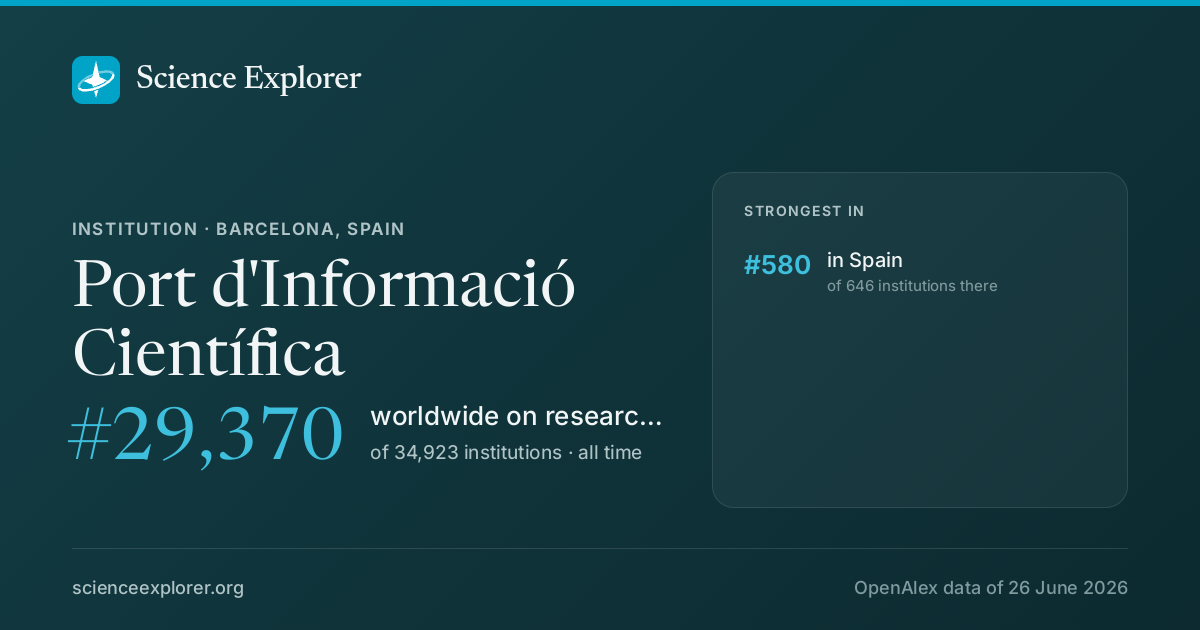
- World rank, all time
- #29,370 of 34,923
- Rank in Spain
- #580 of 646
- Research works
- 129 ▲ 40% vs 2018-21
- Citations
- 921 7.1 per fractional work
- Top-10% rate
- 7.1% all institutions 10.0%
- vs its own fields
- 1.00× 1.00× is exactly expected
- Open access
- 83% world 40%
- International
- 51% world 18%
Which fields of science does Port d'Informació Científica work in?
In 2022-now, 29% of research at Port d'Informació Científica is in Physical Sciences, 29% in Social Sciences. Its largest fields are Agricultural and Biological Sciences (20%), Social Sciences (17%), Computer Science (16%). It does 1.6× the world's share of Life Sciences.
Each ring splits the one inside it: the four domains of science, their fields, their subfields. Size is fractional works in 2022-now. Every slice is a page; the interactive view zooms down to single topics and colours each by how much more of it this institution does than the world.
Its 4 domains and 20 fields, with their numbers
- Physical Sciences1629.3%
- Computer Science916.4%
- Physics and Astronomy47.4%
- Engineering23.1%
- Environmental Science11.1%
- Materials Science00.9%
- Mathematics00.4%
- Chemistry00.0%
- Earth and Planetary Sciences00.0%
- Social Sciences1628.8%
- Social Sciences917.2%
- Decision Sciences46.8%
- Arts and Humanities12.3%
- Psychology12.1%
- Economics, Econometrics and Finance00.3%
- Life Sciences1324.0%
- Health Sciences1017.9%
- Veterinary59.5%
- Medicine46.8%
- Health Professions11.3%
- Dentistry00.1%
- Nursing00.1%
Field profile
Location quotient across every field it publishes in: outside the ring is more than an institution of this size would be expected to publish, inside it is less.
Rings at 0.5×, 1× and 2×. Widest outward: Veterinary, 70.1×. Every wedge is a field page.
All 20 fields, with their numbers
- Veterinary70.09×5 works
- Decision Sciences7.00×4 works
- Agricultural and Biological Sciences4.15×11 works
- Physics and Astronomy3.31×4 works
- Computer Science2.11×9 works
- Social Sciences1.36×10 works
- Biochemistry, Genetics and Molecular Biology0.81×2 works
- Arts and Humanities0.81×1 works
- Psychology0.69×1 works
- Health Professions0.48×1 works
- Medicine0.35×4 works
- Mathematics0.31×0 works
- Dentistry0.31×0 works
- Nursing0.31×0 works
- Materials Science0.25×0 works
- Environmental Science0.23×1 works
- Engineering0.21×2 works
- Economics, Econometrics and Finance0.14×0 works
- Chemistry0.01×0 works
- Earth and Planetary Sciences0.01×0 works
- Veterinary 70.1×
- Decision Sciences 7.0×
- Agricultural and Biological Sciences 4.2×
- Physics and Astronomy 3.3×
- Computer Science 2.1×
- Social Sciences 1.4×
- Biochemistry, Genetics and Molecular Biology 0.8×
- Arts and Humanities 0.8×
- Psychology 0.7×
- Health Professions 0.5×
- Medicine 0.3×
- Mathematics 0.3×
- Dentistry 0.3×
- Nursing 0.3×
- Materials Science 0.2×
- Environmental Science 0.2×
- Engineering 0.2×
- Economics, Econometrics and Finance 0.1×
- Chemistry 0.0×
- Earth and Planetary Sciences 0.0×
Who are the top researchers at Port d'Informació Científica?
Ranked on the quality score, Jordi Camp Montoro and Jiyao Guo lead among researchers whose main affiliation is Port d'Informació Científica.
- 1
Jordi Camp Montoro
 Spain · #4,733,795 worldwide
152 citations · 37 works
- 2
Jiyao Guo
Spain · #5,102,328 worldwide
49 citations · 26 works
Which keywords describe research at Port d'Informació Científica?
By fractional works in 2022-now, weighted toward what it does more of than the world: Heat Stress, Gut Microbiota, Probiotics, Amino Acids, Antibiotic Alternatives, Animal Welfare, Emotional State and Stress Indicators.
- Scientific Workflows
- Reproducibility
- Crowdsourcing
- Scholarly Communication
- Bioinformatics
- Meat Quality
- Dark Matter
- Collaboration
- Distributed Storage
- Distributed Systems
- Research Evaluation
- Social Inequality
- Parallel Computing
- High-Performance Computing
- Media Studies
- Workflow Management
- Stress Indicators
- Animal Welfare
- Antibiotic Alternatives
- Gut Microbiota
- Heat Stress
- Amino Acids
- Probiotics
- Emotional State
- Social Media
- Digital Communication
- Bibliometric Analysis
- Interdisciplinary Research
- Research Integrity
- Digital Repositories
- Scientific Impact
- Grid Computing
- Network Coding
- Dairy Cattle
- Latin America
- Ontologies
- Peer Review
- Academic Dishonesty
- Plagiarism
- Residential
Size is fractional works in 2022-now in the topics tagged with each word; colour is the word's share of this institution's work against its share of the world's. The 40 words are chosen for being large and distinctive. Each links to the topic it comes from most.
All 40 words, with their numbers
- Heat Stress7▲ 157×2 topics
- Gut Microbiota6▲ 34×2 topics
- Amino Acids6▲ 119×1 topic
- Antibiotic Alternatives6▲ 207×1 topic
- Probiotics6▲ 48×2 topics
- Animal Welfare6▲ 122×2 topics
- Emotional State5▲ 309×1 topic
- Stress Indicators5▲ 309×1 topic
- Social Media3▲ 3.4×3 topics
- Workflow Management2▲ 62×2 topics
- Digital Communication2▲ 54×1 topic
- Media Studies2▲ 58×1 topic
- Bibliometric Analysis2▲ 62×2 topics
- High-Performance Computing2▲ 40×2 topics
- Interdisciplinary Research2▲ 36×2 topics
- Parallel Computing2▲ 26×2 topics
- Research Integrity2▲ 98×2 topics
- Social Inequality2▲ 12×4 topics
- Digital Repositories2▲ 87×2 topics
- Research Evaluation2▲ 117×1 topic
- Scientific Impact2▲ 117×1 topic
- Distributed Systems1▲ 15×1 topic
- Grid Computing1▲ 79×1 topic
- Distributed Storage1▲ 89×1 topic
- Network Coding1▲ 53×1 topic
- Collaboration1▲ 46×3 topics
- Dairy Cattle1▲ 40×2 topics
- Dark Matter1▲ 19×3 topics
- Latin America1▲ 11×2 topics
- Meat Quality1▲ 29×2 topics
- Ontologies1▲ 37×2 topics
- Bioinformatics1▲ 16×2 topics
- Peer Review1▲ 56×2 topics
- Scholarly Communication1▲ 65×2 topics
- Academic Dishonesty1▲ 125×1 topic
- Crowdsourcing1▲ 27×2 topics
- Plagiarism1▲ 125×1 topic
- Reproducibility1▲ 48×1 topic
- Residential1▲ 102×1 topic
- Scientific Workflows1▲ 48×1 topic
Which research topics does Port d'Informació Científica publish most on?
By volume in 2022-now: Animal Nutrition and Physiology, Animal Behavior and Welfare Studies, Media and Digital Communication and scientometrics and bibliometrics research.
Area is fractional works; colour is the subfield each topic belongs to.
- 1 Animal Nutrition and Physiology Animal Science and Zoology 6 works
- 2 Animal Behavior and Welfare Studies Small Animals 5 works
- 3 Media and Digital Communication Computer Networks and Communications 2 works
- 4 scientometrics and bibliometrics research Statistics, Probability and Uncertainty 2 works
- 5 Distributed and Parallel Computing Systems Computer Networks and Communications 1 works
- 6 Advanced Data Storage Technologies Computer Networks and Communications 1 works
- 7 Scientific Computing and Data Management Information Systems and Management 1 works
- 8 Latin American Urban Studies Urban Studies 1 works
- 9 Academic integrity and plagiarism Safety Research 1 works
- 10 Pharmacological Effects and Assays Animal Science and Zoology 1 works
How open and international is its research?
Against the world's own shares: the tick on each track. Both are shares of its output, so they sit on one scale and can be read against each other as well as against the world.
World: 40% of research is openly available.
World: 18% is written across borders.
How has Port d'Informació Científica's research output changed?
Output in 2022-2025 was 40% higher than in 2018-2021.
The same series as a ribbon: one cell per year, darker for more. The line above answers how much; this answers when.
Its share of all research
Growing output can still be a shrinking share: all of science grows. This is Port d'Informació Científica as a percentage of every work published that year, 0.00022% in 2024.
Fractional works of Port d'Informació Científica over all fractional works that year. How the balance of science has shifted.
Other research institutions in Barcelona
- Universitat de Barcelona
- Universitat Politècnica de Catalunya
- Universitat Pompeu Fabra
- CERCA Institution
- Vall d'Hebron Hospital Universitari
- Hospital de Sant Pau
- Universitat Oberta de Catalunya
- Institució Catalana de Recerca i Estudis Avançats


Share Port d'Informació Científica's ranking
Badges for a website1Each links back here and updates with every snapshot

Research measures only: rankings here say nothing about teaching, admissions or student experience. Comparable institutions and collaboration partners have tabs of their own, above.
Discussion
Ask a question or share a note about Port d'Informació Científica. Keep it to the research: no personal attacks, advertising or links. Any reader can report a post, which collapses it for everyone until it is opened.