Reef Ecologic
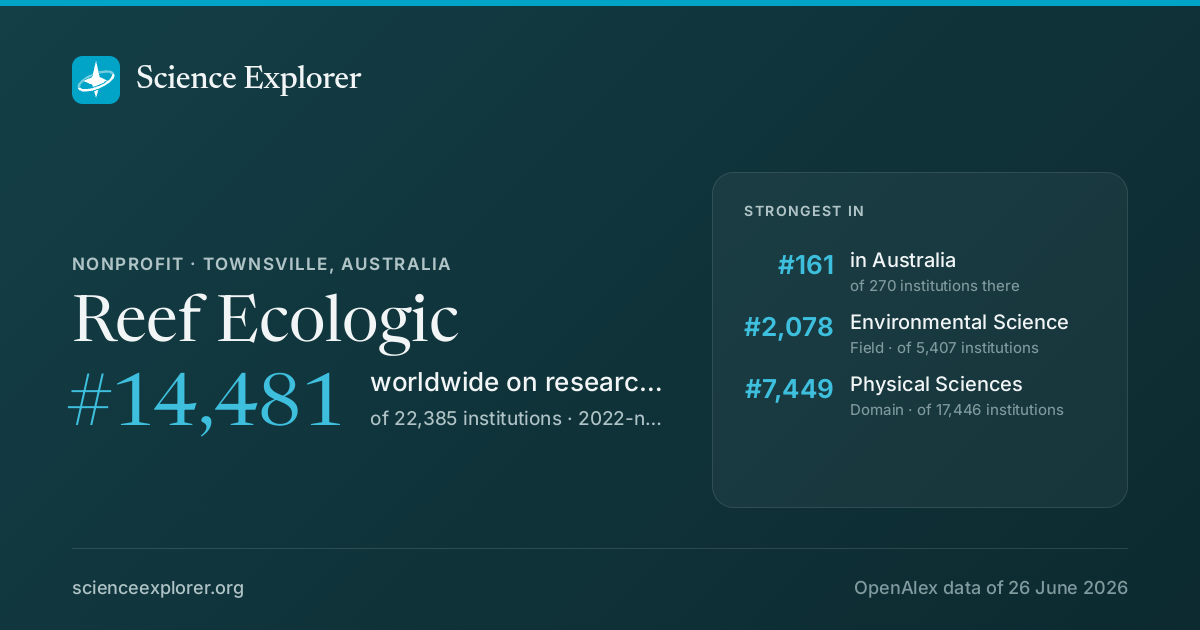
In research, Reef Ecologic stands highest in Environmental Science (#2,078 of 5,407 worldwide) and Physical Sciences (#7,449 of 17,446 worldwide), over all time.
- World rank, 2022-now
- #14,481 of 22,385 · #11,289 all time
- Rank in Australia
- #161 of 270
- Research works
- 590 ▼ 2% vs 2018-21
- Citations
- 12k 20.0 per fractional work
- Top-10% rate
- 10.5% all institutions 10.0%
- vs its own fields
- 1.04× 1.00× is exactly expected
- Open access
- 41% world 40%
- International
- 23% world 18%
What is Reef Ecologic known for in research?
The fields where it stands highest, over all time, ranked among every institution above the floor in each field.
| Field | World rank | Where that sits | Top-10% rate | Works |
|---|---|---|---|---|
| Environmental ScienceField | #2,078 of 5,407 | 15.5% | 161 | |
| Physical SciencesDomain | #7,449 of 17,446 | 13.0% | 327 |
Each strip is that field's whole ranked pool, with the notch where Reef Ecologic sits in it, in the colour of the band that rank falls in. The track under the rate is the rate itself: it carries no average mark, because the average differs by field (from about 6% in Dentistry to 21% in Economics).
Which fields of science does Reef Ecologic work in?
In 2022-now, 50% of research at Reef Ecologic is in Physical Sciences, 23% in Health Sciences. Its largest fields are Environmental Science (24%), Health Professions (17%), Engineering (13%). It does 1.3× the world's share of Physical Sciences.
Each ring splits the one inside it: the four domains of science, their fields, their subfields. Size is fractional works in 2022-now. Every slice is a page; the interactive view zooms down to single topics and colours each by how much more of it this institution does than the world.
Its 4 domains and 25 fields, with their numbers
- Physical Sciences6249.9%
- Environmental Science3024.3%
- Engineering1713.5%
- Earth and Planetary Sciences64.5%
- Computer Science43.4%
- Energy21.3%
- Materials Science21.2%
- Physics and Astronomy10.8%
- Chemistry10.8%
- Chemical Engineering00.1%
- Health Sciences2923.3%
- Health Professions2116.7%
- Medicine75.3%
- Veterinary11.0%
- Nursing00.2%
- Dentistry00.1%
- Social Sciences1714.1%
- Life Sciences1612.7%
Field profile
Location quotient across every field it publishes in: outside the ring is more than an institution of this size would be expected to publish, inside it is less.
Rings at 0.5×, 1× and 2×. Widest outward: Veterinary, 7.7×. Every wedge is a field page.
All 25 fields, with their numbers
- Veterinary7.68×1 works
- Health Professions6.33×21 works
- Environmental Science4.89×30 works
- Earth and Planetary Sciences2.88×6 works
- Arts and Humanities2.82×10 works
- Immunology and Microbiology2.01×2 works
- Energy1.41×2 works
- Agricultural and Biological Sciences1.32×8 works
- Engineering0.90×17 works
- Decision Sciences0.82×1 works
- Biochemistry, Genetics and Molecular Biology0.62×4 works
- Neuroscience0.60×1 works
- Economics, Econometrics and Finance0.54×1 works
- Chemistry0.49×1 works
- Computer Science0.44×4 works
- Psychology0.41×2 works
- Chemical Engineering0.39×0 works
- Physics and Astronomy0.37×1 works
- Materials Science0.35×2 works
- Pharmacology, Toxicology and Pharmaceutics0.34×0 works
- Nursing0.31×0 works
- Medicine0.27×6 works
- Dentistry0.23×0 works
- Social Sciences0.18×3 works
- Business, Management and Accounting0.15×1 works
- Veterinary 7.7×
- Health Professions 6.3×
- Environmental Science 4.9×
- Earth and Planetary Sciences 2.9×
- Arts and Humanities 2.8×
- Immunology and Microbiology 2.0×
- Energy 1.4×
- Agricultural and Biological Sciences 1.3×
- Engineering 0.9×
- Decision Sciences 0.8×
- Biochemistry, Genetics and Molecular Biology 0.6×
- Neuroscience 0.6×
- Economics, Econometrics and Finance 0.5×
- Chemistry 0.5×
- Computer Science 0.4×
- Psychology 0.4×
- Chemical Engineering 0.4×
- Physics and Astronomy 0.4×
- Materials Science 0.3×
- Pharmacology, Toxicology and Pharmaceutics 0.3×
- Nursing 0.3×
- Medicine 0.3×
- Dentistry 0.2×
- Social Sciences 0.2×
- Business, Management and Accounting 0.1×
Who are the top researchers at Reef Ecologic?
Ranked on the quality score, Jonathan Hanger, Nathan A. Cook and John Trudinger lead among researchers whose main affiliation is Reef Ecologic.
- 1
Jonathan Hanger
 Australia · #1,707,302 worldwide
593 citations · 15 works
- 2
Nathan A. Cook
Australia · #2,093,317 worldwide
1.1k citations · 25 works
- 3
John Trudinger
Australia · #2,238,778 worldwide
514 citations · 67 works
- 4
Omid Ansari
Australia · #2,642,201 worldwide
521 citations · 18 works
- 5
Jon J. Hanger
Australia · #3,028,819 worldwide
1.7k citations · 65 works
- 6
Adam Kingsley Smith
Australia · #3,524,201 worldwide
2.5k citations · 106 works
- 7
Paul Downton
Australia · #3,546,270 worldwide
289 citations · 44 works
- 8
Pekka Matilainen
Australia · #4,282,673 worldwide
205 citations · 20 works
- 9
Stephen S. Phillips
Australia · #4,322,347 worldwide
635 citations · 38 works
- 10
Steve Raaymakers
Australia · #4,327,442 worldwide
296 citations · 21 works
Which keywords describe research at Reef Ecologic?
By fractional works in 2022-now, weighted toward what it does more of than the world: Climate Change, History, Narrative, Medical Ethics, Aging, Caregiving, Elderly and Healthcare Legislation.
- Wave Propagation
- Marine Biodiversity
- Benthic Communities
- Predator-Prey Interactions
- Coastal Protection
- Environmental Noise
- Animal Movement
- Invasive Species
- Habitat Selection
- Coral Reefs
- Vibration Control
- Trophic Cascades
- Ocean Acidification
- Patient Rights
- Hermeneutics
- Elderly
- Medical Ethics
- Aging
- Narrative
- Quality of Life
- Climate Change
- History
- Mental Health
- Healthcare
- Caregiving
- Healthcare Legislation
- Interpretation
- Population Dynamics
- Conservation
- Marine Ecosystems
- Bleaching
- Climate Change Impacts
- Health Effects
- Biodiversity
- Occupancy Rates
- Noise Pollution
- Fisheries Sustainability
- Conservation Biology
- Ecosystem Resilience
- Sea-Level Rise
Size is fractional works in 2022-now in the topics tagged with each word; colour is the word's share of this institution's work against its share of the world's. The 40 words are chosen for being large and distinctive. Each links to the topic it comes from most.
All 40 words, with their numbers
- Climate Change20▲ 6.1×45 topics
- Quality of Life9▲ 5.0×6 topics
- History8▲ 9.7×2 topics
- Narrative8▲ 44×2 topics
- Mental Health8▲ 4.7×3 topics
- Aging8▲ 12×2 topics
- Healthcare8▲ 5.8×2 topics
- Medical Ethics8▲ 53×2 topics
- Caregiving8▲ 94×1 topic
- Elderly8▲ 27×1 topic
- Healthcare Legislation8▲ 117×1 topic
- Hermeneutics8▲ 81×1 topic
- Interpretation8▲ 172×1 topic
- Patient Rights8▲ 94×1 topic
- Population Dynamics8▲ 24×7 topics
- Ocean Acidification6▲ 64×2 topics
- Conservation6▲ 11×11 topics
- Trophic Cascades5▲ 45×2 topics
- Marine Ecosystems5▲ 72×2 topics
- Vibration Control4▲ 55×2 topics
- Bleaching4▲ 101×1 topic
- Coral Reefs4▲ 101×1 topic
- Climate Change Impacts4▲ 26×4 topics
- Habitat Selection4▲ 42×2 topics
- Health Effects4▲ 5.1×8 topics
- Invasive Species4▲ 7.3×9 topics
- Biodiversity4▲ 3.9×12 topics
- Animal Movement3▲ 49×1 topic
- Occupancy Rates3▲ 49×1 topic
- Environmental Noise3▲ 57×1 topic
- Noise Pollution3▲ 57×1 topic
- Coastal Protection3▲ 33×2 topics
- Fisheries Sustainability3▲ 25×2 topics
- Predator-Prey Interactions3▲ 27×2 topics
- Conservation Biology2▲ 19×4 topics
- Benthic Communities2▲ 31×2 topics
- Ecosystem Resilience2▲ 13×4 topics
- Marine Biodiversity2▲ 31×2 topics
- Sea-Level Rise2▲ 17×4 topics
- Wave Propagation2▲ 18×2 topics
Which research topics does Reef Ecologic publish most on?
By volume in 2022-now: Hermeneutics and Narrative Identity, Health, Medicine and Society, Aging, Elder Care, and Social Issues and Coral and Marine Ecosystems Studies.
Area is fractional works; colour is the subfield each topic belongs to.
- 1 Hermeneutics and Narrative Identity Philosophy 8 works
- 2 Health, Medicine and Society General Health Professions 8 works
- 3 Aging, Elder Care, and Social Issues General Health Professions 8 works
- 4 Coral and Marine Ecosystems Studies Ecology 4 works
- 5 Wildlife Ecology and Conservation Ecology 3 works
- 6 Noise Effects and Management Speech and Hearing 3 works
- 7 Acoustic Wave Phenomena Research Biomedical Engineering 2 works
- 8 Vehicle Noise and Vibration Control Automotive Engineering 2 works
- 9 Music Technology and Sound Studies Computer Vision and Pattern Recognition 2 works
- 10 Marine and fisheries research Global and Planetary Change 2 works
How open and international is its research?
Against the world's own shares: the tick on each track. Both are shares of its output, so they sit on one scale and can be read against each other as well as against the world.
World: 40% of research is openly available.
World: 18% is written across borders.
How has Reef Ecologic's research output changed?
Output in 2022-2025 was 2% lower than in 2018-2021.
The same series as a ribbon: one cell per year, darker for more. The line above answers how much; this answers when.
Its share of all research
Growing output can still be a shrinking share: all of science grows. This is Reef Ecologic as a percentage of every work published that year, 0.00032% in 2024.
Fractional works of Reef Ecologic over all fractional works that year. How the balance of science has shifted.
How much of it reaches the world top 10%
Year by year, against all institutions in the same year.
Of each year's output, the share that reached the world's 10% most cited for its field and year. Peak 23.8% in 2017.
Other research institutions in Townsville
- James Cook University
- Australian Institute of Marine Science
- Australian Institute of Tropical Health and Medicine
- Ergon Energy (Australia)
- AIMS@JCU
- Central and North West Queensland Medicare Local
- HCOV Global
Share Reef Ecologic's ranking
Badges for a website1Each links back here and updates with every snapshot

Research measures only: rankings here say nothing about teaching, admissions or student experience. Comparable institutions and collaboration partners have tabs of their own, above.
Discussion
Ask a question or share a note about Reef Ecologic. Posts are plain text and can be reported.