Science Explorer Back to mapMap
Discussion
Institution · Liberec · Czechia

Regional Development Agency

In research, Regional Development Agency stands highest in Social Sciences (#5,894 of 9,585 worldwide) and Social Sciences (#4,830 of 5,988 worldwide), 2022-now.

World rank, 2022-now
#11,102
of 22,385 · #15,678 all time
Rank in Czechia
#43
of 110
Research works
528
▲ 64% vs 2018-21
Citations
2.1k
4.0 per fractional work
Top-10% rate
8.2%
all institutions 10.0%
vs its own fields
0.94×
1.00× is exactly expected
Open access
72%
world 40%
International
51%
world 18%

What is Regional Development Agency known for in research?

The fields where it stands highest, 2022-now, ranked among every institution above the floor in each field.

FieldWorld rankWhere that sitsTop-10% rateWorksAll time
Social SciencesDomain #5,894 of 9,585 8.2%107 #7577
Social SciencesField #4,830 of 5,988 8.3%61 #6523

Each strip is that field's whole ranked pool, with the notch where Regional Development Agency sits in it, in the colour of the band that rank falls in. The track under the rate is the rate itself: it carries no average mark, because the average differs by field (from about 6% in Dentistry to 21% in Economics).

Which fields of science does Regional Development Agency work in?

In 2022-now, 56% of research at Regional Development Agency is in Social Sciences, 23% in Physical Sciences. Its largest fields are Social Sciences (32%), Agricultural and Biological Sciences (11%), Environmental Science (10%). It does 2.2× the world's share of Social Sciences.

Social Sciences: 122 fractional works · 55.7% of its workSocial Sciences: 70 fractional works · 31.9% of its workSociology and Political Science: 17 fractional works · 7.6% of its workPolitical Science and International Relations: 12 fractional works · 5.7% of its workEducation: 8 fractional works · 3.6% of its workDemography: 7 fractional works · 3.4% of its workGeography, Planning and Development: 7 fractional works · 3.2% of its workUrban Studies: 3 fractional works · 1.6% of its workTransportation: 3 fractional works · 1.3% of its workLaw: 3 fractional works · 1.2% of its workHuman Factors and Ergonomics: 3 fractional works · 1.2% of its workCultural Studies: 2 fractional works · 0.9% of its workSafety Research: 1 fractional works · 0.5% of its workGeneral Social Sciences: 1 fractional works · 0.4% of its workHealth: 1 fractional works · 0.3% of its workLinguistics and Language: 1 fractional works · 0.3% of its workDevelopment: 0 fractional works · 0.2% of its workGender Studies: 0 fractional works · 0.2% of its workSmaller subfields together: 1 fractional works · 0.4% of its workEconomics, Econometrics and Finance: 21 fractional works · 9.7% of its workEconomics and Econometrics: 18 fractional works · 8.2% of its workFinance: 2 fractional works · 0.9% of its workGeneral Economics, Econometrics and Finance: 1 fractional works · 0.5% of its workBusiness, Management and Accounting: 18 fractional works · 8.0% of its workStrategy and Management: 5 fractional works · 2.3% of its workManagement of Technology and Innovation: 3 fractional works · 1.5% of its workManagement Information Systems: 3 fractional works · 1.2% of its workAccounting: 3 fractional works · 1.2% of its workOrganizational Behavior and Human Resource Management: 2 fractional works · 1.1% of its workMarketing: 1 fractional works · 0.5% of its workBusiness and International Management: 1 fractional works · 0.3% of its workArts and Humanities: 7 fractional works · 3.2% of its workConservation: 3 fractional works · 1.2% of its workLanguage and Linguistics: 2 fractional works · 0.9% of its workArcheology: 1 fractional works · 0.4% of its workMuseology: 0 fractional works · 0.2% of its workSmaller subfields together: 1 fractional works · 0.5% of its workPsychology: 4 fractional works · 1.6% of its workSocial Psychology: 2 fractional works · 0.8% of its workDevelopmental and Educational Psychology: 1 fractional works · 0.5% of its workExperimental and Cognitive Psychology: 1 fractional works · 0.2% of its workSmaller subfields together: 0 fractional works · 0.1% of its workDecision Sciences: 3 fractional works · 1.3% of its workManagement Science and Operations Research: 1 fractional works · 0.6% of its workInformation Systems and Management: 1 fractional works · 0.4% of its workStatistics, Probability and Uncertainty: 0 fractional works · 0.2% of its workPhysical Sciences: 50 fractional works · 22.9% of its workEnvironmental Science: 22 fractional works · 10.2% of its workGlobal and Planetary Change: 6 fractional works · 2.8% of its workManagement, Monitoring, Policy and Law: 5 fractional works · 2.1% of its workEcology: 4 fractional works · 1.6% of its workWater Science and Technology: 2 fractional works · 1.0% of its workEnvironmental Engineering: 1 fractional works · 0.7% of its workIndustrial and Manufacturing Engineering: 1 fractional works · 0.7% of its workHealth, Toxicology and Mutagenesis: 1 fractional works · 0.5% of its workPollution: 1 fractional works · 0.4% of its workNature and Landscape Conservation: 1 fractional works · 0.3% of its workSmaller subfields together: 0 fractional works · 0.2% of its workEngineering: 12 fractional works · 5.4% of its workOcean Engineering: 3 fractional works · 1.2% of its workBuilding and Construction: 3 fractional works · 1.2% of its workCivil and Structural Engineering: 2 fractional works · 0.9% of its workAutomotive Engineering: 1 fractional works · 0.4% of its workIndustrial and Manufacturing Engineering: 1 fractional works · 0.3% of its workControl and Systems Engineering: 1 fractional works · 0.3% of its workBiomedical Engineering: 1 fractional works · 0.2% of its workAerospace Engineering: 0 fractional works · 0.2% of its workSmaller subfields together: 2 fractional works · 0.7% of its workComputer Science: 7 fractional works · 3.0% of its workInformation Systems: 4 fractional works · 1.8% of its workArtificial Intelligence: 2 fractional works · 0.7% of its workSmaller subfields together: 1 fractional works · 0.5% of its workEarth and Planetary Sciences: 5 fractional works · 2.3% of its workGeology: 2 fractional works · 0.9% of its workAtmospheric Science: 1 fractional works · 0.5% of its workEarth-Surface Processes: 1 fractional works · 0.3% of its workGeophysics: 1 fractional works · 0.3% of its workSmaller subfields together: 1 fractional works · 0.3% of its workMathematics: 1 fractional works · 0.7% of its workNumerical Analysis: 1 fractional works · 0.3% of its workSmaller subfields together: 1 fractional works · 0.4% of its workMaterials Science: 1 fractional works · 0.6% of its workPolymers and Plastics: 1 fractional works · 0.3% of its workBiomaterials: 0 fractional works · 0.2% of its workSmaller subfields together: 0 fractional works · 0.2% of its workEnergy: 1 fractional works · 0.6% of its workPhysics and Astronomy: 0 fractional works · 0.1% of its workChemistry: 0 fractional works · 0.0% of its workLife Sciences: 28 fractional works · 12.6% of its workAgricultural and Biological Sciences: 24 fractional works · 11.1% of its workPlant Science: 8 fractional works · 3.5% of its workGeneral Agricultural and Biological Sciences: 5 fractional works · 2.1% of its workSoil Science: 2 fractional works · 1.1% of its workAgronomy and Crop Science: 2 fractional works · 0.9% of its workForestry: 2 fractional works · 0.9% of its workFood Science: 2 fractional works · 0.9% of its workAquatic Science: 1 fractional works · 0.5% of its workInsect Science: 1 fractional works · 0.5% of its workEcology, Evolution, Behavior and Systematics: 1 fractional works · 0.4% of its workHorticulture: 0 fractional works · 0.2% of its workSmaller subfields together: 0 fractional works · 0.2% of its workBiochemistry, Genetics and Molecular Biology: 3 fractional works · 1.3% of its workMolecular Biology: 2 fractional works · 0.8% of its workSmaller subfields together: 1 fractional works · 0.5% of its workNeuroscience: 0 fractional works · 0.1% of its workPharmacology, Toxicology and Pharmaceutics: 0 fractional works · 0.1% of its workImmunology and Microbiology: 0 fractional works · 0.0% of its workHealth Sciences: 19 fractional works · 8.8% of its workMedicine: 12 fractional works · 5.6% of its workPhysiology: 2 fractional works · 0.9% of its workPublic Health, Environmental and Occupational Health: 2 fractional works · 0.8% of its workEpidemiology: 1 fractional works · 0.6% of its workPediatrics, Perinatology and Child Health: 1 fractional works · 0.5% of its workInfectious Diseases: 1 fractional works · 0.4% of its workComplementary and alternative medicine: 1 fractional works · 0.4% of its workPharmacology: 1 fractional works · 0.3% of its workPulmonary and Respiratory Medicine: 1 fractional works · 0.3% of its workCardiology and Cardiovascular Medicine: 1 fractional works · 0.3% of its workSmaller subfields together: 3 fractional works · 1.2% of its workHealth Professions: 5 fractional works · 2.5% of its workGeneral Health Professions: 4 fractional works · 1.8% of its workHealth Information Management: 1 fractional works · 0.3% of its workEmergency Medical Services: 0 fractional works · 0.2% of its workSmaller subfields together: 0 fractional works · 0.2% of its workNursing: 1 fractional works · 0.5% of its workNutrition and Dietetics: 1 fractional works · 0.5% of its workVeterinary: 0 fractional works · 0.1% of its workALL ITS WORKRegionalDevelopment…219fractional works, 2022-now
Life Sciences13%Physical Sciences23%Health Sciences9%Social Sciences56%

Each ring splits the one inside it: the four domains of science, their fields, their subfields. Size is fractional works in 2022-now. Every slice is a page; the interactive view zooms down to single topics and colours each by how much more of it this institution does than the world.

Its 4 domains and 24 fields, with their numbers
    1. Social Sciences7031.9%
    2. Economics, Econometrics and Finance219.7%
    3. Business, Management and Accounting188.0%
    4. Arts and Humanities73.2%
    5. Psychology41.6%
    6. Decision Sciences31.3%
    1. Environmental Science2210.2%
    2. Engineering125.4%
    3. Computer Science73.0%
    4. Earth and Planetary Sciences52.3%
    5. Mathematics10.7%
    6. Materials Science10.6%
    7. Energy10.6%
    8. Physics and Astronomy00.1%
    9. Chemistry00.0%
    1. Agricultural and Biological Sciences2411.1%
    2. Biochemistry, Genetics and Molecular Biology31.3%
    3. Neuroscience00.1%
    4. Pharmacology, Toxicology and Pharmaceutics00.1%
    5. Immunology and Microbiology00.0%
    1. Medicine125.6%
    2. Health Professions52.5%
    3. Nursing10.5%
    4. Veterinary00.1%
All of science, and how each field's share has moved since 1950: the Science domain explorer

Field profile

Location quotient across every field it publishes in: outside the ring is more than an institution of this size would be expected to publish, inside it is less.

Agricultural and Biological Sciences: 2.33× its world share, 24 worksAgricultural and Bio…Biochemistry, Genetics and Molecular Biology: 0.24× its world share, 3 worksBiochemistry, Geneti…Immunology and Microbiology: 0.04× its world share, 0 worksImmunology and Micro…Neuroscience: 0.07× its world share, 0 worksNeurosciencePharmacology, Toxicology and Pharmaceutics: 0.30× its world share, 0 worksPharmacology, Toxico…Chemistry: 0.02× its world share, 0 worksChemistryComputer Science: 0.38× its world share, 6 worksComputer ScienceEarth and Planetary Sciences: 1.44× its world share, 5 worksEarth and Planetary …Energy: 0.63× its world share, 1 worksEnergyEngineering: 0.36× its world share, 12 worksEngineeringEnvironmental Science: 2.06× its world share, 22 worksEnvironmental ScienceMaterials Science: 0.18× its world share, 1 worksMaterials ScienceMathematics: 0.58× its world share, 2 worksMathematicsPhysics and Astronomy: 0.04× its world share, 0 worksPhysics and AstronomyHealth Professions: 0.95× its world share, 6 worksHealth ProfessionsMedicine: 0.29× its world share, 12 worksMedicineNursing: 1.10× its world share, 1 worksNursingVeterinary: 0.75× its world share, 0 worksVeterinaryArts and Humanities: 1.11× its world share, 7 worksArts and HumanitiesBusiness, Management and Accounting: 2.49× its world share, 18 worksBusiness, Management…Decision Sciences: 1.34× its world share, 3 worksDecision SciencesEconomics, Econometrics and Finance: 4.51× its world share, 21 worksEconomics, Econometr…Psychology: 0.54× its world share, 4 worksPsychologySocial Sciences: 2.52× its world share, 70 worksSocial Sciences1×world share
more than its size predictsabout as predictedless

Rings at 0.5×, 1× and 2×. Widest outward: Economics, Econometrics and Finance, 4.5×. Every wedge is a field page.

All 24 fields, with their numbers
  1. Economics, Econometrics and Finance4.51×21 works
  2. Social Sciences2.52×70 works
  3. Business, Management and Accounting2.49×18 works
  4. Agricultural and Biological Sciences2.33×24 works
  5. Environmental Science2.06×22 works
  6. Earth and Planetary Sciences1.44×5 works
  7. Decision Sciences1.34×3 works
  8. Arts and Humanities1.11×7 works
  9. Nursing1.10×1 works
  10. Health Professions0.95×6 works
  11. Veterinary0.75×0 works
  12. Energy0.63×1 works
  13. Mathematics0.58×2 works
  14. Psychology0.54×4 works
  15. Computer Science0.38×6 works
  16. Engineering0.36×12 works
  17. Pharmacology, Toxicology and Pharmaceutics0.30×0 works
  18. Medicine0.29×12 works
  19. Biochemistry, Genetics and Molecular Biology0.24×3 works
  20. Materials Science0.18×1 works
  21. Neuroscience0.07×0 works
  22. Immunology and Microbiology0.04×0 works
  23. Physics and Astronomy0.04×0 works
  24. Chemistry0.02×0 works

Who are the top researchers at Regional Development Agency?

Ranked on the quality score, Andjar Prasetyo, Agustinus Hartopo and Ari Sasmoko Adi lead among researchers whose main affiliation is Regional Development Agency.

  1. 1 Andjar Prasetyo Czechia · #1,341,286 worldwide 348 citations · 65 works
  2. 2 Agustinus Hartopo Czechia · #2,348,110 worldwide 27 citations · 14 works
  3. 3 Ari Sasmoko Adi Czechia · #3,002,944 worldwide 127 citations · 21 works
  4. 4 Sekar Nur Wulandari Czechia · #3,129,373 worldwide 73 citations · 18 works
  5. 5 Zbigniew Mogiła Czechia · #3,365,153 worldwide 53 citations · 24 works
  6. 6 Herrukmi Septa Rinawati Czechia · #3,562,751 worldwide 71 citations · 21 works
  7. 7 Nana Noviana Czechia · #3,841,409 worldwide 40 citations · 16 works
  8. 8 Moh. Sofyan Budiarto Czechia · #4,404,324 worldwide 31 citations · 15 works
  9. 9 Janusz Zaleski Czechia · #5,534,980 worldwide 197 citations · 55 works
All ranked researchers at Regional Development Agency

What are the most cited papers from Regional Development Agency?

The most cited paper from Regional Development Agency is "For Outpatient Rotator Cuff Surgery, Nerve Block Anesthesia Provides Superior Same-day Recovery over General Anesthesia" (Admir Hadžić, Brian A. Williams, Pelin Emine Karaca et al., 2005), with 316 citations. Next come "From Disaster to Sustainable Civil Society: The Kobe Experience" (309) and "Effect of medicinal plants on wound healing" (191).

Most cited papers
#PaperReleasedCitations
1 For Outpatient Rotator Cuff Surgery, Nerve Block Anesthesia Provides Superior Same-day Recovery over General Anesthesia Admir Hadžić, Brian A. Williams, Pelin Emine Karaca et al. · Anesthesiology 18 Apr 2005 316
2 From Disaster to Sustainable Civil Society: The Kobe Experience Rajib Shaw, Katsuihciro Goda · Disasters 27 Feb 2004 309
3 Effect of medicinal plants on wound healing Arie Budovsky, Ludmila Yarmolinsky, Shimon Ben‐Shabat · Wound Repair and Regeneration 19 Feb 2015 191
4 Solidification/stabilisation of metals contaminated industrial soil from former Zn smelter in Celje, Slovenia, using cement as a hydraulic binder Grega E. Voglar, Domen Leštan · Journal of Hazardous Materials Open access 17 Feb 2010 94
5 Efficiency modeling of solidification/stabilization of multi-metal contaminated industrial soil using cement and additives Grega E. Voglar, Domen Leštan · Journal of Hazardous Materials 6 Jun 2011 55
All 63 most cited papers, with filters and sorting

Which keywords describe research at Regional Development Agency?

By fractional works in 2022-now, weighted toward what it does more of than the world: Sustainable Development, Economic Growth, Regional Development, Community Empowerment, Sustainability, Rural Development, Climate Change and Local Wisdom.

▲ more of its work than of the world's◆ about the world's share▼ less than the world's

Size is fractional works in 2022-now in the topics tagged with each word; colour is the word's share of this institution's work against its share of the world's. The 40 words are chosen for being large and distinctive. Each links to the topic it comes from most.

All 40 words, with their numbers
  1. Sustainable Development22▲ 6.5×43 topics
  2. Sustainability17▲ 3.1×52 topics
  3. Climate Change14▲ 2.4×52 topics
  4. Economic Growth14▲ 8.0×18 topics
  5. Community Empowerment12▲ 7.7×11 topics
  6. Regional Development12▲ 16×11 topics
  7. Environmental Impact11▲ 2.9×34 topics
  8. COVID-1910▲ 3.6×13 topics
  9. Rural Development10▲ 13×12 topics
  10. Remote Sensing9▲ 3.3×19 topics
  11. Social Media8▲ 2.8×10 topics
  12. Pandemic8▲ 3.8×9 topics
  13. Local Wisdom8▲ 7.7×7 topics
  14. E-commerce7▲ 6.0×8 topics
  15. Financial Performance7▲ 6.0×6 topics
  16. Local Government7▲ 46×2 topics
  17. Indonesia7▲ 7.6×4 topics
  18. Fiscal Decentralization7▲ 32×2 topics
  19. Sustainable Development Goals7▲ 18×3 topics
  20. Economic Development7▲ 3.8×20 topics
  21. Economic Impact7▲ 5.7×7 topics
  22. Spatial Planning7▲ 20×5 topics
  23. Social Capital6▲ 5.7×10 topics
  24. Social Innovation6▲ 19×2 topics
  25. Village Fund6▲ 49×1 topic
  26. Village-Owned Enterprises6▲ 49×1 topic
  27. Local Government Finance6▲ 28×2 topics
  28. Econometrics6▲ 33×1 topic
  29. Public Economics6▲ 33×1 topic
  30. SMEs6▲ 8.3×4 topics
  31. Food Security6▲ 4.8×13 topics
  32. Agriculture5▲ 6.5×11 topics
  33. Digital Marketing5▲ 6.4×2 topics
  34. Biodiversity Conservation5▲ 6.3×9 topics
  35. UMKM5▲ 8.8×1 topic
  36. Institutional Quality5▲ 21×3 topics
  37. Knowledge Economy4▲ 19×3 topics
  38. Service Quality4▲ 7.6×6 topics
  39. Smart Specialization4▲ 55×2 topics
  40. Pandemic Response4▲ 8.5×2 topics

Which research topics does Regional Development Agency publish most on?

By volume in 2022-now: Local Governance and Development, Economic Growth and Fiscal Policies, SMEs Development and Digital Marketing and Regional Development and Policy.

  1. 1 Local Governance and Development Geography, Planning and Development 6 works
  2. 2 Economic Growth and Fiscal Policies Economics and Econometrics 6 works
  3. 3 SMEs Development and Digital Marketing Demography 5 works
  4. 4 Regional Development and Policy Political Science and International Relations 4 works
  5. 5 Community-based Tourism Development and Sustainability Sociology and Political Science 4 works
  6. 6 Employee Performance and Management Human Factors and Ergonomics 3 works
  7. 7 Public Administration in Developing Nations Political Science and International Relations 2 works
  8. 8 Wetland Management and Conservation Ocean Engineering 2 works
  9. 9 Disaster Management and Resilience Sociology and Political Science 2 works
  10. 10 Architectural and Urban Studies Conservation 2 works

How open and international is its research?

Against the world's own shares: the tick on each track. Both are shares of its output, so they sit on one scale and can be read against each other as well as against the world.

openly available72.3%not open27.7%

World: 40% of research is openly available.

with international co-authors51.2%domestic only48.8%

World: 18% is written across borders.

How has Regional Development Agency's research output changed?

Output in 2022-2025 was 64% higher than in 2018-2021.

still counting1990200020102020
grewheldshrank

The same series as a ribbon: one cell per year, darker for more. The line above answers how much; this answers when.

Its share of all research

Growing output can still be a shrinking share: all of science grows. This is Regional Development Agency as a percentage of every work published that year, 0.00088% in 2024.

still counting0.00050%0.0010%0.0015%Regional Development Agency0.0012% in 202519801990200020102020

Fractional works of Regional Development Agency over all fractional works that year. How the balance of science has shifted.

How much of it reaches the world top 10%

Year by year, against all institutions in the same year.

still counting5%10%15%all institutions10.0% in 2025Regional Development Agency8.0% in 20252020

Of each year's output, the share that reached the world's 10% most cited for its field and year. Peak 9.5% in 2023.

Other research institutions in Liberec

All research institutions in Liberec

Share Regional Development Agency's ranking
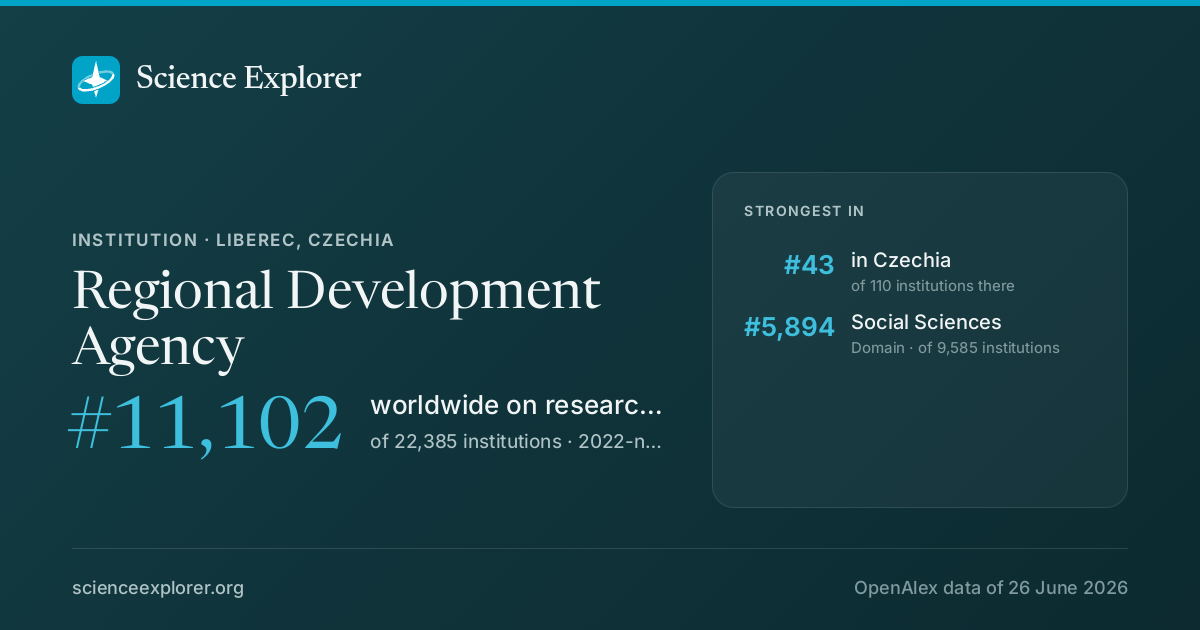
Regional Development Agency on Science Explorer

A card with Regional Development Agency's standing and the fields it leads in, for a post or a slide. A link to this page previews as the same card.

Download the card

1200 × 630 PNG, sized for social posts, drawn from the latest snapshot.

Badges for a website1Each links back here and updates with every snapshot

Research measures only: rankings here say nothing about teaching, admissions or student experience. Comparable institutions and collaboration partners have tabs of their own, above.

Discussion

Ask a question or share a note about Regional Development Agency. Posts are plain text and can be reported.