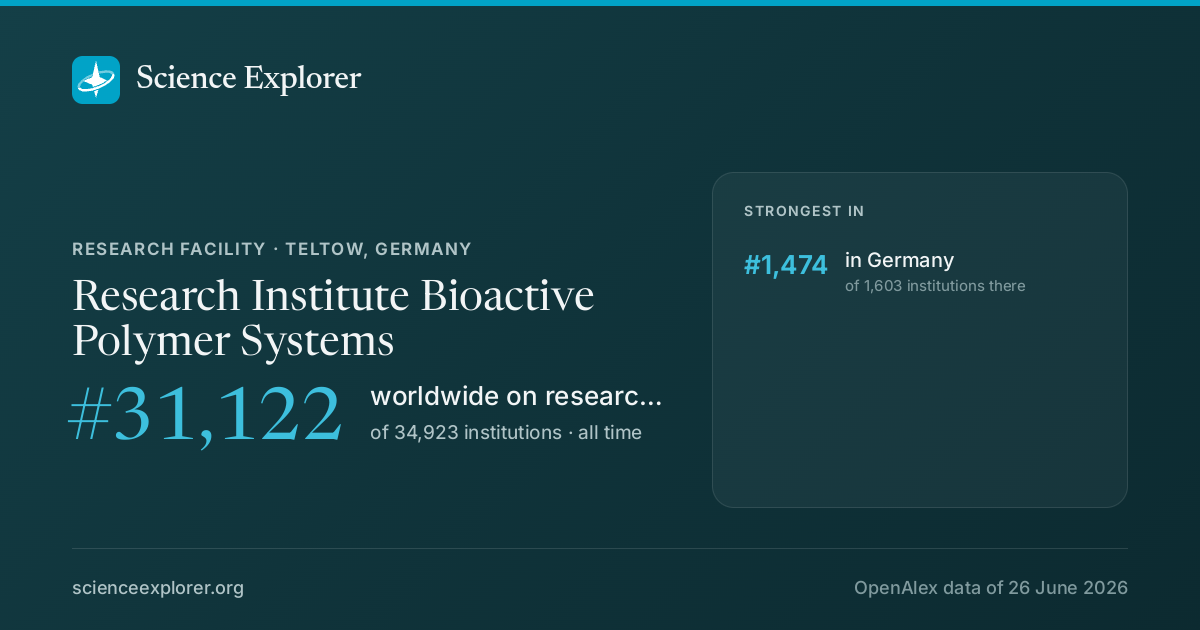
- World rank, all time
- #31,122 of 34,923
- Rank in Germany
- #1,474 of 1,603
- Research works
- 141 ▲ 12% vs 2018-21
- Citations
- 9.1k 64.1 per fractional work
- Top-10% rate
- 10.0% all institutions 10.0%
- vs its own fields
- 1.10× 1.00× is exactly expected
- Open access
- 11% world 40%
- International
- 21% world 18%
Which fields of science does Research Institute Bioactive Polymer Systems work in?
In all years, 71% of research at Research Institute Bioactive Polymer Systems is in Physical Sciences, 18% in Life Sciences. Its largest fields are Materials Science (33%), Engineering (23%), Biochemistry, Genetics and Molecular Biology (13%). It does 1.7× the world's share of Physical Sciences.
Each ring splits the one inside it: the four domains of science, their fields, their subfields. Size is fractional works in all years. Every slice is a page; the interactive view zooms down to single topics and colours each by how much more of it this institution does than the world.
Its 4 domains and 19 fields, with their numbers
- Physical Sciences10171.3%
- Materials Science4632.8%
- Engineering3323.4%
- Chemistry107.3%
- Environmental Science53.8%
- Chemical Engineering21.7%
- Physics and Astronomy10.9%
- Earth and Planetary Sciences10.7%
- Energy10.4%
- Computer Science00.2%
- Life Sciences2517.7%
- Health Sciences1410.2%
- Medicine139.3%
- Nursing10.7%
- Health Professions00.2%
- Social Sciences10.8%
Field profile
Location quotient across every field it publishes in: outside the ring is more than an institution of this size would be expected to publish, inside it is less.
Rings at 0.5×, 1× and 2×. Widest outward: Materials Science, 6.9×. Every wedge is a field page.
All 11 fields, with their numbers
- Materials Science6.91×1 works
- Nursing6.05×0 works
- Immunology and Microbiology3.93×0 works
- Earth and Planetary Sciences3.78×0 works
- Biochemistry, Genetics and Molecular Biology2.08×0 works
- Environmental Science1.79×0 works
- Health Professions1.77×0 works
- Medicine1.47×1 works
- Agricultural and Biological Sciences0.62×0 works
- Engineering0.40×0 works
- Business, Management and Accounting0.37×0 works
- Materials Science 6.9×
- Nursing 6.0×
- Immunology and Microbiology 3.9×
- Earth and Planetary Sciences 3.8×
- Biochemistry, Genetics and Molecular Biology 2.1×
- Environmental Science 1.8×
- Health Professions 1.8×
- Medicine 1.5×
- Agricultural and Biological Sciences 0.6×
- Engineering 0.4×
- Business, Management and Accounting 0.4×
Who are the top researchers at Research Institute Bioactive Polymer Systems?
Ranked on the quality score, Steffen Kelch, Karola Lützow and Th. Weigel lead among researchers whose main affiliation is Research Institute Bioactive Polymer Systems.
- 1
Steffen Kelch
 Germany · #1,499,539 worldwide
3.5k citations · 80 works
- 2
Karola Lützow
Germany · #2,426,118 worldwide
1.8k citations · 33 works
- 3
Th. Weigel
Germany · #4,828,642 worldwide
442 citations · 28 works
- 4
Rudolf Schmolke
Germany · #4,978,790 worldwide
109 citations · 19 works
Which keywords describe research at Research Institute Bioactive Polymer Systems?
By fractional works in all years, weighted toward what it does more of than the world: Biodegradable Polymers, Biomedical Applications, Nanocomposites, Renewable Resources, Shape Memory Polymers, Polymer Composites, Self-Healing and Supramolecular Polymers.
- Rheology
- Molecular Switches
- Click Chemistry
- Recycling
- Heterogeneous Catalysts
- Micelles
- Biological Applications
- Hydrogels
- Conducting Polymers
- Self-Assembly
- Nanofibers
- Enzymatic Hydrolysis
- Mechanical Properties
- Catalysis
- Polyhydroxyalkanoates
- Tissue Engineering
- Supramolecular Polymers
- Polymer Composites
- Renewable Resources
- Biomedical Applications
- Biodegradable Polymers
- Nanocomposites
- Shape Memory Polymers
- Self-Healing
- Nanoparticles
- Drug Delivery
- Polylactic Acid
- Regenerative Medicine
- Green Chemistry
- Lignocellulosic Biomass
- Pretreatment
- Biomass
- Genome-Scale Models
- Metabolic Engineering
- Biomaterials
- Bioinspired Materials
- Ionic Liquids
- Block Copolymers
- Living Radical Polymerization
- Photochromic
Size is fractional works in all years in the topics tagged with each word; colour is the word's share of this institution's work against its share of the world's. The 40 words are chosen for being large and distinctive. Each links to the topic it comes from most.
All 40 words, with their numbers
- Biodegradable Polymers18▲ 100×3 topics
- Biomedical Applications17▲ 11×16 topics
- Nanocomposites16▲ 14×13 topics
- Renewable Resources14▲ 74×2 topics
- Shape Memory Polymers14▲ 189×2 topics
- Polymer Composites13▲ 50×3 topics
- Self-Healing12▲ 316×1 topic
- Supramolecular Polymers12▲ 316×1 topic
- Nanoparticles12▲ 6.3×12 topics
- Tissue Engineering9▲ 12×9 topics
- Drug Delivery7▲ 9.9×9 topics
- Polyhydroxyalkanoates6▲ 68×1 topic
- Polylactic Acid6▲ 68×1 topic
- Catalysis6▲ 5.2×11 topics
- Regenerative Medicine6▲ 19×5 topics
- Mechanical Properties5▲ 3.9×7 topics
- Green Chemistry5▲ 12×5 topics
- Enzymatic Hydrolysis5▲ 34×2 topics
- Lignocellulosic Biomass5▲ 33×1 topic
- Nanofibers5▲ 18×3 topics
- Pretreatment5▲ 51×1 topic
- Self-Assembly4▲ 7.8×6 topics
- Biomass4▲ 33×2 topics
- Conducting Polymers4▲ 19×2 topics
- Genome-Scale Models4▲ 48×1 topic
- Hydrogels4▲ 20×4 topics
- Metabolic Engineering4▲ 22×1 topic
- Biological Applications4▲ 22×3 topics
- Biomaterials4▲ 13×6 topics
- Micelles4▲ 33×2 topics
- Bioinspired Materials4▲ 31×3 topics
- Heterogeneous Catalysts4▲ 22×3 topics
- Ionic Liquids4▲ 7.5×4 topics
- Recycling4▲ 9.9×3 topics
- Block Copolymers3▲ 47×2 topics
- Click Chemistry3▲ 29×1 topic
- Living Radical Polymerization3▲ 57×1 topic
- Molecular Switches3▲ 95×1 topic
- Photochromic3▲ 95×1 topic
- Rheology3▲ 10×2 topics
Which research topics does Research Institute Bioactive Polymer Systems publish most on?
By volume in 2022-now: Archaeology and ancient environmental studies, Electromagnetic wave absorption materials, Non-Invasive Vital Sign Monitoring and Forensic and Genetic Research.
Area is fractional works; colour is the subfield each topic belongs to.
- 1 Archaeology and ancient environmental studies Paleontology 0 works
- 2 Electromagnetic wave absorption materials Electronic, Optical and Magnetic Materials 0 works
- 3 Non-Invasive Vital Sign Monitoring Biomedical Engineering 0 works
- 4 Forensic and Genetic Research Genetics 0 works
- 5 Healthcare Technology and Patient Monitoring Surgery 0 works
- 6 Environmental DNA in Biodiversity Studies Ecology 0 works
- 7 Phonocardiography and Auscultation Techniques Pulmonary and Respiratory Medicine 0 works
- 8 Immunotoxicology and immune responses Immunology 0 works
- 9 Wound Healing and Treatments Rehabilitation 0 works
- 10 Carcinogens and Genotoxicity Assessment Cancer Research 0 works
How open and international is its research?
Against the world's own shares: the tick on each track. Both are shares of its output, so they sit on one scale and can be read against each other as well as against the world.
World: 40% of research is openly available.
World: 18% is written across borders.
How has Research Institute Bioactive Polymer Systems's research output changed?
Output in 2022-2025 was 12% higher than in 2018-2021.
The same series as a ribbon: one cell per year, darker for more. The line above answers how much; this answers when.
Its share of all research
Growing output can still be a shrinking share: all of science grows. This is Research Institute Bioactive Polymer Systems as a percentage of every work published that year, 0.0000043% in 2024.
Fractional works of Research Institute Bioactive Polymer Systems over all fractional works that year. How the balance of science has shifted.
Other research institutions in Teltow
- Institut für Dünnschichttechnologie und Mikrosensorik
- SensoMotoric Instruments (Germany)
- Wita Proteomics (Germany)
- Codon (Germany)
- Dover (Germany)
Share Research Institute Bioactive Polymer Systems's ranking
Badges for a website1Each links back here and updates with every snapshot

Research measures only: rankings here say nothing about teaching, admissions or student experience. Comparable institutions and collaboration partners have tabs of their own, above.
Discussion
Ask a question or share a note about Research Institute Bioactive Polymer Systems. Keep it to the research: no personal attacks, advertising or links. Any reader can report a post, which collapses it for everyone until it is opened.