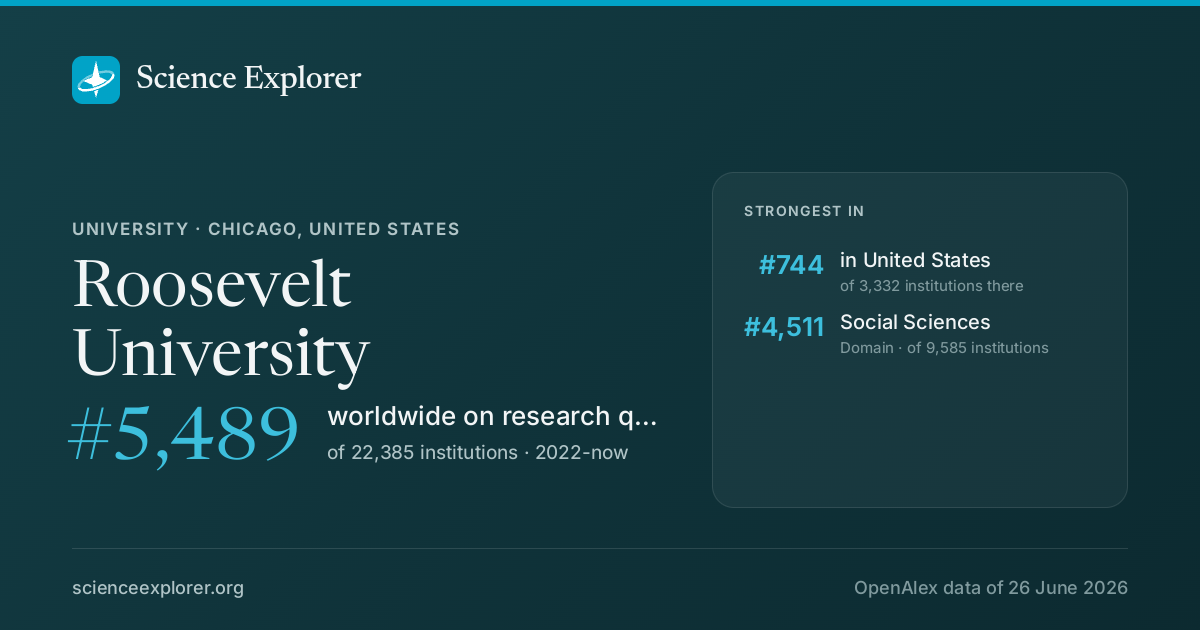
World rank, 2022-now #5,489
of 22,385 · #1,743 all time
Rank in United States #744
of 3,332 Research works 2.1k
▼ 24% vs 2018-21
Citations 42k 19.8 per fractional work
Top-10% rate 7.6%
all institutions 10.0%
vs its own fields 0.96×
1.00× is exactly expected
Open access 25%
world 40%
International 10%
world 18%
What is Roosevelt University known for in research?
The fields where it stands highest, 2022-now, ranked among every institution above the floor in each field.
Field World rank Where that sits Top-10% rate Works All time Domain #4,511 of 9,585 5.2% 76
#1071
Which fields of science does Roosevelt University work in?
In 2022-now, 44% of research at Roosevelt University is in Social Sciences , 27% in Health Sciences . Its largest fields are Medicine (21%), Social Sciences (20%), Psychology (9%). It does 1.7× the world's share of Social Sciences.
Social Sciences: 84 fractional works · 44.3% of its work Social Sciences: 38 fractional works · 20.3% of its work Sociology and Political Science: 13 fractional works · 6.8% of its work Education: 7 fractional works · 3.6% of its work Political Science and International Relations: 5 fractional works · 2.6% of its work Gender Studies: 4 fractional works · 2.3% of its work Safety Research: 2 fractional works · 1.3% of its work Health: 2 fractional works · 1.2% of its work Anthropology: 1 fractional works · 0.7% of its work Law: 1 fractional works · 0.5% of its work Transportation: 1 fractional works · 0.4% of its work Linguistics and Language: 0 fractional works · 0.3% of its work Public Administration: 0 fractional works · 0.3% of its work Cultural Studies: 0 fractional works · 0.2% of its work Smaller subfields together: 0 fractional works · 0.2% of its work Psychology: 17 fractional works · 8.8% of its work Clinical Psychology: 8 fractional works · 4.0% of its work Social Psychology: 5 fractional works · 2.6% of its work Experimental and Cognitive Psychology: 2 fractional works · 1.2% of its work Applied Psychology: 1 fractional works · 0.5% of its work Developmental and Educational Psychology: 1 fractional works · 0.3% of its work Smaller subfields together: 0 fractional works · 0.1% of its work Arts and Humanities: 12 fractional works · 6.4% of its work Music: 3 fractional works · 1.6% of its work Literature and Literary Theory: 2 fractional works · 1.2% of its work Philosophy: 2 fractional works · 0.9% of its work History and Philosophy of Science: 2 fractional works · 0.8% of its work History: 1 fractional works · 0.7% of its work Language and Linguistics: 1 fractional works · 0.7% of its work Museology: 0 fractional works · 0.3% of its work Visual Arts and Performing Arts: 0 fractional works · 0.2% of its work Business, Management and Accounting: 9 fractional works · 4.7% of its work Accounting: 3 fractional works · 1.4% of its work Organizational Behavior and Human Resource Management: 2 fractional works · 0.9% of its work Strategy and Management: 2 fractional works · 0.8% of its work Marketing: 1 fractional works · 0.6% of its work Business and International Management: 1 fractional works · 0.4% of its work Management Information Systems: 1 fractional works · 0.3% of its work Management of Technology and Innovation: 0 fractional works · 0.3% of its work Economics, Econometrics and Finance: 5 fractional works · 2.8% of its work Economics and Econometrics: 4 fractional works · 1.9% of its work Finance: 2 fractional works · 0.9% of its work Decision Sciences: 2 fractional works · 1.3% of its work Information Systems and Management: 1 fractional works · 0.8% of its work Management Science and Operations Research: 1 fractional works · 0.4% of its work Smaller subfields together: 0 fractional works · 0.1% of its work Health Sciences: 50 fractional works · 26.6% of its work Medicine: 40 fractional works · 21.0% of its work Epidemiology: 5 fractional works · 2.8% of its work Public Health, Environmental and Occupational Health: 5 fractional works · 2.7% of its work Psychiatry and Mental health: 5 fractional works · 2.6% of its work Surgery: 3 fractional works · 1.6% of its work Oncology: 2 fractional works · 1.2% of its work Infectious Diseases: 2 fractional works · 1.1% of its work Reproductive Medicine: 2 fractional works · 1.1% of its work Rheumatology: 2 fractional works · 1.1% of its work Geriatrics and Gerontology: 2 fractional works · 0.9% of its work Physiology: 1 fractional works · 0.7% of its work Pediatrics, Perinatology and Child Health: 1 fractional works · 0.6% of its work Pulmonary and Respiratory Medicine: 1 fractional works · 0.5% of its work Radiology, Nuclear Medicine and Imaging: 1 fractional works · 0.5% of its work Neurology: 1 fractional works · 0.3% of its work Anesthesiology and Pain Medicine: 1 fractional works · 0.3% of its work Health Informatics: 1 fractional works · 0.3% of its work Pathology and Forensic Medicine: 1 fractional works · 0.3% of its work Pharmacology: 0 fractional works · 0.3% of its work Rehabilitation: 0 fractional works · 0.3% of its work Cardiology and Cardiovascular Medicine: 0 fractional works · 0.3% of its work Obstetrics and Gynecology: 0 fractional works · 0.2% of its work Ophthalmology: 0 fractional works · 0.2% of its work Orthopedics and Sports Medicine: 0 fractional works · 0.2% of its work Smaller subfields together: 2 fractional works · 1.0% of its work Health Professions: 9 fractional works · 4.8% of its work General Health Professions: 6 fractional works · 3.3% of its work Emergency Medical Services: 1 fractional works · 0.6% of its work Physical Therapy, Sports Therapy and Rehabilitation: 1 fractional works · 0.3% of its work Speech and Hearing: 1 fractional works · 0.3% of its work Smaller subfields together: 0 fractional works · 0.1% of its work Dentistry: 1 fractional works · 0.5% of its work Periodontics: 0 fractional works · 0.3% of its work Smaller subfields together: 0 fractional works · 0.2% of its work Nursing: 0 fractional works · 0.2% of its work Veterinary: 0 fractional works · 0.2% of its work Physical Sciences: 34 fractional works · 18.0% of its work Computer Science: 11 fractional works · 5.7% of its work Artificial Intelligence: 4 fractional works · 2.1% of its work Information Systems: 2 fractional works · 0.8% of its work Computer Science Applications: 1 fractional works · 0.7% of its work Computational Theory and Mathematics: 1 fractional works · 0.7% of its work Computer Networks and Communications: 1 fractional works · 0.6% of its work Computer Vision and Pattern Recognition: 1 fractional works · 0.5% of its work Signal Processing: 0 fractional works · 0.2% of its work Smaller subfields together: 0 fractional works · 0.1% of its work Chemistry: 5 fractional works · 2.6% of its work Organic Chemistry: 3 fractional works · 1.6% of its work Inorganic Chemistry: 2 fractional works · 1.0% of its work Smaller subfields together: 0 fractional works · 0.1% of its work Environmental Science: 5 fractional works · 2.4% of its work Ecology: 1 fractional works · 0.6% of its work Health, Toxicology and Mutagenesis: 1 fractional works · 0.6% of its work Global and Planetary Change: 1 fractional works · 0.5% of its work Nature and Landscape Conservation: 0 fractional works · 0.2% of its work Smaller subfields together: 1 fractional works · 0.5% of its work Mathematics: 3 fractional works · 1.7% of its work Applied Mathematics: 1 fractional works · 0.6% of its work Statistics and Probability: 1 fractional works · 0.4% of its work Mathematical Physics: 1 fractional works · 0.4% of its work Theoretical Computer Science: 0 fractional works · 0.3% of its work Smaller subfields together: 0 fractional works · 0.1% of its work Materials Science: 3 fractional works · 1.7% of its work Materials Chemistry: 2 fractional works · 0.9% of its work Electronic, Optical and Magnetic Materials: 1 fractional works · 0.7% of its work Smaller subfields together: 0 fractional works · 0.2% of its work Engineering: 3 fractional works · 1.5% of its work Control and Systems Engineering: 1 fractional works · 0.5% of its work Aerospace Engineering: 0 fractional works · 0.3% of its work Mechanical Engineering: 0 fractional works · 0.2% of its work Biomedical Engineering: 0 fractional works · 0.2% of its work Smaller subfields together: 1 fractional works · 0.4% of its work Energy: 2 fractional works · 0.8% of its work Renewable Energy, Sustainability and the Environment: 1 fractional works · 0.6% of its work General Energy: 0 fractional works · 0.2% of its work Earth and Planetary Sciences: 1 fractional works · 0.7% of its work Geology: 0 fractional works · 0.3% of its work Paleontology: 0 fractional works · 0.2% of its work Smaller subfields together: 0 fractional works · 0.2% of its work Physics and Astronomy: 1 fractional works · 0.4% of its work Statistical and Nonlinear Physics: 0 fractional works · 0.3% of its work Smaller subfields together: 0 fractional works · 0.2% of its work Chemical Engineering: 1 fractional works · 0.3% of its work Life Sciences: 21 fractional works · 11.1% of its work Biochemistry, Genetics and Molecular Biology: 9 fractional works · 4.8% of its work Molecular Biology: 4 fractional works · 2.1% of its work Genetics: 3 fractional works · 1.5% of its work Biophysics: 1 fractional works · 0.4% of its work Cell Biology: 0 fractional works · 0.2% of its work Molecular Medicine: 0 fractional works · 0.2% of its work Smaller subfields together: 1 fractional works · 0.4% of its work Neuroscience: 4 fractional works · 2.1% of its work Cognitive Neuroscience: 2 fractional works · 1.1% of its work Cellular and Molecular Neuroscience: 1 fractional works · 0.4% of its work Behavioral Neuroscience: 0 fractional works · 0.2% of its work Biological Psychiatry: 0 fractional works · 0.2% of its work Smaller subfields together: 0 fractional works · 0.1% of its work Agricultural and Biological Sciences: 3 fractional works · 1.5% of its work Food Science: 1 fractional works · 0.4% of its work Ecology, Evolution, Behavior and Systematics: 1 fractional works · 0.4% of its work Plant Science: 0 fractional works · 0.2% of its work Smaller subfields together: 1 fractional works · 0.5% of its work Pharmacology, Toxicology and Pharmaceutics: 3 fractional works · 1.5% of its work Pharmacology: 2 fractional works · 0.8% of its work Pharmaceutical Science: 1 fractional works · 0.4% of its work Toxicology: 0 fractional works · 0.3% of its work Immunology and Microbiology: 2 fractional works · 1.2% of its work Immunology: 2 fractional works · 1.0% of its work Smaller subfields together: 0 fractional works · 0.2% of its work Social Sciences Social Sciences Psychology Arts and Humanities Business Economics Health Sciences Medicine Health Pr… Physical Sciences Computer Science Chemistry Environme… Mathemati… Materials… Engineeri… Life Sciences Biochemis… Neuroscie… Agricultu… Pharmacol… ALL ITS WORK Roosevelt University 189 fractional works, 2022-now 11% 18% 27% 44%
Each ring splits the one inside it: the four domains of science, their fields, their subfields. Size is fractional works in 2022-now. Every slice is a page; the interactive view zooms down to single topics and colours each by how much more of it this institution does than the world.
Its 4 domains and 26 fields, with their numbers 38 20.3% 17 8.8% 12 6.4% 9 4.7% 5 2.8% 2 1.3% 40 21.0% 9 4.8% 1 0.5% 0 0.2% 0 0.2% 11 5.7% 5 2.6% 5 2.4% 3 1.7% 3 1.7% 3 1.5% 2 0.8% 1 0.7% 1 0.4% 1 0.3% 9 4.8% 4 2.1% 3 1.5% 3 1.5% 2 1.2% All of science, and how each field's share has moved since 1950: the Science domain explorer
Field profile
Location quotient across every field it publishes in: outside the ring is more than an institution of this size would be expected to publish, inside it is less.
Agricultural and Biological Sciences: 0.32× its world share, 3 works Agricultural and Bio… Biochemistry, Genetics and Molecular Biology: 0.91× its world share, 9 works Biochemistry, Geneti… Immunology and Microbiology: 1.20× its world share, 2 works Immunology and Micro… Neuroscience: 1.31× its world share, 4 works Neuroscience Pharmacology, Toxicology and Pharmaceutics: 4.17× its world share, 3 works Pharmacology, Toxico… Chemical Engineering: 0.84× its world share, 1 works Chemical Engineering Chemistry: 1.69× its world share, 5 works Chemistry Computer Science: 0.74× its world share, 11 works Computer Science Earth and Planetary Sciences: 0.43× its world share, 1 works Earth and Planetary … Energy: 0.91× its world share, 2 works Energy Engineering: 0.10× its world share, 3 works Engineering Environmental Science: 0.49× its world share, 5 works Environmental Science Materials Science: 0.48× its world share, 3 works Materials Science Mathematics: 1.48× its world share, 3 works Mathematics Physics and Astronomy: 0.20× its world share, 1 works Physics and Astronomy Dentistry: 1.06× its world share, 1 works Dentistry Health Professions: 1.80× its world share, 9 works Health Professions Medicine: 1.09× its world share, 40 works Medicine Nursing: 0.35× its world share, 0 works Nursing Veterinary: 1.30× its world share, 0 works Veterinary Arts and Humanities: 2.20× its world share, 12 works Arts and Humanities Business, Management and Accounting: 1.46× its world share, 9 works Business, Management… Decision Sciences: 1.30× its world share, 2 works Decision Sciences Economics, Econometrics and Finance: 1.33× its world share, 5 works Economics, Econometr… Psychology: 2.90× its world share, 17 works Psychology Social Sciences: 1.60× its world share, 38 works Social Sciences 1× world share
Rings at 0.5×, 1× and 2×. Widest outward: Pharmacology, Toxicology and Pharmaceutics , 4.2×. Every wedge is a field page.
All 26 fields, with their numbers Pharmacology, Toxicology and Pharmaceutics 4.17× 3 works Psychology 2.90× 17 works Arts and Humanities 2.20× 12 works Health Professions 1.80× 9 works Chemistry 1.69× 5 works Social Sciences 1.60× 38 works Mathematics 1.48× 3 works Business, Management and Accounting 1.46× 9 works Economics, Econometrics and Finance 1.33× 5 works Neuroscience 1.31× 4 works Veterinary 1.30× 0 works Decision Sciences 1.30× 2 works Immunology and Microbiology 1.20× 2 works Medicine 1.09× 40 works Dentistry 1.06× 1 works Biochemistry, Genetics and Molecular Biology 0.91× 9 works Energy 0.91× 2 works Chemical Engineering 0.84× 1 works Computer Science 0.74× 11 works Environmental Science 0.49× 5 works Materials Science 0.48× 3 works Earth and Planetary Sciences 0.43× 1 works Nursing 0.35× 0 works Agricultural and Biological Sciences 0.32× 3 works Physics and Astronomy 0.20× 1 works Engineering 0.10× 3 works
Who are the top researchers at Roosevelt University?
Ranked on the quality score, Lawrence A. Potempa , Hugh Dalziel Duncan and Joshua Telser lead among researchers whose main affiliation is Roosevelt University.
1
Lawrence A. Potempa
United States · #231,119 worldwide6k citations · 119 works
2
Hugh Dalziel Duncan
United States · #482,159 worldwide3.8k citations · 36 works
3
Joshua Telser
United States · #516,095 worldwide26k citations · 504 works
4
Eugene Lieber
United States · #620,895 worldwide2.1k citations · 83 works
5
Howard Stein
United States · #642,129 worldwide2.9k citations · 166 works
6
D. J. White
United States · #643,550 worldwide13k citations · 151 works
7
Daniel R. Headrick
United States · #676,986 worldwide3.7k citations · 168 works
8
Ibraheem M. Rajab
United States · #845,382 worldwide846 citations · 22 works
9
Matthew D. Skinta
United States · #987,401 worldwide1.1k citations · 103 works
10
St. Clair Drake
United States · #998,548 worldwide548 citations · 68 works
All ranked researchers at Roosevelt University
What are the most cited papers from Roosevelt University?
The most cited paper from Roosevelt University is "Free radicals and antioxidants in normal physiological functions and human disease" (Marián Valko, Dieter Leibfritz, Ján Moncóľ et al., 2006), with 14,300 citations. Next come "Traveling Towards Disease: Transportation Barriers to Health Care Access" (2,024) and "Role of oxygen radicals in DNA damage and cancer incidence" (1,814).
Most cited papers
# Paper Released Citations 1
Free radicals and antioxidants in normal physiological functions and human disease
Marián Valko, Dieter Leibfritz, Ján Moncóľ et al. · The International Journal of Biochemistry & Cell Biology
7 Aug 2006
14,300 2
Traveling Towards Disease: Transportation Barriers to Health Care Access
Samina T. Syed, Ben S. Gerber, Lisa Kay Sharp · Journal of Community Health
Open access 30 Mar 2013
2,024 3
Role of oxygen radicals in DNA damage and cancer incidence
Marián Valko, Mário Izakovič, Milan Mazúr et al. · Molecular and Cellular Biochemistry
Nov 2004
1,814 4
Standards of Evidence: Criteria for Efficacy, Effectiveness and Dissemination
Brian R. Flay, Anthony Biglan, Robert Francis Boruch et al. · Prevention Science
16 May 2005
1,346 5
Financialisation and capital accumulation in the non-financial corporate sector:: A theoretical and empirical investigation on the US economy: 1973-2003
Özgür Orhangazi · Cambridge Journal of Economics
9 Apr 2008
980
All 60 most cited papers, with filters and sorting
Which keywords describe research at Roosevelt University?
By fractional works in 2022-now, weighted toward what it does more of than the world: Epidemiology , Mental Health , Gender, Colonialism, Nationalism, Feminism, Recovery and Biomarkers.
Size is fractional works in 2022-now in the topics tagged with each word; colour is the word's share of this institution's work against its share of the world's. The 40 words are chosen for being large and distinctive. Each links to the topic it comes from most.
All 40 words, with their numbers Epidemiology 11 ▲ 1.48× 51 topics Mental Health 7 ▲ 2.7× 24 topics Globalization 5 ▲ 1.41× 21 topics Inflammation 5 ▲ 1.29× 26 topics Gender 5 ▲ 4.5× 9 topics Colonialism 4 ▲ 4.9× 11 topics Social Media 4 ▲ 1.62× 10 topics Biomarkers 4 ▲ 3.1× 7 topics Nationalism 4 ▲ 4.8× 6 topics Depression 4 ▲ 2.3× 15 topics Identity 4 ▲ 2.8× 12 topics Leadership 4 ▲ 3.9× 6 topics Feminism 3 ▲ 6.1× 5 topics Meta-Analysis 3 ▲ 3.1× 10 topics Social Justice 3 ▲ 3.0× 7 topics History 3 ▲ 2.5× 10 topics Neurobiology 3 ▲ 5.9× 6 topics Ethics 3 ▲ 3.0× 9 topics Income Inequality 3 ▲ 10× 3 topics Job Satisfaction 3 ▲ 3.3× 6 topics Recovery 3 ▲ 13× 2 topics Metastasis 3 ▲ 4.0× 6 topics Neuropathology 3 ▲ 11× 2 topics Public Opinion 3 ▲ 11× 5 topics Concussion 2 ▲ 30× 1 topic Encephalopathy 2 ▲ 19× 1 topic Political Philosophy 2 ▲ 23× 2 topics Cultural Competence 2 ▲ 8.5× 5 topics Cognitive Training 2 ▲ 11× 2 topics Financial Literacy 2 ▲ 11× 1 topic Inclusion 2 ▲ 7.3× 2 topics Retirement Planning 2 ▲ 31× 1 topic Cognitive Decline 2 ▲ 8.3× 2 topics Dementia 2 ▲ 10× 1 topic Mild Cognitive Impairment 2 ▲ 12× 1 topic Stereotypes 2 ▲ 11× 2 topics American founding 2 ▲ 35× 1 topic Constitutional government 2 ▲ 35× 1 topic Imperialism 2 ▲ 13× 3 topics Social Cognitive Theory 2 ▲ 22× 2 topics
Which research topics does Roosevelt University publish most on?
By volume in 2022-now: Traumatic Brain Injury Research , Financial Literacy, Pension, Retirement Analysis , Dementia and Cognitive Impairment Research and American Constitutional Law and Politics .
1
Epidemiology 2 works
2
Accounting 2 works
3
Psychiatry and Mental health 2 works
4
Political Science and International Relations 2 works
5
Geriatrics and Gerontology 2 works
6
Gender Studies 2 works
7
Reproductive Medicine 1 works
8
Music 1 works
9
Sociology and Political Science 1 works
10
Gender Studies 1 works
How open and international is its research?
Against the world's own shares: the tick on each track. Both are shares of its output, so they
sit on one scale and can be read against each other as well as against the world.
25% 75%
24.9% 75.1%
World: 40% of research is openly available.
10% 90%
10.5% 89.5%
World: 18% is written across borders.
How has Roosevelt University's research output changed?
Output in 2022-2025 was 24% lower than in 2018-2021.
still counting 1990 2000 2010 2020
The same series as a ribbon: one cell per year, darker for more. The line above answers how much ; this answers when .
Its share of all research
still counting 0.0050% 0.010% Roosevelt University 0.00070% in 2025 1980 1990 2000 2010 2020 Fractional works of Roosevelt University over all fractional works that year. How the balance of science has shifted .
How much of it reaches the world top 10%
still counting 10% 20% 30% all institutions 10.0% in 2025 Roosevelt University 7.6% in 2025 2000 2010 2020 Of each year's output, the share that reached the world's 10% most cited for its field and year. Peak 23.2% in 1994.
Share Roosevelt University's ranking
A card with Roosevelt University's standing and the fields it leads in, for a post or a slide. A link to this page previews as the same card.
Badges for a website 1 Each links back here and updates with every snapshot
 United States · #231,119 worldwide
6k citations · 119 works