Sanya University
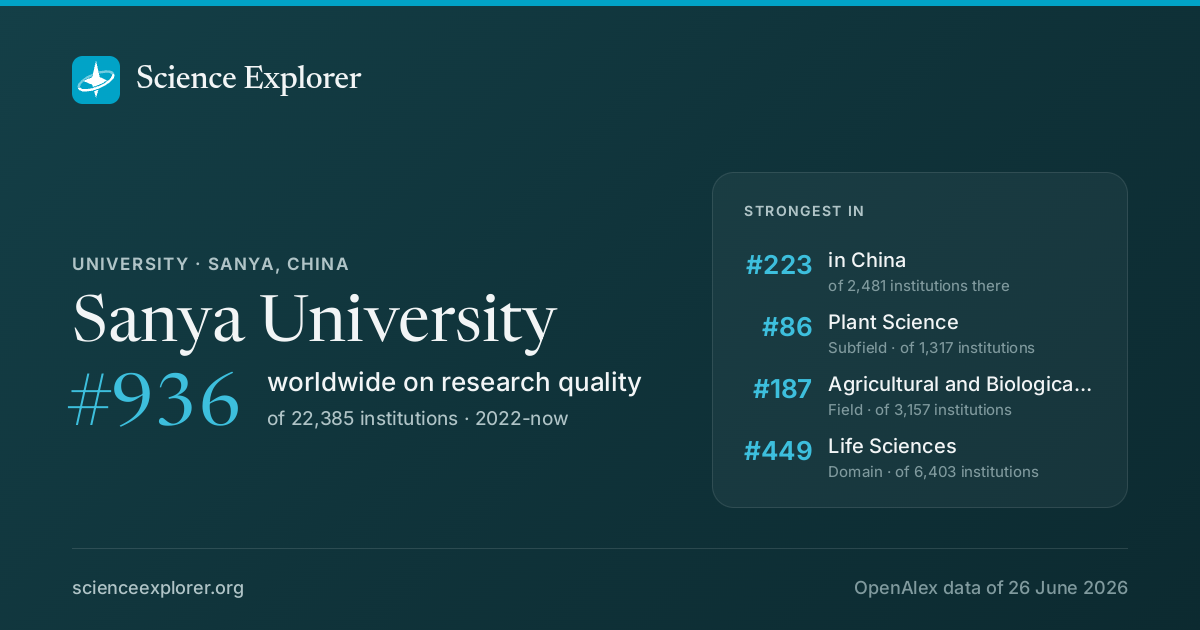
In research, Sanya University stands highest in Agricultural and Biological Sciences (#187 of 3,157 worldwide), Plant Science (#86 of 1,317 worldwide) and Life Sciences (#449 of 6,403 worldwide), 2022-now. Relative to its size it is most specialised in Business and International Management, Plant Science and Ocean Engineering (Business and International Management is 9.5× its share of world research).
- World rank, 2022-now
- #936 of 22,385 · #1,369 all time
- Rank in China
- #223 of 2,481
- Research works
- 3.7k ▲ 709% vs 2018-21
- Citations
- 24k 6.3 per fractional work
- Top-10% rate
- 15.4% all institutions 10.0%
- vs its own fields
- 1.24× 1.00× is exactly expected
- Open access
- 52% world 40%
- International
- 14% world 18%
What is Sanya University known for in research?
The fields where it stands highest, 2022-now, ranked among every institution above the floor in each field.
| Field | World rank | Where that sits | Top-10% rate | Works | All time |
|---|---|---|---|---|---|
| Agricultural and Biological SciencesField | #187 of 3,157 | 22.2% | 513 | #449 | |
| Plant ScienceSubfield | #86 of 1,317 | 21.3% | 356 | #282 | |
| Life SciencesDomain | #449 of 6,403 | 20.2% | 851 | #774 | |
| Physical SciencesDomain | #1,118 of 10,670 | 15.0% | 1,216 | #1533 | |
| EngineeringField | #620 of 5,901 | 16.5% | 551 | #1065 | |
| Biochemistry, Genetics and Molecular BiologyField | #527 of 2,964 | 17.2% | 285 | #859 | |
| Health SciencesDomain | #2,214 of 9,902 | 16.4% | 148 | #3208 | |
| Environmental ScienceField | #746 of 3,334 | 15.9% | 198 | #1006 | |
| Computer ScienceField | #1,074 of 4,417 | 10.4% | 247 | #1175 | |
| Molecular BiologySubfield | #492 of 1,880 | 17.5% | 186 | #843 |
Each strip is that field's whole ranked pool, with the notch where Sanya University sits in it, in the colour of the band that rank falls in. The track under the rate is the rate itself: it carries no average mark, because the average differs by field (from about 6% in Dentistry to 21% in Economics).
Which of those standings moved
The same fields on both windows: where it stood over the whole record, and where it stands in 2022-now. The distance is the story, and it is the one thing the two rank columns above cannot show.
- Agricultural and Biological Sciences#449 #187
- Plant Science#282 #86
- Life Sciences#774 #449
- Physical Sciences#1,533 #1,118
- Engineering#1,065 #620
- Biochemistry, Genetics and Molecular Biology#859 #527
- Health Sciences#3,208 #2,214
- Environmental Science#1,006 #746
- Computer Science#1,175 #1,074
- Molecular Biology#843 #492
A dot further right is a better standing. Fields it was not ranked in over the whole record are left out.
Which fields of science does Sanya University work in?
In 2022-now, 48% of research at Sanya University is in Physical Sciences, 34% in Life Sciences. Its largest fields are Engineering (22%), Agricultural and Biological Sciences (20%), Biochemistry, Genetics and Molecular Biology (11%). It does 2.6× the world's share of Life Sciences.
Each ring splits the one inside it: the four domains of science, their fields, their subfields. Size is fractional works in 2022-now. Every slice is a page; the interactive view zooms down to single topics and colours each by how much more of it this institution does than the world.
Its 4 domains and 26 fields, with their numbers
- Physical Sciences1,46248.4%
- Engineering65821.8%
- Computer Science2909.6%
- Environmental Science2347.8%
- Materials Science1043.4%
- Earth and Planetary Sciences933.1%
- Chemistry270.9%
- Energy240.8%
- Physics and Astronomy140.5%
- Mathematics110.4%
- Chemical Engineering70.2%
- Life Sciences1,02233.8%
- Social Sciences36312.0%
- Social Sciences1424.7%
- Business, Management and Accounting1003.3%
- Economics, Econometrics and Finance461.5%
- Decision Sciences301.0%
- Psychology240.8%
- Arts and Humanities220.7%
- Health Sciences1755.8%
- Medicine1324.4%
- Nursing200.7%
- Health Professions180.6%
- Veterinary30.1%
- Dentistry20.1%
What does Sanya University specialise in?
Where its research is concentrated relative to its size: Business and International Management takes 9.5× the share of its output that it takes of world research.
- Business and International ManagementSubfield · 30.3 works9.5×
- Plant ScienceSubfield · 427.9 works8.1×
- Ocean EngineeringSubfield · 77.8 works5.0×
- OceanographySubfield · 38.1 works4.5×
- Insect ScienceSubfield · 37.2 works4.3×
- Agricultural and Biological SciencesField · 611.5 works4.3×
- Aquatic ScienceSubfield · 22.0 works4.0×
Location quotient, a volume reading rather than an impact one. It surfaces small, lopsided specialities.
Field profile
Location quotient across every field it publishes in: outside the ring is more than an institution of this size would be expected to publish, inside it is less.
Rings at 0.5×, 1× and 2×. Widest outward: Agricultural and Biological Sciences, 4.3×. Every wedge is a field page.
All 26 fields, with their numbers
- Agricultural and Biological Sciences4.26×612 works
- Biochemistry, Genetics and Molecular Biology2.14×346 works
- Earth and Planetary Sciences1.97×93 works
- Environmental Science1.56×234 works
- Engineering1.45×658 works
- Nursing1.34×20 works
- Immunology and Microbiology1.26×38 works
- Computer Science1.23×290 works
- Business, Management and Accounting1.02×100 works
- Decision Sciences1.02×30 works
- Materials Science0.98×104 works
- Energy0.87×24 works
- Veterinary0.84×3 works
- Economics, Econometrics and Finance0.71×46 works
- Chemical Engineering0.63×7 works
- Chemistry0.57×27 works
- Pharmacology, Toxicology and Pharmaceutics0.52×6 works
- Neuroscience0.43×21 works
- Social Sciences0.37×142 works
- Mathematics0.30×11 works
- Psychology0.26×24 works
- Arts and Humanities0.25×22 works
- Medicine0.23×132 works
- Health Professions0.22×18 works
- Physics and Astronomy0.21×14 works
- Dentistry0.13×2 works
- Agricultural and Biological Sciences 4.3×
- Biochemistry, Genetics and Molecular Biology 2.1×
- Earth and Planetary Sciences 2.0×
- Environmental Science 1.6×
- Engineering 1.4×
- Nursing 1.3×
- Immunology and Microbiology 1.3×
- Computer Science 1.2×
- Business, Management and Accounting 1.0×
- Decision Sciences 1.0×
- Materials Science 1.0×
- Energy 0.9×
- Veterinary 0.8×
- Economics, Econometrics and Finance 0.7×
- Chemical Engineering 0.6×
- Chemistry 0.6×
- Pharmacology, Toxicology and Pharmaceutics 0.5×
- Neuroscience 0.4×
- Social Sciences 0.4×
- Mathematics 0.3×
- Psychology 0.3×
- Arts and Humanities 0.2×
- Medicine 0.2×
- Health Professions 0.2×
- Physics and Astronomy 0.2×
- Dentistry 0.1×
Who are the top researchers at Sanya University?
Ranked on the quality score, Arthur William Fodouop Kouam, Jiang Xuefei and Qiongdan Xie lead among researchers whose main affiliation is Sanya University.
- 1
Arthur William Fodouop Kouam
 China · #616,022 worldwide
125 citations · 45 works
- 2
Jiang Xuefei
China · #1,357,493 worldwide
176 citations · 24 works
- 3
Qiongdan Xie
China · #1,480,298 worldwide
693 citations · 19 works
- 4
Tingting Yang
China · #1,642,884 worldwide
512 citations · 56 works
- 5
Boxiong Yang
China · #1,670,605 worldwide
709 citations · 36 works
- 6
Pengfei Miao
China · #1,680,844 worldwide
493 citations · 21 works
- 7
Zhipeng Ou
China · #2,225,900 worldwide
90 citations · 22 works
- 8
Xia Liu
China · #2,327,784 worldwide
4.5k citations · 489 works
- 9
Xuejie Feng
China · #2,448,005 worldwide
102 citations · 28 works
- 10
Lijuan Lian
China · #2,524,775 worldwide
268 citations · 27 works
Which keywords describe research at Sanya University?
By fractional works in 2022-now, weighted toward what it does more of than the world: Gene Expression, Deep Learning, Transcription Factors, Epigenetic Regulation, Machine Learning, Artificial Intelligence, Wireless Sensor Networks and MicroRNA.
- Quantitative Trait Loci
- Salt Tolerance
- Plant Development
- Abiotic Stress
- Metabolic Pathways
- Genetic Regulation
- Plant Responses
- Reactive Oxygen Species
- Genetic Diversity
- Drought Resistance
- Plant
- Aquaculture
- Metabolism
- Development
- Risk Assessment
- Wireless Sensor Networks
- Internet of Things
- Transcription Factors
- Climate Change
- Machine Learning
- Deep Learning
- Gene Expression
- Artificial Intelligence
- Environmental Impact
- Remote Sensing
- Epigenetic Regulation
- Data Mining
- Antioxidants
- MicroRNA
- Auxin
- Cloud Computing
- QTL Mapping
- Genetic Mapping
- Signal Transduction
- Logistics
- Plant Immunity
- Big Data Analytics
- Biochar Application
- Anthocyanins
- Stress Signaling
Size is fractional works in 2022-now in the topics tagged with each word; colour is the word's share of this institution's work against its share of the world's. The 40 words are chosen for being large and distinctive. Each links to the topic it comes from most.
All 40 words, with their numbers
- Deep Learning223▲ 2.1×80 topics
- Machine Learning155▲ 1.54×76 topics
- Gene Expression141▲ 7.4×19 topics
- Climate Change127▲ 1.54×76 topics
- Artificial Intelligence112▲ 2.6×42 topics
- Transcription Factors94▲ 24×5 topics
- Environmental Impact87▲ 1.69×55 topics
- Internet of Things82▲ 3.1×26 topics
- Remote Sensing77▲ 2.1×37 topics
- Wireless Sensor Networks71▲ 5.2×16 topics
- Epigenetic Regulation71▲ 11×6 topics
- Risk Assessment64▲ 3.2×15 topics
- Data Mining64▲ 2.9×17 topics
- Development61▲ 5.7×10 topics
- Antioxidants60▲ 4.5×15 topics
- Metabolism58▲ 3.6×25 topics
- MicroRNA58▲ 16×2 topics
- Aquaculture56▲ 7.3×8 topics
- Auxin55▲ 38×1 topic
- Plant55▲ 38×1 topic
- Cloud Computing53▲ 6.1×13 topics
- Drought Resistance53▲ 18×4 topics
- QTL Mapping51▲ 15×6 topics
- Genetic Diversity49▲ 3.8×21 topics
- Genetic Mapping49▲ 21×6 topics
- Reactive Oxygen Species48▲ 3.9×13 topics
- Signal Transduction48▲ 10×6 topics
- Plant Responses46▲ 19×2 topics
- Logistics45▲ 9.7×5 topics
- Genetic Regulation44▲ 8.9×5 topics
- Plant Immunity44▲ 15×2 topics
- Metabolic Pathways43▲ 25×3 topics
- Big Data Analytics39▲ 6.1×5 topics
- Abiotic Stress37▲ 16×2 topics
- Biochar Application35▲ 11×2 topics
- Plant Development35▲ 18×3 topics
- Anthocyanins35▲ 17×3 topics
- Salt Tolerance35▲ 23×1 topic
- Stress Signaling35▲ 23×1 topic
- Quantitative Trait Loci34▲ 20×3 topics
Which research topics does Sanya University publish most on?
By volume in 2022-now: Plant Molecular Biology Research, Plant Stress Responses and Tolerance, Plant Gene Expression Analysis and E-commerce and Technology Innovations.
Area is fractional works; colour is the subfield each topic belongs to.
- 1 Plant Molecular Biology Research Plant Science 55 works
- 2 Plant Stress Responses and Tolerance Plant Science 35 works
- 3 Plant Gene Expression Analysis Molecular Biology 31 works
- 4 E-commerce and Technology Innovations Business and International Management 29 works
- 5 Educational Technology and Pedagogy Artificial Intelligence 27 works
- 6 Plant-Microbe Interactions and Immunity Plant Science 27 works
- 7 Plant nutrient uptake and metabolism Plant Science 25 works
- 8 Educational Reforms and Innovations Health, Toxicology and Mutagenesis 24 works
- 9 Genetic Mapping and Diversity in Plants and Animals Genetics 23 works
- 10 Ideological and Political Education Education 20 works
How open and international is its research?
Against the world's own shares: the tick on each track. Both are shares of its output, so they sit on one scale and can be read against each other as well as against the world.
World: 40% of research is openly available.
World: 18% is written across borders.
How has Sanya University's research output changed?
Output in 2022-2025 was 709% higher than in 2018-2021.
The same series as a ribbon: one cell per year, darker for more. The line above answers how much; this answers when.
Its share of all research
Growing output can still be a shrinking share: all of science grows. This is Sanya University as a percentage of every work published that year, 0.014% in 2024.
Fractional works of Sanya University over all fractional works that year. How the balance of science has shifted.
How much of it reaches the world top 10%
Year by year, against all institutions in the same year.
Of each year's output, the share that reached the world's 10% most cited for its field and year. Peak 15.9% in 2025.
Other research institutions in Sanya
Compare Sanya University with
- vs
 University of L'Aquila
- vs
 Singapore Management University
- vs
 Universidad Pablo de Olavide
- vs
 Northwestern University
- vs
 King Abdulaziz University
- vs
 University of Wrocław
Share Sanya University's ranking



Research measures only: rankings here say nothing about teaching, admissions or student experience. Comparable institutions and collaboration partners have tabs of their own, above.
Discussion
Ask a question or share a note about Sanya University. Posts are plain text and can be reported.