Sasaki Institute
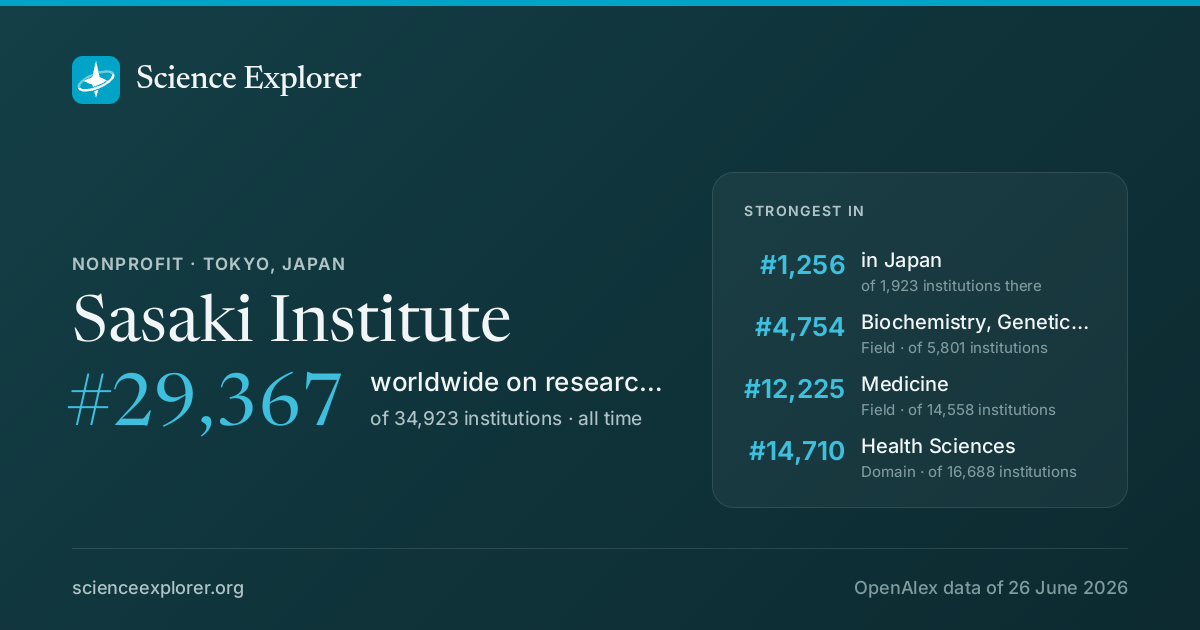
In research, Sasaki Institute stands highest in Biochemistry, Genetics and Molecular Biology (#4,754 of 5,801 worldwide), Medicine (#12,225 of 14,558 worldwide) and Health Sciences (#14,710 of 16,688 worldwide), over all time.
- World rank, all time
- #29,367 of 34,923
- Rank in Japan
- #1,256 of 1,923
- Research works
- 609 ▲ 24% vs 2018-21
- Citations
- 9.8k 16.1 per fractional work
- Top-10% rate
- 6.5% all institutions 10.0%
- vs its own fields
- 0.68× 1.00× is exactly expected
- Open access
- 43% world 40%
- International
- 10% world 18%
What is Sasaki Institute known for in research?
The fields where it stands highest, over all time, ranked among every institution above the floor in each field.
| Field | World rank | Where that sits | Top-10% rate | Works |
|---|---|---|---|---|
| Biochemistry, Genetics and Molecular BiologyField | #4,754 of 5,801 | 4.6% | 162 | |
| MedicineField | #12,225 of 14,558 | 6.0% | 251 | |
| Health SciencesDomain | #14,710 of 16,688 | 6.0% | 262 | |
| Life SciencesDomain | #9,873 of 11,023 | 4.1% | 226 |
Each strip is that field's whole ranked pool, with the notch where Sasaki Institute sits in it, in the colour of the band that rank falls in. The track under the rate is the rate itself: it carries no average mark, because the average differs by field (from about 6% in Dentistry to 21% in Economics).
Which fields of science does Sasaki Institute work in?
In 2022-now, 49% of research at Sasaki Institute is in Health Sciences, 24% in Life Sciences. Its largest fields are Medicine (47%), Biochemistry, Genetics and Molecular Biology (20%), Engineering (8%). It does 1.9× the world's share of Health Sciences.
Each ring splits the one inside it: the four domains of science, their fields, their subfields. Size is fractional works in 2022-now. Every slice is a page; the interactive view zooms down to single topics and colours each by how much more of it this institution does than the world.
Its 4 domains and 22 fields, with their numbers
- Health Sciences3249.1%
- Medicine3147.4%
- Nursing10.8%
- Health Professions00.7%
- Dentistry00.3%
- Life Sciences1624.4%
- Physical Sciences1421.4%
- Engineering58.2%
- Earth and Planetary Sciences46.8%
- Environmental Science12.3%
- Computer Science11.7%
- Materials Science11.3%
- Chemistry11.1%
- Physics and Astronomy00.1%
- Social Sciences35.1%
Field profile
Location quotient across every field it publishes in: outside the ring is more than an institution of this size would be expected to publish, inside it is less.
Rings at 0.5×, 1× and 2×. Widest outward: Earth and Planetary Sciences, 4.3×. Every wedge is a field page.
All 22 fields, with their numbers
- Earth and Planetary Sciences4.34×4 works
- Biochemistry, Genetics and Molecular Biology3.82×13 works
- Medicine2.46×31 works
- Nursing1.69×0 works
- Immunology and Microbiology1.61×1 works
- Pharmacology, Toxicology and Pharmaceutics0.84×0 works
- Chemistry0.68×1 works
- Economics, Econometrics and Finance0.56×1 works
- Engineering0.55×5 works
- Decision Sciences0.55×0 works
- Dentistry0.53×0 works
- Environmental Science0.46×2 works
- Materials Science0.37×1 works
- Agricultural and Biological Sciences0.33×1 works
- Neuroscience0.31×0 works
- Health Professions0.25×0 works
- Arts and Humanities0.25×0 works
- Computer Science0.21×1 works
- Social Sciences0.19×2 works
- Business, Management and Accounting0.05×0 works
- Physics and Astronomy0.04×0 works
- Psychology0.04×0 works
- Earth and Planetary Sciences 4.3×
- Biochemistry, Genetics and Molecular Biology 3.8×
- Medicine 2.5×
- Nursing 1.7×
- Immunology and Microbiology 1.6×
- Pharmacology, Toxicology and Pharmaceutics 0.8×
- Chemistry 0.7×
- Economics, Econometrics and Finance 0.6×
- Engineering 0.6×
- Decision Sciences 0.6×
- Dentistry 0.5×
- Environmental Science 0.5×
- Materials Science 0.4×
- Agricultural and Biological Sciences 0.3×
- Neuroscience 0.3×
- Health Professions 0.2×
- Arts and Humanities 0.2×
- Computer Science 0.2×
- Social Sciences 0.2×
- Business, Management and Accounting 0.1×
- Physics and Astronomy 0.0×
- Psychology 0.0×
Who are the top researchers at Sasaki Institute?
Ranked on the quality score, Sayuri Hara‐Kuge, Katsuko Yamashita and Takaoki Sasaki lead among researchers whose main affiliation is Sasaki Institute.
- 1
Sayuri Hara‐Kuge
 Japan · #3,721,976 worldwide
632 citations · 23 works
- 2
Katsuko Yamashita
Japan · #3,769,933 worldwide
5.2k citations · 169 works
- 3
Takaoki Sasaki
Japan · #4,120,375 worldwide
253 citations · 20 works
- 4
Fumiyuki Uematsu
Japan · #4,543,263 worldwide
599 citations · 22 works
- 5
Yuko Nagamura
Japan · #4,759,249 worldwide
1.3k citations · 26 works
- 6
Keiko Fukushima
Japan · #4,832,220 worldwide
1.6k citations · 102 works
- 7
H. Sakunaga
Japan · #4,898,283 worldwide
488 citations · 29 works
- 8
Hidenosuke Ueda
Japan · #4,940,893 worldwide
28 citations · 18 works
- 9
Jin Ando
Japan · #4,983,720 worldwide
1k citations · 29 works
- 10
Tsukasa Akiya
Japan · #5,626,918 worldwide
254 citations · 19 works
Which keywords describe research at Sasaki Institute?
By fractional works in 2022-now, weighted toward what it does more of than the world: Chemotherapy, Inflammation, Molecular Characterization, Cancer, Subduction, Earthquakes, Plate Boundaries and Extracellular Matrix.
- Tumor Metastasis
- Chemoradiation
- Cancer Stem Cells
- Stem Cells
- Cytoreductive Surgery
- Laparoscopic Surgery
- Cancer Genomics
- PET Imaging
- Hereditary Syndromes
- Targeted Therapy
- Genetic Testing
- Immunotherapy
- Survival Analysis
- Angiogenesis
- Plate Boundaries
- Earthquakes
- Cancer Therapy
- Subduction
- Cancer
- Epidemiology
- Inflammation
- Chemotherapy
- Molecular Characterization
- Treatment
- Clinical Practice Guidelines
- Extracellular Matrix
- Adjuvant Chemotherapy
- Gastric Cancer
- Cancer Risk
- Prognostic Factors
- Genomic Instability
- Epithelial-Mesenchymal Transition
- Microsatellite Instability
- Surgical Management
- Drug Resistance
- Mutational Signatures
- Neoadjuvant Therapy
- Cancer Progression
- Cell Adhesion
- Endoscopic Resection
Size is fractional works in 2022-now in the topics tagged with each word; colour is the word's share of this institution's work against its share of the world's. The 40 words are chosen for being large and distinctive. Each links to the topic it comes from most.
All 40 words, with their numbers
- Inflammation5▲ 3.4×21 topics
- Epidemiology4▲ 1.62×24 topics
- Chemotherapy4▲ 8.8×10 topics
- Cancer4▲ 4.1×16 topics
- Molecular Characterization3▲ 25×4 topics
- Subduction2▲ 52×2 topics
- Treatment2▲ 3.2×13 topics
- Cancer Therapy2▲ 6.4×8 topics
- Clinical Practice Guidelines2▲ 6.3×5 topics
- Earthquakes2▲ 63×1 topic
- Extracellular Matrix2▲ 19×4 topics
- Plate Boundaries2▲ 63×1 topic
- Adjuvant Chemotherapy2▲ 48×2 topics
- Angiogenesis2▲ 9.7×4 topics
- Gastric Cancer2▲ 29×3 topics
- Survival Analysis2▲ 11×4 topics
- Cancer Risk2▲ 13×4 topics
- Immunotherapy2▲ 3.8×10 topics
- Prognostic Factors2▲ 6.3×7 topics
- Genetic Testing2▲ 22×2 topics
- Genomic Instability2▲ 22×2 topics
- Targeted Therapy2▲ 11×3 topics
- Epithelial-Mesenchymal Transition2▲ 23×2 topics
- Hereditary Syndromes2▲ 74×1 topic
- Microsatellite Instability2▲ 74×1 topic
- PET Imaging2▲ 14×3 topics
- Surgical Management2▲ 5.8×4 topics
- Cancer Genomics1▲ 30×1 topic
- Drug Resistance1▲ 7.3×2 topics
- Laparoscopic Surgery1▲ 17×3 topics
- Mutational Signatures1▲ 30×1 topic
- Cytoreductive Surgery1▲ 31×2 topics
- Neoadjuvant Therapy1▲ 8.4×4 topics
- Stem Cells1▲ 7.2×7 topics
- Cancer Progression1▲ 10×3 topics
- Cancer Stem Cells1▲ 42×1 topic
- Cell Adhesion1▲ 41×2 topics
- Chemoradiation1▲ 28×2 topics
- Endoscopic Resection1▲ 19×2 topics
- Tumor Metastasis1▲ 33×1 topic
Which research topics does Sasaki Institute publish most on?
By volume in 2022-now: earthquake and tectonic studies, Genetic factors in colorectal cancer, Cancer Genomics and Diagnostics and Cancer Cells and Metastasis.
Area is fractional works; colour is the subfield each topic belongs to.
- 1 earthquake and tectonic studies Geophysics 2 works
- 2 Genetic factors in colorectal cancer Pathology and Forensic Medicine 2 works
- 3 Cancer Genomics and Diagnostics Cancer Research 1 works
- 4 Cancer Cells and Metastasis Oncology 1 works
- 5 Gastrointestinal Tumor Research and Treatment Gastroenterology 1 works
- 6 Gastric Cancer Management and Outcomes Pulmonary and Respiratory Medicine 1 works
- 7 Seismic Performance and Analysis Civil and Structural Engineering 1 works
- 8 Colorectal and Anal Carcinomas Surgery 1 works
- 9 Cell Adhesion Molecules Research Immunology and Allergy 1 works
- 10 Seismology and Earthquake Studies Artificial Intelligence 1 works
How open and international is its research?
Against the world's own shares: the tick on each track. Both are shares of its output, so they sit on one scale and can be read against each other as well as against the world.
World: 40% of research is openly available.
World: 18% is written across borders.
How has Sasaki Institute's research output changed?
Output in 2022-2025 was 24% higher than in 2018-2021.
The same series as a ribbon: one cell per year, darker for more. The line above answers how much; this answers when.
Its share of all research
Growing output can still be a shrinking share: all of science grows. This is Sasaki Institute as a percentage of every work published that year, 0.00023% in 2024.
Fractional works of Sasaki Institute over all fractional works that year. How the balance of science has shifted.
Other research institutions in Tokyo
- The University of Tokyo
- Tokyo Institute of Technology
- Keio University
- Waseda University
- Tokyo University of Science
- Nihon University
- Hitachi (Japan)
- NTT (Japan)


Share Sasaki Institute's ranking
Badges for a website1Each links back here and updates with every snapshot

Research measures only: rankings here say nothing about teaching, admissions or student experience. Comparable institutions and collaboration partners have tabs of their own, above.
Discussion
Ask a question or share a note about Sasaki Institute. Keep it to the research: no personal attacks, advertising or links. Any reader can report a post, which collapses it for everyone until it is opened.