Science Explorer Back to mapMap
Hospital / health system · Redwood City · United States

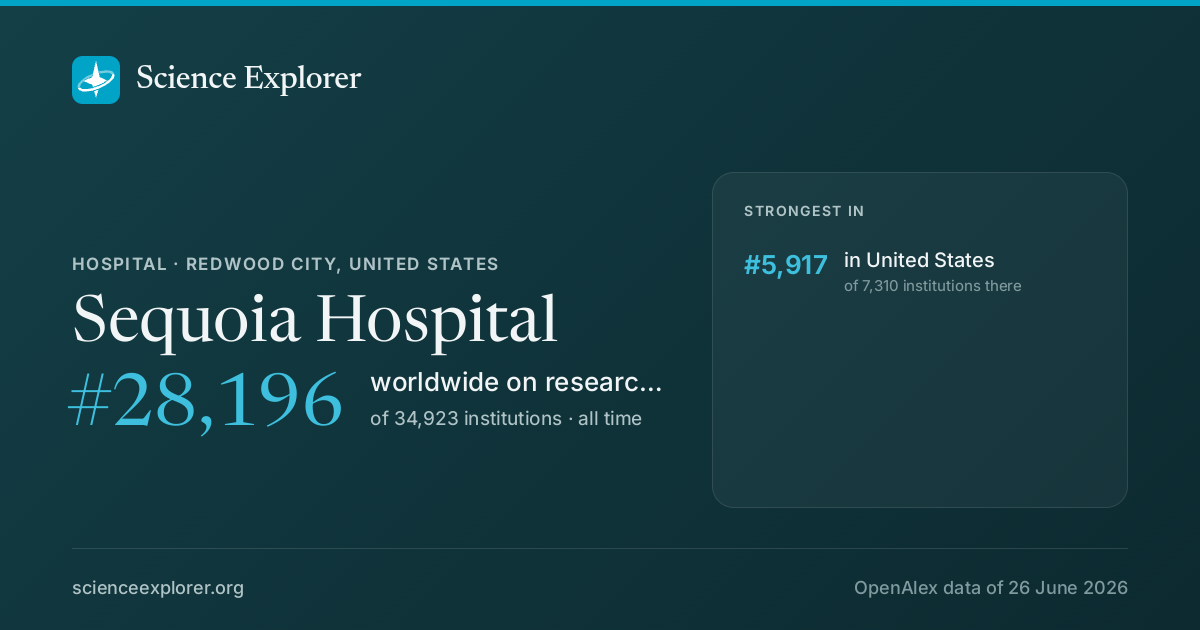
Sequoia Hospital

World rank, all time
#28,196
of 34,923
Rank in United States
#5,917
of 7,310
Research works
150
▲ 172% vs 2018-21
Citations
5.1k
34.1 per fractional work
Top-10% rate
15.7%
all institutions 10.0%
vs its own fields
1.14×
1.00× is exactly expected
Open access
22%
world 40%
International
9%
world 18%

Which fields of science does Sequoia Hospital work in?

In all years, 80% of research at Sequoia Hospital is in Health Sciences, 9% in Social Sciences. Its largest fields are Medicine (72%), Health Professions (6%), Engineering (4%). It does 3.2× the world's share of Health Sciences.

Health Sciences: 119 fractional works · 79.6% of its workMedicine: 109 fractional works · 72.4% of its workCardiology and Cardiovascular Medicine: 33 fractional works · 22.1% of its workSurgery: 29 fractional works · 19.1% of its workPulmonary and Respiratory Medicine: 14 fractional works · 9.4% of its workEpidemiology: 4 fractional works · 2.4% of its workRadiology, Nuclear Medicine and Imaging: 4 fractional works · 2.4% of its workInternal Medicine: 2 fractional works · 1.6% of its workAnesthesiology and Pain Medicine: 2 fractional works · 1.4% of its workReproductive Medicine: 2 fractional works · 1.2% of its workEmergency Medicine: 2 fractional works · 1.2% of its workHematology: 2 fractional works · 1.1% of its workEndocrinology, Diabetes and Metabolism: 2 fractional works · 1.1% of its workRheumatology: 1 fractional works · 1.0% of its workOncology: 1 fractional works · 0.9% of its workPublic Health, Environmental and Occupational Health: 1 fractional works · 0.8% of its workPhysiology: 1 fractional works · 0.8% of its workNeurology: 1 fractional works · 0.7% of its workInfectious Diseases: 1 fractional works · 0.6% of its workBiochemistry: 1 fractional works · 0.6% of its workPharmacology: 1 fractional works · 0.5% of its workDermatology: 1 fractional works · 0.5% of its workUrology: 1 fractional works · 0.4% of its workPediatrics, Perinatology and Child Health: 1 fractional works · 0.4% of its workPsychiatry and Mental health: 1 fractional works · 0.4% of its workObstetrics and Gynecology: 0 fractional works · 0.3% of its workOrthopedics and Sports Medicine: 0 fractional works · 0.3% of its workImmunology and Allergy: 0 fractional works · 0.2% of its workCritical Care and Intensive Care Medicine: 0 fractional works · 0.2% of its workHealth Informatics: 0 fractional works · 0.2% of its workSmaller subfields together: 1 fractional works · 0.8% of its workHealth Professions: 9 fractional works · 5.8% of its workGeneral Health Professions: 4 fractional works · 2.9% of its workRadiological and Ultrasound Technology: 1 fractional works · 1.0% of its workEmergency Medical Services: 1 fractional works · 0.8% of its workHealth Information Management: 1 fractional works · 0.4% of its workPhysical Therapy, Sports Therapy and Rehabilitation: 0 fractional works · 0.3% of its workSpeech and Hearing: 0 fractional works · 0.2% of its workSmaller subfields together: 0 fractional works · 0.2% of its workNursing: 2 fractional works · 1.0% of its workIssues, ethics and legal aspects: 1 fractional works · 0.8% of its workNutrition and Dietetics: 0 fractional works · 0.2% of its workDentistry: 0 fractional works · 0.3% of its workOral Surgery: 0 fractional works · 0.3% of its workVeterinary: 0 fractional works · 0.2% of its workSocial Sciences: 13 fractional works · 8.7% of its workSocial Sciences: 3 fractional works · 2.3% of its workEducation: 2 fractional works · 1.1% of its workCultural Studies: 1 fractional works · 0.6% of its workSociology and Political Science: 1 fractional works · 0.4% of its workGender Studies: 0 fractional works · 0.2% of its workSmaller subfields together: 0 fractional works · 0.1% of its workArts and Humanities: 3 fractional works · 2.0% of its workPhilosophy: 2 fractional works · 1.2% of its workLanguage and Linguistics: 0 fractional works · 0.3% of its workLiterature and Literary Theory: 0 fractional works · 0.3% of its workVisual Arts and Performing Arts: 0 fractional works · 0.2% of its workPsychology: 3 fractional works · 2.0% of its workClinical Psychology: 2 fractional works · 1.2% of its workApplied Psychology: 0 fractional works · 0.3% of its workExperimental and Cognitive Psychology: 0 fractional works · 0.2% of its workSocial Psychology: 0 fractional works · 0.2% of its workEconomics, Econometrics and Finance: 2 fractional works · 1.6% of its workEconomics and Econometrics: 2 fractional works · 1.6% of its workBusiness, Management and Accounting: 1 fractional works · 0.7% of its workOrganizational Behavior and Human Resource Management: 1 fractional works · 0.7% of its workDecision Sciences: 0 fractional works · 0.1% of its workLife Sciences: 10 fractional works · 6.8% of its workBiochemistry, Genetics and Molecular Biology: 4 fractional works · 2.6% of its workMolecular Biology: 2 fractional works · 1.5% of its workGenetics: 1 fractional works · 0.6% of its workCancer Research: 0 fractional works · 0.3% of its workSmaller subfields together: 0 fractional works · 0.3% of its workNeuroscience: 2 fractional works · 1.6% of its workCellular and Molecular Neuroscience: 2 fractional works · 1.0% of its workCognitive Neuroscience: 1 fractional works · 0.4% of its workNeurology: 0 fractional works · 0.3% of its workAgricultural and Biological Sciences: 1 fractional works · 0.9% of its workAgronomy and Crop Science: 1 fractional works · 0.7% of its workSmaller subfields together: 0 fractional works · 0.3% of its workImmunology and Microbiology: 1 fractional works · 0.9% of its workImmunology: 1 fractional works · 0.7% of its workSmaller subfields together: 0 fractional works · 0.1% of its workPharmacology, Toxicology and Pharmaceutics: 1 fractional works · 0.7% of its workPharmacology: 1 fractional works · 0.7% of its workPhysical Sciences: 7 fractional works · 4.9% of its workEngineering: 5 fractional works · 3.5% of its workBiomedical Engineering: 4 fractional works · 2.5% of its workElectrical and Electronic Engineering: 1 fractional works · 0.6% of its workAerospace Engineering: 0 fractional works · 0.2% of its workComputational Mechanics: 0 fractional works · 0.2% of its workComputer Science: 1 fractional works · 0.7% of its workArtificial Intelligence: 1 fractional works · 0.7% of its workSmaller subfields together: 0 fractional works · 0.0% of its workChemistry: 0 fractional works · 0.3% of its workAnalytical Chemistry: 0 fractional works · 0.3% of its workMaterials Science: 0 fractional works · 0.2% of its workBiomaterials: 0 fractional works · 0.2% of its workEnvironmental Science: 0 fractional works · 0.1% of its workMathematics: 0 fractional works · 0.0% of its workALL ITS WORKSequoia Hospital150fractional works, all years
Life Sciences7%Physical Sciences5%Health Sciences80%Social Sciences9%

Each ring splits the one inside it: the four domains of science, their fields, their subfields. Size is fractional works in all years. Every slice is a page; the interactive view zooms down to single topics and colours each by how much more of it this institution does than the world.

Its 4 domains and 22 fields, with their numbers
    1. Medicine10972.4%
    2. Health Professions95.8%
    3. Nursing21.0%
    4. Dentistry00.3%
    5. Veterinary00.2%
    1. Social Sciences32.3%
    2. Arts and Humanities32.0%
    3. Psychology32.0%
    4. Economics, Econometrics and Finance21.6%
    5. Business, Management and Accounting10.7%
    6. Decision Sciences00.1%
    1. Biochemistry, Genetics and Molecular Biology42.6%
    2. Neuroscience21.6%
    3. Agricultural and Biological Sciences10.9%
    4. Immunology and Microbiology10.9%
    5. Pharmacology, Toxicology and Pharmaceutics10.7%
    1. Engineering53.5%
    2. Computer Science10.7%
    3. Chemistry00.3%
    4. Materials Science00.2%
    5. Environmental Science00.1%
    6. Mathematics00.0%
All of science, and how each field's share has moved since 1950: the Science domain explorer

Field profile

Location quotient across every field it publishes in: outside the ring is more than an institution of this size would be expected to publish, inside it is less.

Agricultural and Biological Sciences: 0.24× its world share, 0 worksAgricultural and Bio…Biochemistry, Genetics and Molecular Biology: 1.03× its world share, 0 worksBiochemistry, Geneti…Immunology and Microbiology: 1.71× its world share, 0 worksImmunology and Micro…Neuroscience: 3.07× its world share, 0 worksNeuroscienceComputer Science: 0.06× its world share, 0 worksComputer ScienceMathematics: 0.42× its world share, 0 worksMathematicsDentistry: 1.42× its world share, 0 worksDentistryHealth Professions: 2.02× its world share, 0 worksHealth ProfessionsMedicine: 3.64× its world share, 7 worksMedicineArts and Humanities: 0.59× its world share, 0 worksArts and HumanitiesPsychology: 1.13× its world share, 0 worksPsychologySocial Sciences: 0.36× its world share, 0 worksSocial Sciences1×world share
more than its size predictsabout as predictedless

Rings at 0.5×, 1× and 2×. Widest outward: Medicine, 3.6×. Every wedge is a field page.

All 12 fields, with their numbers
  1. Medicine3.64×7 works
  2. Neuroscience3.07×0 works
  3. Health Professions2.02×0 works
  4. Immunology and Microbiology1.71×0 works
  5. Dentistry1.42×0 works
  6. Psychology1.13×0 works
  7. Biochemistry, Genetics and Molecular Biology1.03×0 works
  8. Arts and Humanities0.59×0 works
  9. Mathematics0.42×0 works
  10. Social Sciences0.36×0 works
  11. Agricultural and Biological Sciences0.24×0 works
  12. Computer Science0.06×0 works

Who are the top researchers at Sequoia Hospital?

Ranked on the quality score, R. Hardwin Mead, Tomoaki Hinohara and Rob A. Patrawala lead among researchers whose main affiliation is Sequoia Hospital.

  1. 1 R. Hardwin Mead United States · #404,845 worldwide 4.2k citations · 70 works
  2. 2 Tomoaki Hinohara United States · #511,525 worldwide 6.2k citations · 97 works
  3. 3 Rob A. Patrawala United States · #754,860 worldwide 1.5k citations · 29 works
  4. 4 Vincent A. Gaudiani United States · #842,875 worldwide 2.2k citations · 49 works
  5. 5 Matthew R. Selmon United States · #874,927 worldwide 2.4k citations · 34 works
  6. 6 John B. Simpson United States · #977,836 worldwide 8.9k citations · 223 works
  7. 7 Gregory C. Robertson United States · #1,456,834 worldwide 2.1k citations · 60 works
  8. 8 Melissa H. Kong United States · #1,499,153 worldwide 2.6k citations · 91 works
  9. 9 Wally S. Buch United States · #1,736,415 worldwide 1.4k citations · 18 works
  10. 10 Nellis A. Smith United States · #1,962,653 worldwide 1.3k citations · 15 works
All ranked researchers at Sequoia Hospital

What are the most cited papers from Sequoia Hospital?

The most cited paper from Sequoia Hospital is "Predicting Successful Guidewire Crossing Through Chronic Total Occlusion of Native Coronary Lesions Within 30 Minutes" (Yoshihiro Morino, Mitsuru Abe, Takeshi Morimoto et al., 2011), with 903 citations. Next come "Long-term outcome with the automatic implantable cardioverter-defibrillator" (724) and "A Comparison of Directional Atherectomy with Coronary Angioplasty in Patients with Coronary Artery Disease" (700).

Most cited papers
#PaperReleasedCitations
1 Predicting Successful Guidewire Crossing Through Chronic Total Occlusion of Native Coronary Lesions Within 30 Minutes Yoshihiro Morino, Mitsuru Abe, Takeshi Morimoto et al. · JACC: Cardiovascular Interventions Open access Feb 2011 903
2 Long-term outcome with the automatic implantable cardioverter-defibrillator Roger A. Winkle, R. Hardwin Mead, Michael A. Ruder et al. · Journal of the American College of Cardiology Open access May 1989 724
3 A Comparison of Directional Atherectomy with Coronary Angioplasty in Patients with Coronary Artery Disease Eric J. Topol, Ferdinand S. Leya, Cass A. Pinkerton et al. · New England Journal of Medicine Open access 22 Jul 1993 700
4 Meta‐analysis: effect of hormone‐replacement therapy on components of the metabolic syndrome in postmenopausal women Shelley R. Salpeter, Judith M. E. Walsh, Thomas M. Ormiston et al. · Diabetes Obesity and Metabolism 24 Nov 2005 643
5 The CONNECT (Clinical Evaluation of Remote Notification to Reduce Time to Clinical Decision) Trial George H. Crossley, Andrew Boyle, Holly S. Vitense et al. · Journal of the American College of Cardiology Open access 24 Jan 2011 531
All 60 most cited papers, with filters and sorting

Which keywords describe research at Sequoia Hospital?

By fractional works in all years, weighted toward what it does more of than the world: Atherosclerosis, Guidelines, Catheter Ablation, Percutaneous Coronary Intervention, Risk Factors, Arrhythmias, Sudden Cardiac Death and Heart Failure.

▲ more of its work than of the world's◆ about the world's share▼ less than the world's

Size is fractional works in all years in the topics tagged with each word; colour is the word's share of this institution's work against its share of the world's. The 40 words are chosen for being large and distinctive. Each links to the topic it comes from most.

All 40 words, with their numbers
  1. Atherosclerosis18▲ 33×8 topics
  2. Guidelines17▲ 24×9 topics
  3. Catheter Ablation14▲ 76×2 topics
  4. Percutaneous Coronary Intervention13▲ 58×4 topics
  5. Risk Factors12▲ 7.7×8 topics
  6. Arrhythmias11▲ 55×2 topics
  7. Sudden Cardiac Death10▲ 56×2 topics
  8. Heart Failure10▲ 14×8 topics
  9. Stroke Prevention9▲ 48×2 topics
  10. Coronary Stents9▲ 118×1 topic
  11. Myocardial Revascularization9▲ 118×1 topic
  12. Remote Monitoring9▲ 52×2 topics
  13. Echocardiography9▲ 21×4 topics
  14. Radiofrequency Ablation8▲ 51×1 topic
  15. Ventricular Tachycardia8▲ 96×1 topic
  16. Diabetes8▲ 10×6 topics
  17. Revascularization8▲ 35×3 topics
  18. Angioplasty7▲ 70×2 topics
  19. Cardiac Resynchronization Therapy7▲ 110×1 topic
  20. Implantable Cardioverter-Defibrillator7▲ 110×1 topic
  21. Claudication7▲ 119×1 topic
  22. Peripheral Arterial Disease7▲ 119×1 topic
  23. Anticoagulant Therapy6▲ 35×3 topics
  24. Atrial Fibrillation6▲ 41×1 topic
  25. Risk Stratification6▲ 59×1 topic
  26. Magnetic Resonance Imaging6▲ 10×3 topics
  27. Treatment6▲ 2.9×14 topics
  28. Diagnosis5▲ 3.5×14 topics
  29. Myocardial Infarction4▲ 11×4 topics
  30. Clinical Practice Guidelines4▲ 4.4×9 topics
  31. Hemostasis3▲ 15×2 topics
  32. Coronary Artery Disease3▲ 18×2 topics
  33. Carotid Artery Stenosis3▲ 36×1 topic
  34. Endarterectomy3▲ 36×1 topic
  35. Cardiac Imaging3▲ 14×2 topics
  36. Prophylaxis3▲ 14×3 topics
  37. Femoral Access3▲ 74×1 topic
  38. Radial Access3▲ 74×1 topic
  39. Antithrombotic Therapy3▲ 18×2 topics
  40. Calcium Signaling3▲ 14×2 topics

Which research topics does Sequoia Hospital publish most on?

By volume in 2022-now: Cardiac Arrhythmias and Treatments, Cardiac pacing and defibrillation studies, Radiomics and Machine Learning in Medical Imaging and Atrial Fibrillation Management and Outcomes.

  1. 1 Cardiac Arrhythmias and Treatments Cardiology and Cardiovascular Medicine 1 works
  2. 2 Cardiac pacing and defibrillation studies Cardiology and Cardiovascular Medicine 0 works
  3. 3 Radiomics and Machine Learning in Medical Imaging Radiology, Nuclear Medicine and Imaging 0 works
  4. 4 Atrial Fibrillation Management and Outcomes Cardiology and Cardiovascular Medicine 0 works
  5. 5 Colorectal Cancer Screening and Detection Oncology 0 works
  6. 6 Artificial Intelligence in Healthcare Health Information Management 0 works
  7. 7 Brain Tumor Detection and Classification Neurology 0 works
  8. 8 Gastric Cancer Management and Outcomes Pulmonary and Respiratory Medicine 0 works
  9. 9 Pancreatic and Hepatic Oncology Research Oncology 0 works
  10. 10 Cardiovascular Syncope and Autonomic Disorders Surgery 0 works

How open and international is its research?

Against the world's own shares: the tick on each track. Both are shares of its output, so they sit on one scale and can be read against each other as well as against the world.

openly available21.5%not open78.5%

World: 40% of research is openly available.

with international co-authors9.3%domestic only90.7%

World: 18% is written across borders.

How has Sequoia Hospital's research output changed?

Output in 2022-2025 was 172% higher than in 2018-2021.

still counting1990200020102020
grewheldshrank

The same series as a ribbon: one cell per year, darker for more. The line above answers how much; this answers when.

Its share of all research

Growing output can still be a shrinking share: all of science grows. This is Sequoia Hospital as a percentage of every work published that year, 0.000061% in 2024.

still counting0.00050%0.0010%0.0015%Sequoia Hospital0.000022% in 202519801990200020102020

Fractional works of Sequoia Hospital over all fractional works that year. How the balance of science has shifted.

Other research institutions in Redwood City

All research institutions in Redwood City

Share Sequoia Hospital's ranking

Sequoia Hospital on Science Explorer

A card with Sequoia Hospital's standing and the fields it leads in, for a post or a slide. A link to this page previews as the same card.

Download the card

1200 × 630 PNG, sized for social posts, drawn from the latest snapshot.

Badges for a website1Each links back here and updates with every snapshot

Research measures only: rankings here say nothing about teaching, admissions or student experience. Comparable institutions and collaboration partners have tabs of their own, above.

Discussion

Ask a question or share a note about Sequoia Hospital. Posts are plain text and can be reported.