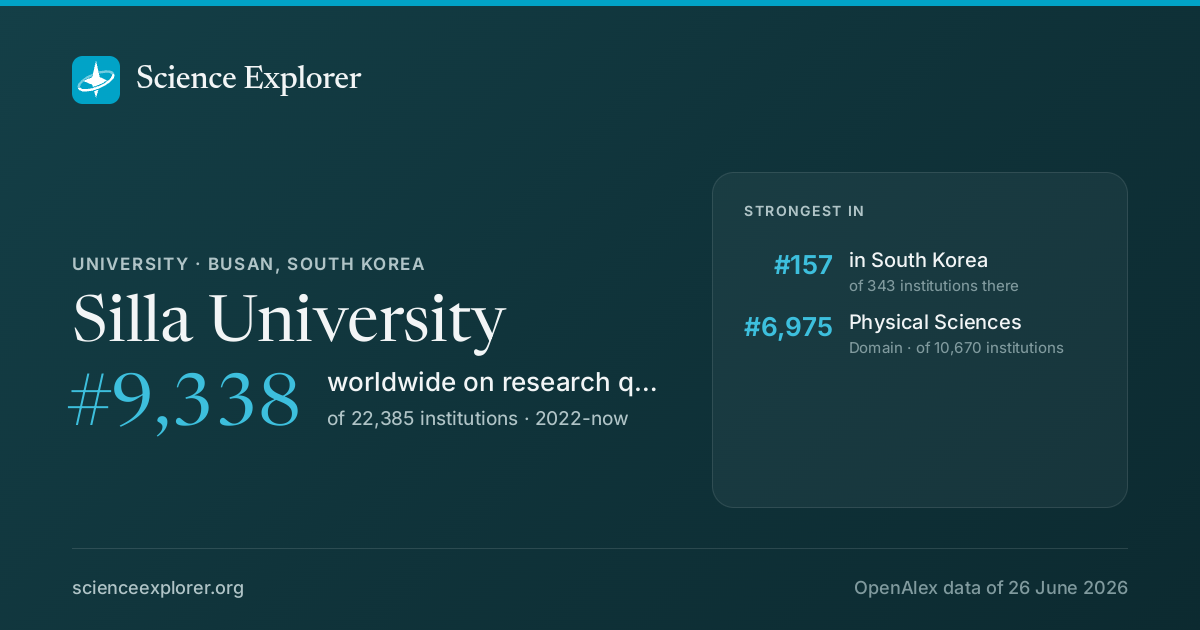
World rank, 2022-now #9,338
of 22,385 · #12,219 all time
Rank in South Korea #157
of 343 Research works 1.5k
▼ 5% vs 2018-21
Citations 17k 11.1 per fractional work
Top-10% rate 6.2%
all institutions 10.0%
vs its own fields 0.84×
1.00× is exactly expected
Open access 55%
world 40%
International 12%
world 18%
What is Silla University known for in research?
The fields where it stands highest, 2022-now, ranked among every institution above the floor in each field.
Field World rank Where that sits Top-10% rate Works All time Domain #6,975 of 10,670 6.2% 90
#12022
Which fields of science does Silla University work in?
In 2022-now, 39% of research at Silla University is in Physical Sciences , 24% in Health Sciences . Its largest fields are Medicine (15%), Engineering (12%), Computer Science (10%).
Physical Sciences: 99 fractional works · 38.5% of its work Engineering: 31 fractional works · 12.2% of its work Electrical and Electronic Engineering: 10 fractional works · 3.8% of its work Biomedical Engineering: 5 fractional works · 1.9% of its work Mechanical Engineering: 4 fractional works · 1.5% of its work Industrial and Manufacturing Engineering: 3 fractional works · 1.1% of its work Control and Systems Engineering: 2 fractional works · 0.7% of its work Aerospace Engineering: 2 fractional works · 0.6% of its work Ocean Engineering: 1 fractional works · 0.5% of its work Civil and Structural Engineering: 1 fractional works · 0.5% of its work Building and Construction: 1 fractional works · 0.5% of its work Mechanics of Materials: 1 fractional works · 0.4% of its work Media Technology: 1 fractional works · 0.4% of its work Smaller subfields together: 1 fractional works · 0.2% of its work Computer Science: 25 fractional works · 9.6% of its work Computer Vision and Pattern Recognition: 8 fractional works · 3.2% of its work Information Systems: 4 fractional works · 1.7% of its work Computer Graphics and Computer-Aided Design: 4 fractional works · 1.4% of its work Artificial Intelligence: 3 fractional works · 1.2% of its work Human-Computer Interaction: 2 fractional works · 0.8% of its work Computer Networks and Communications: 2 fractional works · 0.7% of its work Computational Theory and Mathematics: 1 fractional works · 0.5% of its work Materials Science: 20 fractional works · 7.7% of its work Materials Chemistry: 17 fractional works · 6.7% of its work Electronic, Optical and Magnetic Materials: 1 fractional works · 0.5% of its work Biomaterials: 1 fractional works · 0.3% of its work Smaller subfields together: 0 fractional works · 0.2% of its work Environmental Science: 7 fractional works · 2.9% of its work Global and Planetary Change: 2 fractional works · 0.6% of its work Ecology: 1 fractional works · 0.6% of its work Health, Toxicology and Mutagenesis: 1 fractional works · 0.5% of its work Management, Monitoring, Policy and Law: 1 fractional works · 0.3% of its work Water Science and Technology: 1 fractional works · 0.3% of its work Environmental Engineering: 1 fractional works · 0.2% of its work Pollution: 1 fractional works · 0.2% of its work Smaller subfields together: 0 fractional works · 0.1% of its work Mathematics: 6 fractional works · 2.1% of its work Applied Mathematics: 2 fractional works · 0.7% of its work Algebra and Number Theory: 1 fractional works · 0.6% of its work Modeling and Simulation: 1 fractional works · 0.2% of its work Smaller subfields together: 2 fractional works · 0.7% of its work Physics and Astronomy: 3 fractional works · 1.4% of its work Radiation: 2 fractional works · 0.9% of its work Statistical and Nonlinear Physics: 1 fractional works · 0.4% of its work Smaller subfields together: 0 fractional works · 0.0% of its work Chemistry: 2 fractional works · 0.8% of its work Organic Chemistry: 1 fractional works · 0.5% of its work Inorganic Chemistry: 1 fractional works · 0.3% of its work Smaller subfields together: 0 fractional works · 0.1% of its work Earth and Planetary Sciences: 2 fractional works · 0.7% of its work Geology: 1 fractional works · 0.4% of its work Smaller subfields together: 1 fractional works · 0.4% of its work Energy: 2 fractional works · 0.7% of its work Renewable Energy, Sustainability and the Environment: 2 fractional works · 0.7% of its work Chemical Engineering: 1 fractional works · 0.4% of its work Catalysis: 1 fractional works · 0.3% of its work Smaller subfields together: 0 fractional works · 0.1% of its work Health Sciences: 62 fractional works · 24.2% of its work Medicine: 38 fractional works · 15.0% of its work Physiology: 4 fractional works · 1.4% of its work Pharmacology: 3 fractional works · 1.1% of its work Complementary and alternative medicine: 3 fractional works · 1.1% of its work Dermatology: 3 fractional works · 1.0% of its work Orthopedics and Sports Medicine: 2 fractional works · 0.9% of its work Public Health, Environmental and Occupational Health: 2 fractional works · 0.8% of its work Pulmonary and Respiratory Medicine: 2 fractional works · 0.8% of its work Oncology: 2 fractional works · 0.7% of its work Surgery: 2 fractional works · 0.7% of its work Rehabilitation: 2 fractional works · 0.7% of its work Psychiatry and Mental health: 2 fractional works · 0.6% of its work Biochemistry: 1 fractional works · 0.6% of its work Radiology, Nuclear Medicine and Imaging: 1 fractional works · 0.5% of its work Gastroenterology: 1 fractional works · 0.5% of its work Epidemiology: 1 fractional works · 0.5% of its work Pathology and Forensic Medicine: 1 fractional works · 0.3% of its work Obstetrics and Gynecology: 1 fractional works · 0.3% of its work Geriatrics and Gerontology: 1 fractional works · 0.3% of its work Emergency Medicine: 1 fractional works · 0.3% of its work Cardiology and Cardiovascular Medicine: 1 fractional works · 0.2% of its work Health Informatics: 1 fractional works · 0.2% of its work Infectious Diseases: 1 fractional works · 0.2% of its work Endocrinology, Diabetes and Metabolism: 1 fractional works · 0.2% of its work Smaller subfields together: 3 fractional works · 1.2% of its work Dentistry: 14 fractional works · 5.4% of its work Periodontics: 10 fractional works · 4.1% of its work Oral Surgery: 2 fractional works · 0.9% of its work Orthodontics: 1 fractional works · 0.4% of its work Smaller subfields together: 0 fractional works · 0.1% of its work Health Professions: 7 fractional works · 2.6% of its work General Health Professions: 3 fractional works · 1.1% of its work Physical Therapy, Sports Therapy and Rehabilitation: 2 fractional works · 0.7% of its work Health Information Management: 1 fractional works · 0.2% of its work Smaller subfields together: 2 fractional works · 0.6% of its work Nursing: 3 fractional works · 1.1% of its work Nutrition and Dietetics: 2 fractional works · 0.9% of its work Smaller subfields together: 0 fractional works · 0.2% of its work Veterinary: 0 fractional works · 0.0% of its work Social Sciences: 57 fractional works · 22.4% of its work Social Sciences: 23 fractional works · 9.1% of its work Sociology and Political Science: 6 fractional works · 2.4% of its work Cultural Studies: 5 fractional works · 2.1% of its work Education: 3 fractional works · 1.3% of its work Demography: 2 fractional works · 0.7% of its work Linguistics and Language: 1 fractional works · 0.5% of its work Political Science and International Relations: 1 fractional works · 0.5% of its work Communication: 1 fractional works · 0.4% of its work General Social Sciences: 1 fractional works · 0.3% of its work Urban Studies: 1 fractional works · 0.3% of its work Health: 1 fractional works · 0.2% of its work Smaller subfields together: 1 fractional works · 0.4% of its work Psychology: 14 fractional works · 5.3% of its work Social Psychology: 9 fractional works · 3.6% of its work Experimental and Cognitive Psychology: 2 fractional works · 0.8% of its work Developmental and Educational Psychology: 1 fractional works · 0.5% of its work Clinical Psychology: 1 fractional works · 0.3% of its work Smaller subfields together: 0 fractional works · 0.1% of its work Business, Management and Accounting: 10 fractional works · 3.9% of its work Marketing: 4 fractional works · 1.6% of its work Management of Technology and Innovation: 2 fractional works · 0.6% of its work Strategy and Management: 2 fractional works · 0.6% of its work Organizational Behavior and Human Resource Management: 1 fractional works · 0.3% of its work Management Information Systems: 1 fractional works · 0.3% of its work Accounting: 1 fractional works · 0.2% of its work Business and International Management: 1 fractional works · 0.2% of its work Arts and Humanities: 5 fractional works · 1.8% of its work Language and Linguistics: 2 fractional works · 0.6% of its work Archeology: 1 fractional works · 0.5% of its work Museology: 1 fractional works · 0.4% of its work Conservation: 1 fractional works · 0.2% of its work Smaller subfields together: 0 fractional works · 0.2% of its work Economics, Econometrics and Finance: 3 fractional works · 1.3% of its work Economics and Econometrics: 2 fractional works · 0.9% of its work Finance: 1 fractional works · 0.2% of its work Smaller subfields together: 0 fractional works · 0.2% of its work Decision Sciences: 2 fractional works · 0.9% of its work Information Systems and Management: 1 fractional works · 0.5% of its work Management Science and Operations Research: 1 fractional works · 0.4% of its work Smaller subfields together: 0 fractional works · 0.1% of its work Life Sciences: 38 fractional works · 14.9% of its work Biochemistry, Genetics and Molecular Biology: 20 fractional works · 7.6% of its work Molecular Biology: 11 fractional works · 4.2% of its work Biotechnology: 3 fractional works · 1.3% of its work Cell Biology: 3 fractional works · 1.0% of its work Genetics: 2 fractional works · 0.6% of its work Smaller subfields together: 1 fractional works · 0.5% of its work Agricultural and Biological Sciences: 12 fractional works · 4.8% of its work Food Science: 5 fractional works · 1.9% of its work Aquatic Science: 2 fractional works · 0.9% of its work Plant Science: 2 fractional works · 0.8% of its work Insect Science: 1 fractional works · 0.6% of its work Animal Science and Zoology: 1 fractional works · 0.4% of its work Smaller subfields together: 1 fractional works · 0.2% of its work Neuroscience: 4 fractional works · 1.4% of its work Cognitive Neuroscience: 1 fractional works · 0.4% of its work Neurology: 1 fractional works · 0.3% of its work Cellular and Molecular Neuroscience: 1 fractional works · 0.3% of its work Endocrine and Autonomic Systems: 1 fractional works · 0.2% of its work Smaller subfields together: 1 fractional works · 0.3% of its work Immunology and Microbiology: 2 fractional works · 0.6% of its work Immunology: 1 fractional works · 0.4% of its work Smaller subfields together: 1 fractional works · 0.2% of its work Pharmacology, Toxicology and Pharmaceutics: 1 fractional works · 0.4% of its work Pharmacology: 1 fractional works · 0.4% of its work Smaller subfields together: 0 fractional works · 0.1% of its work Physical Sciences Engineering Computer Science Materials Science Environme… Mathemati… Health Sciences Medicine Dentistry Health Pr… Social Sciences Social Sciences Psychology Business Arts and… Life Sciences Biochemistry Agricultu… Neuroscie… ALL ITS WORK Silla University 256 fractional works, 2022-now 15% 39% 24% 22%
Each ring splits the one inside it: the four domains of science, their fields, their subfields. Size is fractional works in 2022-now. Every slice is a page; the interactive view zooms down to single topics and colours each by how much more of it this institution does than the world.
Its 4 domains and 26 fields, with their numbers 31 12.2% 25 9.6% 20 7.7% 7 2.9% 6 2.1% 3 1.4% 2 0.8% 2 0.7% 2 0.7% 1 0.4% 38 15.0% 14 5.4% 7 2.6% 3 1.1% 0 0.0% 23 9.1% 14 5.3% 10 3.9% 5 1.8% 3 1.3% 2 0.9% 20 7.6% 12 4.8% 4 1.4% 2 0.6% 1 0.4% All of science, and how each field's share has moved since 1950: the Science domain explorer
Field profile
Location quotient across every field it publishes in: outside the ring is more than an institution of this size would be expected to publish, inside it is less.
Agricultural and Biological Sciences: 1.01× its world share, 12 works Agricultural and Bio… Biochemistry, Genetics and Molecular Biology: 1.43× its world share, 20 works Biochemistry, Geneti… Immunology and Microbiology: 0.61× its world share, 2 works Immunology and Micro… Neuroscience: 0.89× its world share, 4 works Neuroscience Pharmacology, Toxicology and Pharmaceutics: 1.22× its world share, 1 works Pharmacology, Toxico… Chemical Engineering: 1.25× its world share, 1 works Chemical Engineering Chemistry: 0.53× its world share, 2 works Chemistry Computer Science: 1.23× its world share, 24 works Computer Science Earth and Planetary Sciences: 0.47× its world share, 2 works Earth and Planetary … Energy: 0.79× its world share, 2 works Energy Engineering: 0.81× its world share, 31 works Engineering Environmental Science: 0.58× its world share, 7 works Environmental Science Materials Science: 2.21× its world share, 20 works Materials Science Mathematics: 1.82× its world share, 6 works Mathematics Physics and Astronomy: 0.61× its world share, 4 works Physics and Astronomy Dentistry: 11.17× its world share, 14 works Dentistry Health Professions: 0.99× its world share, 7 works Health Professions Medicine: 0.78× its world share, 38 works Medicine Nursing: 2.29× its world share, 3 works Nursing Veterinary: 0.32× its world share, 0 works Veterinary Arts and Humanities: 0.63× its world share, 5 works Arts and Humanities Business, Management and Accounting: 1.22× its world share, 10 works Business, Management… Decision Sciences: 0.98× its world share, 2 works Decision Sciences Economics, Econometrics and Finance: 0.60× its world share, 3 works Economics, Econometr… Psychology: 1.73× its world share, 14 works Psychology Social Sciences: 0.72× its world share, 23 works Social Sciences 1× world share
Rings at 0.5×, 1× and 2×. Widest outward: Dentistry , 11.2×. Every wedge is a field page.
All 26 fields, with their numbers Dentistry 11.17× 14 works Nursing 2.29× 3 works Materials Science 2.21× 20 works Mathematics 1.82× 6 works Psychology 1.73× 14 works Biochemistry, Genetics and Molecular Biology 1.43× 20 works Chemical Engineering 1.25× 1 works Computer Science 1.23× 24 works Pharmacology, Toxicology and Pharmaceutics 1.22× 1 works Business, Management and Accounting 1.22× 10 works Agricultural and Biological Sciences 1.01× 12 works Health Professions 0.99× 7 works Decision Sciences 0.98× 2 works Neuroscience 0.89× 4 works Engineering 0.81× 31 works Energy 0.79× 2 works Medicine 0.78× 38 works Social Sciences 0.72× 23 works Arts and Humanities 0.63× 5 works Immunology and Microbiology 0.61× 2 works Physics and Astronomy 0.61× 4 works Economics, Econometrics and Finance 0.60× 3 works Environmental Science 0.58× 7 works Chemistry 0.53× 2 works Earth and Planetary Sciences 0.47× 2 works Veterinary 0.32× 0 works
Who are the top researchers at Silla University?
Ranked on the quality score, Donghyeon Kim , Yuzhe Qi and Jung‐Chul Park lead among researchers whose main affiliation is Silla University.
1
Donghyeon Kim
South Korea · #1,851,824 worldwide507 citations · 18 works
2
Yuzhe Qi
South Korea · #2,523,019 worldwide72 citations · 18 works
3
Jung‐Chul Park
South Korea · #2,740,536 worldwide1.7k citations · 80 works
4
R. Balakrishnaiah
South Korea · #2,764,298 worldwide616 citations · 27 works
5
Donggiun Kim
South Korea · #2,779,135 worldwide2.1k citations · 47 works
6
Inseok Kwak
South Korea · #2,805,043 worldwide1.1k citations · 26 works
7
Soung‐Soo Yi
South Korea · #3,473,181 worldwide2.3k citations · 92 works
8
Woo Sung Kim
South Korea · #3,839,573 worldwide198 citations · 15 works
9
Andre Kim
South Korea · #4,321,536 worldwide1.4k citations · 80 works
10
Jongbum Park
South Korea · #4,333,893 worldwide340 citations · 15 works
All ranked researchers at Silla University
What are the most cited papers from Silla University?
The most cited paper from Silla University is "Biology of Acinetobacter baumannii: Pathogenesis, Antibiotic Resistance Mechanisms, and Prospective Treatment Options" (Chang-Ro Lee, Jung Hun Lee, Moonhee Park et al., 2017), with 1,049 citations. Next come "Bacillus strains as human probiotics: characterization, safety, microbiome, and probiotic carrier" (387) and "High-performance gas sensor array for indoor air quality monitoring: the role of Au nanoparticles on WO 3 , SnO 2 , and NiO-based gas sensors" (300).
Most cited papers
# Paper Released Citations 1
Biology of Acinetobacter baumannii: Pathogenesis, Antibiotic Resistance Mechanisms, and Prospective Treatment Options
Chang-Ro Lee, Jung Hun Lee, Moonhee Park et al. · Frontiers in Cellular and Infection Microbiology
Open access 12 Mar 2017
1,049 2
Bacillus strains as human probiotics: characterization, safety, microbiome, and probiotic carrier
Na‐Kyoung Lee, Won-Suck Kim, Hyun‐Dong Paik · Food Science and Biotechnology
Open access Oct 2019
387 3
High-performance gas sensor array for indoor air quality monitoring: the role of Au nanoparticles on WO 3 , SnO 2 , and NiO-based gas sensors
Jinho Lee, Youngmo Jung, Seung-Hyun Sung et al. · Journal of Materials Chemistry A
10 Dec 2020
300 4
Epidemiology and Characteristics of Metallo-β-Lactamase-ProducingPseudomonas aeruginosa
Duck Jin Hong, Il Kwon Bae, In-Ho Jang et al. · Infection and Chemotherapy
Open access 2015
284 5
Recent Highlights in Hemicarcerand Chemistry
Ralf Warmuth, Juyoung Yoon · Accounts of Chemical Research
11 Jan 2001
252
All 60 most cited papers, with filters and sorting
Which keywords describe research at Silla University?
By fractional works in 2022-now, weighted toward what it does more of than the world: Dental Caries, Product Design, User Satisfaction, Prevention, Consumer Preferences, Virtual Reality, Luminescent Materials and Solar Cell Efficiency.
Size is fractional works in 2022-now in the topics tagged with each word; colour is the word's share of this institution's work against its share of the world's. The 40 words are chosen for being large and distinctive. Each links to the topic it comes from most.
All 40 words, with their numbers Deep Learning 15 ▲ 1.68× 33 topics Epidemiology 12 ▲ 1.21× 25 topics Dental Caries 10 ▲ 38× 2 topics Quality of Life 10 ▲ 2.7× 17 topics Artificial Intelligence 10 ▲ 2.7× 20 topics Product Design 9 ▲ 25× 3 topics Risk Factors 8 ▲ 3.0× 12 topics Prevention 8 ▲ 7.6× 5 topics Virtual Reality 8 ▲ 6.5× 10 topics User Satisfaction 8 ▲ 17× 2 topics Consumer Preferences 8 ▲ 42× 2 topics Inflammation 8 ▲ 1.39× 27 topics Luminescent Materials 8 ▲ 42× 2 topics Solar Cell Efficiency 7 ▲ 28× 2 topics Cognitive Performance 7 ▲ 28× 2 topics Nanocrystal Synthesis 7 ▲ 60× 1 topic Oxidative Stress 7 ▲ 1.72× 18 topics Upconversion Nanoparticles 7 ▲ 60× 1 topic Color Psychology 7 ▲ 91× 1 topic Kansei Engineering 7 ▲ 91× 1 topic Antioxidant Activity 7 ▲ 4.1× 13 topics Bacterial Diversity 6 ▲ 19× 2 topics Microbial Ecology 6 ▲ 13× 2 topics Global Burden 6 ▲ 4.0× 3 topics Diabetes Mellitus 5 ▲ 10× 2 topics Oral Microbiome 5 ▲ 34× 1 topic Periodontal Diseases 5 ▲ 34× 1 topic Antioxidants 5 ▲ 4.3× 6 topics Fluoride 5 ▲ 33× 1 topic Medical Imaging 5 ▲ 3.5× 6 topics Oral Health 5 ▲ 31× 1 topic Human-Computer Interaction 4 ▲ 9.2× 4 topics Crystal Growth 4 ▲ 5.8× 5 topics Consumer Perception 4 ▲ 6.6× 5 topics Multimedia Technology 4 ▲ 25× 2 topics Hallyu 4 ▲ 55× 1 topic Korean Wave 4 ▲ 55× 1 topic Health Benefits 4 ▲ 4.4× 4 topics Digital Media Technology 4 ▲ 36× 1 topic Visual Communication Design 4 ▲ 36× 1 topic
How open and international is its research?
Against the world's own shares: the tick on each track. Both are shares of its output, so they
sit on one scale and can be read against each other as well as against the world.
55% 45%
55.4% 44.6%
World: 40% of research is openly available.
12% 88%
12.1% 87.9%
World: 18% is written across borders.
How has Silla University's research output changed?
Output in 2022-2025 was 5% lower than in 2018-2021.
still counting 1990 2000 2010 2020
The same series as a ribbon: one cell per year, darker for more. The line above answers how much ; this answers when .
Its share of all research
How much of it reaches the world top 10%
still counting 5% 10% 15% all institutions 10.0% in 2025 Silla University 5.6% in 2025 2010 2020 Of each year's output, the share that reached the world's 10% most cited for its field and year. Peak 12.5% in 2002.
Share Silla University's ranking
A card with Silla University's standing and the fields it leads in, for a post or a slide. A link to this page previews as the same card.
Badges for a website 1 Each links back here and updates with every snapshot
 South Korea · #1,851,824 worldwide
507 citations · 18 works