Science Explorer Back to mapMap
Discussion
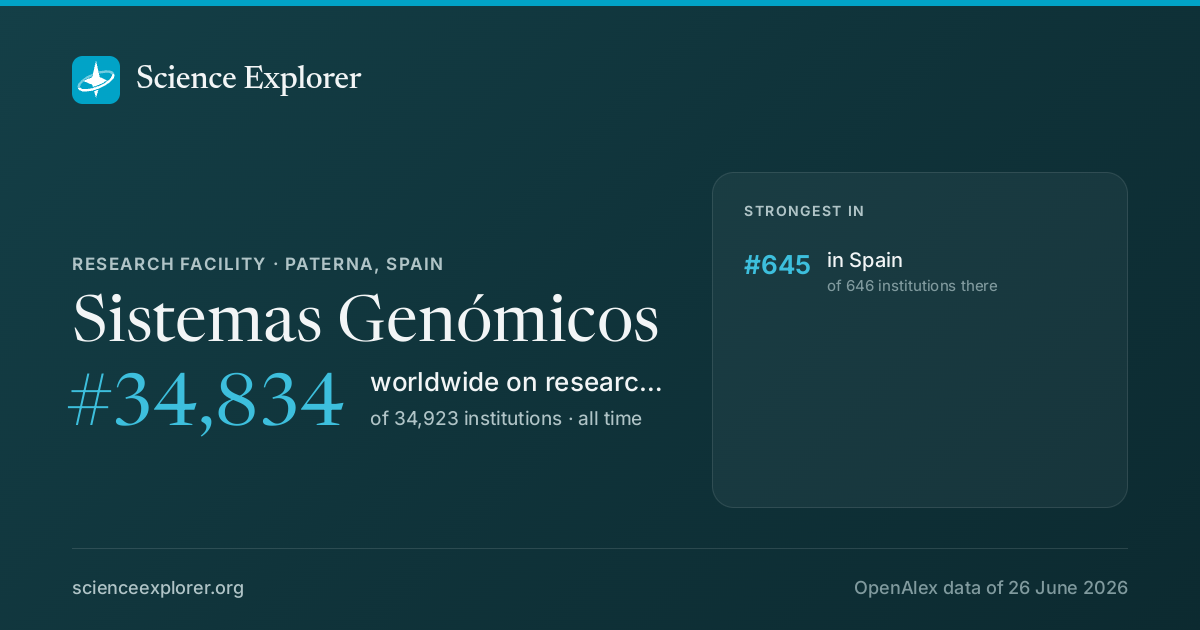
Research facility · Paterna · Spain

Sistemas Genómicos

World rank, all time
#34,834
of 34,923
Rank in Spain
#645
of 646
Research works
204
▼ 16% vs 2018-21
Citations
1.6k
8.0 per fractional work
Top-10% rate
4.9%
all institutions 10.0%
vs its own fields
0.79×
1.00× is exactly expected
Open access
36%
world 40%
International
17%
world 18%

Which fields of science does Sistemas Genómicos work in?

In 2022-now, 40% of research at Sistemas Genómicos is in Health Sciences, 28% in Life Sciences. Its largest fields are Medicine (35%), Biochemistry, Genetics and Molecular Biology (16%), Agricultural and Biological Sciences (9%). It does 1.6× the world's share of Life Sciences.

Health Sciences: 9 fractional works · 39.8% of its workMedicine: 8 fractional works · 35.5% of its workPediatrics, Perinatology and Child Health: 1 fractional works · 5.5% of its workPathology and Forensic Medicine: 1 fractional works · 4.8% of its workNeurology: 1 fractional works · 4.7% of its workOncology: 1 fractional works · 3.8% of its workHematology: 1 fractional works · 3.2% of its workSurgery: 0 fractional works · 2.1% of its workPublic Health, Environmental and Occupational Health: 0 fractional works · 1.4% of its workReproductive Medicine: 0 fractional works · 1.2% of its workPulmonary and Respiratory Medicine: 0 fractional works · 1.1% of its workDermatology: 0 fractional works · 0.9% of its workEpidemiology: 0 fractional works · 0.9% of its workInfectious Diseases: 0 fractional works · 0.9% of its workCardiology and Cardiovascular Medicine: 0 fractional works · 0.8% of its workEndocrinology, Diabetes and Metabolism: 0 fractional works · 0.7% of its workGenetics: 0 fractional works · 0.7% of its workTransplantation: 0 fractional works · 0.6% of its workPhysiology: 0 fractional works · 0.5% of its workHepatology: 0 fractional works · 0.4% of its workRheumatology: 0 fractional works · 0.4% of its workImmunology and Allergy: 0 fractional works · 0.3% of its workOtorhinolaryngology: 0 fractional works · 0.3% of its workComplementary and alternative medicine: 0 fractional works · 0.2% of its workGeriatrics and Gerontology: 0 fractional works · 0.2% of its workHealth Professions: 1 fractional works · 4.3% of its workGeneral Health Professions: 1 fractional works · 2.8% of its workMedical Laboratory Technology: 0 fractional works · 0.7% of its workOccupational Therapy: 0 fractional works · 0.7% of its workLife Sciences: 6 fractional works · 28.2% of its workBiochemistry, Genetics and Molecular Biology: 4 fractional works · 16.3% of its workGenetics: 2 fractional works · 9.3% of its workMolecular Biology: 1 fractional works · 5.8% of its workCancer Research: 0 fractional works · 1.2% of its workAgricultural and Biological Sciences: 2 fractional works · 8.9% of its workPlant Science: 1 fractional works · 5.3% of its workForestry: 0 fractional works · 2.2% of its workInsect Science: 0 fractional works · 1.1% of its workAquatic Science: 0 fractional works · 0.4% of its workImmunology and Microbiology: 1 fractional works · 2.3% of its workImmunology: 1 fractional works · 2.3% of its workNeuroscience: 0 fractional works · 0.7% of its workCellular and Molecular Neuroscience: 0 fractional works · 0.7% of its workPhysical Sciences: 4 fractional works · 17.3% of its workComputer Science: 2 fractional works · 8.1% of its workSoftware: 1 fractional works · 2.2% of its workComputer Networks and Communications: 0 fractional works · 1.4% of its workComputer Science Applications: 0 fractional works · 1.4% of its workComputer Vision and Pattern Recognition: 0 fractional works · 0.7% of its workHardware and Architecture: 0 fractional works · 0.7% of its workArtificial Intelligence: 0 fractional works · 0.7% of its workInformation Systems: 0 fractional works · 0.5% of its workComputational Theory and Mathematics: 0 fractional works · 0.3% of its workEngineering: 1 fractional works · 2.9% of its workElectrical and Electronic Engineering: 0 fractional works · 1.1% of its workIndustrial and Manufacturing Engineering: 0 fractional works · 1.1% of its workAutomotive Engineering: 0 fractional works · 0.4% of its workBuilding and Construction: 0 fractional works · 0.4% of its workSmaller subfields together: 0 fractional works · 0.0% of its workEnvironmental Science: 1 fractional works · 2.5% of its workNature and Landscape Conservation: 0 fractional works · 1.8% of its workEcological Modeling: 0 fractional works · 0.6% of its workChemistry: 0 fractional works · 2.2% of its workInorganic Chemistry: 0 fractional works · 2.2% of its workPhysics and Astronomy: 0 fractional works · 1.3% of its workStatistical and Nonlinear Physics: 0 fractional works · 0.7% of its workCondensed Matter Physics: 0 fractional works · 0.4% of its workSmaller subfields together: 0 fractional works · 0.2% of its workMathematics: 0 fractional works · 0.4% of its workStatistics and Probability: 0 fractional works · 0.4% of its workSocial Sciences: 3 fractional works · 14.7% of its workSocial Sciences: 2 fractional works · 6.9% of its workSociology and Political Science: 1 fractional works · 3.7% of its workDevelopment: 0 fractional works · 1.4% of its workDemography: 0 fractional works · 1.0% of its workPolitical Science and International Relations: 0 fractional works · 0.7% of its workDecision Sciences: 1 fractional works · 5.1% of its workInformation Systems and Management: 1 fractional works · 5.1% of its workPsychology: 0 fractional works · 2.2% of its workDevelopmental and Educational Psychology: 0 fractional works · 1.4% of its workSocial Psychology: 0 fractional works · 0.7% of its workEconomics, Econometrics and Finance: 0 fractional works · 0.5% of its workEconomics and Econometrics: 0 fractional works · 0.5% of its workALL ITS WORKSistemasGenómicos23fractional works, 2022-now
Life Sciences28%Physical Sciences17%Health Sciences40%Social Sciences15%

Each ring splits the one inside it: the four domains of science, their fields, their subfields. Size is fractional works in 2022-now. Every slice is a page; the interactive view zooms down to single topics and colours each by how much more of it this institution does than the world.

Its 4 domains and 16 fields, with their numbers
    1. Medicine835.5%
    2. Health Professions14.3%
    1. Biochemistry, Genetics and Molecular Biology416.3%
    2. Agricultural and Biological Sciences28.9%
    3. Immunology and Microbiology12.3%
    4. Neuroscience00.7%
    1. Computer Science28.1%
    2. Engineering12.9%
    3. Environmental Science12.5%
    4. Chemistry02.2%
    5. Physics and Astronomy01.3%
    6. Mathematics00.4%
    1. Social Sciences26.9%
    2. Decision Sciences15.1%
    3. Psychology02.2%
    4. Economics, Econometrics and Finance00.5%
All of science, and how each field's share has moved since 1950: the Science domain explorer

Field profile

Location quotient across every field it publishes in: outside the ring is more than an institution of this size would be expected to publish, inside it is less.

Agricultural and Biological Sciences: 1.89× its world share, 2 worksAgricultural and Bio…Biochemistry, Genetics and Molecular Biology: 3.05× its world share, 4 worksBiochemistry, Geneti…Immunology and Microbiology: 2.27× its world share, 0 worksImmunology and Micro…Neuroscience: 0.45× its world share, 0 worksNeuroscienceChemistry: 1.40× its world share, 0 worksChemistryComputer Science: 1.04× its world share, 2 worksComputer ScienceEngineering: 0.19× its world share, 1 worksEngineeringEnvironmental Science: 0.49× its world share, 1 worksEnvironmental ScienceMathematics: 0.31× its world share, 0 worksMathematicsPhysics and Astronomy: 0.57× its world share, 0 worksPhysics and AstronomyHealth Professions: 1.63× its world share, 1 worksHealth ProfessionsMedicine: 1.84× its world share, 8 worksMedicineDecision Sciences: 5.29× its world share, 1 worksDecision SciencesEconomics, Econometrics and Finance: 0.23× its world share, 0 worksEconomics, Econometr…Psychology: 0.72× its world share, 0 worksPsychologySocial Sciences: 0.54× its world share, 2 worksSocial Sciences1×world share
more than its size predictsabout as predictedless

Rings at 0.5×, 1× and 2×. Widest outward: Decision Sciences, 5.3×. Every wedge is a field page.

All 16 fields, with their numbers
  1. Decision Sciences5.29×1 works
  2. Biochemistry, Genetics and Molecular Biology3.05×4 works
  3. Immunology and Microbiology2.27×0 works
  4. Agricultural and Biological Sciences1.89×2 works
  5. Medicine1.84×8 works
  6. Health Professions1.63×1 works
  7. Chemistry1.40×0 works
  8. Computer Science1.04×2 works
  9. Psychology0.72×0 works
  10. Physics and Astronomy0.57×0 works
  11. Social Sciences0.54×2 works
  12. Environmental Science0.49×1 works
  13. Neuroscience0.45×0 works
  14. Mathematics0.31×0 works
  15. Economics, Econometrics and Finance0.23×0 works
  16. Engineering0.19×1 works

Who are the top researchers at Sistemas Genómicos?

Ranked on the quality score, Juan Carlos Triviño, Rosa Bautista-Llácer and Rebeca Miñambres lead among researchers whose main affiliation is Sistemas Genómicos.

  1. 1 Juan Carlos Triviño Spain · #1,053,499 worldwide 2.4k citations · 98 works
  2. 2 Rosa Bautista-Llácer Spain · #4,272,866 worldwide 742 citations · 22 works
  3. 3 Rebeca Miñambres Spain · #4,801,572 worldwide 705 citations · 19 works
  4. 4 Xavier Vendrell Spain · #5,919,280 worldwide 302 citations · 50 works
  5. 5 Elena García-Mengual Spain · #6,042,382 worldwide 274 citations · 19 works
All ranked researchers at Sistemas Genómicos

What are the most cited papers from Sistemas Genómicos?

The most cited paper from Sistemas Genómicos is "The tomato genome sequence provides insights into fleshy fruit evolution" (Hideki Hirakawa et al., 2012), with 3,442 citations. Next come "Mutations in ERCC4, Encoding the DNA-Repair Endonuclease XPF, Cause Fanconi Anemia" (312) and "Allelic Variation of MYB10 Is the Major Force Controlling Natural Variation in Skin and Flesh Color in Strawberry ( Fragaria spp.) Fruit" (248).

Most cited papers
#PaperReleasedCitations
1 The tomato genome sequence provides insights into fleshy fruit evolution Hideki Hirakawa et al. · Nature Open access271 authors May 2012 3,442
2 Mutations in ERCC4, Encoding the DNA-Repair Endonuclease XPF, Cause Fanconi Anemia Massimo Bogliolo et al. · The American Journal of Human Genetics Open access 25 Apr 2013 312
3 Allelic Variation of MYB10 Is the Major Force Controlling Natural Variation in Skin and Flesh Color in Strawberry ( Fragaria spp.) Fruit Cristina Castillejo et al. · The Plant Cell Open access 30 Sep 2020 248
4 Tumor MicroRNA Expression Profiling Identifies Circulating MicroRNAs for Early Breast Cancer Detection Nerea Matamala, María Teresa Vargas, Ricardo González‐Cámpora et al. · Clinical Chemistry 9 Jun 2015 224
5 Exosomes from bulk and stem cells from human prostate cancer have a differential microRNA content that contributes cooperatively over local and pre-metastatic niche Catherine Sánchez, Eliana Andahur, Rodrigo B. Valenzuela et al. · Oncotarget Open access 9 Dec 2015 204
All 60 most cited papers, with filters and sorting

Which keywords describe research at Sistemas Genómicos?

By fractional works in 2022-now, weighted toward what it does more of than the world: Genetic Diversity, Embryonic Stem Cells, Qualitative Research, Lymphoma, Organizational Management, Research Methods, Gene Expression and Prenatal Diagnosis.

▲ more of its work than of the world's◆ about the world's share▼ less than the world's

Size is fractional works in 2022-now in the topics tagged with each word; colour is the word's share of this institution's work against its share of the world's. The 14 words are chosen for being large and distinctive. Each links to the topic it comes from most.

All 14 words, with their numbers
  1. Genetic Diversity1▲ 14×4 topics
  2. Embryonic Stem Cells1▲ 133×2 topics
  3. Qualitative Research1▲ 6.6×2 topics
  4. Gene Expression1▲ 8.1×5 topics
  5. Lymphoma1▲ 32×2 topics
  6. Organizational Management1▲ 85×1 topic
  7. Prenatal Diagnosis1▲ 35×2 topics
  8. Research Methods1▲ 33×1 topic
  9. Parkinson's Disease1▲ 19×2 topics
  10. Camptocormia1▲ 411×1 topic
  11. Dropped Head Syndrome1▲ 411×1 topic
  12. Genetic Modification1▲ 260×1 topic
  13. Rituximab1▲ 30×2 topics
  14. Transgenic Animals1▲ 260×1 topic

Which research topics does Sistemas Genómicos publish most on?

By volume in 2022-now: Business and Management Studies, Parkinson's Disease and Spinal Disorders, Animal Genetics and Reproduction and Lymphoma Diagnosis and Treatment.

  1. 1 Business and Management Studies Information Systems and Management 1 works
  2. 2 Parkinson's Disease and Spinal Disorders Neurology 1 works
  3. 3 Animal Genetics and Reproduction Genetics 1 works
  4. 4 Lymphoma Diagnosis and Treatment Pathology and Forensic Medicine 1 works
  5. 5 Prenatal Screening and Diagnostics Pediatrics, Perinatology and Child Health 1 works
  6. 6 Genomic variations and chromosomal abnormalities Genetics 0 works
  7. 7 Agricultural and Food Sciences Forestry 0 works
  8. 8 Growth and nutrition in plants Plant Science 0 works
  9. 9 Coconut Research and Applications Inorganic Chemistry 0 works
  10. 10 Genomics and Rare Diseases Genetics 0 works

How open and international is its research?

Against the world's own shares: the tick on each track. Both are shares of its output, so they sit on one scale and can be read against each other as well as against the world.

openly available35.5%not open64.5%

World: 40% of research is openly available.

with international co-authors16.7%domestic only83.3%

World: 18% is written across borders.

How has Sistemas Genómicos's research output changed?

Output in 2022-2025 was 16% lower than in 2018-2021.

still counting1990200020102020
grewheldshrank

The same series as a ribbon: one cell per year, darker for more. The line above answers how much; this answers when.

Its share of all research

Growing output can still be a shrinking share: all of science grows. This is Sistemas Genómicos as a percentage of every work published that year, 0.000060% in 2024.

still counting0.0010%0.0020%0.0030%Sistemas Genómicos0.000032% in 20251990200020102020

Fractional works of Sistemas Genómicos over all fractional works that year. How the balance of science has shifted.

Other research institutions in Paterna

All research institutions in Paterna

Share Sistemas Genómicos's ranking

Sistemas Genómicos on Science Explorer

A card with Sistemas Genómicos's standing and the fields it leads in, for a post or a slide. A link to this page previews as the same card.

Download the card

1200 × 630 PNG, sized for social posts, drawn from the latest snapshot.

Badges for a website1Each links back here and updates with every snapshot

Research measures only: rankings here say nothing about teaching, admissions or student experience. Comparable institutions and collaboration partners have tabs of their own, above.

Discussion

Ask a question or share a note about Sistemas Genómicos. Posts are plain text and can be reported.