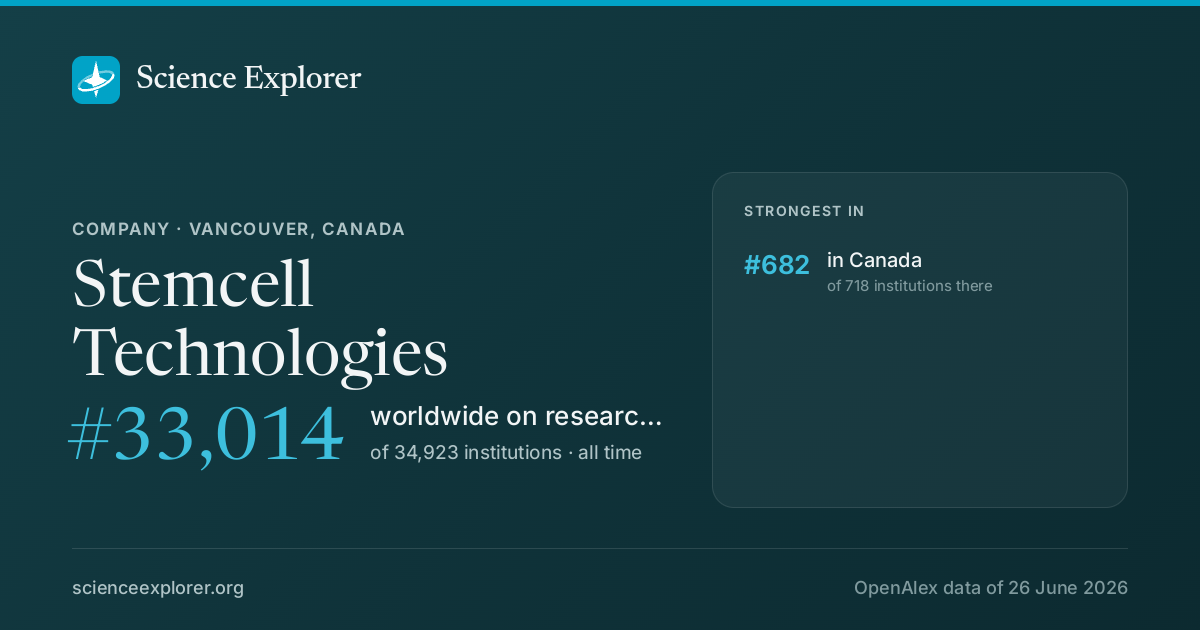
- World rank, all time
- #33,014 of 34,923
- Rank in Canada
- #682 of 718
- Research works
- 150 ▲ 30% vs 2018-21
- Citations
- 2.4k 16.2 per fractional work
- Top-10% rate
- 7.2% all institutions 10.0%
- vs its own fields
- 0.90× 1.00× is exactly expected
- Open access
- 27% world 40%
- International
- 22% world 18%
Which fields of science does Stemcell Technologies work in?
In 2022-now, 55% of research at Stemcell Technologies is in Health Sciences, 24% in Life Sciences. Its largest fields are Medicine (54%), Biochemistry, Genetics and Molecular Biology (16%), Engineering (15%). It does 2.0× the world's share of Health Sciences.
Each ring splits the one inside it: the four domains of science, their fields, their subfields. Size is fractional works in 2022-now. Every slice is a page; the interactive view zooms down to single topics and colours each by how much more of it this institution does than the world.
Its 4 domains and 15 fields, with their numbers
- Health Sciences2155.0%
- Medicine2154.2%
- Health Professions00.7%
- Veterinary00.2%
- Life Sciences923.9%
- Physical Sciences820.8%
- Engineering614.5%
- Environmental Science12.6%
- Chemistry11.5%
- Earth and Planetary Sciences01.3%
- Materials Science00.4%
- Computer Science00.3%
- Physics and Astronomy00.1%
- Social Sciences00.2%
- Social Sciences00.2%
- Decision Sciences00.0%
Field profile
Location quotient across every field it publishes in: outside the ring is more than an institution of this size would be expected to publish, inside it is less.
Rings at 0.5×, 1× and 2×. Widest outward: Immunology and Microbiology, 5.3×. Every wedge is a field page.
All 15 fields, with their numbers
- Immunology and Microbiology5.29×2 works
- Biochemistry, Genetics and Molecular Biology3.07×6 works
- Medicine2.82×21 works
- Neuroscience1.39×1 works
- Veterinary1.07×0 works
- Engineering0.97×6 works
- Chemistry0.94×1 works
- Earth and Planetary Sciences0.83×0 works
- Environmental Science0.53×1 works
- Health Professions0.25×0 works
- Materials Science0.12×0 works
- Computer Science0.04×0 works
- Physics and Astronomy0.03×0 works
- Decision Sciences0.02×0 works
- Social Sciences0.02×0 works
- Immunology and Microbiology 5.3×
- Biochemistry, Genetics and Molecular Biology 3.1×
- Medicine 2.8×
- Neuroscience 1.4×
- Veterinary 1.1×
- Engineering 1.0×
- Chemistry 0.9×
- Earth and Planetary Sciences 0.8×
- Environmental Science 0.5×
- Health Professions 0.2×
- Materials Science 0.1×
- Computer Science 0.0×
- Physics and Astronomy 0.0×
- Decision Sciences 0.0×
- Social Sciences 0.0×
Who are the top researchers at Stemcell Technologies?
Ranked on the quality score, Salvatore Simmini, Ryan K. Conder and Andy I. Kokaji lead among researchers whose main affiliation is Stemcell Technologies.
- 1
Salvatore Simmini
 Canada · #1,608,852 worldwide
863 citations · 26 works
- 2
Ryan K. Conder
Canada · #2,110,565 worldwide
2.8k citations · 23 works
- 3
Andy I. Kokaji
Canada · #2,268,177 worldwide
279 citations · 39 works
- 4
Emer Clarke
Canada · #2,376,037 worldwide
678 citations · 23 works
- 5
Steven M. Woodside
Canada · #2,682,086 worldwide
371 citations · 38 works
- 6
Wing Y. Chang
Canada · #3,015,150 worldwide
1.1k citations · 51 works
- 7
Emma L. Clarke
Canada · #3,038,423 worldwide
543 citations · 35 works
- 8
Terry E. Thomas
Canada · #3,042,293 worldwide
3.2k citations · 139 works
- 9
Sharon A. Louis
Canada · #3,077,973 worldwide
715 citations · 86 works
- 10
Albertus W. Wognum
Canada · #3,509,848 worldwide
1k citations · 42 works
Which keywords describe research at Stemcell Technologies?
By fractional works in 2022-now, weighted toward what it does more of than the world: Immunotherapy, Tissue Engineering, Cancer Immunotherapy, CAR T Cells, Chimeric Antigen Receptor, Regenerative Medicine, Cell Culture and Embryonic Stem Cells.
- Well Integrity
- Uterine Fibroids
- Low-Carbohydrate Diet
- Hydraulic Fracturing
- Biopharmaceutical Production
- Glycosylation
- Respiratory Syncytial Virus
- Gene Expression
- Machine Learning
- Neurological Disorders
- Preterm Infants
- Transcriptional Regulation
- Inflammation
- Microfluidic Devices
- Bioprinting
- Cancer Stem Cells
- Cell Culture
- Chimeric Antigen Receptor
- Epidemiology
- Tissue Engineering
- Immunotherapy
- Cancer Immunotherapy
- CAR T Cells
- Regenerative Medicine
- Embryonic Stem Cells
- Tumor Metastasis
- Differentiation
- Induced Pluripotent Stem Cells
- Pluripotent Stem Cells
- Bronchopulmonary Dysplasia
- Nanoparticles
- Fertility Preservation
- Ovarian Tissue Cryopreservation
- Human Metapneumovirus
- Cancer Therapy
- Metabolic Syndrome
- Drilling Fluids
- Ketogenic Diet
- Stem Cell Therapy
- Uterine Leiomyoma
Size is fractional works in 2022-now in the topics tagged with each word; colour is the word's share of this institution's work against its share of the world's. The 40 words are chosen for being large and distinctive. Each links to the topic it comes from most.
All 40 words, with their numbers
- Immunotherapy4▲ 12×2 topics
- Tissue Engineering3▲ 15×4 topics
- Cancer Immunotherapy3▲ 55×2 topics
- Epidemiology3▲ 2.1×8 topics
- CAR T Cells3▲ 112×1 topic
- Chimeric Antigen Receptor3▲ 112×1 topic
- Regenerative Medicine3▲ 30×4 topics
- Cell Culture2▲ 56×2 topics
- Embryonic Stem Cells2▲ 140×2 topics
- Cancer Stem Cells2▲ 128×1 topic
- Tumor Metastasis2▲ 101×1 topic
- Bioprinting2▲ 86×1 topic
- Differentiation2▲ 85×2 topics
- Microfluidic Devices2▲ 44×1 topic
- Induced Pluripotent Stem Cells2▲ 179×1 topic
- Inflammation2▲ 2.3×4 topics
- Pluripotent Stem Cells2▲ 95×1 topic
- Transcriptional Regulation2▲ 30×2 topics
- Bronchopulmonary Dysplasia2▲ 64×1 topic
- Preterm Infants2▲ 33×1 topic
- Nanoparticles2▲ 3.1×2 topics
- Neurological Disorders1▲ 6.5×3 topics
- Fertility Preservation1▲ 63×1 topic
- Machine Learning1◆ 1.05×4 topics
- Ovarian Tissue Cryopreservation1▲ 63×1 topic
- Gene Expression1▲ 4.9×4 topics
- Human Metapneumovirus1▲ 66×1 topic
- Respiratory Syncytial Virus1▲ 66×1 topic
- Cancer Therapy1▲ 5.0×2 topics
- Glycosylation1▲ 27×3 topics
- Metabolic Syndrome1▲ 3.5×2 topics
- Biopharmaceutical Production1▲ 69×2 topics
- Drilling Fluids1▲ 50×1 topic
- Hydraulic Fracturing1▲ 25×2 topics
- Ketogenic Diet1▲ 29×1 topic
- Low-Carbohydrate Diet1▲ 32×1 topic
- Stem Cell Therapy1▲ 28×2 topics
- Uterine Fibroids1▲ 89×1 topic
- Uterine Leiomyoma1▲ 89×1 topic
- Well Integrity1▲ 50×1 topic
Which research topics does Stemcell Technologies publish most on?
By volume in 2022-now: CAR-T cell therapy research, Cancer Cells and Metastasis, 3D Printing in Biomedical Research and Pluripotent Stem Cells Research.
Area is fractional works; colour is the subfield each topic belongs to.
- 1 CAR-T cell therapy research Oncology 3 works
- 2 Cancer Cells and Metastasis Oncology 2 works
- 3 3D Printing in Biomedical Research Biomedical Engineering 2 works
- 4 Pluripotent Stem Cells Research Molecular Biology 2 works
- 5 Neonatal Respiratory Health Research Pulmonary and Respiratory Medicine 2 works
- 6 Reproductive Biology and Fertility Public Health, Environmental and Occupational Health 1 works
- 7 Respiratory viral infections research Epidemiology 1 works
- 8 Drilling and Well Engineering Ocean Engineering 1 works
- 9 Uterine Myomas and Treatments Obstetrics and Gynecology 1 works
- 10 Diet and metabolism studies Physiology 1 works
How open and international is its research?
Against the world's own shares: the tick on each track. Both are shares of its output, so they sit on one scale and can be read against each other as well as against the world.
World: 40% of research is openly available.
World: 18% is written across borders.
How has Stemcell Technologies's research output changed?
Output in 2022-2025 was 30% higher than in 2018-2021.
The same series as a ribbon: one cell per year, darker for more. The line above answers how much; this answers when.
Its share of all research
Growing output can still be a shrinking share: all of science grows. This is Stemcell Technologies as a percentage of every work published that year, 0.00012% in 2024.
Fractional works of Stemcell Technologies over all fractional works that year. How the balance of science has shifted.
Other research institutions in Vancouver
- University of British Columbia
- TRIUMF
- Vancouver Coastal Health
- Columbia College
- Provincial Health Services Authority
- Quest University Canada
- Providence Health Care
- Children's & Women's Health Centre of British Columbia

Share Stemcell Technologies's ranking
Badges for a website1Each links back here and updates with every snapshot

Research measures only: rankings here say nothing about teaching, admissions or student experience. Comparable institutions and collaboration partners have tabs of their own, above.
Discussion
Ask a question or share a note about Stemcell Technologies. Posts are plain text and can be reported.