Science Explorer Back to mapMap
Discussion
Company · Tokyo · Japan

Tokuyama (Japan)

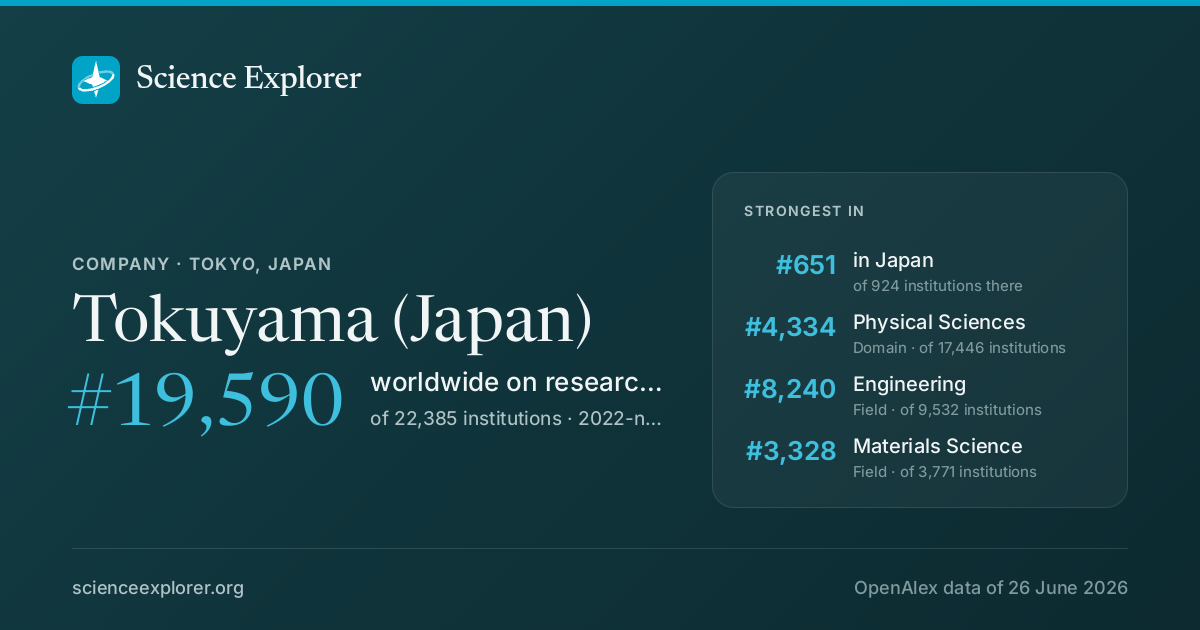
In research, Tokuyama (Japan) stands highest in Physical Sciences (#4,334 of 17,446 worldwide), Engineering (#8,240 of 9,532 worldwide) and Materials Science (#3,328 of 3,771 worldwide), over all time.

World rank, 2022-now
#19,590
of 22,385 · #10,606 all time
Rank in Japan
#651
of 924
Research works
1.4k
▲ 8% vs 2018-21
Citations
16k
11.1 per fractional work
Top-10% rate
4.4%
all institutions 10.0%
vs its own fields
0.86×
1.00× is exactly expected
Open access
45%
world 40%
International
9%
world 18%

What is Tokuyama (Japan) known for in research?

The fields where it stands highest, over all time, ranked among every institution above the floor in each field.

FieldWorld rankWhere that sitsTop-10% rateWorks
Physical SciencesDomain #4,334 of 17,446 6.7%971
EngineeringField #8,240 of 9,532 6.2%443
Materials ScienceField #3,328 of 3,771 5.2%214
MedicineField #13,215 of 14,558 3.1%324
Health SciencesDomain #15,496 of 16,688 3.2%342

Each strip is that field's whole ranked pool, with the notch where Tokuyama (Japan) sits in it, in the colour of the band that rank falls in. The track under the rate is the rate itself: it carries no average mark, because the average differs by field (from about 6% in Dentistry to 21% in Economics).

Which fields of science does Tokuyama (Japan) work in?

In 2022-now, 47% of research at Tokuyama (Japan) is in Health Sciences, 38% in Physical Sciences. Its largest fields are Medicine (45%), Engineering (14%), Materials Science (10%). It does 1.9× the world's share of Health Sciences.

Health Sciences: 59 fractional works · 47.2% of its workMedicine: 56 fractional works · 44.7% of its workSurgery: 9 fractional works · 6.8% of its workEpidemiology: 5 fractional works · 4.1% of its workPulmonary and Respiratory Medicine: 5 fractional works · 4.0% of its workNeurology: 4 fractional works · 3.1% of its workPublic Health, Environmental and Occupational Health: 4 fractional works · 2.8% of its workOncology: 3 fractional works · 2.5% of its workCardiology and Cardiovascular Medicine: 3 fractional works · 2.5% of its workPediatrics, Perinatology and Child Health: 3 fractional works · 2.1% of its workRheumatology: 2 fractional works · 2.0% of its workRadiology, Nuclear Medicine and Imaging: 2 fractional works · 1.8% of its workObstetrics and Gynecology: 2 fractional works · 1.4% of its workReproductive Medicine: 2 fractional works · 1.3% of its workGastroenterology: 1 fractional works · 1.2% of its workPhysiology: 1 fractional works · 1.0% of its workEndocrinology, Diabetes and Metabolism: 1 fractional works · 0.9% of its workPsychiatry and Mental health: 1 fractional works · 0.8% of its workPharmacology: 1 fractional works · 0.7% of its workPathology and Forensic Medicine: 1 fractional works · 0.7% of its workGenetics: 1 fractional works · 0.6% of its workDermatology: 1 fractional works · 0.5% of its workHematology: 1 fractional works · 0.4% of its workRehabilitation: 1 fractional works · 0.4% of its workGeriatrics and Gerontology: 0 fractional works · 0.4% of its workUrology: 0 fractional works · 0.4% of its workEmergency Medicine: 0 fractional works · 0.3% of its workAnesthesiology and Pain Medicine: 0 fractional works · 0.3% of its workOrthopedics and Sports Medicine: 0 fractional works · 0.3% of its workInfectious Diseases: 0 fractional works · 0.3% of its workComplementary and alternative medicine: 0 fractional works · 0.2% of its workHepatology: 0 fractional works · 0.2% of its workSmaller subfields together: 1 fractional works · 0.6% of its workHealth Professions: 2 fractional works · 1.8% of its workEmergency Medical Services: 1 fractional works · 0.8% of its workGeneral Health Professions: 0 fractional works · 0.4% of its workSpeech and Hearing: 0 fractional works · 0.3% of its workSmaller subfields together: 0 fractional works · 0.3% of its workDentistry: 1 fractional works · 0.5% of its workNursing: 0 fractional works · 0.1% of its workVeterinary: 0 fractional works · 0.1% of its workPhysical Sciences: 48 fractional works · 38.2% of its workEngineering: 18 fractional works · 14.3% of its workCivil and Structural Engineering: 6 fractional works · 4.4% of its workMechanical Engineering: 3 fractional works · 2.3% of its workElectrical and Electronic Engineering: 2 fractional works · 1.6% of its workBiomedical Engineering: 2 fractional works · 1.5% of its workBuilding and Construction: 1 fractional works · 0.8% of its workIndustrial and Manufacturing Engineering: 1 fractional works · 0.8% of its workAerospace Engineering: 1 fractional works · 0.8% of its workAutomotive Engineering: 1 fractional works · 0.6% of its workComputational Mechanics: 1 fractional works · 0.5% of its workOcean Engineering: 0 fractional works · 0.3% of its workControl and Systems Engineering: 0 fractional works · 0.2% of its workSmaller subfields together: 0 fractional works · 0.3% of its workMaterials Science: 13 fractional works · 10.4% of its workMaterials Chemistry: 8 fractional works · 6.0% of its workCeramics and Composites: 2 fractional works · 1.4% of its workElectronic, Optical and Magnetic Materials: 2 fractional works · 1.2% of its workBiomaterials: 1 fractional works · 1.1% of its workGeneral Materials Science: 0 fractional works · 0.4% of its workPolymers and Plastics: 0 fractional works · 0.3% of its workChemistry: 6 fractional works · 4.7% of its workOrganic Chemistry: 4 fractional works · 3.1% of its workInorganic Chemistry: 2 fractional works · 1.2% of its workElectrochemistry: 0 fractional works · 0.3% of its workSmaller subfields together: 0 fractional works · 0.1% of its workEnvironmental Science: 4 fractional works · 2.9% of its workWater Science and Technology: 1 fractional works · 0.8% of its workEnvironmental Engineering: 1 fractional works · 0.6% of its workPollution: 1 fractional works · 0.5% of its workNature and Landscape Conservation: 0 fractional works · 0.4% of its workEcology: 0 fractional works · 0.3% of its workSmaller subfields together: 0 fractional works · 0.4% of its workPhysics and Astronomy: 3 fractional works · 2.8% of its workCondensed Matter Physics: 1 fractional works · 0.7% of its workRadiation: 1 fractional works · 0.7% of its workNuclear and High Energy Physics: 1 fractional works · 0.5% of its workAtomic and Molecular Physics, and Optics: 1 fractional works · 0.4% of its workAstronomy and Astrophysics: 0 fractional works · 0.3% of its workSmaller subfields together: 0 fractional works · 0.1% of its workComputer Science: 3 fractional works · 2.4% of its workArtificial Intelligence: 2 fractional works · 1.3% of its workComputer Networks and Communications: 1 fractional works · 0.5% of its workComputer Vision and Pattern Recognition: 0 fractional works · 0.3% of its workSmaller subfields together: 0 fractional works · 0.3% of its workEarth and Planetary Sciences: 1 fractional works · 0.5% of its workAtmospheric Science: 0 fractional works · 0.2% of its workSmaller subfields together: 0 fractional works · 0.3% of its workEnergy: 0 fractional works · 0.3% of its workRenewable Energy, Sustainability and the Environment: 0 fractional works · 0.3% of its workMathematics: 0 fractional works · 0.0% of its workLife Sciences: 12 fractional works · 9.7% of its workBiochemistry, Genetics and Molecular Biology: 5 fractional works · 3.6% of its workMolecular Biology: 2 fractional works · 1.8% of its workGenetics: 2 fractional works · 1.2% of its workCancer Research: 0 fractional works · 0.3% of its workPhysiology: 0 fractional works · 0.2% of its workSmaller subfields together: 0 fractional works · 0.1% of its workImmunology and Microbiology: 4 fractional works · 2.9% of its workImmunology: 3 fractional works · 2.5% of its workSmaller subfields together: 1 fractional works · 0.4% of its workAgricultural and Biological Sciences: 3 fractional works · 2.7% of its workPlant Science: 1 fractional works · 0.6% of its workSoil Science: 1 fractional works · 0.6% of its workEcology, Evolution, Behavior and Systematics: 1 fractional works · 0.5% of its workAnimal Science and Zoology: 0 fractional works · 0.4% of its workInsect Science: 0 fractional works · 0.2% of its workSmaller subfields together: 1 fractional works · 0.4% of its workNeuroscience: 1 fractional works · 0.5% of its workCognitive Neuroscience: 0 fractional works · 0.2% of its workSmaller subfields together: 0 fractional works · 0.2% of its workSocial Sciences: 6 fractional works · 4.8% of its workSocial Sciences: 3 fractional works · 2.6% of its workSociology and Political Science: 1 fractional works · 1.0% of its workTransportation: 1 fractional works · 0.9% of its workEducation: 0 fractional works · 0.4% of its workLinguistics and Language: 0 fractional works · 0.3% of its workSmaller subfields together: 0 fractional works · 0.0% of its workPsychology: 2 fractional works · 1.3% of its workDevelopmental and Educational Psychology: 1 fractional works · 0.5% of its workClinical Psychology: 1 fractional works · 0.4% of its workSmaller subfields together: 0 fractional works · 0.3% of its workArts and Humanities: 1 fractional works · 0.6% of its workLanguage and Linguistics: 0 fractional works · 0.3% of its workLiterature and Literary Theory: 0 fractional works · 0.3% of its workSmaller subfields together: 0 fractional works · 0.1% of its workBusiness, Management and Accounting: 0 fractional works · 0.2% of its workDecision Sciences: 0 fractional works · 0.2% of its workALL ITS WORKTokuyama (Japan)125fractional works, 2022-now
Life Sciences10%Physical Sciences38%Health Sciences47%Social Sciences5%

Each ring splits the one inside it: the four domains of science, their fields, their subfields. Size is fractional works in 2022-now. Every slice is a page; the interactive view zooms down to single topics and colours each by how much more of it this institution does than the world.

Its 4 domains and 23 fields, with their numbers
    1. Medicine5644.7%
    2. Health Professions21.8%
    3. Dentistry10.5%
    4. Nursing00.1%
    5. Veterinary00.1%
    1. Engineering1814.3%
    2. Materials Science1310.4%
    3. Chemistry64.7%
    4. Environmental Science42.9%
    5. Physics and Astronomy32.8%
    6. Computer Science32.4%
    7. Earth and Planetary Sciences10.5%
    8. Energy00.3%
    9. Mathematics00.0%
    1. Biochemistry, Genetics and Molecular Biology53.6%
    2. Immunology and Microbiology42.9%
    3. Agricultural and Biological Sciences32.7%
    4. Neuroscience10.5%
    1. Social Sciences32.6%
    2. Psychology21.3%
    3. Arts and Humanities10.6%
    4. Business, Management and Accounting00.2%
    5. Decision Sciences00.2%
All of science, and how each field's share has moved since 1950: the Science domain explorer

Field profile

Location quotient across every field it publishes in: outside the ring is more than an institution of this size would be expected to publish, inside it is less.

Agricultural and Biological Sciences: 0.57× its world share, 3 worksAgricultural and Bio…Biochemistry, Genetics and Molecular Biology: 0.68× its world share, 5 worksBiochemistry, Geneti…Immunology and Microbiology: 2.87× its world share, 4 worksImmunology and Micro…Neuroscience: 0.29× its world share, 1 worksNeuroscienceChemistry: 2.97× its world share, 6 worksChemistryComputer Science: 0.31× its world share, 3 worksComputer ScienceEarth and Planetary Sciences: 0.32× its world share, 1 worksEarth and Planetary …Energy: 0.29× its world share, 0 worksEnergyEngineering: 0.95× its world share, 18 worksEngineeringEnvironmental Science: 0.59× its world share, 4 worksEnvironmental ScienceMaterials Science: 2.97× its world share, 13 worksMaterials ScienceMathematics: 0.03× its world share, 0 worksMathematicsPhysics and Astronomy: 1.24× its world share, 4 worksPhysics and AstronomyDentistry: 0.96× its world share, 1 worksDentistryHealth Professions: 0.69× its world share, 2 worksHealth ProfessionsMedicine: 2.32× its world share, 56 worksMedicineNursing: 0.27× its world share, 0 worksNursingVeterinary: 0.98× its world share, 0 worksVeterinaryArts and Humanities: 0.21× its world share, 1 worksArts and HumanitiesBusiness, Management and Accounting: 0.05× its world share, 0 worksBusiness, Management…Decision Sciences: 0.16× its world share, 0 worksDecision SciencesPsychology: 0.43× its world share, 2 worksPsychologySocial Sciences: 0.20× its world share, 3 worksSocial Sciences1×world share
more than its size predictsabout as predictedless

Rings at 0.5×, 1× and 2×. Widest outward: Chemistry, 3.0×. Every wedge is a field page.

All 23 fields, with their numbers
  1. Chemistry2.97×6 works
  2. Materials Science2.97×13 works
  3. Immunology and Microbiology2.87×4 works
  4. Medicine2.32×56 works
  5. Physics and Astronomy1.24×4 works
  6. Veterinary0.98×0 works
  7. Dentistry0.96×1 works
  8. Engineering0.95×18 works
  9. Health Professions0.69×2 works
  10. Biochemistry, Genetics and Molecular Biology0.68×5 works
  11. Environmental Science0.59×4 works
  12. Agricultural and Biological Sciences0.57×3 works
  13. Psychology0.43×2 works
  14. Earth and Planetary Sciences0.32×1 works
  15. Computer Science0.31×3 works
  16. Neuroscience0.29×1 works
  17. Energy0.29×0 works
  18. Nursing0.27×0 works
  19. Arts and Humanities0.21×1 works
  20. Social Sciences0.20×3 works
  21. Decision Sciences0.16×0 works
  22. Business, Management and Accounting0.05×0 works
  23. Mathematics0.03×0 works

Who are the top researchers at Tokuyama (Japan)?

Ranked on the quality score, Hiroyuki Yanagi, Toru Kinoshita and Toru Nagashima lead among researchers whose main affiliation is Tokuyama (Japan).

  1. 1 Hiroyuki Yanagi Japan · #965,963 worldwide 1.3k citations · 44 works
  2. 2 Toru Kinoshita Japan · #1,612,577 worldwide 2.6k citations · 97 works
  3. 3 Toru Nagashima Japan · #2,121,162 worldwide 1.6k citations · 48 works
  4. 4 Takatoshi Wakeyama Japan · #2,341,328 worldwide 1.2k citations · 60 works
  5. 5 Reiichi Yamane Japan · #2,442,269 worldwide 491 citations · 16 works
  6. 6 Nobuyuki KURAMOTO Japan · #2,898,664 worldwide 501 citations · 17 works
  7. 7 Tetsuo Wakino Japan · #3,418,897 worldwide 722 citations · 30 works
  8. 8 Hitofumi Taniguchi Japan · #3,492,456 worldwide 539 citations · 29 works
  9. 9 Hiroko Okochi Japan · #3,716,987 worldwide 259 citations · 16 works
  10. 10 Akira Takaki Japan · #4,063,851 worldwide 1k citations · 75 works
All ranked researchers at Tokuyama (Japan)

What are the most cited papers from Tokuyama (Japan)?

The most cited paper from Tokuyama (Japan) is "International Photographic Classification and Grading System for Myopic Maculopathy" (Kyoko Ohno‐Matsui et al., 2015), with 884 citations. Next come "Concentration of polychlorinated biphenyls (PCBs) in beached resin pellets: Variability among individual particles and regional differences" (614) and "Adsorption characteristics of superplasticizers on cement component minerals" (509).

Most cited papers
#PaperReleasedCitations
1 International Photographic Classification and Grading System for Myopic Maculopathy Kyoko Ohno‐Matsui et al. · American Journal of Ophthalmology 26 Jan 2015 884
2 Concentration of polychlorinated biphenyls (PCBs) in beached resin pellets: Variability among individual particles and regional differences Satoshi Endo, Reiko Takizawa, Keiji Okuda et al. · Marine Pollution Bulletin 18 May 2005 614
3 Adsorption characteristics of superplasticizers on cement component minerals Kazuhiro Yoshioka, Ei-ichi Tazawa, Kenji Kawai et al. · Cement and Concrete Research 26 Aug 2002 509
4 4-(4,6-dimethoxy-1,3,5-triazin-2-yl)-4-methyl-morpholinium chloride: an efficient condensing agent leading to the formation of amides and esters Munetaka Kunishima, Chiho Kawachi, Jun Monta et al. · Tetrahedron Nov 1999 481
5 Studies on cation-exchange membranes having permselectivity between cations in electrodialysis Toshikatsu Sata, Toshikatsu Sata, Tomoaki Sata et al. · Journal of Membrane Science Aug 2002 345
All 60 most cited papers, with filters and sorting

Which keywords describe research at Tokuyama (Japan)?

By fractional works in 2022-now, weighted toward what it does more of than the world: Epidemiology, Prognostic Factors, Surgical Management, Synthesis, Nanocomposites, Regulatory T Cells, Decidual NK Cells and Fetal-Maternal Interface.

▲ more of its work than of the world's◆ about the world's share▼ less than the world's

Size is fractional works in 2022-now in the topics tagged with each word; colour is the word's share of this institution's work against its share of the world's. The 40 words are chosen for being large and distinctive. Each links to the topic it comes from most.

All 40 words, with their numbers
  1. Epidemiology9▲ 1.82×41 topics
  2. Diagnosis4▲ 3.3×18 topics
  3. Nanocomposites4▲ 4.0×9 topics
  4. Prognostic Factors4▲ 6.9×6 topics
  5. Surgical Management3▲ 6.4×7 topics
  6. Chemotherapy3▲ 3.6×9 topics
  7. Synthesis3▲ 6.7×6 topics
  8. Treatment3▲ 2.1×19 topics
  9. Biomedical Applications3▲ 2.0×7 topics
  10. Regulatory T Cells3▲ 20×2 topics
  11. Decidual NK Cells3▲ 60×1 topic
  12. Fetal-Maternal Interface3▲ 60×1 topic
  13. Material Properties3▲ 23×2 topics
  14. Surgery3▲ 6.4×8 topics
  15. PET Imaging2▲ 12×4 topics
  16. Complications2▲ 3.6×10 topics
  17. Tumor Microenvironment2▲ 4.1×6 topics
  18. Radiation Therapy2▲ 13×3 topics
  19. Thermal Management2▲ 5.3×2 topics
  20. Vaccine2▲ 4.3×5 topics
  21. Pancreatic Cancer2▲ 15×2 topics
  22. Reproductive Outcome2▲ 40×2 topics
  23. Composite Materials2▲ 7.5×2 topics
  24. Neoadjuvant Therapy2▲ 6.5×4 topics
  25. Ceramic Materials2▲ 15×1 topic
  26. Fertility Preservation2▲ 26×1 topic
  27. Ovarian Tissue Cryopreservation2▲ 26×1 topic
  28. Sintering2▲ 11×1 topic
  29. Crystal Structure2▲ 9.8×2 topics
  30. Gemcitabine2▲ 19×1 topic
  31. Prenatal Diagnosis2▲ 9.4×3 topics
  32. Surgical Complications2▲ 17×1 topic
  33. Characterization2▲ 9.3×2 topics
  34. Genomic Sequencing2▲ 11×3 topics
  35. Boron Nitride2▲ 44×1 topic
  36. Desmoid Tumor2▲ 87×1 topic
  37. Solitary Fibrous Tumor2▲ 87×1 topic
  38. Thermal Conductivity2▲ 7.5×1 topic
  39. Geopolymer1▲ 7.9×2 topics
  40. Nanowires1▲ 8.0×4 topics

Which research topics does Tokuyama (Japan) publish most on?

By volume in 2022-now: Reproductive System and Pregnancy, Advanced ceramic materials synthesis, Reproductive Biology and Fertility and Pancreatic and Hepatic Oncology Research.

  1. 1 Reproductive System and Pregnancy Immunology 3 works
  2. 2 Advanced ceramic materials synthesis Ceramics and Composites 2 works
  3. 3 Reproductive Biology and Fertility Public Health, Environmental and Occupational Health 2 works
  4. 4 Pancreatic and Hepatic Oncology Research Oncology 2 works
  5. 5 Soft tissue tumor case studies Rheumatology 2 works
  6. 6 Thermal properties of materials Materials Chemistry 2 works
  7. 7 Gynecological conditions and treatments Obstetrics and Gynecology 1 works
  8. 8 Congenital Heart Disease Studies Epidemiology 1 works
  9. 9 Gastrointestinal Tumor Research and Treatment Gastroenterology 1 works
  10. 10 Herpesvirus Infections and Treatments Epidemiology 1 works

How open and international is its research?

Against the world's own shares: the tick on each track. Both are shares of its output, so they sit on one scale and can be read against each other as well as against the world.

openly available45.2%not open54.8%

World: 40% of research is openly available.

with international co-authors8.6%domestic only91.4%

World: 18% is written across borders.

How has Tokuyama (Japan)'s research output changed?

Output in 2022-2025 was 8% higher than in 2018-2021.

still counting1990200020102020
grewheldshrank

The same series as a ribbon: one cell per year, darker for more. The line above answers how much; this answers when.

Its share of all research

Growing output can still be a shrinking share: all of science grows. This is Tokuyama (Japan) as a percentage of every work published that year, 0.00054% in 2024.

still counting0.0020%0.0040%0.0060%Tokuyama (Japan)0.00050% in 202519801990200020102020

Fractional works of Tokuyama (Japan) over all fractional works that year. How the balance of science has shifted.

How much of it reaches the world top 10%

Year by year, against all institutions in the same year.

still counting10%20%all institutions10.0% in 2025Tokuyama (Japan)7.3% in 2025200020102020

Of each year's output, the share that reached the world's 10% most cited for its field and year. Peak 16.6% in 1990.

Other research institutions in Tokyo

All research institutions in Tokyo

Share Tokuyama (Japan)'s ranking

Tokuyama (Japan) on Science Explorer

A card with Tokuyama (Japan)'s standing and the fields it leads in, for a post or a slide. A link to this page previews as the same card.

Download the card

1200 × 630 PNG, sized for social posts, drawn from the latest snapshot.

Badges for a website1Each links back here and updates with every snapshot

Research measures only: rankings here say nothing about teaching, admissions or student experience. Comparable institutions and collaboration partners have tabs of their own, above.

Discussion

Ask a question or share a note about Tokuyama (Japan). Keep it to the research: no personal attacks, advertising or links. Any reader can report a post, which collapses it for everyone until it is opened.