Science Explorer Back to mapMap
Discussion
Company · Gölbaşı · Türkiye

Türksat (Turkey)

World rank, 2022-now
#18,943
of 22,385 · #22,011 all time
Rank in Türkiye
#275
of 297
Research works
178
▲ 82% vs 2018-21
Citations
1k
5.9 per fractional work
Top-10% rate
7.5%
all institutions 10.0%
vs its own fields
0.99×
1.00× is exactly expected
Open access
55%
world 40%
International
19%
world 18%

Which fields of science does Türksat (Turkey) work in?

In 2022-now, 44% of research at Türksat (Turkey) is in Physical Sciences, 38% in Social Sciences. Its largest fields are Engineering (29%), Social Sciences (13%), Medicine (9%). It does 1.5× the world's share of Social Sciences.

Physical Sciences: 33 fractional works · 44.3% of its workEngineering: 21 fractional works · 29.2% of its workAerospace Engineering: 9 fractional works · 12.2% of its workElectrical and Electronic Engineering: 5 fractional works · 7.4% of its workCivil and Structural Engineering: 2 fractional works · 2.2% of its workControl and Systems Engineering: 1 fractional works · 1.8% of its workMechanical Engineering: 1 fractional works · 1.8% of its workAutomotive Engineering: 1 fractional works · 1.1% of its workBiomedical Engineering: 1 fractional works · 1.0% of its workMechanics of Materials: 0 fractional works · 0.6% of its workOcean Engineering: 0 fractional works · 0.6% of its workBuilding and Construction: 0 fractional works · 0.3% of its workSafety, Risk, Reliability and Quality: 0 fractional works · 0.2% of its workComputer Science: 4 fractional works · 5.0% of its workArtificial Intelligence: 1 fractional works · 1.8% of its workComputer Networks and Communications: 1 fractional works · 1.1% of its workInformation Systems: 1 fractional works · 0.9% of its workSoftware: 0 fractional works · 0.4% of its workComputer Vision and Pattern Recognition: 0 fractional works · 0.3% of its workHardware and Architecture: 0 fractional works · 0.2% of its workSignal Processing: 0 fractional works · 0.2% of its workMaterials Science: 2 fractional works · 2.5% of its workPolymers and Plastics: 1 fractional works · 1.1% of its workMaterials Chemistry: 0 fractional works · 0.6% of its workBiomaterials: 0 fractional works · 0.5% of its workElectronic, Optical and Magnetic Materials: 0 fractional works · 0.2% of its workEarth and Planetary Sciences: 2 fractional works · 2.5% of its workAtmospheric Science: 1 fractional works · 1.0% of its workGeophysics: 0 fractional works · 0.7% of its workOceanography: 0 fractional works · 0.4% of its workEarth-Surface Processes: 0 fractional works · 0.3% of its workEnvironmental Science: 1 fractional works · 2.0% of its workGlobal and Planetary Change: 1 fractional works · 0.9% of its workHealth, Toxicology and Mutagenesis: 0 fractional works · 0.4% of its workPollution: 0 fractional works · 0.3% of its workEnvironmental Engineering: 0 fractional works · 0.2% of its workManagement, Monitoring, Policy and Law: 0 fractional works · 0.2% of its workPhysics and Astronomy: 1 fractional works · 1.8% of its workAstronomy and Astrophysics: 1 fractional works · 1.6% of its workSmaller subfields together: 0 fractional works · 0.2% of its workMathematics: 1 fractional works · 0.8% of its workStatistics and Probability: 0 fractional works · 0.4% of its workModeling and Simulation: 0 fractional works · 0.2% of its workSmaller subfields together: 0 fractional works · 0.1% of its workEnergy: 0 fractional works · 0.6% of its workEnergy Engineering and Power Technology: 0 fractional works · 0.4% of its workSmaller subfields together: 0 fractional works · 0.1% of its workSocial Sciences: 28 fractional works · 38.3% of its workSocial Sciences: 10 fractional works · 13.1% of its workSociology and Political Science: 4 fractional works · 5.2% of its workPolitical Science and International Relations: 2 fractional works · 3.1% of its workSafety Research: 1 fractional works · 1.5% of its workEducation: 1 fractional works · 0.8% of its workHealth: 0 fractional works · 0.7% of its workCultural Studies: 0 fractional works · 0.6% of its workUrban Studies: 0 fractional works · 0.4% of its workGender Studies: 0 fractional works · 0.2% of its workDemography: 0 fractional works · 0.2% of its workSmaller subfields together: 0 fractional works · 0.4% of its workBusiness, Management and Accounting: 6 fractional works · 8.0% of its workAccounting: 4 fractional works · 5.7% of its workStrategy and Management: 1 fractional works · 1.3% of its workMarketing: 0 fractional works · 0.4% of its workOrganizational Behavior and Human Resource Management: 0 fractional works · 0.2% of its workSmaller subfields together: 0 fractional works · 0.3% of its workArts and Humanities: 4 fractional works · 5.7% of its workMuseology: 1 fractional works · 1.9% of its workLiterature and Literary Theory: 1 fractional works · 1.5% of its workReligious studies: 0 fractional works · 0.7% of its workLanguage and Linguistics: 0 fractional works · 0.7% of its workHistory: 0 fractional works · 0.5% of its workPhilosophy: 0 fractional works · 0.4% of its workEconomics, Econometrics and Finance: 3 fractional works · 4.5% of its workEconomics and Econometrics: 2 fractional works · 2.3% of its workFinance: 1 fractional works · 1.5% of its workGeneral Economics, Econometrics and Finance: 0 fractional works · 0.7% of its workDecision Sciences: 3 fractional works · 3.8% of its workManagement Science and Operations Research: 3 fractional works · 3.6% of its workInformation Systems and Management: 0 fractional works · 0.2% of its workPsychology: 2 fractional works · 3.3% of its workClinical Psychology: 1 fractional works · 1.5% of its workSocial Psychology: 1 fractional works · 0.8% of its workApplied Psychology: 0 fractional works · 0.6% of its workDevelopmental and Educational Psychology: 0 fractional works · 0.4% of its workHealth Sciences: 10 fractional works · 13.0% of its workMedicine: 7 fractional works · 9.5% of its workEpidemiology: 1 fractional works · 1.4% of its workHealth Informatics: 1 fractional works · 0.9% of its workNeurology: 1 fractional works · 0.9% of its workSurgery: 1 fractional works · 0.9% of its workPulmonary and Respiratory Medicine: 1 fractional works · 0.8% of its workPsychiatry and Mental health: 1 fractional works · 0.7% of its workPublic Health, Environmental and Occupational Health: 0 fractional works · 0.4% of its workPediatrics, Perinatology and Child Health: 0 fractional works · 0.3% of its workInfectious Diseases: 0 fractional works · 0.3% of its workOncology: 0 fractional works · 0.3% of its workOrthopedics and Sports Medicine: 0 fractional works · 0.3% of its workRadiology, Nuclear Medicine and Imaging: 0 fractional works · 0.3% of its workHematology: 0 fractional works · 0.3% of its workObstetrics and Gynecology: 0 fractional works · 0.2% of its workOphthalmology: 0 fractional works · 0.2% of its workOtorhinolaryngology: 0 fractional works · 0.2% of its workPhysiology: 0 fractional works · 0.2% of its workSmaller subfields together: 0 fractional works · 0.6% of its workHealth Professions: 2 fractional works · 2.6% of its workGeneral Health Professions: 1 fractional works · 2.0% of its workSpeech and Hearing: 0 fractional works · 0.3% of its workRadiological and Ultrasound Technology: 0 fractional works · 0.2% of its workSmaller subfields together: 0 fractional works · 0.1% of its workDentistry: 1 fractional works · 1.0% of its workOral Surgery: 0 fractional works · 0.4% of its workOrthodontics: 0 fractional works · 0.3% of its workPeriodontics: 0 fractional works · 0.2% of its workSmaller subfields together: 0 fractional works · 0.1% of its workLife Sciences: 3 fractional works · 4.3% of its workAgricultural and Biological Sciences: 2 fractional works · 2.1% of its workPlant Science: 1 fractional works · 0.9% of its workInsect Science: 0 fractional works · 0.3% of its workAquatic Science: 0 fractional works · 0.3% of its workGeneral Agricultural and Biological Sciences: 0 fractional works · 0.2% of its workSmaller subfields together: 0 fractional works · 0.5% of its workBiochemistry, Genetics and Molecular Biology: 1 fractional works · 1.5% of its workMolecular Biology: 0 fractional works · 0.7% of its workGenetics: 0 fractional works · 0.6% of its workCancer Research: 0 fractional works · 0.2% of its workImmunology and Microbiology: 0 fractional works · 0.5% of its workImmunology: 0 fractional works · 0.5% of its workNeuroscience: 0 fractional works · 0.3% of its workALL ITS WORKTürksat (Turkey)73fractional works, 2022-now
Life Sciences4%Physical Sciences44%Health Sciences13%Social Sciences38%

Each ring splits the one inside it: the four domains of science, their fields, their subfields. Size is fractional works in 2022-now. Every slice is a page; the interactive view zooms down to single topics and colours each by how much more of it this institution does than the world.

Its 4 domains and 21 fields, with their numbers
    1. Engineering2129.2%
    2. Computer Science45.0%
    3. Materials Science22.5%
    4. Earth and Planetary Sciences22.5%
    5. Environmental Science12.0%
    6. Physics and Astronomy11.8%
    7. Mathematics10.8%
    8. Energy00.6%
    1. Social Sciences1013.1%
    2. Business, Management and Accounting68.0%
    3. Arts and Humanities45.7%
    4. Economics, Econometrics and Finance34.5%
    5. Decision Sciences33.8%
    6. Psychology23.3%
    1. Medicine79.5%
    2. Health Professions22.6%
    3. Dentistry11.0%
    1. Agricultural and Biological Sciences22.1%
    2. Biochemistry, Genetics and Molecular Biology11.5%
    3. Immunology and Microbiology00.5%
    4. Neuroscience00.3%
All of science, and how each field's share has moved since 1950: the Science domain explorer

Field profile

Location quotient across every field it publishes in: outside the ring is more than an institution of this size would be expected to publish, inside it is less.

Agricultural and Biological Sciences: 0.45× its world share, 2 worksAgricultural and Bio…Biochemistry, Genetics and Molecular Biology: 0.28× its world share, 1 worksBiochemistry, Geneti…Immunology and Microbiology: 0.47× its world share, 0 worksImmunology and Micro…Neuroscience: 0.16× its world share, 0 worksNeuroscienceComputer Science: 0.64× its world share, 4 worksComputer ScienceEarth and Planetary Sciences: 1.56× its world share, 2 worksEarth and Planetary …Energy: 0.62× its world share, 0 worksEnergyEngineering: 1.95× its world share, 22 worksEngineeringEnvironmental Science: 0.40× its world share, 2 worksEnvironmental ScienceMaterials Science: 0.70× its world share, 2 worksMaterials ScienceMathematics: 0.71× its world share, 1 worksMathematicsPhysics and Astronomy: 0.82× its world share, 1 worksPhysics and AstronomyDentistry: 2.03× its world share, 1 worksDentistryHealth Professions: 0.98× its world share, 2 worksHealth ProfessionsMedicine: 0.49× its world share, 7 worksMedicineArts and Humanities: 1.99× its world share, 4 worksArts and HumanitiesBusiness, Management and Accounting: 2.47× its world share, 6 worksBusiness, Management…Decision Sciences: 3.91× its world share, 3 worksDecision SciencesEconomics, Econometrics and Finance: 2.09× its world share, 3 worksEconomics, Econometr…Psychology: 1.07× its world share, 2 worksPsychologySocial Sciences: 1.04× its world share, 10 worksSocial Sciences1×world share
more than its size predictsabout as predictedless

Rings at 0.5×, 1× and 2×. Widest outward: Decision Sciences, 3.9×. Every wedge is a field page.

All 21 fields, with their numbers
  1. Decision Sciences3.91×3 works
  2. Business, Management and Accounting2.47×6 works
  3. Economics, Econometrics and Finance2.09×3 works
  4. Dentistry2.03×1 works
  5. Arts and Humanities1.99×4 works
  6. Engineering1.95×22 works
  7. Earth and Planetary Sciences1.56×2 works
  8. Psychology1.07×2 works
  9. Social Sciences1.04×10 works
  10. Health Professions0.98×2 works
  11. Physics and Astronomy0.82×1 works
  12. Mathematics0.71×1 works
  13. Materials Science0.70×2 works
  14. Computer Science0.64×4 works
  15. Energy0.62×0 works
  16. Medicine0.49×7 works
  17. Immunology and Microbiology0.47×0 works
  18. Agricultural and Biological Sciences0.45×2 works
  19. Environmental Science0.40×2 works
  20. Biochemistry, Genetics and Molecular Biology0.28×1 works
  21. Neuroscience0.16×0 works

Who are the top researchers at Türksat (Turkey)?

Ranked on the quality score, Asım Balcı, Murat Bulut and Kamil Ufuk Bilgin lead among researchers whose main affiliation is Türksat (Turkey).

  1. 1 Asım Balcı Türkiye · #2,848,081 worldwide 302 citations · 36 works
  2. 2 Murat Bulut Türkiye · #3,137,125 worldwide 472 citations · 39 works
  3. 3 Kamil Ufuk Bilgin Türkiye · #3,223,278 worldwide 50 citations · 15 works
  4. 4 Oğuz Çetin Türkiye · #3,306,187 worldwide 13 citations · 12 works
  5. 5 Ahmet F. Yagli Türkiye · #4,815,047 worldwide 67 citations · 19 works
  6. 6 Mesut Gökten Türkiye · #4,835,225 worldwide 77 citations · 28 works
  7. 7 Ümit Cezmi YILMAZ Türkiye · #4,950,522 worldwide 40 citations · 16 works
  8. 8 Kaan Ramazan ÇAKALI Türkiye · #5,094,268 worldwide 43 citations · 24 works
  9. 9 Erdem Demircioğlu Türkiye · #5,158,116 worldwide 41 citations · 26 works
  10. 10 Şenol Gülgönül Türkiye · #5,622,772 worldwide 127 citations · 33 works
All ranked researchers at Türksat (Turkey)

What are the most cited papers from Türksat (Turkey)?

The most cited paper from Türksat (Turkey) is "INCOG Recommendations for Management of Cognition Following Traumatic Brain Injury, Part IV" (Leanne Togher, Catherine Wiseman‐Hakes, Jacinta Douglas et al., 2014), with 229 citations. Next come "COBRA framework to evaluate e-government services: A citizen-centric perspective" (174) and "A Review of Vapor Chambers" (134).

Most cited papers
#PaperReleasedCitations
1 INCOG Recommendations for Management of Cognition Following Traumatic Brain Injury, Part IV Leanne Togher, Catherine Wiseman‐Hakes, Jacinta Douglas et al. · Journal of Head Trauma Rehabilitation Jul 2014 229
2 COBRA framework to evaluate e-government services: A citizen-centric perspective Ibrahim H. Osman, Abdel Latef Anouze, Zahir Irani et al. · Government Information Quarterly Open access Apr 2014 174
3 A Review of Vapor Chambers Murat Bulut, Satish G. Kandlikar, Nedim Sözbi̇r · Heat Transfer Engineering 18 Jun 2018 134
4 INCOG Guidelines for Cognitive Rehabilitation Following Traumatic Brain Injury Mark Theodore Bayley, Robyn L. Tate, Jacinta Douglas et al. · Journal of Head Trauma Rehabilitation Jul 2014 124
5 A Reconfigurable Microwave Combline Filter Mehmet Yuceer · IEEE Transactions on Circuits & Systems II Express Briefs 8 Dec 2015 73
All 63 most cited papers, with filters and sorting

Which keywords describe research at Türksat (Turkey)?

By fractional works in 2022-now, weighted toward what it does more of than the world: Cultural Heritage, Orbit Determination, Corporate Governance, IoT Applications, LEO Satellite Constellation, Satellite Communications, Ethnic Conflict and Financial Reporting.

▲ more of its work than of the world's◆ about the world's share▼ less than the world's

Size is fractional works in 2022-now in the topics tagged with each word; colour is the word's share of this institution's work against its share of the world's. The 40 words are chosen for being large and distinctive. Each links to the topic it comes from most.

All 40 words, with their numbers
  1. Cultural Heritage4▲ 9.2×5 topics
  2. Corporate Governance3▲ 6.0×4 topics
  3. Orbit Determination3▲ 89×2 topics
  4. IoT Applications3▲ 96×2 topics
  5. Mental Health3▲ 2.5×11 topics
  6. LEO Satellite Constellation2▲ 116×1 topic
  7. Satellite Communications2▲ 116×1 topic
  8. Economic Growth2▲ 3.5×8 topics
  9. Sustainability2◆ 1.11×8 topics
  10. Artificial Intelligence2▲ 1.78×4 topics
  11. Ethnic Conflict2▲ 57×4 topics
  12. Energy Efficiency2▲ 2.6×4 topics
  13. Financial Reporting2▲ 19×2 topics
  14. CubeSat2▲ 128×1 topic
  15. small satellite2▲ 128×1 topic
  16. Neoliberalism2▲ 6.1×4 topics
  17. Sufism2▲ 47×2 topics
  18. Fiscal Policy2▲ 9.7×4 topics
  19. Healthcare2▲ 1.74×4 topics
  20. On-Orbit Servicing2▲ 88×1 topic
  21. Renewable Energy Integration2▲ 6.2×5 topics
  22. Space Debris2▲ 88×1 topic
  23. Audit Committee1▲ 43×1 topic
  24. Earnings Management1▲ 20×1 topic
  25. Folklore1▲ 38×1 topic
  26. GNSS1▲ 90×1 topic
  27. Global Navigation Satellite Systems1▲ 75×1 topic
  28. Renewable Energy1▲ 1.33×5 topics
  29. Smart Grid1▲ 5.3×4 topics
  30. Turkish Culture1▲ 62×1 topic
  31. Heat Transfer1▲ 3.5×5 topics
  32. Data Envelopment Analysis1▲ 95×1 topic
  33. Efficiency Measurement1▲ 95×1 topic
  34. Productivity Growth1▲ 40×2 topics
  35. Social Justice1▲ 2.7×3 topics
  36. Authoritarianism1▲ 16×2 topics
  37. Divan Poetry1▲ 60×1 topic
  38. Turkish Literature1▲ 60×1 topic
  39. Power Electronics1▲ 4.2×3 topics
  40. Sensor Fusion1▲ 13×2 topics

Which research topics does Türksat (Turkey) publish most on?

By volume in 2022-now: Satellite Communication Systems, Spacecraft Design and Technology, Space Satellite Systems and Control and GNSS positioning and interference.

  1. 1 Satellite Communication Systems Aerospace Engineering 2 works
  2. 2 Spacecraft Design and Technology Aerospace Engineering 2 works
  3. 3 Space Satellite Systems and Control Aerospace Engineering 2 works
  4. 4 GNSS positioning and interference Aerospace Engineering 1 works
  5. 5 Auditing, Earnings Management, Governance Accounting 1 works
  6. 6 Cultural and Sociopolitical Studies Museology 1 works
  7. 7 Efficiency Analysis Using DEA Management Science and Operations Research 1 works
  8. 8 Turkish Literature and Culture Literature and Literary Theory 1 works
  9. 9 Risk Management in Financial Firms Accounting 1 works
  10. 10 Space exploration and regulation Astronomy and Astrophysics 1 works

How open and international is its research?

Against the world's own shares: the tick on each track. Both are shares of its output, so they sit on one scale and can be read against each other as well as against the world.

openly available55.1%not open44.9%

World: 40% of research is openly available.

with international co-authors19.4%domestic only80.6%

World: 18% is written across borders.

How has Türksat (Turkey)'s research output changed?

Output in 2022-2025 was 82% higher than in 2018-2021.

still counting1990200020102020
grewheldshrank

The same series as a ribbon: one cell per year, darker for more. The line above answers how much; this answers when.

Its share of all research

Growing output can still be a shrinking share: all of science grows. This is Türksat (Turkey) as a percentage of every work published that year, 0.00021% in 2024.

still counting0.00020%0.00040%Türksat (Turkey)0.00031% in 202519801990200020102020

Fractional works of Türksat (Turkey) over all fractional works that year. How the balance of science has shifted.

Share Türksat (Turkey)'s ranking
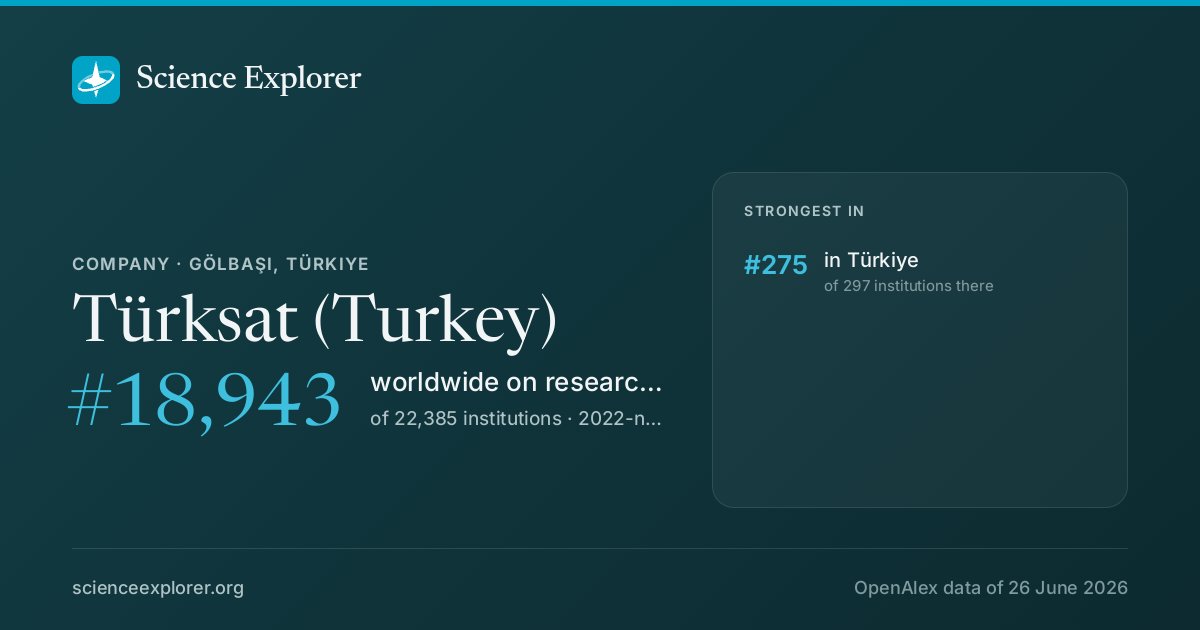
Türksat (Turkey) on Science Explorer

A card with Türksat (Turkey)'s standing and the fields it leads in, for a post or a slide. A link to this page previews as the same card.

Download the card

1200 × 630 PNG, sized for social posts, drawn from the latest snapshot.

Badges for a website1Each links back here and updates with every snapshot

Research measures only: rankings here say nothing about teaching, admissions or student experience. Comparable institutions and collaboration partners have tabs of their own, above.

Discussion

Ask a question or share a note about Türksat (Turkey). Posts are plain text and can be reported.