Science Explorer Back to mapMap
Discussion
University · San José · Costa Rica

Universidad Braulio Carrillo

World rank, all time
#24,925
of 34,923
Rank in Costa Rica
#30
of 39
Research works
225
▼ 53% vs 2018-21
Citations
1.5k
6.9 per fractional work
Top-10% rate
8.6%
all institutions 10.0%
vs its own fields
0.82×
1.00× is exactly expected
Open access
54%
world 40%
International
75%
world 18%

Which fields of science does Universidad Braulio Carrillo work in?

In 2022-now, 40% of research at Universidad Braulio Carrillo is in Social Sciences, 32% in Physical Sciences. Its largest fields are Social Sciences (25%), Computer Science (18%), Medicine (14%). It does 1.5× the world's share of Social Sciences.

Social Sciences: 13 fractional works · 40.3% of its workSocial Sciences: 8 fractional works · 24.8% of its workEducation: 2 fractional works · 6.1% of its workCultural Studies: 2 fractional works · 5.0% of its workSociology and Political Science: 2 fractional works · 4.9% of its workGeography, Planning and Development: 0 fractional works · 1.6% of its workLinguistics and Language: 0 fractional works · 1.3% of its workPublic Administration: 0 fractional works · 1.3% of its workLibrary and Information Sciences: 0 fractional works · 1.0% of its workSafety Research: 0 fractional works · 1.0% of its workUrban Studies: 0 fractional works · 0.7% of its workCommunication: 0 fractional works · 0.5% of its workDemography: 0 fractional works · 0.5% of its workPolitical Science and International Relations: 0 fractional works · 0.5% of its workAnthropology: 0 fractional works · 0.3% of its workPsychology: 2 fractional works · 5.9% of its workExperimental and Cognitive Psychology: 1 fractional works · 3.6% of its workClinical Psychology: 0 fractional works · 1.2% of its workSocial Psychology: 0 fractional works · 0.9% of its workApplied Psychology: 0 fractional works · 0.2% of its workArts and Humanities: 2 fractional works · 5.8% of its workConservation: 1 fractional works · 2.1% of its workLiterature and Literary Theory: 0 fractional works · 1.3% of its workHistory: 0 fractional works · 1.0% of its workLanguage and Linguistics: 0 fractional works · 0.5% of its workMuseology: 0 fractional works · 0.5% of its workPhilosophy: 0 fractional works · 0.3% of its workBusiness, Management and Accounting: 1 fractional works · 1.8% of its workManagement Information Systems: 0 fractional works · 0.8% of its workOrganizational Behavior and Human Resource Management: 0 fractional works · 0.5% of its workStrategy and Management: 0 fractional works · 0.5% of its workEconomics, Econometrics and Finance: 0 fractional works · 1.4% of its workEconomics and Econometrics: 0 fractional works · 1.0% of its workFinance: 0 fractional works · 0.3% of its workDecision Sciences: 0 fractional works · 0.5% of its workManagement Science and Operations Research: 0 fractional works · 0.5% of its workPhysical Sciences: 10 fractional works · 32.0% of its workComputer Science: 6 fractional works · 17.5% of its workComputer Networks and Communications: 3 fractional works · 8.1% of its workArtificial Intelligence: 1 fractional works · 3.3% of its workInformation Systems: 1 fractional works · 1.9% of its workComputational Theory and Mathematics: 1 fractional works · 1.8% of its workComputer Vision and Pattern Recognition: 0 fractional works · 1.5% of its workHuman-Computer Interaction: 0 fractional works · 0.8% of its workSmaller subfields together: 0 fractional works · 0.1% of its workEngineering: 3 fractional works · 8.7% of its workMedia Technology: 1 fractional works · 2.1% of its workComputational Mechanics: 0 fractional works · 1.1% of its workArchitecture: 0 fractional works · 1.0% of its workMechanical Engineering: 0 fractional works · 0.9% of its workMechanics of Materials: 0 fractional works · 0.9% of its workElectrical and Electronic Engineering: 0 fractional works · 0.8% of its workBuilding and Construction: 0 fractional works · 0.5% of its workIndustrial and Manufacturing Engineering: 0 fractional works · 0.5% of its workControl and Systems Engineering: 0 fractional works · 0.5% of its workAerospace Engineering: 0 fractional works · 0.2% of its workOcean Engineering: 0 fractional works · 0.2% of its workEnvironmental Science: 1 fractional works · 3.8% of its workManagement, Monitoring, Policy and Law: 0 fractional works · 1.6% of its workEnvironmental Chemistry: 0 fractional works · 1.0% of its workWater Science and Technology: 0 fractional works · 0.7% of its workHealth, Toxicology and Mutagenesis: 0 fractional works · 0.2% of its workPollution: 0 fractional works · 0.2% of its workSmaller subfields together: 0 fractional works · 0.1% of its workMathematics: 0 fractional works · 1.0% of its workStatistics and Probability: 0 fractional works · 1.0% of its workPhysics and Astronomy: 0 fractional works · 0.9% of its workAtomic and Molecular Physics, and Optics: 0 fractional works · 0.5% of its workAstronomy and Astrophysics: 0 fractional works · 0.4% of its workHealth Sciences: 8 fractional works · 23.8% of its workMedicine: 4 fractional works · 13.9% of its workPhysiology: 1 fractional works · 2.9% of its workNeurology: 0 fractional works · 1.2% of its workPsychiatry and Mental health: 0 fractional works · 1.2% of its workGeriatrics and Gerontology: 0 fractional works · 1.0% of its workPublic Health, Environmental and Occupational Health: 0 fractional works · 1.0% of its workPharmacology: 0 fractional works · 1.0% of its workRadiology, Nuclear Medicine and Imaging: 0 fractional works · 0.9% of its workSurgery: 0 fractional works · 0.8% of its workEpidemiology: 0 fractional works · 0.6% of its workEndocrinology, Diabetes and Metabolism: 0 fractional works · 0.6% of its workGenetics: 0 fractional works · 0.5% of its workPulmonary and Respiratory Medicine: 0 fractional works · 0.3% of its workReproductive Medicine: 0 fractional works · 0.3% of its workPathology and Forensic Medicine: 0 fractional works · 0.3% of its workCardiology and Cardiovascular Medicine: 0 fractional works · 0.3% of its workOncology: 0 fractional works · 0.3% of its workEmergency Medicine: 0 fractional works · 0.2% of its workObstetrics and Gynecology: 0 fractional works · 0.2% of its workSmaller subfields together: 0 fractional works · 0.1% of its workHealth Professions: 2 fractional works · 7.3% of its workGeneral Health Professions: 2 fractional works · 5.7% of its workSpeech and Hearing: 0 fractional works · 0.7% of its workRadiological and Ultrasound Technology: 0 fractional works · 0.5% of its workEmergency Medical Services: 0 fractional works · 0.3% of its workDentistry: 1 fractional works · 2.0% of its workOrthodontics: 0 fractional works · 1.0% of its workOral Surgery: 0 fractional works · 0.5% of its workPeriodontics: 0 fractional works · 0.4% of its workNursing: 0 fractional works · 0.7% of its workIssues, ethics and legal aspects: 0 fractional works · 0.3% of its workResearch and Theory: 0 fractional works · 0.3% of its workLife Sciences: 1 fractional works · 3.9% of its workBiochemistry, Genetics and Molecular Biology: 0 fractional works · 1.5% of its workMolecular Biology: 0 fractional works · 1.2% of its workAging: 0 fractional works · 0.3% of its workSmaller subfields together: 0 fractional works · 0.0% of its workNeuroscience: 0 fractional works · 1.5% of its workCognitive Neuroscience: 0 fractional works · 0.6% of its workCellular and Molecular Neuroscience: 0 fractional works · 0.5% of its workDevelopmental Neuroscience: 0 fractional works · 0.3% of its workImmunology and Microbiology: 0 fractional works · 0.8% of its workApplied Microbiology and Biotechnology: 0 fractional works · 0.3% of its workImmunology: 0 fractional works · 0.3% of its workSmaller subfields together: 0 fractional works · 0.2% of its workPharmacology, Toxicology and Pharmaceutics: 0 fractional works · 0.2% of its workALL ITS WORKUniversidadBraulio Carrillo32fractional works, 2022-now
Life Sciences4%Physical Sciences32%Health Sciences24%Social Sciences40%

Each ring splits the one inside it: the four domains of science, their fields, their subfields. Size is fractional works in 2022-now. Every slice is a page; the interactive view zooms down to single topics and colours each by how much more of it this institution does than the world.

Its 4 domains and 19 fields, with their numbers
    1. Social Sciences824.8%
    2. Psychology25.9%
    3. Arts and Humanities25.8%
    4. Business, Management and Accounting11.8%
    5. Economics, Econometrics and Finance01.4%
    6. Decision Sciences00.5%
    1. Computer Science617.5%
    2. Engineering38.7%
    3. Environmental Science13.8%
    4. Mathematics01.0%
    5. Physics and Astronomy00.9%
    1. Medicine413.9%
    2. Health Professions27.3%
    3. Dentistry12.0%
    4. Nursing00.7%
    1. Biochemistry, Genetics and Molecular Biology01.5%
    2. Neuroscience01.5%
    3. Immunology and Microbiology00.8%
    4. Pharmacology, Toxicology and Pharmaceutics00.2%
All of science, and how each field's share has moved since 1950: the Science domain explorer

Field profile

Location quotient across every field it publishes in: outside the ring is more than an institution of this size would be expected to publish, inside it is less.

Biochemistry, Genetics and Molecular Biology: 0.27× its world share, 0 worksBiochemistry, Geneti…Immunology and Microbiology: 0.84× its world share, 0 worksImmunology and Micro…Neuroscience: 0.90× its world share, 0 worksNeurosciencePharmacology, Toxicology and Pharmaceutics: 0.42× its world share, 0 worksPharmacology, Toxico…Computer Science: 2.25× its world share, 6 worksComputer ScienceEngineering: 0.58× its world share, 3 worksEngineeringEnvironmental Science: 0.77× its world share, 1 worksEnvironmental ScienceMathematics: 0.89× its world share, 0 worksMathematicsPhysics and Astronomy: 0.42× its world share, 0 worksPhysics and AstronomyDentistry: 4.07× its world share, 1 worksDentistryHealth Professions: 2.76× its world share, 2 worksHealth ProfessionsMedicine: 0.72× its world share, 4 worksMedicineNursing: 1.42× its world share, 0 worksNursingArts and Humanities: 2.02× its world share, 2 worksArts and HumanitiesBusiness, Management and Accounting: 0.57× its world share, 1 worksBusiness, Management…Decision Sciences: 0.54× its world share, 0 worksDecision SciencesEconomics, Econometrics and Finance: 0.65× its world share, 0 worksEconomics, Econometr…Psychology: 1.94× its world share, 2 worksPsychologySocial Sciences: 1.96× its world share, 8 worksSocial Sciences1×world share
more than its size predictsabout as predictedless

Rings at 0.5×, 1× and 2×. Widest outward: Dentistry, 4.1×. Every wedge is a field page.

All 19 fields, with their numbers
  1. Dentistry4.07×1 works
  2. Health Professions2.76×2 works
  3. Computer Science2.25×6 works
  4. Arts and Humanities2.02×2 works
  5. Social Sciences1.96×8 works
  6. Psychology1.94×2 works
  7. Nursing1.42×0 works
  8. Neuroscience0.90×0 works
  9. Mathematics0.89×0 works
  10. Immunology and Microbiology0.84×0 works
  11. Environmental Science0.77×1 works
  12. Medicine0.72×4 works
  13. Economics, Econometrics and Finance0.65×0 works
  14. Engineering0.58×3 works
  15. Business, Management and Accounting0.57×1 works
  16. Decision Sciences0.54×0 works
  17. Pharmacology, Toxicology and Pharmaceutics0.42×0 works
  18. Physics and Astronomy0.42×0 works
  19. Biochemistry, Genetics and Molecular Biology0.27×0 works

What are the most cited papers from Universidad Braulio Carrillo?

The most cited paper from Universidad Braulio Carrillo is "First‐YearWilkinson Microwave Anisotropy Probe(WMAP) Observations: Interpretation of the TT and TE Angular Power Spectrum Peaks" (Lyman A. Page, M. R. Nolta, Chris P. Barnes et al., 2003), with 308 citations. Next come "Kubric: A scalable dataset generator" (208) and "Curved folding" (198).

Most cited papers
#PaperReleasedCitations
1 First‐YearWilkinson Microwave Anisotropy Probe(WMAP) Observations: Interpretation of the TT and TE Angular Power Spectrum Peaks Lyman A. Page, M. R. Nolta, Chris P. Barnes et al. · The Astrophysical Journal Supplement Series Open access 19 Aug 2003 308
2 Kubric: A scalable dataset generator Klaus Greff et al. · 2022 IEEE/CVF Conference on Computer Vision and Pattern Recognition (CVPR) Conference paper Jun 2022 208
3 Curved folding Martin Kilian, Simon Flöry, Zhonggui Chen et al. · ACM Transactions on Graphics Aug 2008 198
4 Chronic Illness Experience: Insights from a Metastudy Sally Elizabeth Thorne, Barbara L. Paterson, Sonia Acorn et al. · Qualitative Health Research Apr 2002 169
5 Multidimensional context-aware social network architecture for mobile crowdsensing Xiping Hu, Xitong Li, Edith C.‐H. Ngai et al. · IEEE Communications Magazine Jun 2014 126
All 60 most cited papers, with filters and sorting

Which keywords describe research at Universidad Braulio Carrillo?

By fractional works in 2022-now, weighted toward what it does more of than the world: Gender, Identity, Higher Education, Literature, 5G Networks, Primary Care, Colonialism and Culture.

▲ more of its work than of the world's◆ about the world's share▼ less than the world's

Size is fractional works in 2022-now in the topics tagged with each word; colour is the word's share of this institution's work against its share of the world's. The 15 words are chosen for being large and distinctive. Each links to the topic it comes from most.

All 15 words, with their numbers
  1. Deep Learning2▲ 1.69×12 topics
  2. Epidemiology2▲ 1.39×11 topics
  3. Gender2▲ 9.8×4 topics
  4. Identity2▲ 6.8×4 topics
  5. Globalization1▲ 2.2×7 topics
  6. Higher Education1▲ 8.5×5 topics
  7. Literature1▲ 7.8×3 topics
  8. Public Health1▲ 3.1×6 topics
  9. 5G Networks1▲ 21×2 topics
  10. Primary Care1▲ 11×7 topics
  11. Colonialism1▲ 8.2×2 topics
  12. Culture1▲ 7.5×2 topics
  13. Ethics1▲ 6.9×6 topics
  14. Sustainability1▲ 1.39×4 topics
  15. Community1▲ 27×3 topics

Which research topics does Universidad Braulio Carrillo publish most on?

By volume in 2022-now: Japanese History and Culture, Software System Performance and Reliability, IoT and Edge/Fog Computing and Software-Defined Networks and 5G.

  1. 1 Japanese History and Culture Cultural Studies 1 works
  2. 2 Software System Performance and Reliability Computer Networks and Communications 1 works
  3. 3 IoT and Edge/Fog Computing Computer Networks and Communications 1 works
  4. 4 Software-Defined Networks and 5G Computer Networks and Communications 1 works
  5. 5 Sleep and related disorders Experimental and Cognitive Psychology 1 works
  6. 6 Rural Development and Agriculture Management, Monitoring, Policy and Law 0 works
  7. 7 Reflective Practices in Education Education 0 works
  8. 8 Latin American and Latino Studies Cultural Studies 0 works
  9. 9 Higher Education Practises and Engagement Education 0 works
  10. 10 Obstructive Sleep Apnea Research Physiology 0 works

How open and international is its research?

Against the world's own shares: the tick on each track. Both are shares of its output, so they sit on one scale and can be read against each other as well as against the world.

openly available53.8%not open46.2%

World: 40% of research is openly available.

with international co-authors74.9%domestic only25.1%

World: 18% is written across borders.

How has Universidad Braulio Carrillo's research output changed?

Output in 2022-2025 was 53% lower than in 2018-2021.

still counting200020102020
grewheldshrank

The same series as a ribbon: one cell per year, darker for more. The line above answers how much; this answers when.

Its share of all research

Growing output can still be a shrinking share: all of science grows. This is Universidad Braulio Carrillo as a percentage of every work published that year, 0.000090% in 2024.

still counting0.00020%0.00040%0.00060%Universidad Braulio Carrillo0.00019% in 202519801990200020102020

Fractional works of Universidad Braulio Carrillo over all fractional works that year. How the balance of science has shifted.

Other research institutions in San José

All research institutions in San José

Share Universidad Braulio Carrillo's ranking
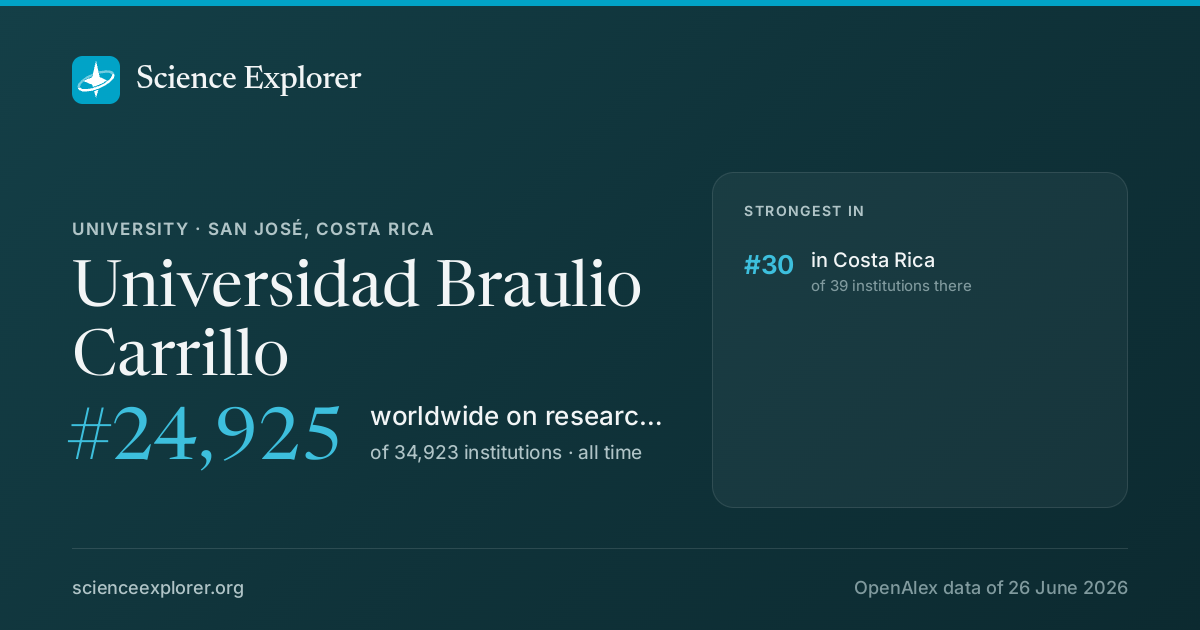
Universidad Braulio Carrillo on Science Explorer

A card with Universidad Braulio Carrillo's standing and the fields it leads in, for a post or a slide. A link to this page previews as the same card.

Download the card

1200 × 630 PNG, sized for social posts, drawn from the latest snapshot.

Badges for a website1Each links back here and updates with every snapshot

Research measures only: rankings here say nothing about teaching, admissions or student experience. Comparable institutions and collaboration partners have tabs of their own, above.

Discussion

Ask a question or share a note about Universidad Braulio Carrillo. Keep it to the research: no personal attacks, advertising or links. Any reader can report a post, which collapses it for everyone until it is opened.