Université de Bordeaux
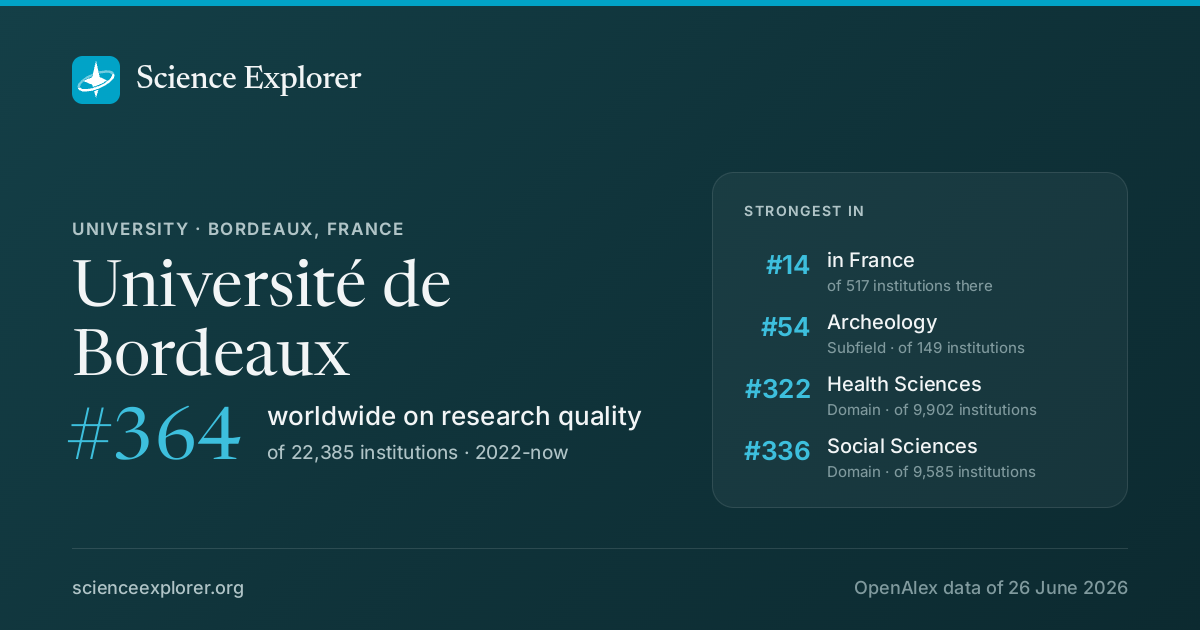
In research, Université de Bordeaux stands highest in Health Sciences (#322 of 9,902 worldwide), Social Sciences (#336 of 9,585 worldwide) and Medicine (#325 of 8,541 worldwide), 2022-now. Relative to its size it is most specialised in Anthropology, Linguistics and Language and Archeology (Anthropology is 5.6× its share of world research).
- World rank, 2022-now
- #364 of 22,385 · #407 all time
- Rank in France
- #14 of 517
- Research works
- 34k ▼ 34% vs 2018-21
- Citations
- 701k 20.9 per fractional work
- Top-10% rate
- 9.4% all institutions 10.0%
- vs its own fields
- 1.10× 1.00× is exactly expected
- Open access
- 42% world 40%
- International
- 24% world 18%
What is Université de Bordeaux known for in research?
The fields where it stands highest, 2022-now, ranked among every institution above the floor in each field.
| Field | World rank | Where that sits | Top-10% rate | Works | All time |
|---|---|---|---|---|---|
| Health SciencesDomain | #322 of 9,902 | 12.9% | 894 | #350 | |
| Social SciencesDomain | #336 of 9,585 | 8.0% | 1,238 | #425 | |
| MedicineField | #325 of 8,541 | 13.3% | 719 | #350 | |
| Social SciencesField | #282 of 5,988 | 8.3% | 655 | #418 | |
| Life SciencesDomain | #325 of 6,403 | 10.0% | 587 | #313 | |
| Physical SciencesDomain | #602 of 10,670 | 8.2% | 1,398 | #596 | |
| EngineeringField | #659 of 5,901 | 7.1% | 433 | #507 | |
| Agricultural and Biological SciencesField | #370 of 3,157 | 10.2% | 153 | #278 | |
| Biochemistry, Genetics and Molecular BiologyField | #370 of 2,964 | 10.7% | 244 | #393 | |
| Sociology and Political ScienceSubfield | #376 of 2,526 | 10.0% | 265 | #442 |
Each strip is that field's whole ranked pool, with the notch where Université de Bordeaux sits in it, in the colour of the band that rank falls in. The track under the rate is the rate itself: it carries no average mark, because the average differs by field (from about 6% in Dentistry to 21% in Economics).
Which of those standings moved
The same fields on both windows: where it stood over the whole record, and where it stands in 2022-now. The distance is the story, and it is the one thing the two rank columns above cannot show.
- Health Sciences#350 #322
- Social Sciences#425 #336
- Medicine#350 #325
- Social Sciences#418 #282
- Life Sciences#313 #325
- Physical Sciences#596 #602
- Engineering#507 #659
- Agricultural and Biological Sciences#278 #370
- Biochemistry, Genetics and Molecular Biology#393 #370
- Sociology and Political Science#442 #376
A dot further right is a better standing. Fields it was not ranked in over the whole record are left out.
Which fields of science does Université de Bordeaux work in?
In 2022-now, 34% of research at Université de Bordeaux is in Physical Sciences, 29% in Social Sciences. Its largest fields are Medicine (18%), Social Sciences (16%), Engineering (10%).
Each ring splits the one inside it: the four domains of science, their fields, their subfields. Size is fractional works in 2022-now. Every slice is a page; the interactive view zooms down to single topics and colours each by how much more of it this institution does than the world.
Its 4 domains and 26 fields, with their numbers
- Physical Sciences1,56633.9%
- Engineering47510.3%
- Computer Science2505.4%
- Physics and Astronomy1813.9%
- Environmental Science1743.8%
- Materials Science1503.2%
- Earth and Planetary Sciences1122.4%
- Mathematics1042.3%
- Chemistry881.9%
- Energy170.4%
- Chemical Engineering150.3%
- Social Sciences1,36029.5%
- Social Sciences72315.7%
- Arts and Humanities2826.1%
- Psychology1553.4%
- Business, Management and Accounting1042.3%
- Economics, Econometrics and Finance661.4%
- Decision Sciences300.6%
- Health Sciences1,01522.0%
- Medicine82117.8%
- Health Professions1653.6%
- Dentistry160.4%
- Nursing110.2%
- Veterinary20.0%
- Life Sciences67314.6%
What does Université de Bordeaux specialise in?
Where its research is concentrated relative to its size: Anthropology takes 5.6× the share of its output that it takes of world research.
- AnthropologySubfield · 72.2 works5.6×
- Linguistics and LanguageSubfield · 28.9 works5.5×
- ArcheologySubfield · 70.4 works5.1×
- Urban StudiesSubfield · 55.7 works4.4×
Location quotient, a volume reading rather than an impact one. It surfaces small, lopsided specialities.
Field profile
Location quotient across every field it publishes in: outside the ring is more than an institution of this size would be expected to publish, inside it is less.
Rings at 0.5×, 1× and 2×. Widest outward: Arts and Humanities, 2.1×. Every wedge is a field page.
All 26 fields, with their numbers
- Arts and Humanities2.11×282 works
- Neuroscience1.98×148 works
- Mathematics1.92×104 works
- Physics and Astronomy1.76×181 works
- Earth and Planetary Sciences1.55×112 works
- Health Professions1.36×165 works
- Social Sciences1.24×723 works
- Chemistry1.21×88 works
- Immunology and Microbiology1.19×55 works
- Biochemistry, Genetics and Molecular Biology1.15×283 works
- Psychology1.10×155 works
- Pharmacology, Toxicology and Pharmaceutics0.93×15 works
- Materials Science0.93×150 works
- Medicine0.93×821 works
- Chemical Engineering0.92×15 works
- Agricultural and Biological Sciences0.78×170 works
- Environmental Science0.76×174 works
- Dentistry0.73×16 works
- Computer Science0.70×250 works
- Business, Management and Accounting0.70×104 works
- Engineering0.69×475 works
- Decision Sciences0.67×30 works
- Economics, Econometrics and Finance0.67×66 works
- Nursing0.50×11 works
- Energy0.40×17 works
- Veterinary0.32×2 works
- Arts and Humanities 2.1×
- Neuroscience 2.0×
- Mathematics 1.9×
- Physics and Astronomy 1.8×
- Earth and Planetary Sciences 1.6×
- Health Professions 1.4×
- Social Sciences 1.2×
- Chemistry 1.2×
- Immunology and Microbiology 1.2×
- Biochemistry, Genetics and Molecular Biology 1.1×
- Psychology 1.1×
- Pharmacology, Toxicology and Pharmaceutics 0.9×
- Materials Science 0.9×
- Medicine 0.9×
- Chemical Engineering 0.9×
- Agricultural and Biological Sciences 0.8×
- Environmental Science 0.8×
- Dentistry 0.7×
- Computer Science 0.7×
- Business, Management and Accounting 0.7×
- Engineering 0.7×
- Decision Sciences 0.7×
- Economics, Econometrics and Finance 0.7×
- Nursing 0.5×
- Energy 0.4×
- Veterinary 0.3×
Who are the top researchers at Université de Bordeaux?
Ranked on the quality score, Daniel Choquet, Aniket Mishra and Jean‐Louis Turon lead among researchers whose main affiliation is Université de Bordeaux.
- 1
Daniel Choquet
 France · #20,390 worldwide
24k citations · 273 works
- 2
Aniket Mishra
France · #64,896 worldwide
8.8k citations · 112 works
- 3
Jean‐Louis Turon
France · #69,483 worldwide
9.3k citations · 151 works
- 4
E. do Couto e Silva
France · #81,366 worldwide
3.9k citations · 25 works
- 5
Jan A. Veenstra
France · #113,699 worldwide
15k citations · 272 works
- 6
Josette M Duprat
France · #116,690 worldwide
4.5k citations · 79 works
- 7
Laurent Cognet
France · #137,367 worldwide
12k citations · 281 works
- 8
Francis E. Grousset
France · #142,783 worldwide
9.1k citations · 139 works
- 9
Françis Mégraud
France · #155,526 worldwide
48k citations · 806 works
- 10
Jean-Christophe Delpech
France · #160,389 worldwide
2.6k citations · 63 works
Which keywords describe research at Université de Bordeaux?
By fractional works in 2022-now, weighted toward what it does more of than the world: Community Engagement, Territorial Governance, Local Development, Gender Studies, Educational Policies, Sociological Analysis, Ethnographic Research and Professional Practices.
- Universal Health Coverage
- Healthcare Policy
- Healthcare Quality Indicators
- Patient Rights
- Psychological Trauma
- End-of-Life Care
- Cultural Diversity
- Participative Evaluation
- Proximity and Innovation
- Cooperatives
- Social Innovation
- Citizenship
- Professional Practices
- Sociological Analysis
- Social Determinants of Health
- Gender Studies
- Mental Health
- Local Development
- Community Engagement
- Climate Change
- Epidemiology
- Globalization
- Territorial Governance
- Social Justice
- Public Policy
- Gender
- Educational Policies
- Ethnographic Research
- Public Action
- Citizen Participation
- Institutionalization
- Environmental Participation
- Solidarity Economy
- Palliative Care
- Sociolinguistics
- Medical Ethics
- Healthcare Legislation
- Digital Health
- Healthcare Management
- Inequalities
Size is fractional works in 2022-now in the topics tagged with each word; colour is the word's share of this institution's work against its share of the world's. The 40 words are chosen for being large and distinctive. Each links to the topic it comes from most.
All 40 words, with their numbers
- Epidemiology159◆ 0.87×132 topics
- Climate Change143◆ 1.14×98 topics
- Globalization114▲ 1.26×10⁸ topics
- Community Engagement111▲ 7.4×14 topics
- Territorial Governance104▲ 20×3 topics
- Local Development104▲ 22×2 topics
- Social Justice96▲ 3.5×30 topics
- Mental Health95▲ 1.44×37 topics
- Public Policy86▲ 3.9×23 topics
- Gender Studies83▲ 12×11 topics
- Gender70▲ 2.8×44 topics
- Social Determinants of Health67▲ 6.8×7 topics
- Educational Policies66▲ 13×3 topics
- Sociological Analysis66▲ 26×2 topics
- Ethnographic Research66▲ 29×2 topics
- Professional Practices66▲ 40×1 topic
- Public Action66▲ 40×1 topic
- Citizenship56▲ 10×11 topics
- Citizen Participation54▲ 10×2 topics
- Social Innovation54▲ 7.6×8 topics
- Institutionalization53▲ 12×4 topics
- Cooperatives53▲ 16×3 topics
- Environmental Participation53▲ 16×1 topic
- Proximity and Innovation53▲ 16×1 topic
- Solidarity Economy52▲ 20×2 topics
- Participative Evaluation52▲ 34×1 topic
- Palliative Care50▲ 7.1×6 topics
- Cultural Diversity49▲ 4.8×16 topics
- Sociolinguistics46▲ 5.4×7 topics
- End-of-Life Care43▲ 8.3×3 topics
- Medical Ethics43▲ 7.5×6 topics
- Psychological Trauma42▲ 15×2 topics
- Healthcare Legislation42▲ 17×1 topic
- Patient Rights42▲ 13×1 topic
- Digital Health42▲ 8.0×4 topics
- Healthcare Quality Indicators40▲ 15×2 topics
- Healthcare Management39▲ 11×3 topics
- Healthcare Policy39▲ 9.4×2 topics
- Inequalities39▲ 26×1 topic
- Universal Health Coverage39▲ 26×1 topic
Which research topics does Université de Bordeaux publish most on?
By volume in 2022-now: Education, sociology, and vocational training, French Urban and Social Studies, Social Sciences and Governance and Health, Medicine and Society.
Area is fractional works; colour is the subfield each topic belongs to.
- 1 Education, sociology, and vocational training Sociology and Political Science 66 works
- 2 French Urban and Social Studies Sociology and Political Science 53 works
- 3 Social Sciences and Governance Urban Studies 52 works
- 4 Health, Medicine and Society General Health Professions 42 works
- 5 Healthcare Systems and Practices General Health Professions 39 works
- 6 Pleistocene-Era Hominins and Archaeology Anthropology 28 works
- 7 Multiculturalism, Politics, Migration, Gender Political Science and International Relations 27 works
- 8 Linguistics and Discourse Analysis Philosophy 26 works
- 9 Social Policies and Family Sociology and Political Science 22 works
- 10 French Language Learning Methods Linguistics and Language 22 works
How open and international is its research?
Against the world's own shares: the tick on each track. Both are shares of its output, so they sit on one scale and can be read against each other as well as against the world.
World: 40% of research is openly available.
World: 18% is written across borders.
How has Université de Bordeaux's research output changed?
Output in 2022-2025 was 34% lower than in 2018-2021.
The same series as a ribbon: one cell per year, darker for more. The line above answers how much; this answers when.
Its share of all research
Growing output can still be a shrinking share: all of science grows. This is Université de Bordeaux as a percentage of every work published that year, 0.018% in 2024.
Fractional works of Université de Bordeaux over all fractional works that year. How the balance of science has shifted.
How much of it reaches the world top 10%
Year by year, against all institutions in the same year.
Of each year's output, the share that reached the world's 10% most cited for its field and year. Peak 13.5% in 2010.
Other research institutions in Bordeaux
- Université Bordeaux Montaigne
- Centre Hospitalier Universitaire de Bordeaux
- Institut Polytechnique de Bordeaux
- Hôpital Pellegrin
- Institut Bergonié
- Sciences Po Bordeaux
- Hôpital Saint-André
- Centre Hospitalier Charles Perrens

Which institutions have research most like Université de Bordeaux's?
Among the world's leading institutions, Sorbonne Université has the research profile closest to Université de Bordeaux's, with both strong in Arts and Humanities.
- 1
Sorbonne UniversitéFrance · Both strong in Arts and Humanities, Mathematics, Physics and Astronomy
0.82 Compare
- 2
Aix-Marseille UniversitéFrance · Both strong in Arts and Humanities, Neuroscience, Physics and Astronomy
0.82 Compare
- 3
Université de StrasbourgFrance · Both strong in Arts and Humanities, Neuroscience, Health Professions
0.80 Compare
- 4
UCLouvain
 Belgium · Both strong in Arts and Humanities, Mathematics, Neuroscience
0.80 Compare
- 5
University of Tübingen
 Germany · Both strong in Arts and Humanities, Neuroscience, Physics and Astronomy
0.80 Compare

Similarity is the correlation of each side's location quotients across every field it publishes in, on a log scale: 1 is the same shape of research, 0 is unrelated. It ignores size. How it is measured.
Compare Université de Bordeaux with
- vs
 University of Massachusetts Chan Medical School
- vs
 China Pharmaceutical University
- vs The University of Texas MD Anderson Cancer Center
- vs University of Oklahoma
- vs University of Houston
- vs
 Université Laval
Share Université de Bordeaux's ranking



Research measures only: rankings here say nothing about teaching, admissions or student experience. Comparable institutions and collaboration partners have tabs of their own, above.
Discussion
Ask a question or share a note about Université de Bordeaux. Posts are plain text and can be reported.