Urologische Klinik München
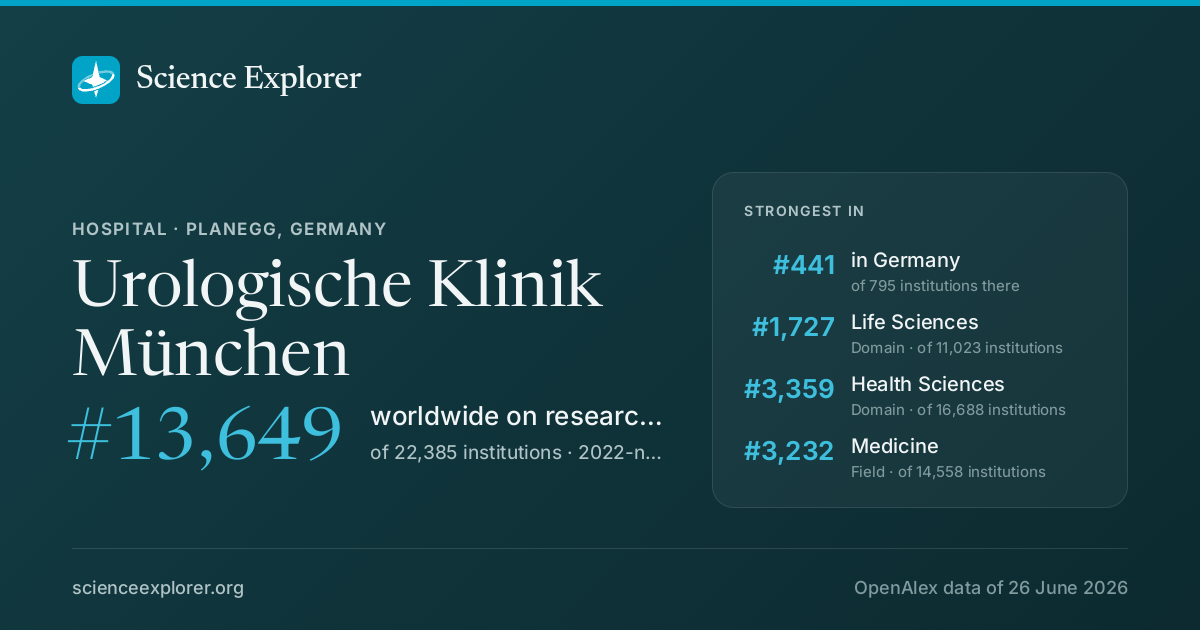
In research, Urologische Klinik München stands highest in Life Sciences (#1,727 of 11,023 worldwide), Health Sciences (#3,359 of 16,688 worldwide) and Medicine (#3,232 of 14,558 worldwide), over all time.
- World rank, 2022-now
- #13,649 of 22,385 · #4,650 all time
- Rank in Germany
- #441 of 795
- Research works
- 496 ▼ 56% vs 2018-21
- Citations
- 12k 24.2 per fractional work
- Top-10% rate
- 10.2% all institutions 10.0%
- vs its own fields
- 1.03× 1.00× is exactly expected
- Open access
- 38% world 40%
- International
- 24% world 18%
What is Urologische Klinik München known for in research?
The fields where it stands highest, over all time, ranked among every institution above the floor in each field.
| Field | World rank | Where that sits | Top-10% rate | Works |
|---|---|---|---|---|
| Life SciencesDomain | #1,727 of 11,023 | 14.5% | 174 | |
| Health SciencesDomain | #3,359 of 16,688 | 9.7% | 158 | |
| MedicineField | #3,232 of 14,558 | 10.4% | 140 |
Each strip is that field's whole ranked pool, with the notch where Urologische Klinik München sits in it, in the colour of the band that rank falls in. The track under the rate is the rate itself: it carries no average mark, because the average differs by field (from about 6% in Dentistry to 21% in Economics).
Which fields of science does Urologische Klinik München work in?
In 2022-now, 45% of research at Urologische Klinik München is in Life Sciences, 40% in Health Sciences. Its largest fields are Medicine (38%), Biochemistry, Genetics and Molecular Biology (24%), Agricultural and Biological Sciences (11%). It does 3.0× the world's share of Life Sciences.
Each ring splits the one inside it: the four domains of science, their fields, their subfields. Size is fractional works in 2022-now. Every slice is a page; the interactive view zooms down to single topics and colours each by how much more of it this institution does than the world.
Its 4 domains and 25 fields, with their numbers
- Life Sciences4744.7%
- Health Sciences4340.4%
- Medicine4038.0%
- Health Professions22.1%
- Dentistry00.2%
- Nursing00.2%
- Physical Sciences1311.9%
- Environmental Science43.6%
- Engineering32.7%
- Earth and Planetary Sciences11.3%
- Computer Science11.2%
- Materials Science11.2%
- Chemistry10.9%
- Physics and Astronomy10.5%
- Energy00.3%
- Chemical Engineering00.2%
- Mathematics00.1%
- Social Sciences33.0%
Field profile
Location quotient across every field it publishes in: outside the ring is more than an institution of this size would be expected to publish, inside it is less.
Rings at 0.5×, 1× and 2×. Widest outward: Immunology and Microbiology, 5.4×. Every wedge is a field page.
All 25 fields, with their numbers
- Immunology and Microbiology5.36×6 works
- Biochemistry, Genetics and Molecular Biology4.45×25 works
- Neuroscience2.61×4 works
- Agricultural and Biological Sciences2.31×12 works
- Medicine1.97×40 works
- Pharmacology, Toxicology and Pharmaceutics0.96×0 works
- Earth and Planetary Sciences0.82×1 works
- Health Professions0.81×2 works
- Environmental Science0.72×4 works
- Chemistry0.57×1 works
- Chemical Engineering0.52×0 works
- Arts and Humanities0.38×1 works
- Psychology0.38×1 works
- Dentistry0.34×0 works
- Materials Science0.33×1 works
- Nursing0.32×0 works
- Energy0.31×0 works
- Physics and Astronomy0.23×0 works
- Engineering0.18×3 works
- Computer Science0.15×1 works
- Decision Sciences0.12×0 works
- Mathematics0.07×0 works
- Business, Management and Accounting0.07×0 works
- Social Sciences0.03×0 works
- Economics, Econometrics and Finance0.01×0 works
- Immunology and Microbiology 5.4×
- Biochemistry, Genetics and Molecular Biology 4.5×
- Neuroscience 2.6×
- Agricultural and Biological Sciences 2.3×
- Medicine 2.0×
- Pharmacology, Toxicology and Pharmaceutics 1.0×
- Earth and Planetary Sciences 0.8×
- Health Professions 0.8×
- Environmental Science 0.7×
- Chemistry 0.6×
- Chemical Engineering 0.5×
- Arts and Humanities 0.4×
- Psychology 0.4×
- Dentistry 0.3×
- Materials Science 0.3×
- Nursing 0.3×
- Energy 0.3×
- Physics and Astronomy 0.2×
- Engineering 0.2×
- Computer Science 0.1×
- Decision Sciences 0.1×
- Mathematics 0.1×
- Business, Management and Accounting 0.1×
- Social Sciences 0.0×
- Economics, Econometrics and Finance 0.0×
Who are the top researchers at Urologische Klinik München?
Ranked on the quality score, Gerhard Laux, Eugen Leo and Markus Haake lead among researchers whose main affiliation is Urologische Klinik München.
- 1
Gerhard Laux
 Germany · #703,546 worldwide
2.9k citations · 42 works
- 2
Eugen Leo
Germany · #811,864 worldwide
3.1k citations · 72 works
- 3
Markus Haake
Germany · #1,315,658 worldwide
546 citations · 29 works
- 4
Sabrina Genßler
Germany · #1,374,633 worldwide
775 citations · 22 works
- 5
Christine Schuberth-Wagner
Germany · #1,424,751 worldwide
691 citations · 31 works
- 6
Adam Merschbacher
Germany · #1,795,673 worldwide
96 citations · 142 works
- 7
Neha Vashist
Germany · #1,962,151 worldwide
288 citations · 17 works
- 8
Petra Fettes
Germany · #2,129,404 worldwide
461 citations · 22 works
- 9
Kathrin Klar
Germany · #2,305,947 worldwide
206 citations · 26 works
- 10
H. W. Frickhinger
Germany · #2,986,955 worldwide
75 citations · 112 works
Which keywords describe research at Urologische Klinik München?
By fractional works in 2022-now, weighted toward what it does more of than the world: Inflammation, Urinary Incontinence, Rehabilitation, Epidemiology, Neuroprotection, Biomarkers, Surgical Treatment and Immunotherapy.
- TGF-ß
- Neoadjuvant Therapy
- Benign Prostatic Hyperplasia
- Signal Transduction
- Light Harvesting
- Reactive Oxygen Species
- Guidelines
- Tumor Microenvironment
- Invasive Species
- Clinical Guidelines
- Biodiversity
- TGF-ß Superfamily
- Growth-Differentiation Factor-15
- Gene Expression
- Pelvic Organ Prolapse
- Cardiovascular Disease
- Neuroprotection
- Rehabilitation
- Quality of Life
- Inflammation
- Epidemiology
- Urinary Incontinence
- Biomarkers
- Immunotherapy
- Surgical Treatment
- Pelvic Floor Dysfunction
- Cancer
- Genetic Diversity
- Obesity
- Prostate Cancer
- Innate Immunity
- Genetic Mutations
- Molecular Characterization
- Epigenetic Regulation
- Phylogenetic Analysis
- Genetic Variants
- Photosystem II
- RNA-Seq
- Lower Urinary Tract Symptoms
- Adaptive Evolution
Size is fractional works in 2022-now in the topics tagged with each word; colour is the word's share of this institution's work against its share of the world's. The 40 words are chosen for being large and distinctive. Each links to the topic it comes from most.
All 40 words, with their numbers
- Epidemiology9▲ 2.1×37 topics
- Inflammation9▲ 3.9×30 topics
- Urinary Incontinence5▲ 60×2 topics
- Quality of Life5▲ 3.3×13 topics
- Biomarkers5▲ 6.2×9 topics
- Rehabilitation5▲ 11×2 topics
- Immunotherapy4▲ 5.7×9 topics
- Neuroprotection4▲ 11×7 topics
- Surgical Treatment4▲ 19×3 topics
- Cardiovascular Disease4▲ 3.2×4 topics
- Pelvic Floor Dysfunction4▲ 71×1 topic
- Pelvic Organ Prolapse4▲ 71×1 topic
- Cancer3▲ 2.4×22 topics
- Gene Expression3▲ 4.8×12 topics
- Genetic Diversity3▲ 6.3×8 topics
- Growth-Differentiation Factor-153▲ 200×1 topic
- Obesity3▲ 3.5×2 topics
- TGF-ß Superfamily3▲ 200×1 topic
- Prostate Cancer3▲ 18×3 topics
- Biodiversity2▲ 3.1×11 topics
- Innate Immunity2▲ 7.1×9 topics
- Clinical Guidelines2▲ 7.5×4 topics
- Genetic Mutations2▲ 4.9×7 topics
- Invasive Species2▲ 5.2×9 topics
- Molecular Characterization2▲ 12×2 topics
- Tumor Microenvironment2▲ 4.6×6 topics
- Epigenetic Regulation2▲ 9.3×6 topics
- Guidelines2▲ 4.2×6 topics
- Phylogenetic Analysis2▲ 6.3×11 topics
- Reactive Oxygen Species2▲ 4.9×4 topics
- Genetic Variants2▲ 9.8×5 topics
- Light Harvesting2▲ 47×1 topic
- Photosystem II2▲ 47×1 topic
- Signal Transduction2▲ 11×5 topics
- RNA-Seq2▲ 13×2 topics
- Benign Prostatic Hyperplasia2▲ 44×1 topic
- Lower Urinary Tract Symptoms2▲ 44×1 topic
- Neoadjuvant Therapy2▲ 6.4×5 topics
- Adaptive Evolution2▲ 25×2 topics
- TGF-ß2▲ 8.8×3 topics
Which research topics does Urologische Klinik München publish most on?
By volume in 2022-now: Pelvic floor disorders treatments, GDF15 and Related Biomarkers, Photosynthetic Processes and Mechanisms and Urinary Bladder and Prostate Research.
Area is fractional works; colour is the subfield each topic belongs to.
- 1 Pelvic floor disorders treatments Rheumatology 4 works
- 2 GDF15 and Related Biomarkers Rheumatology 3 works
- 3 Photosynthetic Processes and Mechanisms Molecular Biology 2 works
- 4 Urinary Bladder and Prostate Research Urology 2 works
- 5 Bladder and Urothelial Cancer Treatments Surgery 1 works
- 6 Prostate Cancer Diagnosis and Treatment Pulmonary and Respiratory Medicine 1 works
- 7 Cancer Immunotherapy and Biomarkers Oncology 1 works
- 8 Medical Practices and Rehabilitation Physical Therapy, Sports Therapy and Rehabilitation 1 works
- 9 Genomics and Phylogenetic Studies Molecular Biology 1 works
- 10 Theatre and Performance Studies Visual Arts and Performing Arts 1 works
How open and international is its research?
Against the world's own shares: the tick on each track. Both are shares of its output, so they sit on one scale and can be read against each other as well as against the world.
World: 40% of research is openly available.
World: 18% is written across borders.
How has Urologische Klinik München's research output changed?
Output in 2022-2025 was 56% lower than in 2018-2021.
The same series as a ribbon: one cell per year, darker for more. The line above answers how much; this answers when.
Its share of all research
Growing output can still be a shrinking share: all of science grows. This is Urologische Klinik München as a percentage of every work published that year, 0.00041% in 2024.
Fractional works of Urologische Klinik München over all fractional works that year. How the balance of science has shifted.
Other research institutions in Planegg
- MorphoSys (Germany)
- Medigene (Germany)
- Müller BBM (Germany)
- Eisbach Bio (Germany)
- Dynamic Biosensors (Germany)
- advanceCOR (Germany)
- Ethris (Germany)
- Hikma Pharmaceuticals (Germany)
Share Urologische Klinik München's ranking
Badges for a website1Each links back here and updates with every snapshot

Research measures only: rankings here say nothing about teaching, admissions or student experience. Comparable institutions and collaboration partners have tabs of their own, above.
Discussion
Ask a question or share a note about Urologische Klinik München. Keep it to the research: no personal attacks, advertising or links. Any reader can report a post, which collapses it for everyone until it is opened.