Science Explorer Back to mapMap
University · Collegeville · United States

Ursinus College

In research, Ursinus College stands highest in Social Sciences (#4,212 of 14,833 worldwide), Social Sciences (#3,224 of 9,330 worldwide) and Physical Sciences (#7,540 of 17,446 worldwide), over all time.

World rank, 2022-now
#14,430
of 22,385 · #8,784 all time
Rank in United States
#2,033
of 3,332
Research works
985
◆ 1% vs 2018-21
Citations
10k
10.6 per fractional work
Top-10% rate
5.4%
all institutions 10.0%
vs its own fields
0.90×
1.00× is exactly expected
Open access
33%
world 40%
International
6%
world 18%

What is Ursinus College known for in research?

The fields where it stands highest, over all time, ranked among every institution above the floor in each field.

FieldWorld rankWhere that sitsTop-10% rateWorks
Social SciencesDomain #4,212 of 14,833 8.4%521
Social SciencesField #3,224 of 9,330 8.2%264
Physical SciencesDomain #7,540 of 17,446 7.1%228
Life SciencesDomain #6,832 of 11,023 5.9%128
Arts and HumanitiesField #2,259 of 3,511 10.3%122

Each strip is that field's whole ranked pool, with the notch where Ursinus College sits in it, in the colour of the band that rank falls in. The track under the rate is the rate itself: it carries no average mark, because the average differs by field (from about 6% in Dentistry to 21% in Economics).

Which fields of science does Ursinus College work in?

In 2022-now, 42% of research at Ursinus College is in Social Sciences, 28% in Physical Sciences. Its largest fields are Social Sciences (19%), Medicine (12%), Arts and Humanities (11%). It does 1.7× the world's share of Social Sciences.

Social Sciences: 96 fractional works · 41.8% of its workSocial Sciences: 44 fractional works · 19.1% of its workSociology and Political Science: 14 fractional works · 6.1% of its workEducation: 6 fractional works · 2.8% of its workPolitical Science and International Relations: 6 fractional works · 2.5% of its workCultural Studies: 4 fractional works · 1.9% of its workGender Studies: 4 fractional works · 1.5% of its workAnthropology: 2 fractional works · 1.1% of its workCommunication: 2 fractional works · 0.9% of its workLaw: 2 fractional works · 0.8% of its workDemography: 1 fractional works · 0.4% of its workDevelopment: 1 fractional works · 0.2% of its workSmaller subfields together: 2 fractional works · 0.7% of its workArts and Humanities: 26 fractional works · 11.3% of its workLiterature and Literary Theory: 7 fractional works · 3.1% of its workHistory: 5 fractional works · 2.2% of its workPhilosophy: 4 fractional works · 2.0% of its workHistory and Philosophy of Science: 3 fractional works · 1.4% of its workVisual Arts and Performing Arts: 2 fractional works · 0.8% of its workClassics: 1 fractional works · 0.6% of its workMusic: 1 fractional works · 0.6% of its workReligious studies: 1 fractional works · 0.4% of its workSmaller subfields together: 1 fractional works · 0.3% of its workPsychology: 14 fractional works · 6.1% of its workSocial Psychology: 6 fractional works · 2.7% of its workDevelopmental and Educational Psychology: 3 fractional works · 1.1% of its workClinical Psychology: 2 fractional works · 1.1% of its workExperimental and Cognitive Psychology: 2 fractional works · 0.9% of its workApplied Psychology: 1 fractional works · 0.3% of its workEconomics, Econometrics and Finance: 6 fractional works · 2.5% of its workEconomics and Econometrics: 4 fractional works · 1.7% of its workFinance: 1 fractional works · 0.6% of its workGeneral Economics, Econometrics and Finance: 0 fractional works · 0.2% of its workBusiness, Management and Accounting: 5 fractional works · 2.1% of its workStrategy and Management: 2 fractional works · 0.8% of its workBusiness and International Management: 1 fractional works · 0.4% of its workMarketing: 1 fractional works · 0.3% of its workOrganizational Behavior and Human Resource Management: 1 fractional works · 0.2% of its workSmaller subfields together: 1 fractional works · 0.4% of its workDecision Sciences: 2 fractional works · 0.7% of its workManagement Science and Operations Research: 1 fractional works · 0.5% of its workSmaller subfields together: 0 fractional works · 0.2% of its workPhysical Sciences: 64 fractional works · 28.0% of its workComputer Science: 13 fractional works · 5.7% of its workComputational Theory and Mathematics: 4 fractional works · 1.6% of its workInformation Systems: 3 fractional works · 1.3% of its workArtificial Intelligence: 2 fractional works · 1.0% of its workComputer Vision and Pattern Recognition: 2 fractional works · 0.7% of its workComputer Networks and Communications: 1 fractional works · 0.5% of its workSmaller subfields together: 1 fractional works · 0.6% of its workEngineering: 11 fractional works · 5.0% of its workBiomedical Engineering: 6 fractional works · 2.5% of its workMedia Technology: 1 fractional works · 0.5% of its workBuilding and Construction: 1 fractional works · 0.4% of its workElectrical and Electronic Engineering: 1 fractional works · 0.4% of its workAerospace Engineering: 1 fractional works · 0.3% of its workArchitecture: 1 fractional works · 0.3% of its workOcean Engineering: 1 fractional works · 0.2% of its workSmaller subfields together: 1 fractional works · 0.4% of its workEnvironmental Science: 10 fractional works · 4.6% of its workEcology: 4 fractional works · 1.8% of its workGlobal and Planetary Change: 2 fractional works · 0.9% of its workEnvironmental Chemistry: 1 fractional works · 0.5% of its workManagement, Monitoring, Policy and Law: 1 fractional works · 0.4% of its workNature and Landscape Conservation: 1 fractional works · 0.4% of its workIndustrial and Manufacturing Engineering: 1 fractional works · 0.3% of its workPollution: 0 fractional works · 0.2% of its workSmaller subfields together: 1 fractional works · 0.2% of its workPhysics and Astronomy: 8 fractional works · 3.4% of its workNuclear and High Energy Physics: 2 fractional works · 1.1% of its workAstronomy and Astrophysics: 2 fractional works · 0.7% of its workAtomic and Molecular Physics, and Optics: 2 fractional works · 0.7% of its workRadiation: 1 fractional works · 0.5% of its workStatistical and Nonlinear Physics: 1 fractional works · 0.4% of its workSmaller subfields together: 0 fractional works · 0.0% of its workMathematics: 7 fractional works · 3.1% of its workMathematical Physics: 2 fractional works · 1.0% of its workTheoretical Computer Science: 2 fractional works · 0.9% of its workGeometry and Topology: 1 fractional works · 0.4% of its workStatistics and Probability: 1 fractional works · 0.3% of its workSmaller subfields together: 1 fractional works · 0.6% of its workMaterials Science: 6 fractional works · 2.6% of its workMaterials Chemistry: 2 fractional works · 1.1% of its workBiomaterials: 2 fractional works · 0.9% of its workPolymers and Plastics: 1 fractional works · 0.4% of its workSmaller subfields together: 0 fractional works · 0.2% of its workChemistry: 4 fractional works · 1.9% of its workOrganic Chemistry: 2 fractional works · 0.9% of its workSpectroscopy: 1 fractional works · 0.5% of its workPhysical and Theoretical Chemistry: 1 fractional works · 0.4% of its workSmaller subfields together: 0 fractional works · 0.1% of its workEarth and Planetary Sciences: 4 fractional works · 1.6% of its workOceanography: 2 fractional works · 0.9% of its workAtmospheric Science: 1 fractional works · 0.4% of its workPaleontology: 1 fractional works · 0.2% of its workSmaller subfields together: 0 fractional works · 0.1% of its workChemical Engineering: 0 fractional works · 0.1% of its workLife Sciences: 38 fractional works · 16.6% of its workBiochemistry, Genetics and Molecular Biology: 25 fractional works · 10.8% of its workMolecular Biology: 16 fractional works · 6.8% of its workCell Biology: 4 fractional works · 1.7% of its workGenetics: 4 fractional works · 1.5% of its workSmaller subfields together: 2 fractional works · 0.7% of its workAgricultural and Biological Sciences: 6 fractional works · 2.6% of its workEcology, Evolution, Behavior and Systematics: 2 fractional works · 1.0% of its workPlant Science: 1 fractional works · 0.6% of its workSoil Science: 1 fractional works · 0.4% of its workFood Science: 1 fractional works · 0.2% of its workSmaller subfields together: 1 fractional works · 0.4% of its workNeuroscience: 5 fractional works · 2.3% of its workCognitive Neuroscience: 2 fractional works · 1.1% of its workCellular and Molecular Neuroscience: 1 fractional works · 0.6% of its workSmaller subfields together: 1 fractional works · 0.6% of its workImmunology and Microbiology: 2 fractional works · 0.8% of its workImmunology: 2 fractional works · 0.8% of its workSmaller subfields together: 0 fractional works · 0.0% of its workHealth Sciences: 31 fractional works · 13.6% of its workMedicine: 27 fractional works · 11.6% of its workPhysiology: 5 fractional works · 2.2% of its workCardiology and Cardiovascular Medicine: 3 fractional works · 1.5% of its workPublic Health, Environmental and Occupational Health: 2 fractional works · 1.1% of its workRadiology, Nuclear Medicine and Imaging: 2 fractional works · 1.0% of its workOrthopedics and Sports Medicine: 2 fractional works · 1.0% of its workComplementary and alternative medicine: 2 fractional works · 0.9% of its workRehabilitation: 2 fractional works · 0.7% of its workSurgery: 1 fractional works · 0.5% of its workEpidemiology: 1 fractional works · 0.5% of its workPsychiatry and Mental health: 1 fractional works · 0.3% of its workEndocrinology, Diabetes and Metabolism: 1 fractional works · 0.3% of its workObstetrics and Gynecology: 1 fractional works · 0.3% of its workReproductive Medicine: 1 fractional works · 0.3% of its workGenetics: 1 fractional works · 0.3% of its workPediatrics, Perinatology and Child Health: 1 fractional works · 0.3% of its workSmaller subfields together: 1 fractional works · 0.6% of its workHealth Professions: 3 fractional works · 1.3% of its workGeneral Health Professions: 2 fractional works · 0.7% of its workHealth Information Management: 1 fractional works · 0.3% of its workSmaller subfields together: 1 fractional works · 0.3% of its workNursing: 1 fractional works · 0.3% of its workNutrition and Dietetics: 1 fractional works · 0.3% of its workVeterinary: 1 fractional works · 0.3% of its workSmall Animals: 1 fractional works · 0.3% of its workDentistry: 0 fractional works · 0.1% of its workALL ITS WORKUrsinus College229fractional works, 2022-now
Life Sciences17%Physical Sciences28%Health Sciences14%Social Sciences42%

Each ring splits the one inside it: the four domains of science, their fields, their subfields. Size is fractional works in 2022-now. Every slice is a page; the interactive view zooms down to single topics and colours each by how much more of it this institution does than the world.

Its 4 domains and 24 fields, with their numbers
    1. Social Sciences4419.1%
    2. Arts and Humanities2611.3%
    3. Psychology146.1%
    4. Economics, Econometrics and Finance62.5%
    5. Business, Management and Accounting52.1%
    6. Decision Sciences20.7%
    1. Computer Science135.7%
    2. Engineering115.0%
    3. Environmental Science104.6%
    4. Physics and Astronomy83.4%
    5. Mathematics73.1%
    6. Materials Science62.6%
    7. Chemistry41.9%
    8. Earth and Planetary Sciences41.6%
    9. Chemical Engineering00.1%
    1. Biochemistry, Genetics and Molecular Biology2510.8%
    2. Agricultural and Biological Sciences62.6%
    3. Neuroscience52.3%
    4. Immunology and Microbiology20.8%
    1. Medicine2711.6%
    2. Health Professions31.3%
    3. Nursing10.3%
    4. Veterinary10.3%
    5. Dentistry00.1%
All of science, and how each field's share has moved since 1950: the Science domain explorer

Field profile

Location quotient across every field it publishes in: outside the ring is more than an institution of this size would be expected to publish, inside it is less.

Agricultural and Biological Sciences: 0.55× its world share, 6 worksAgricultural and Bio…Biochemistry, Genetics and Molecular Biology: 2.03× its world share, 25 worksBiochemistry, Geneti…Immunology and Microbiology: 0.84× its world share, 2 worksImmunology and Micro…Neuroscience: 1.41× its world share, 5 worksNeuroscienceChemical Engineering: 0.42× its world share, 0 worksChemical EngineeringChemistry: 1.20× its world share, 4 worksChemistryComputer Science: 0.73× its world share, 13 worksComputer ScienceEarth and Planetary Sciences: 1.05× its world share, 4 worksEarth and Planetary …Engineering: 0.33× its world share, 11 worksEngineeringEnvironmental Science: 0.92× its world share, 10 worksEnvironmental ScienceMaterials Science: 0.73× its world share, 6 worksMaterials ScienceMathematics: 2.62× its world share, 7 worksMathematicsPhysics and Astronomy: 1.53× its world share, 8 worksPhysics and AstronomyDentistry: 0.15× its world share, 0 worksDentistryHealth Professions: 0.50× its world share, 3 worksHealth ProfessionsMedicine: 0.60× its world share, 26 worksMedicineNursing: 0.67× its world share, 1 worksNursingVeterinary: 2.14× its world share, 1 worksVeterinaryArts and Humanities: 3.91× its world share, 26 worksArts and HumanitiesBusiness, Management and Accounting: 0.66× its world share, 5 worksBusiness, Management…Decision Sciences: 0.72× its world share, 2 worksDecision SciencesEconomics, Econometrics and Finance: 1.16× its world share, 6 worksEconomics, Econometr…Psychology: 2.01× its world share, 14 worksPsychologySocial Sciences: 1.51× its world share, 44 worksSocial Sciences1×world share
more than its size predictsabout as predictedless

Rings at 0.5×, 1× and 2×. Widest outward: Arts and Humanities, 3.9×. Every wedge is a field page.

All 24 fields, with their numbers
  1. Arts and Humanities3.91×26 works
  2. Mathematics2.62×7 works
  3. Veterinary2.14×1 works
  4. Biochemistry, Genetics and Molecular Biology2.03×25 works
  5. Psychology2.01×14 works
  6. Physics and Astronomy1.53×8 works
  7. Social Sciences1.51×44 works
  8. Neuroscience1.41×5 works
  9. Chemistry1.20×4 works
  10. Economics, Econometrics and Finance1.16×6 works
  11. Earth and Planetary Sciences1.05×4 works
  12. Environmental Science0.92×10 works
  13. Immunology and Microbiology0.84×2 works
  14. Computer Science0.73×13 works
  15. Materials Science0.73×6 works
  16. Decision Sciences0.72×2 works
  17. Nursing0.67×1 works
  18. Business, Management and Accounting0.66×5 works
  19. Medicine0.60×26 works
  20. Agricultural and Biological Sciences0.55×6 works
  21. Health Professions0.50×3 works
  22. Chemical Engineering0.42×0 works
  23. Engineering0.33×11 works
  24. Dentistry0.15×0 works

Who are the top researchers at Ursinus College?

Ranked on the quality score, Patrick T. Hurley, Anthony Nadler and William Joseph Middleton lead among researchers whose main affiliation is Ursinus College.

  1. 1 Patrick T. Hurley United States · #145,997 worldwide 5.2k citations · 83 works
  2. 2 Anthony Nadler United States · #374,305 worldwide 545 citations · 23 works
  3. 3 William Joseph Middleton United States · #403,948 worldwide 5.2k citations · 144 works
  4. 4 Jennifer L. Stevenson United States · #658,726 worldwide 2.7k citations · 47 works
  5. 5 Brent A. Mattingly United States · #694,133 worldwide 1.6k citations · 74 works
  6. 6 Cory S. Straub United States · #805,481 worldwide 1.6k citations · 25 works
  7. 7 Lynne Edwards United States · #1,126,658 worldwide 929 citations · 20 works
  8. 8 Johannes Karreth United States · #1,142,895 worldwide 462 citations · 134 works
  9. 9 April Kontostathis United States · #1,148,366 worldwide 1.4k citations · 31 works
  10. 10 Providence Independent United States · #1,182,721 worldwide 0 citations · 958 works
All ranked researchers at Ursinus College

What are the most cited papers from Ursinus College?

The most cited paper from Ursinus College is "CREMA-D: Crowd-Sourced Emotional Multimodal Actors Dataset" (Houwei Cao, David G. Cooper, Michael K. Keutmann et al., 2014), with 908 citations. Next come "Cognitive function following a major depressive episode: a systematic review and meta-analysis" (646) and "Using Machine Learning to Detect Cyberbullying" (462).

Most cited papers
#PaperReleasedCitations
1 CREMA-D: Crowd-Sourced Emotional Multimodal Actors Dataset Houwei Cao, David G. Cooper, Michael K. Keutmann et al. · IEEE Transactions on Affective Computing Open access 25 Sep 2014 908
2 Cognitive function following a major depressive episode: a systematic review and meta-analysis Maria Semkovska, Lisa Quinlivan, Tara O’Grady et al. · The Lancet Psychiatry ReviewOpen access 15 Aug 2019 646
3 Using Machine Learning to Detect Cyberbullying Kenneth Michael Reynolds, April Kontostathis, Lindsey Ann Edwards Conference paper Dec 2011 462
4 The mitochondrial Na+/Ca2+ exchanger is essential for Ca2+ homeostasis and viability Timothy S. Luongo, Jonathan P. Lambert, Polina Gross et al. · Nature Open access 25 Apr 2017 403
5 The role of cultural ecosystem services in landscape management and planning Tobías Plieninger, Claudia Bieling, Nora Fagerholm et al. · Current Opinion in Environmental Sustainability Review 7 Mar 2015 379
All 60 most cited papers, with filters and sorting

Which keywords describe research at Ursinus College?

By fractional works in 2022-now, weighted toward what it does more of than the world: Identity, Gender, Literature, History, Culture, Globalization, Colonialism and Exercise.

▲ more of its work than of the world's◆ about the world's share▼ less than the world's

Size is fractional works in 2022-now in the topics tagged with each word; colour is the word's share of this institution's work against its share of the world's. The 40 words are chosen for being large and distinctive. Each links to the topic it comes from most.

All 40 words, with their numbers
  1. Globalization11▲ 2.4×26 topics
  2. Identity11▲ 6.5×22 topics
  3. Climate Change8▲ 1.36×20 topics
  4. Gender8▲ 6.9×18 topics
  5. History8▲ 5.3×16 topics
  6. Literature8▲ 6.6×16 topics
  7. Culture7▲ 5.8×16 topics
  8. Social Media6▲ 2.0×10 topics
  9. Colonialism6▲ 5.9×17 topics
  10. Education6▲ 1.59×15 topics
  11. Cancer Therapy6▲ 4.4×9 topics
  12. Religion5▲ 5.1×10 topics
  13. Exercise5▲ 19×2 topics
  14. Nationalism4▲ 4.4×9 topics
  15. Population Dynamics4▲ 7.7×7 topics
  16. Metabolic Regulation4▲ 10×3 topics
  17. Social Movements4▲ 5.9×7 topics
  18. Insulin Resistance4▲ 3.7×3 topics
  19. Philosophy4▲ 3.9×9 topics
  20. Higher Education4▲ 3.0×5 topics
  21. Technology4▲ 3.1×8 topics
  22. Emotion Regulation4▲ 5.0×7 topics
  23. Feminism4▲ 5.4×7 topics
  24. Mitochondrial Dysfunction4▲ 5.4×2 topics
  25. High-Intensity Interval Training3▲ 13×2 topics
  26. Race3▲ 12×9 topics
  27. Resistance Training3▲ 16×2 topics
  28. Brown Adipose Tissue3▲ 29×1 topic
  29. Thermogenesis3▲ 29×1 topic
  30. Predator-Prey Interactions3▲ 17×3 topics
  31. Protein3▲ 11×3 topics
  32. Genetic Variation3▲ 6.0×5 topics
  33. Society3▲ 6.9×8 topics
  34. Literary Criticism3▲ 25×4 topics
  35. Ocean Acidification3▲ 16×3 topics
  36. Postcolonialism3▲ 8.4×7 topics
  37. Vascular Function3▲ 12×3 topics
  38. Fan Culture3▲ 42×1 topic
  39. Sport3▲ 29×1 topic
  40. Mathematics Education2▲ 23×2 topics

Which research topics does Ursinus College publish most on?

By volume in 2022-now: Adipose Tissue and Metabolism, Sports, Gender, and Society, History and Theory of Mathematics and Cardiovascular and exercise physiology.

  1. 1 Adipose Tissue and Metabolism Physiology 3 works
  2. 2 Sports, Gender, and Society Gender Studies 3 works
  3. 3 History and Theory of Mathematics Theoretical Computer Science 2 works
  4. 4 Cardiovascular and exercise physiology Complementary and alternative medicine 2 works
  5. 5 Topological and Geometric Data Analysis Computational Theory and Mathematics 2 works
  6. 6 Muscle metabolism and nutrition Cell Biology 2 works
  7. 7 Marine animal studies overview Ecology 2 works
  8. 8 Race, History, and American Society Sociology and Political Science 2 works
  9. 9 American Sports and Literature History 2 works
  10. 10 RNA Interference and Gene Delivery Molecular Biology 2 works

How open and international is its research?

Against the world's own shares: the tick on each track. Both are shares of its output, so they sit on one scale and can be read against each other as well as against the world.

openly available33.4%not open66.6%

World: 40% of research is openly available.

with international co-authors5.6%domestic only94.4%

World: 18% is written across borders.

How has Ursinus College's research output changed?

Output in 2022-2025 was 1% lower than in 2018-2021.

still counting1990200020102020
grewheldshrank

The same series as a ribbon: one cell per year, darker for more. The line above answers how much; this answers when.

Its share of all research

Growing output can still be a shrinking share: all of science grows. This is Ursinus College as a percentage of every work published that year, 0.00074% in 2024.

still counting0.0010%0.0020%0.0030%Ursinus College0.00051% in 202519801990200020102020

Fractional works of Ursinus College over all fractional works that year. How the balance of science has shifted.

How much of it reaches the world top 10%

Year by year, against all institutions in the same year.

still counting5%10%15%all institutions10.0% in 2025Ursinus College9.5% in 202520102020

Of each year's output, the share that reached the world's 10% most cited for its field and year. Peak 13.4% in 2018.

Other research institutions in Collegeville

All research institutions in Collegeville

Share Ursinus College's ranking
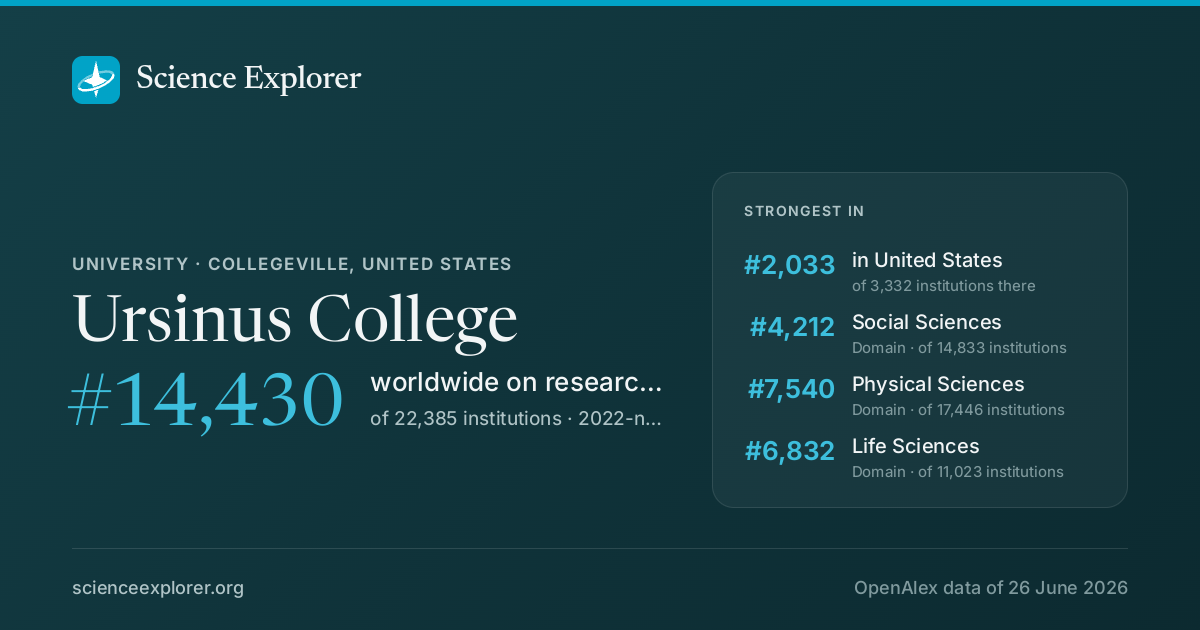
Ursinus College on Science Explorer

A card with Ursinus College's standing and the fields it leads in, for a post or a slide. A link to this page previews as the same card.

Download the card

1200 × 630 PNG, sized for social posts, drawn from the latest snapshot.

Badges for a website1Each links back here and updates with every snapshot

Research measures only: rankings here say nothing about teaching, admissions or student experience. Comparable institutions and collaboration partners have tabs of their own, above.

Discussion

Ask a question or share a note about Ursinus College. Keep it to the research: no personal attacks, advertising or links. Any reader can report a post, which collapses it for everyone until it is opened.
