Science Explorer Back to mapMap
Discussion
Hospital / health system · Melbourne · Australia

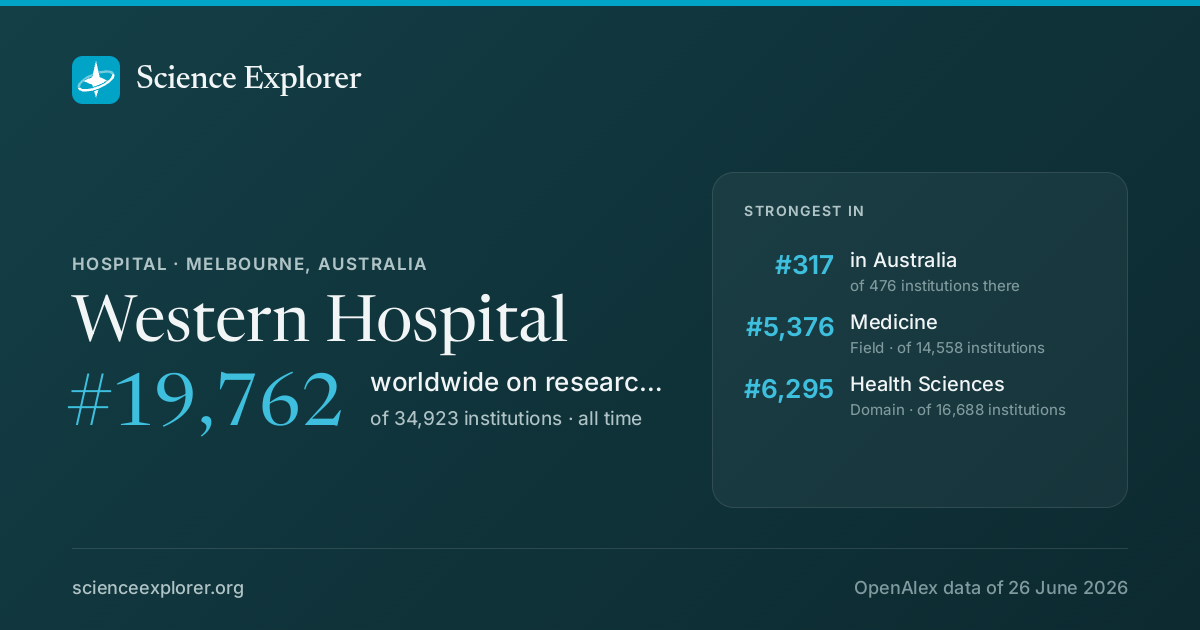
Western Hospital

In research, Western Hospital stands highest in Medicine (#5,376 of 14,558 worldwide) and Health Sciences (#6,295 of 16,688 worldwide), over all time. Relative to its size it is most specialised in Medicine (Medicine is 4.2× its share of world research).

World rank, all time
#19,762
of 34,923
Rank in Australia
#317
of 476
Research works
558
▼ 8% vs 2018-21
Citations
16k
28.5 per fractional work
Top-10% rate
7.5%
all institutions 10.0%
vs its own fields
0.86×
1.00× is exactly expected
Open access
32%
world 40%
International
24%
world 18%

What is Western Hospital known for in research?

The fields where it stands highest, over all time, ranked among every institution above the floor in each field.

FieldWorld rankWhere that sitsTop-10% rateWorks
MedicineField #5,376 of 14,558 8.3%416
Health SciencesDomain #6,295 of 16,688 8.1%455

Each strip is that field's whole ranked pool, with the notch where Western Hospital sits in it, in the colour of the band that rank falls in. The track under the rate is the rate itself: it carries no average mark, because the average differs by field (from about 6% in Dentistry to 21% in Economics).

Which fields of science does Western Hospital work in?

In 2022-now, 86% of research at Western Hospital is in Health Sciences, 8% in Life Sciences. Its largest fields are Medicine (81%), Biochemistry, Genetics and Molecular Biology (5%), Neuroscience (3%). It does 2.9× the world's share of Health Sciences.

Health Sciences: 24 fractional works · 85.8% of its workMedicine: 23 fractional works · 81.4% of its workSurgery: 5 fractional works · 16.9% of its workPulmonary and Respiratory Medicine: 2 fractional works · 8.3% of its workEpidemiology: 2 fractional works · 5.8% of its workNeurology: 1 fractional works · 5.2% of its workRadiology, Nuclear Medicine and Imaging: 1 fractional works · 4.2% of its workInfectious Diseases: 1 fractional works · 4.1% of its workRheumatology: 1 fractional works · 3.7% of its workOncology: 1 fractional works · 3.5% of its workEmergency Medicine: 1 fractional works · 2.6% of its workCardiology and Cardiovascular Medicine: 1 fractional works · 2.5% of its workPhysiology: 1 fractional works · 2.3% of its workPublic Health, Environmental and Occupational Health: 1 fractional works · 2.2% of its workGastroenterology: 1 fractional works · 2.1% of its workPathology and Forensic Medicine: 1 fractional works · 1.8% of its workOrthopedics and Sports Medicine: 0 fractional works · 1.6% of its workGenetics: 0 fractional works · 1.4% of its workCritical Care and Intensive Care Medicine: 0 fractional works · 1.3% of its workPsychiatry and Mental health: 0 fractional works · 1.3% of its workUrology: 0 fractional works · 1.3% of its workAnesthesiology and Pain Medicine: 0 fractional works · 1.2% of its workNephrology: 0 fractional works · 1.1% of its workEndocrinology, Diabetes and Metabolism: 0 fractional works · 0.9% of its workRehabilitation: 0 fractional works · 0.9% of its workHematology: 0 fractional works · 0.9% of its workPediatrics, Perinatology and Child Health: 0 fractional works · 0.8% of its workOtorhinolaryngology: 0 fractional works · 0.8% of its workComplementary and alternative medicine: 0 fractional works · 0.6% of its workFamily Practice: 0 fractional works · 0.4% of its workHepatology: 0 fractional works · 0.4% of its workOphthalmology: 0 fractional works · 0.4% of its workObstetrics and Gynecology: 0 fractional works · 0.3% of its workBiochemistry: 0 fractional works · 0.2% of its workSmaller subfields together: 0 fractional works · 0.6% of its workHealth Professions: 1 fractional works · 2.8% of its workGeneral Health Professions: 0 fractional works · 1.7% of its workEmergency Medical Services: 0 fractional works · 0.4% of its workHealth Information Management: 0 fractional works · 0.4% of its workOccupational Therapy: 0 fractional works · 0.4% of its workNursing: 0 fractional works · 1.1% of its workNutrition and Dietetics: 0 fractional works · 1.1% of its workVeterinary: 0 fractional works · 0.6% of its workEquine: 0 fractional works · 0.6% of its workLife Sciences: 2 fractional works · 8.4% of its workBiochemistry, Genetics and Molecular Biology: 1 fractional works · 5.0% of its workMolecular Biology: 1 fractional works · 2.5% of its workCell Biology: 0 fractional works · 0.8% of its workEndocrinology: 0 fractional works · 0.8% of its workGenetics: 0 fractional works · 0.6% of its workCancer Research: 0 fractional works · 0.2% of its workSmaller subfields together: 0 fractional works · 0.0% of its workNeuroscience: 1 fractional works · 3.2% of its workCognitive Neuroscience: 0 fractional works · 1.6% of its workSensory Systems: 0 fractional works · 0.6% of its workCellular and Molecular Neuroscience: 0 fractional works · 0.5% of its workEndocrine and Autonomic Systems: 0 fractional works · 0.5% of its workSmaller subfields together: 0 fractional works · 0.1% of its workAgricultural and Biological Sciences: 0 fractional works · 0.2% of its workPhysical Sciences: 1 fractional works · 3.0% of its workEngineering: 0 fractional works · 1.7% of its workBiomedical Engineering: 0 fractional works · 1.1% of its workElectrical and Electronic Engineering: 0 fractional works · 0.6% of its workChemistry: 0 fractional works · 0.7% of its workOrganic Chemistry: 0 fractional works · 0.7% of its workComputer Science: 0 fractional works · 0.2% of its workComputational Theory and Mathematics: 0 fractional works · 0.2% of its workMaterials Science: 0 fractional works · 0.2% of its workBiomaterials: 0 fractional works · 0.2% of its workEarth and Planetary Sciences: 0 fractional works · 0.2% of its workSocial Sciences: 1 fractional works · 2.8% of its workPsychology: 1 fractional works · 1.9% of its workClinical Psychology: 0 fractional works · 1.3% of its workExperimental and Cognitive Psychology: 0 fractional works · 0.6% of its workEconomics, Econometrics and Finance: 0 fractional works · 0.6% of its workEconomics and Econometrics: 0 fractional works · 0.4% of its workSmaller subfields together: 0 fractional works · 0.2% of its workSocial Sciences: 0 fractional works · 0.3% of its workGender Studies: 0 fractional works · 0.2% of its workSmaller subfields together: 0 fractional works · 0.0% of its workArts and Humanities: 0 fractional works · 0.1% of its workALL ITS WORKWestern Hospital28fractional works, 2022-now
Life Sciences8%Physical Sciences3%Health Sciences86%Social Sciences3%

Each ring splits the one inside it: the four domains of science, their fields, their subfields. Size is fractional works in 2022-now. Every slice is a page; the interactive view zooms down to single topics and colours each by how much more of it this institution does than the world.

Its 4 domains and 16 fields, with their numbers
    1. Medicine2381.4%
    2. Health Professions12.8%
    3. Nursing01.1%
    4. Veterinary00.6%
    1. Biochemistry, Genetics and Molecular Biology15.0%
    2. Neuroscience13.2%
    3. Agricultural and Biological Sciences00.2%
    1. Engineering01.7%
    2. Chemistry00.7%
    3. Computer Science00.2%
    4. Materials Science00.2%
    5. Earth and Planetary Sciences00.2%
    1. Psychology11.9%
    2. Economics, Econometrics and Finance00.6%
    3. Social Sciences00.3%
    4. Arts and Humanities00.1%
All of science, and how each field's share has moved since 1950: the Science domain explorer

What does Western Hospital specialise in?

Where its research is concentrated relative to its size: Medicine takes 4.2× the share of its output that it takes of world research.

  1. MedicineField · 23.2 works4.2×
← less than its size predicts1×more →

Location quotient, a volume reading rather than an impact one. It surfaces small, lopsided specialities.

Field profile

Location quotient across every field it publishes in: outside the ring is more than an institution of this size would be expected to publish, inside it is less.

Agricultural and Biological Sciences: 0.04× its world share, 0 worksAgricultural and Bio…Biochemistry, Genetics and Molecular Biology: 0.93× its world share, 1 worksBiochemistry, Geneti…Neuroscience: 1.98× its world share, 1 worksNeuroscienceChemistry: 0.43× its world share, 0 worksChemistryComputer Science: 0.03× its world share, 0 worksComputer ScienceEarth and Planetary Sciences: 0.12× its world share, 0 worksEarth and Planetary …Engineering: 0.11× its world share, 0 worksEngineeringMaterials Science: 0.07× its world share, 0 worksMaterials ScienceHealth Professions: 1.09× its world share, 1 worksHealth ProfessionsMedicine: 4.23× its world share, 23 worksMedicineNursing: 2.13× its world share, 0 worksNursingVeterinary: 4.31× its world share, 0 worksVeterinaryArts and Humanities: 0.03× its world share, 0 worksArts and HumanitiesEconomics, Econometrics and Finance: 0.26× its world share, 0 worksEconomics, Econometr…Psychology: 0.61× its world share, 0 worksPsychologySocial Sciences: 0.02× its world share, 0 worksSocial Sciences1×world share
more than its size predictsabout as predictedless

Rings at 0.5×, 1× and 2×. Widest outward: Veterinary, 4.3×. Every wedge is a field page.

All 16 fields, with their numbers
  1. Veterinary4.31×0 works
  2. Medicine4.23×23 works
  3. Nursing2.13×0 works
  4. Neuroscience1.98×1 works
  5. Health Professions1.09×1 works
  6. Biochemistry, Genetics and Molecular Biology0.93×1 works
  7. Psychology0.61×0 works
  8. Chemistry0.43×0 works
  9. Economics, Econometrics and Finance0.26×0 works
  10. Earth and Planetary Sciences0.12×0 works
  11. Engineering0.11×0 works
  12. Materials Science0.07×0 works
  13. Agricultural and Biological Sciences0.04×0 works
  14. Computer Science0.03×0 works
  15. Arts and Humanities0.03×0 works
  16. Social Sciences0.02×0 works

Who are the top researchers at Western Hospital?

Ranked on the quality score, Ian Kronborg, Adrian Hall and Paul Older lead among researchers whose main affiliation is Western Hospital.

  1. 1 Ian Kronborg Australia · #957,813 worldwide 3.2k citations · 62 works
  2. 2 Adrian Hall Australia · #1,193,589 worldwide 1.7k citations · 31 works
  3. 3 Paul Older Australia · #2,238,531 worldwide 1.7k citations · 31 works
  4. 4 Chris Dow Australia · #2,330,966 worldwide 707 citations · 20 works
  5. 5 Harry Teichtahl Australia · #2,500,767 worldwide 2.2k citations · 44 works
  6. 6 Yean Leng Lim Australia · #2,570,717 worldwide 1.1k citations · 49 works
  7. 7 Pamela Rosengarten Australia · #3,657,144 worldwide 307 citations · 16 works
  8. 8 Richard L. Travers Australia · #3,705,964 worldwide 476 citations · 33 works
  9. 9 Julian Vahrman Australia · #3,896,405 worldwide 256 citations · 19 works
  10. 10 Kevin W. Bell Australia · #3,967,318 worldwide 218 citations · 15 works
All ranked researchers at Western Hospital

What are the most cited papers from Western Hospital?

The most cited paper from Western Hospital is "Surviving Sepsis Campaign: International Guidelines for Management of Sepsis and Septic Shock: 2016" (Andrew Rhodes et al., 2017), with 6,868 citations. Next come "Endovascular Therapy for Ischemic Stroke with Perfusion-Imaging Selection" (5,898) and "Detection of Circulating Tumor DNA in Early- and Late-Stage Human Malignancies" (5,211).

Most cited papers
#PaperReleasedCitations
1 Surviving Sepsis Campaign: International Guidelines for Management of Sepsis and Septic Shock: 2016 Andrew Rhodes et al. · Intensive Care Medicine Open access 18 Jan 2017 6,868
2 Endovascular Therapy for Ischemic Stroke with Perfusion-Imaging Selection Bruce C.V. Campbell et al. · New England Journal of Medicine Open access 11 Feb 2015 5,898
3 Detection of Circulating Tumor DNA in Early- and Late-Stage Human Malignancies Chetan Bettegowda et al. · Science Translational Medicine Open access 19 Feb 2014 5,211
4 Genome-wide association study identifies novel breast cancer susceptibility loci Douglas F. Easton et al. · Nature Open access239 authors 27 May 2007 2,342
5 Diabetes research and clinical practice James Dunbar, Prasuna Reddy, Kevin Mc Namara et al. · Diabetes Research and Clinical Practice 30 Jun 2010 1,267
All 59 most cited papers, with filters and sorting

Which research topics does Western Hospital publish most on?

By volume in 2022-now: SARS-CoV-2 and COVID-19 Research, Interstitial Lung Diseases and Idiopathic Pulmonary Fibrosis, Pancreatic and Hepatic Oncology Research and Total Knee Arthroplasty Outcomes.

  1. 1 SARS-CoV-2 and COVID-19 Research Infectious Diseases 0 works
  2. 2 Interstitial Lung Diseases and Idiopathic Pulmonary Fibrosis Pulmonary and Respiratory Medicine 0 works
  3. 3 Pancreatic and Hepatic Oncology Research Oncology 0 works
  4. 4 Total Knee Arthroplasty Outcomes Surgery 0 works
  5. 5 Medical Imaging and Pathology Studies Pulmonary and Respiratory Medicine 0 works
  6. 6 Congenital Heart Disease Studies Epidemiology 0 works
  7. 7 Neuroendocrine Tumor Research Advances Epidemiology 0 works
  8. 8 Reconstructive Facial Surgery Techniques Surgery 0 works
  9. 9 Neuroblastoma Research and Treatments Neurology 0 works
  10. 10 Chronic Lymphocytic Leukemia Research Genetics 0 works

How open and international is its research?

Against the world's own shares: the tick on each track. Both are shares of its output, so they sit on one scale and can be read against each other as well as against the world.

openly available31.6%not open68.4%

World: 40% of research is openly available.

with international co-authors23.9%domestic only76.1%

World: 18% is written across borders.

How has Western Hospital's research output changed?

Output in 2022-2025 was 8% lower than in 2018-2021.

still counting1990200020102020
grewheldshrank

The same series as a ribbon: one cell per year, darker for more. The line above answers how much; this answers when.

Its share of all research

Growing output can still be a shrinking share: all of science grows. This is Western Hospital as a percentage of every work published that year, 0.00021% in 2024.

still counting0.0010%0.0020%Western Hospital0.000088% in 202519801990200020102020

Fractional works of Western Hospital over all fractional works that year. How the balance of science has shifted.

How much of it reaches the world top 10%

Year by year, against all institutions in the same year.

10%20%all institutions10.0% in 2014Western Hospital9.3% in 20142010

Of each year's output, the share that reached the world's 10% most cited for its field and year. Peak 15.9% in 2009.

Other research institutions in Melbourne

All research institutions in Melbourne

Share Western Hospital's ranking

Western Hospital on Science Explorer

A card with Western Hospital's standing and the fields it leads in, for a post or a slide. A link to this page previews as the same card.

Download the card

1200 × 630 PNG, sized for social posts, drawn from the latest snapshot.

Badges for a website1Each links back here and updates with every snapshot

Research measures only: rankings here say nothing about teaching, admissions or student experience. Comparable institutions and collaboration partners have tabs of their own, above.

Discussion

Ask a question or share a note about Western Hospital. Keep it to the research: no personal attacks, advertising or links. Any reader can report a post, which collapses it for everyone until it is opened.