Worcester Polytechnic Institute
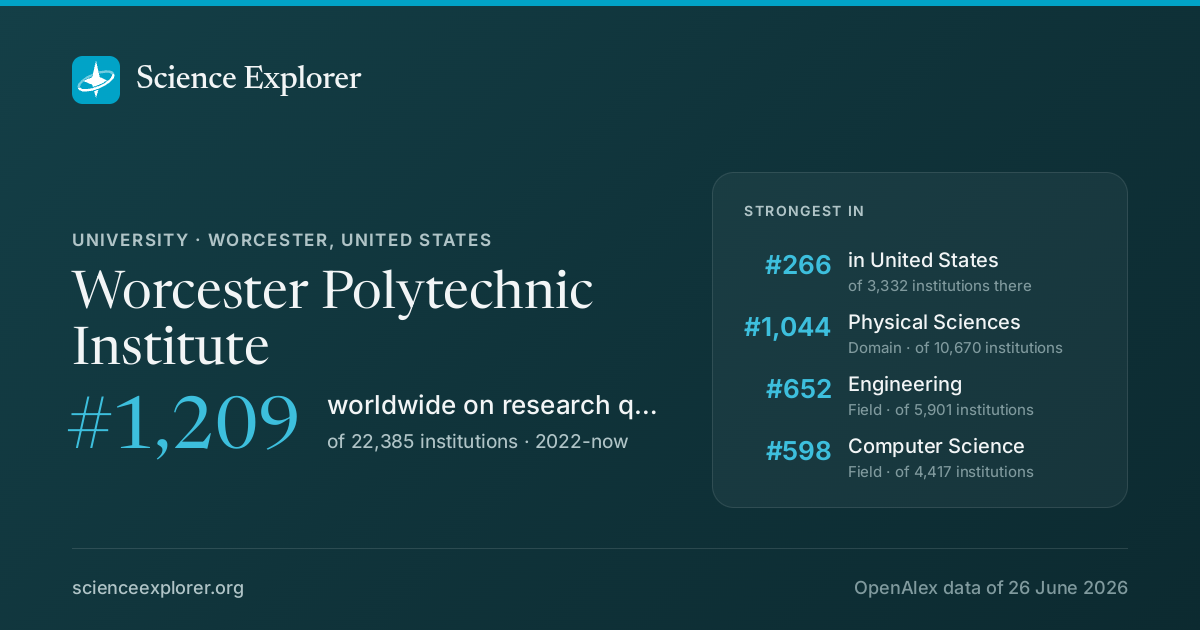
In research, Worcester Polytechnic Institute stands highest in Physical Sciences (#1,044 of 10,670 worldwide), Engineering (#652 of 5,901 worldwide) and Computer Science (#598 of 4,417 worldwide), 2022-now. Relative to its size it is most specialised in Human-Computer Interaction and Computer Science Applications (Human-Computer Interaction is 4.9× its share of world research).
- World rank, 2022-now
- #1,209 of 22,385 · #1,423 all time
- Rank in United States
- #266 of 3,332
- Research works
- 14k ▲ 3% vs 2018-21
- Citations
- 322k 23.4 per fractional work
- Top-10% rate
- 8.8% all institutions 10.0%
- vs its own fields
- 0.87× 1.00× is exactly expected
- Open access
- 24% world 40%
- International
- 13% world 18%
What is Worcester Polytechnic Institute known for in research?
The fields where it stands highest, 2022-now, ranked among every institution above the floor in each field.
| Field | World rank | Where that sits | Top-10% rate | Works | All time |
|---|---|---|---|---|---|
| Physical SciencesDomain | #1,044 of 10,670 | 7.2% | 1,312 | #1392 | |
| EngineeringField | #652 of 5,901 | 7.1% | 604 | #684 | |
| Computer ScienceField | #598 of 4,417 | 7.8% | 402 | #476 | |
| Health SciencesDomain | #1,509 of 9,902 | 11.4% | 190 | #1814 | |
| MedicineField | #1,509 of 8,541 | 11.7% | 160 | #1791 | |
| Social SciencesDomain | #1,819 of 9,585 | 14.0% | 370 | #1751 | |
| Life SciencesDomain | #1,478 of 6,403 | 7.3% | 173 | #1812 | |
| Social SciencesField | #2,001 of 5,988 | 12.9% | 144 | #2778 | |
| Electrical and Electronic EngineeringSubfield | #769 of 2,176 | 6.8% | 95 | #732 | |
| Environmental ScienceField | #1,192 of 3,334 | 7.6% | 86 | #1625 |
Each strip is that field's whole ranked pool, with the notch where Worcester Polytechnic Institute sits in it, in the colour of the band that rank falls in. The track under the rate is the rate itself: it carries no average mark, because the average differs by field (from about 6% in Dentistry to 21% in Economics).
Which of those standings moved
The same fields on both windows: where it stood over the whole record, and where it stands in 2022-now. The distance is the story, and it is the one thing the two rank columns above cannot show.
- Physical Sciences#1,392 #1,044
- Engineering#684 #652
- Computer Science#476 #598
- Health Sciences#1,814 #1,509
- Medicine#1,791 #1,509
- Social Sciences#1,751 #1,819
- Life Sciences#1,812 #1,478
- Social Sciences#2,778 #2,001
- Electrical and Electronic Engineering#732 #769
- Environmental Science#1,625 #1,192
A dot further right is a better standing. Fields it was not ranked in over the whole record are left out.
Which fields of science does Worcester Polytechnic Institute work in?
In 2022-now, 64% of research at Worcester Polytechnic Institute is in Physical Sciences, 18% in Social Sciences. Its largest fields are Engineering (29%), Computer Science (20%), Medicine (8%). It does 1.6× the world's share of Physical Sciences.
Each ring splits the one inside it: the four domains of science, their fields, their subfields. Size is fractional works in 2022-now. Every slice is a page; the interactive view zooms down to single topics and colours each by how much more of it this institution does than the world.
Its 4 domains and 26 fields, with their numbers
- Physical Sciences1,48664.2%
- Engineering67029.0%
- Computer Science45919.8%
- Environmental Science944.1%
- Materials Science944.1%
- Mathematics512.2%
- Physics and Astronomy502.2%
- Chemistry231.0%
- Chemical Engineering200.9%
- Energy140.6%
- Earth and Planetary Sciences110.5%
- Social Sciences41317.8%
- Social Sciences1606.9%
- Psychology783.4%
- Business, Management and Accounting562.4%
- Decision Sciences462.0%
- Economics, Econometrics and Finance431.9%
- Arts and Humanities311.3%
- Health Sciences2169.3%
- Medicine1827.9%
- Health Professions271.2%
- Nursing40.2%
- Dentistry20.1%
- Veterinary10.0%
- Life Sciences2008.6%
What does Worcester Polytechnic Institute specialise in?
Where its research is concentrated relative to its size: Human-Computer Interaction takes 4.9× the share of its output that it takes of world research.
- Human-Computer InteractionSubfield · 23.5 works4.9×
- Computer Science ApplicationsSubfield · 27.9 works4.9×
Location quotient, a volume reading rather than an impact one. It surfaces small, lopsided specialities.
Field profile
Location quotient across every field it publishes in: outside the ring is more than an institution of this size would be expected to publish, inside it is less.
Rings at 0.5×, 1× and 2×. Widest outward: Computer Science, 2.5×. Every wedge is a field page.
All 26 fields, with their numbers
- Computer Science2.55×459 works
- Chemical Engineering2.44×20 works
- Decision Sciences2.06×46 works
- Engineering1.93×670 works
- Mathematics1.86×51 works
- Materials Science1.17×94 works
- Neuroscience1.11×42 works
- Psychology1.10×78 works
- Physics and Astronomy0.97×50 works
- Economics, Econometrics and Finance0.87×43 works
- Biochemistry, Genetics and Molecular Biology0.86×106 works
- Environmental Science0.82×94 works
- Business, Management and Accounting0.75×56 works
- Energy0.65×14 works
- Chemistry0.63×23 works
- Social Sciences0.55×160 works
- Pharmacology, Toxicology and Pharmaceutics0.53×4 works
- Arts and Humanities0.46×30 works
- Health Professions0.44×27 works
- Medicine0.41×182 works
- Nursing0.38×4 works
- Agricultural and Biological Sciences0.37×41 works
- Immunology and Microbiology0.31×7 works
- Earth and Planetary Sciences0.31×11 works
- Veterinary0.21×1 works
- Dentistry0.16×2 works
- Computer Science 2.5×
- Chemical Engineering 2.4×
- Decision Sciences 2.1×
- Engineering 1.9×
- Mathematics 1.9×
- Materials Science 1.2×
- Neuroscience 1.1×
- Psychology 1.1×
- Physics and Astronomy 1.0×
- Economics, Econometrics and Finance 0.9×
- Biochemistry, Genetics and Molecular Biology 0.9×
- Environmental Science 0.8×
- Business, Management and Accounting 0.8×
- Energy 0.7×
- Chemistry 0.6×
- Social Sciences 0.6×
- Pharmacology, Toxicology and Pharmaceutics 0.5×
- Arts and Humanities 0.5×
- Health Professions 0.4×
- Medicine 0.4×
- Nursing 0.4×
- Agricultural and Biological Sciences 0.4×
- Immunology and Microbiology 0.3×
- Earth and Planetary Sciences 0.3×
- Veterinary 0.2×
- Dentistry 0.2×
Who are the top researchers at Worcester Polytechnic Institute?
Ranked on the quality score, Joseph Sarkis, Joe Zhu and D. Tao lead among researchers whose main affiliation is Worcester Polytechnic Institute.
- 1
Joseph Sarkis
 United States · #708 worldwide
82k citations · 687 works
- 2
Joe Zhu
United States · #35,899 worldwide
26k citations · 316 works
- 3
D. Tao
United States · #38,181 worldwide
13k citations · 90 works
- 4
Qingyun Zhu
United States · #73,919 worldwide
3.8k citations · 56 works
- 5
Mahtab Kouhizadeh
United States · #103,339 worldwide
8.2k citations · 30 works
- 6
Berk Sunar
United States · #124,922 worldwide
8.5k citations · 207 works
- 7
Yan Wang
United States · #193,428 worldwide
16k citations · 551 works
- 8
Xiaotu Ma
United States · #209,356 worldwide
4.1k citations · 66 works
- 9
Cagdas Denizel Onal
United States · #232,759 worldwide
7.5k citations · 143 works
- 10
Robert William Thompson
United States · #239,386 worldwide
16k citations · 309 works
Which keywords describe research at Worcester Polytechnic Institute?
By fractional works in 2022-now, weighted toward what it does more of than the world: Deep Learning, Machine Learning, Neural Networks, Mechanical Properties, Metal Recovery, Biomedical Applications, Microstructure and Lithium-ion Batteries.
- Massive Open Online Courses
- Side-Channel Attacks
- Tunnel Fires
- Biomedical Engineering
- Fluid Dynamics
- Minimally Invasive Surgery
- Bioinspired Robotics
- Battery Recycling
- Multi-Agent Systems
- Robotics
- Security Analysis
- Learning Analytics
- Robotic Manipulators
- Energy Storage
- Student Engagement
- Lithium-ion Batteries
- Microstructure
- Sustainability
- Mechanical Properties
- Machine Learning
- Deep Learning
- Neural Networks
- Biomedical Applications
- Environmental Impact
- Big Data
- Metal Recovery
- Convolutional Neural Networks
- Circular Economy
- Recycling
- Additive Manufacturing
- Rare Earth Elements
- Soft Robotics
- Sustainable Technology
- Hydrometallurgical Processes
- Continuum Robots
- Engineering Education
- Wearable Sensors
- Smoke Control
- Bayesian Networks
- Educational Data Mining
Size is fractional works in 2022-now in the topics tagged with each word; colour is the word's share of this institution's work against its share of the world's. The 40 words are chosen for being large and distinctive. Each links to the topic it comes from most.
All 40 words, with their numbers
- Deep Learning192▲ 2.4×75 topics
- Machine Learning138▲ 1.79×75 topics
- Neural Networks88▲ 2.5×35 topics
- Mechanical Properties65▲ 2.9×31 topics
- Biomedical Applications58▲ 2.1×29 topics
- Sustainability52◆ 0.92×58 topics
- Environmental Impact43◆ 1.09×40 topics
- Microstructure41▲ 3.4×17 topics
- Big Data38▲ 1.73×19 topics
- Lithium-ion Batteries37▲ 3.9×4 topics
- Metal Recovery36▲ 8.1×3 topics
- Student Engagement36▲ 4.0×12 topics
- Convolutional Neural Networks32▲ 1.90×14 topics
- Energy Storage31▲ 2.0×11 topics
- Circular Economy30▲ 4.8×5 topics
- Robotic Manipulators26▲ 11×3 topics
- Recycling26▲ 2.9×9 topics
- Learning Analytics23▲ 8.1×2 topics
- Additive Manufacturing22▲ 3.1×7 topics
- Security Analysis22▲ 5.6×4 topics
- Rare Earth Elements21▲ 6.1×4 topics
- Robotics20▲ 3.5×7 topics
- Soft Robotics20▲ 11×2 topics
- Multi-Agent Systems19▲ 4.4×5 topics
- Sustainable Technology19▲ 7.3×2 topics
- Battery Recycling19▲ 10×1 topic
- Hydrometallurgical Processes19▲ 10×1 topic
- Bioinspired Robotics18▲ 22×1 topic
- Continuum Robots18▲ 22×1 topic
- Minimally Invasive Surgery18▲ 13×2 topics
- Engineering Education17▲ 8.6×5 topics
- Fluid Dynamics17▲ 5.2×4 topics
- Wearable Sensors17▲ 6.5×3 topics
- Biomedical Engineering17▲ 5.2×2 topics
- Smoke Control16▲ 27×1 topic
- Tunnel Fires16▲ 27×1 topic
- Bayesian Networks15▲ 7.2×3 topics
- Side-Channel Attacks15▲ 13×3 topics
- Educational Data Mining15▲ 7.5×1 topic
- Massive Open Online Courses15▲ 7.5×1 topic
Which research topics does Worcester Polytechnic Institute publish most on?
By volume in 2022-now: Extraction and Separation Processes, Soft Robotics and Applications, Fire dynamics and safety research and Online Learning and Analytics.
Area is fractional works; colour is the subfield each topic belongs to.
- 1 Extraction and Separation Processes Mechanical Engineering 19 works
- 2 Soft Robotics and Applications Biomedical Engineering 18 works
- 3 Fire dynamics and safety research Safety, Risk, Reliability and Quality 16 works
- 4 Online Learning and Analytics Computer Science Applications 15 works
- 5 Recycling and Waste Management Techniques Industrial and Manufacturing Engineering 14 works
- 6 Advancements in Battery Materials Electrical and Electronic Engineering 13 works
- 7 Intelligent Tutoring Systems and Adaptive Learning Artificial Intelligence 13 works
- 8 Modular Robots and Swarm Intelligence Mechanical Engineering 12 works
- 9 Robotics and Sensor-Based Localization Aerospace Engineering 12 works
- 10 Anomaly Detection Techniques and Applications Artificial Intelligence 12 works
How open and international is its research?
Against the world's own shares: the tick on each track. Both are shares of its output, so they sit on one scale and can be read against each other as well as against the world.
World: 40% of research is openly available.
World: 18% is written across borders.
How has Worcester Polytechnic Institute's research output changed?
Output in 2022-2025 was 3% higher than in 2018-2021.
The same series as a ribbon: one cell per year, darker for more. The line above answers how much; this answers when.
Its share of all research
Growing output can still be a shrinking share: all of science grows. This is Worcester Polytechnic Institute as a percentage of every work published that year, 0.0091% in 2024.
Fractional works of Worcester Polytechnic Institute over all fractional works that year. How the balance of science has shifted.
How much of it reaches the world top 10%
Year by year, against all institutions in the same year.
Of each year's output, the share that reached the world's 10% most cited for its field and year. Peak 16.4% in 1997.
Other research institutions in Worcester
- University of Massachusetts Chan Medical School
- Clark University
- College of the Holy Cross
- UMass Memorial Health Care
- Worcester State University
- Saint Vincent Hospital
- Assumption College
- Worcester Memorial Hospital
Share Worcester Polytechnic Institute's ranking



Research measures only: rankings here say nothing about teaching, admissions or student experience. Comparable institutions and collaboration partners have tabs of their own, above.
Discussion
Ask a question or share a note about Worcester Polytechnic Institute. Posts are plain text and can be reported.