Yangon Technological University
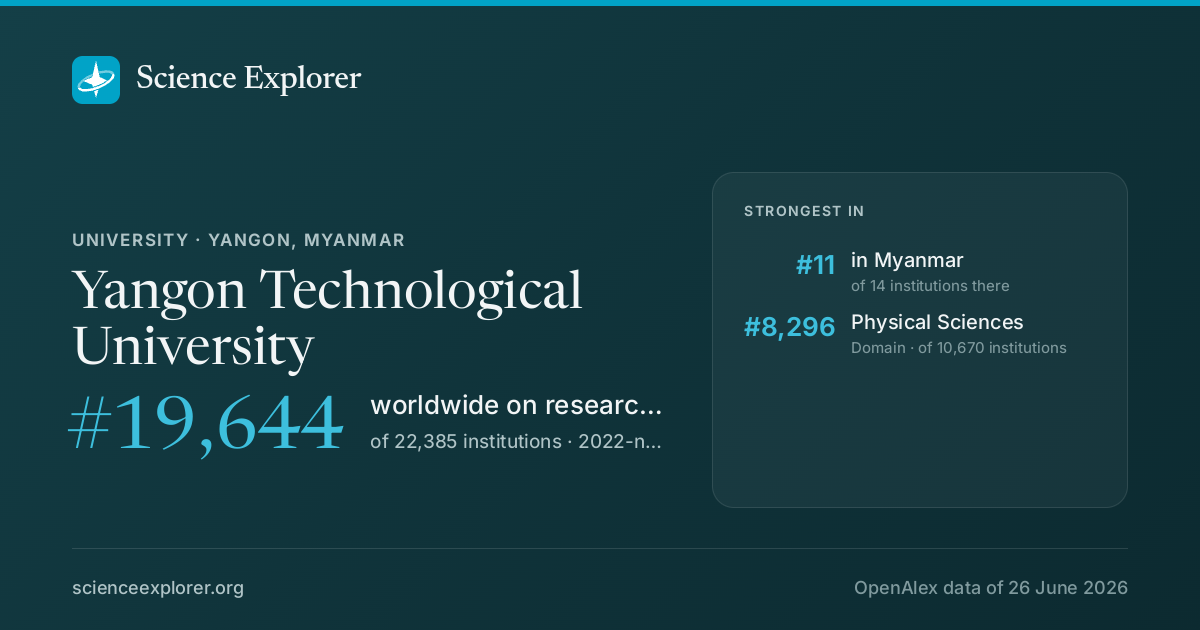
In research, Yangon Technological University stands highest in Physical Sciences (#8,296 of 10,670 worldwide), 2022-now.
- World rank, 2022-now
- #19,644 of 22,385 · #23,046 all time
- Rank in Myanmar
- #11 of 14
- Research works
- 345 ▼ 45% vs 2018-21
- Citations
- 2.2k 6.5 per fractional work
- Top-10% rate
- 3.8% all institutions 10.0%
- vs its own fields
- 0.91× 1.00× is exactly expected
- Open access
- 72% world 40%
- International
- 26% world 18%
What is Yangon Technological University known for in research?
The fields where it stands highest, 2022-now, ranked among every institution above the floor in each field.
| Field | World rank | Where that sits | Top-10% rate | Works | All time |
|---|---|---|---|---|---|
| Physical SciencesDomain | #8,296 of 10,670 | 2.5% | 77 | #10722 |
Each strip is that field's whole ranked pool, with the notch where Yangon Technological University sits in it, in the colour of the band that rank falls in. The track under the rate is the rate itself: it carries no average mark, because the average differs by field (from about 6% in Dentistry to 21% in Economics).
Which fields of science does Yangon Technological University work in?
In 2022-now, 82% of research at Yangon Technological University is in Physical Sciences, 7% in Health Sciences. Its largest fields are Engineering (54%), Computer Science (17%), Medicine (5%). It does 2.0× the world's share of Physical Sciences.
Each ring splits the one inside it: the four domains of science, their fields, their subfields. Size is fractional works in 2022-now. Every slice is a page; the interactive view zooms down to single topics and colours each by how much more of it this institution does than the world.
Its 4 domains and 22 fields, with their numbers
- Physical Sciences8181.8%
- Engineering5353.7%
- Computer Science1717.1%
- Environmental Science44.4%
- Energy43.5%
- Earth and Planetary Sciences21.6%
- Physics and Astronomy10.8%
- Chemistry00.4%
- Materials Science00.2%
- Chemical Engineering00.1%
- Health Sciences76.6%
- Medicine54.7%
- Health Professions21.5%
- Dentistry00.3%
- Nursing00.1%
- Life Sciences66.5%
- Social Sciences55.2%
- Social Sciences22.0%
- Business, Management and Accounting21.6%
- Decision Sciences11.1%
- Arts and Humanities00.4%
- Psychology00.1%
Field profile
Location quotient across every field it publishes in: outside the ring is more than an institution of this size would be expected to publish, inside it is less.
Rings at 0.5×, 1× and 2×. Widest outward: Energy, 3.8×. Every wedge is a field page.
All 22 fields, with their numbers
- Energy3.83×4 works
- Engineering3.58×53 works
- Computer Science2.19×17 works
- Neuroscience2.10×3 works
- Decision Sciences1.10×1 works
- Earth and Planetary Sciences1.00×2 works
- Environmental Science0.88×4 works
- Dentistry0.69×0 works
- Health Professions0.57×2 works
- Agricultural and Biological Sciences0.50×2 works
- Business, Management and Accounting0.50×2 works
- Pharmacology, Toxicology and Pharmaceutics0.48×0 works
- Physics and Astronomy0.38×1 works
- Chemistry0.26×0 works
- Chemical Engineering0.24×0 works
- Medicine0.24×5 works
- Social Sciences0.16×2 works
- Arts and Humanities0.15×0 works
- Biochemistry, Genetics and Molecular Biology0.10×0 works
- Nursing0.10×0 works
- Materials Science0.07×0 works
- Psychology0.02×0 works
- Energy 3.8×
- Engineering 3.6×
- Computer Science 2.2×
- Neuroscience 2.1×
- Decision Sciences 1.1×
- Earth and Planetary Sciences 1.0×
- Environmental Science 0.9×
- Dentistry 0.7×
- Health Professions 0.6×
- Agricultural and Biological Sciences 0.5×
- Business, Management and Accounting 0.5×
- Pharmacology, Toxicology and Pharmaceutics 0.5×
- Physics and Astronomy 0.4×
- Chemistry 0.3×
- Chemical Engineering 0.2×
- Medicine 0.2×
- Social Sciences 0.2×
- Arts and Humanities 0.1×
- Biochemistry, Genetics and Molecular Biology 0.1×
- Nursing 0.1×
- Materials Science 0.1×
- Psychology 0.0×
Who are the top researchers at Yangon Technological University?
Ranked on the quality score, Theint Theint Thu, Win Win Zin and Nyein Nyein Oo lead among researchers whose main affiliation is Yangon Technological University.
- 1
Theint Theint Thu
 Myanmar · #2,152,308 worldwide
216 citations · 21 works
- 2
Win Win Zin
Myanmar · #2,951,839 worldwide
727 citations · 39 works
- 3
Nyein Nyein Oo
Myanmar · #3,796,698 worldwide
128 citations · 20 works
- 4
Tun Naing
Myanmar · #3,906,392 worldwide
49 citations · 15 works
- 5
Mya Mya Aye
Myanmar · #4,002,751 worldwide
498 citations · 33 works
- 6
Khin Su Su Htwe
Myanmar · #4,521,742 worldwide
8 citations · 17 works
- 7
Thanda Win
Myanmar · #4,801,357 worldwide
72 citations · 16 works
- 8
Maung Maung Latt
Myanmar · #4,982,418 worldwide
125 citations · 20 works
- 9
Nyan Myint Kyaw
Myanmar · #5,049,004 worldwide
46 citations · 19 works
- 10
Moe Moe Lwin
Myanmar · #5,318,915 worldwide
28 citations · 23 works
Which keywords describe research at Yangon Technological University?
By fractional works in 2022-now, weighted toward what it does more of than the world: Deep Learning, Power Electronics, Renewable Energy Integration, Convolutional Neural Networks, Renewable Energy, Electric Vehicle Charging, DC-DC Converters and High-Frequency Power Conversion.
- Reinforced Concrete
- Maximum Power Point Tracking
- Thermal Runaway
- Monitoring System
- Recycled Materials
- Parameter Estimation
- Lithium-ion Batteries
- Wireless Communication
- Pavement
- Crack Detection
- Voltage Source Inverters
- Machine Vision
- Solar Energy
- Feature Extraction
- Model Predictive Control
- High-Frequency Power Conversion
- DC-DC Converters
- Convolutional Neural Networks
- Machine Learning
- Power Electronics
- Deep Learning
- Renewable Energy Integration
- Renewable Energy
- Electric Vehicle Charging
- Energy Efficiency
- Image Processing
- Classification
- Photovoltaic Systems
- Data Mining
- Multilevel Converters
- Artificial Neural Networks
- Electric Vehicles
- Convolutional Neural Network
- Brain Tumor
- MRI
- Thermal Analysis
- Battery Management Systems
- Neural Network
- Computer Vision
- Photovoltaic Arrays
Size is fractional works in 2022-now in the topics tagged with each word; colour is the word's share of this institution's work against its share of the world's. The 40 words are chosen for being large and distinctive. Each links to the topic it comes from most.
All 40 words, with their numbers
- Deep Learning15▲ 4.3×32 topics
- Power Electronics8▲ 27×5 topics
- Renewable Energy Integration8▲ 23×4 topics
- Machine Learning7▲ 2.2×16 topics
- Renewable Energy6▲ 4.3×14 topics
- Convolutional Neural Networks6▲ 8.2×9 topics
- Electric Vehicle Charging4▲ 55×2 topics
- DC-DC Converters4▲ 77×1 topic
- Energy Efficiency4▲ 4.5×8 topics
- High-Frequency Power Conversion4▲ 77×1 topic
- Image Processing4▲ 9.5×5 topics
- Model Predictive Control3▲ 13×4 topics
- Classification3▲ 7.0×4 topics
- Feature Extraction3▲ 7.0×4 topics
- Photovoltaic Systems3▲ 35×2 topics
- Solar Energy3▲ 9.6×3 topics
- Data Mining3▲ 3.8×4 topics
- Machine Vision3▲ 13×5 topics
- Multilevel Converters3▲ 51×1 topic
- Voltage Source Inverters3▲ 51×1 topic
- Artificial Neural Networks2▲ 5.4×6 topics
- Crack Detection2▲ 36×1 topic
- Electric Vehicles2▲ 8.8×3 topics
- Pavement2▲ 36×1 topic
- Convolutional Neural Network2▲ 15×2 topics
- Wireless Communication2▲ 17×4 topics
- Brain Tumor2▲ 35×1 topic
- Lithium-ion Batteries2▲ 5.7×2 topics
- MRI2▲ 29×1 topic
- Parameter Estimation2▲ 19×2 topics
- Thermal Analysis2▲ 18×4 topics
- Recycled Materials2▲ 19×2 topics
- Battery Management Systems2▲ 14×1 topic
- Monitoring System2▲ 54×2 topics
- Neural Network2▲ 12×4 topics
- Thermal Runaway2▲ 14×1 topic
- Computer Vision2▲ 7.3×3 topics
- Maximum Power Point Tracking2▲ 37×1 topic
- Photovoltaic Arrays2▲ 37×1 topic
- Reinforced Concrete2▲ 23×2 topics
Which research topics does Yangon Technological University publish most on?
By volume in 2022-now: Advanced DC-DC Converters, Multilevel Inverters and Converters, Infrastructure Maintenance and Monitoring and Brain Tumor Detection and Classification.
Area is fractional works; colour is the subfield each topic belongs to.
- 1 Advanced DC-DC Converters Electrical and Electronic Engineering 4 works
- 2 Multilevel Inverters and Converters Electrical and Electronic Engineering 3 works
- 3 Infrastructure Maintenance and Monitoring Civil and Structural Engineering 2 works
- 4 Brain Tumor Detection and Classification Neurology 2 works
- 5 Advanced Battery Technologies Research Automotive Engineering 2 works
- 6 Photovoltaic System Optimization Techniques Renewable Energy, Sustainability and the Environment 2 works
- 7 Asphalt Pavement Performance Evaluation Civil and Structural Engineering 2 works
- 8 Advanced Neural Network Applications Computer Vision and Pattern Recognition 1 works
- 9 Structural Behavior of Reinforced Concrete Building and Construction 1 works
- 10 Induction Heating and Inverter Technology Mechanical Engineering 1 works
How open and international is its research?
Against the world's own shares: the tick on each track. Both are shares of its output, so they sit on one scale and can be read against each other as well as against the world.
World: 40% of research is openly available.
World: 18% is written across borders.
How has Yangon Technological University's research output changed?
Output in 2022-2025 was 45% lower than in 2018-2021.
The same series as a ribbon: one cell per year, darker for more. The line above answers how much; this answers when.
Its share of all research
Growing output can still be a shrinking share: all of science grows. This is Yangon Technological University as a percentage of every work published that year, 0.00061% in 2024.
Fractional works of Yangon Technological University over all fractional works that year. How the balance of science has shifted.
How much of it reaches the world top 10%
Year by year, against all institutions in the same year.
Of each year's output, the share that reached the world's 10% most cited for its field and year. Peak 8.9% in 2018.
Other research institutions in Yangon
- University of Dental Medicine
- Yangon University of Economics
- University Of Information Technology
- University of Computer Studies Yangon
- Yangon University Of Distance Education
- Ministry of Health
- University Of Medicine 1 Yangon
- University of Yangon
Share Yangon Technological University's ranking
Badges for a website1Each links back here and updates with every snapshot

Research measures only: rankings here say nothing about teaching, admissions or student experience. Comparable institutions and collaboration partners have tabs of their own, above.
Discussion
Ask a question or share a note about Yangon Technological University. Posts are plain text and can be reported.