Science Explorer Back to mapMap
Discussion
University · Yili · China

Yili Normal University

In research, Yili Normal University stands highest in Physical Sciences (#4,211 of 10,670 worldwide), Computer Science (#1,890 of 4,417 worldwide) and Life Sciences (#3,267 of 6,403 worldwide), 2022-now.

World rank, 2022-now
#5,261
of 22,385 · #8,075 all time
Rank in China
#779
of 2,481
Research works
1.9k
▲ 476% vs 2018-21
Citations
7.9k
4.2 per fractional work
Top-10% rate
9.8%
all institutions 10.0%
vs its own fields
0.92×
1.00× is exactly expected
Open access
26%
world 40%
International
5%
world 18%

What is Yili Normal University known for in research?

The fields where it stands highest, 2022-now, ranked among every institution above the floor in each field.

FieldWorld rankWhere that sitsTop-10% rateWorksAll time
Physical SciencesDomain #4,211 of 10,670 9.0%440 #7192
Computer ScienceField #1,890 of 4,417 7.9%94 #3039
Life SciencesDomain #3,267 of 6,403 12.7%86 #4794
EngineeringField #3,783 of 5,901 8.2%109 #7129
Environmental ScienceField #2,795 of 3,334 14.5%66 #3907
Social SciencesDomain #8,122 of 9,585 8.7%92 #11291

Each strip is that field's whole ranked pool, with the notch where Yili Normal University sits in it, in the colour of the band that rank falls in. The track under the rate is the rate itself: it carries no average mark, because the average differs by field (from about 6% in Dentistry to 21% in Economics).

Which of those standings moved

The same fields on both windows: where it stood over the whole record, and where it stands in 2022-now. The distance is the story, and it is the one thing the two rank columns above cannot show.

  1. Physical Sciences#7,192 #4,211
  2. Computer Science#3,039 #1,890
  3. Life Sciences#4,794 #3,267
  4. Engineering#7,129 #3,783
  5. Environmental Science#3,907 #2,795
  6. Social Sciences#11,291 #8,122
all time2022-now, better2022-now, worse

A dot further right is a better standing. Fields it was not ranked in over the whole record are left out.

Which fields of science does Yili Normal University work in?

In 2022-now, 66% of research at Yili Normal University is in Physical Sciences, 15% in Life Sciences. Its largest fields are Engineering (16%), Computer Science (14%), Environmental Science (10%). It does 1.7× the world's share of Physical Sciences.

Physical Sciences: 522 fractional works · 66.0% of its workEngineering: 126 fractional works · 16.0% of its workElectrical and Electronic Engineering: 41 fractional works · 5.1% of its workBiomedical Engineering: 26 fractional works · 3.3% of its workMechanical Engineering: 15 fractional works · 1.9% of its workControl and Systems Engineering: 8 fractional works · 1.1% of its workAerospace Engineering: 7 fractional works · 0.9% of its workCivil and Structural Engineering: 5 fractional works · 0.7% of its workBuilding and Construction: 5 fractional works · 0.6% of its workMedia Technology: 4 fractional works · 0.5% of its workOcean Engineering: 3 fractional works · 0.4% of its workMechanics of Materials: 3 fractional works · 0.4% of its workComputational Mechanics: 3 fractional works · 0.4% of its workIndustrial and Manufacturing Engineering: 2 fractional works · 0.3% of its workAutomotive Engineering: 2 fractional works · 0.3% of its workSmaller subfields together: 1 fractional works · 0.1% of its workComputer Science: 112 fractional works · 14.2% of its workArtificial Intelligence: 41 fractional works · 5.2% of its workComputer Networks and Communications: 22 fractional works · 2.8% of its workComputer Vision and Pattern Recognition: 16 fractional works · 2.1% of its workInformation Systems: 15 fractional works · 2.0% of its workComputational Theory and Mathematics: 7 fractional works · 0.9% of its workComputer Graphics and Computer-Aided Design: 5 fractional works · 0.6% of its workComputer Science Applications: 3 fractional works · 0.3% of its workSmaller subfields together: 3 fractional works · 0.4% of its workEnvironmental Science: 76 fractional works · 9.6% of its workWater Science and Technology: 18 fractional works · 2.2% of its workHealth, Toxicology and Mutagenesis: 17 fractional works · 2.2% of its workGlobal and Planetary Change: 10 fractional works · 1.3% of its workEcology: 9 fractional works · 1.1% of its workPollution: 6 fractional works · 0.7% of its workIndustrial and Manufacturing Engineering: 6 fractional works · 0.7% of its workEnvironmental Engineering: 4 fractional works · 0.5% of its workNature and Landscape Conservation: 2 fractional works · 0.3% of its workEnvironmental Chemistry: 2 fractional works · 0.3% of its workSmaller subfields together: 2 fractional works · 0.2% of its workMaterials Science: 67 fractional works · 8.5% of its workMaterials Chemistry: 43 fractional works · 5.4% of its workElectronic, Optical and Magnetic Materials: 13 fractional works · 1.7% of its workBiomaterials: 5 fractional works · 0.6% of its workPolymers and Plastics: 5 fractional works · 0.6% of its workSmaller subfields together: 2 fractional works · 0.2% of its workMathematics: 40 fractional works · 5.0% of its workApplied Mathematics: 12 fractional works · 1.5% of its workModeling and Simulation: 10 fractional works · 1.3% of its workMathematical Physics: 6 fractional works · 0.8% of its workGeometry and Topology: 3 fractional works · 0.4% of its workAlgebra and Number Theory: 2 fractional works · 0.3% of its workDiscrete Mathematics and Combinatorics: 2 fractional works · 0.3% of its workStatistics and Probability: 2 fractional works · 0.2% of its workNumerical Analysis: 2 fractional works · 0.2% of its workEnergy: 28 fractional works · 3.5% of its workRenewable Energy, Sustainability and the Environment: 26 fractional works · 3.3% of its workFuel Technology: 2 fractional works · 0.2% of its workChemistry: 26 fractional works · 3.3% of its workOrganic Chemistry: 10 fractional works · 1.3% of its workInorganic Chemistry: 6 fractional works · 0.8% of its workSpectroscopy: 3 fractional works · 0.4% of its workAnalytical Chemistry: 3 fractional works · 0.4% of its workElectrochemistry: 2 fractional works · 0.2% of its workSmaller subfields together: 1 fractional works · 0.1% of its workPhysics and Astronomy: 25 fractional works · 3.2% of its workAtomic and Molecular Physics, and Optics: 10 fractional works · 1.3% of its workStatistical and Nonlinear Physics: 9 fractional works · 1.1% of its workCondensed Matter Physics: 2 fractional works · 0.2% of its workSmaller subfields together: 4 fractional works · 0.6% of its workEarth and Planetary Sciences: 15 fractional works · 1.9% of its workAtmospheric Science: 5 fractional works · 0.7% of its workGeochemistry and Petrology: 5 fractional works · 0.6% of its workGeophysics: 4 fractional works · 0.5% of its workSmaller subfields together: 1 fractional works · 0.1% of its workChemical Engineering: 7 fractional works · 0.9% of its workCatalysis: 4 fractional works · 0.5% of its workSmaller subfields together: 3 fractional works · 0.4% of its workLife Sciences: 116 fractional works · 14.6% of its workAgricultural and Biological Sciences: 62 fractional works · 7.9% of its workPlant Science: 35 fractional works · 4.4% of its workFood Science: 6 fractional works · 0.8% of its workSoil Science: 5 fractional works · 0.7% of its workEcology, Evolution, Behavior and Systematics: 5 fractional works · 0.6% of its workAquatic Science: 4 fractional works · 0.4% of its workAgronomy and Crop Science: 3 fractional works · 0.4% of its workAnimal Science and Zoology: 2 fractional works · 0.3% of its workSmaller subfields together: 1 fractional works · 0.2% of its workBiochemistry, Genetics and Molecular Biology: 47 fractional works · 5.9% of its workMolecular Biology: 29 fractional works · 3.7% of its workGenetics: 7 fractional works · 0.9% of its workCell Biology: 3 fractional works · 0.4% of its workCancer Research: 2 fractional works · 0.3% of its workMolecular Medicine: 2 fractional works · 0.2% of its workSmaller subfields together: 4 fractional works · 0.5% of its workImmunology and Microbiology: 3 fractional works · 0.3% of its workImmunology: 2 fractional works · 0.3% of its workSmaller subfields together: 1 fractional works · 0.1% of its workPharmacology, Toxicology and Pharmaceutics: 2 fractional works · 0.3% of its workNeuroscience: 2 fractional works · 0.2% of its workSocial Sciences: 106 fractional works · 13.4% of its workSocial Sciences: 53 fractional works · 6.8% of its workEducation: 23 fractional works · 2.9% of its workSociology and Political Science: 15 fractional works · 1.9% of its workPolitical Science and International Relations: 4 fractional works · 0.5% of its workSafety Research: 2 fractional works · 0.3% of its workSmaller subfields together: 9 fractional works · 1.2% of its workBusiness, Management and Accounting: 19 fractional works · 2.4% of its workBusiness and International Management: 6 fractional works · 0.8% of its workStrategy and Management: 4 fractional works · 0.5% of its workAccounting: 3 fractional works · 0.4% of its workManagement of Technology and Innovation: 2 fractional works · 0.3% of its workOrganizational Behavior and Human Resource Management: 2 fractional works · 0.2% of its workSmaller subfields together: 2 fractional works · 0.2% of its workEconomics, Econometrics and Finance: 10 fractional works · 1.2% of its workEconomics and Econometrics: 7 fractional works · 0.9% of its workFinance: 3 fractional works · 0.3% of its workSmaller subfields together: 0 fractional works · 0.1% of its workPsychology: 10 fractional works · 1.2% of its workDevelopmental and Educational Psychology: 4 fractional works · 0.5% of its workSocial Psychology: 3 fractional works · 0.3% of its workClinical Psychology: 2 fractional works · 0.2% of its workSmaller subfields together: 2 fractional works · 0.2% of its workDecision Sciences: 8 fractional works · 1.1% of its workManagement Science and Operations Research: 7 fractional works · 0.8% of its workSmaller subfields together: 2 fractional works · 0.2% of its workArts and Humanities: 6 fractional works · 0.7% of its workArcheology: 2 fractional works · 0.2% of its workLiterature and Literary Theory: 2 fractional works · 0.2% of its workSmaller subfields together: 2 fractional works · 0.3% of its workHealth Sciences: 47 fractional works · 5.9% of its workMedicine: 34 fractional works · 4.3% of its workComplementary and alternative medicine: 9 fractional works · 1.2% of its workPublic Health, Environmental and Occupational Health: 7 fractional works · 0.8% of its workPharmacology: 4 fractional works · 0.5% of its workInfectious Diseases: 2 fractional works · 0.2% of its workPulmonary and Respiratory Medicine: 2 fractional works · 0.2% of its workSmaller subfields together: 10 fractional works · 1.3% of its workHealth Professions: 7 fractional works · 0.9% of its workPhysical Therapy, Sports Therapy and Rehabilitation: 5 fractional works · 0.6% of its workSmaller subfields together: 2 fractional works · 0.3% of its workNursing: 6 fractional works · 0.7% of its workNutrition and Dietetics: 5 fractional works · 0.7% of its workSmaller subfields together: 0 fractional works · 0.0% of its workDentistry: 0 fractional works · 0.0% of its workALL ITS WORKYili NormalUniversity791fractional works, 2022-now
Life Sciences15%Physical Sciences66%Health Sciences6%Social Sciences13%

Each ring splits the one inside it: the four domains of science, their fields, their subfields. Size is fractional works in 2022-now. Every slice is a page; the interactive view zooms down to single topics and colours each by how much more of it this institution does than the world.

Its 4 domains and 26 fields, with their numbers
    1. Engineering12616.0%
    2. Computer Science11214.2%
    3. Environmental Science769.6%
    4. Materials Science678.5%
    5. Mathematics405.0%
    6. Energy283.5%
    7. Chemistry263.3%
    8. Physics and Astronomy253.2%
    9. Earth and Planetary Sciences151.9%
    10. Chemical Engineering70.9%
    1. Agricultural and Biological Sciences627.9%
    2. Biochemistry, Genetics and Molecular Biology475.9%
    3. Immunology and Microbiology30.3%
    4. Pharmacology, Toxicology and Pharmaceutics20.3%
    5. Neuroscience20.2%
    1. Social Sciences536.8%
    2. Business, Management and Accounting192.4%
    3. Economics, Econometrics and Finance101.2%
    4. Psychology101.2%
    5. Decision Sciences81.1%
    6. Arts and Humanities60.7%
    1. Medicine344.3%
    2. Health Professions70.9%
    3. Nursing60.7%
    4. Dentistry00.0%
    5. Veterinary00.0%
All of science, and how each field's share has moved since 1950: the Science domain explorer

Field profile

Location quotient across every field it publishes in: outside the ring is more than an institution of this size would be expected to publish, inside it is less.

Agricultural and Biological Sciences: 1.66× its world share, 62 worksAgricultural and Bio…Biochemistry, Genetics and Molecular Biology: 1.11× its world share, 47 worksBiochemistry, Geneti…Immunology and Microbiology: 0.35× its world share, 3 worksImmunology and Micro…Neuroscience: 0.14× its world share, 2 worksNeurosciencePharmacology, Toxicology and Pharmaceutics: 0.74× its world share, 2 worksPharmacology, Toxico…Chemical Engineering: 2.50× its world share, 7 worksChemical EngineeringChemistry: 2.10× its world share, 26 worksChemistryComputer Science: 1.83× its world share, 112 worksComputer ScienceEarth and Planetary Sciences: 1.19× its world share, 15 worksEarth and Planetary …Energy: 3.78× its world share, 28 worksEnergyEngineering: 1.06× its world share, 126 worksEngineeringEnvironmental Science: 1.93× its world share, 76 worksEnvironmental ScienceMaterials Science: 2.43× its world share, 67 worksMaterials ScienceMathematics: 4.25× its world share, 40 worksMathematicsPhysics and Astronomy: 1.43× its world share, 25 worksPhysics and AstronomyDentistry: 0.08× its world share, 0 worksDentistryHealth Professions: 0.32× its world share, 7 worksHealth ProfessionsMedicine: 0.22× its world share, 34 worksMedicineNursing: 1.48× its world share, 6 worksNursingVeterinary: 0.08× its world share, 0 worksVeterinaryArts and Humanities: 0.25× its world share, 6 worksArts and HumanitiesBusiness, Management and Accounting: 0.74× its world share, 19 worksBusiness, Management…Decision Sciences: 1.11× its world share, 8 worksDecision SciencesEconomics, Econometrics and Finance: 0.58× its world share, 10 worksEconomics, Econometr…Psychology: 0.41× its world share, 10 worksPsychologySocial Sciences: 0.53× its world share, 53 worksSocial Sciences1×world share
more than its size predictsabout as predictedless

Rings at 0.5×, 1× and 2×. Widest outward: Mathematics, 4.2×. Every wedge is a field page.

All 26 fields, with their numbers
  1. Mathematics4.25×40 works
  2. Energy3.78×28 works
  3. Chemical Engineering2.50×7 works
  4. Materials Science2.43×67 works
  5. Chemistry2.10×26 works
  6. Environmental Science1.93×76 works
  7. Computer Science1.83×112 works
  8. Agricultural and Biological Sciences1.66×62 works
  9. Nursing1.48×6 works
  10. Physics and Astronomy1.43×25 works
  11. Earth and Planetary Sciences1.19×15 works
  12. Biochemistry, Genetics and Molecular Biology1.11×47 works
  13. Decision Sciences1.11×8 works
  14. Engineering1.06×126 works
  15. Pharmacology, Toxicology and Pharmaceutics0.74×2 works
  16. Business, Management and Accounting0.74×19 works
  17. Economics, Econometrics and Finance0.58×10 works
  18. Social Sciences0.53×53 works
  19. Psychology0.41×10 works
  20. Immunology and Microbiology0.35×3 works
  21. Health Professions0.32×7 works
  22. Arts and Humanities0.25×6 works
  23. Medicine0.22×34 works
  24. Neuroscience0.14×2 works
  25. Dentistry0.08×0 works
  26. Veterinary0.08×0 works

Who are the top researchers at Yili Normal University?

Ranked on the quality score, Xiuling Yan, Mengjie Liu and Yi Liang lead among researchers whose main affiliation is Yili Normal University.

  1. 1 Xiuling Yan China · #654,984 worldwide 2.2k citations · 55 works
  2. 2 Mengjie Liu China · #889,844 worldwide 218 citations · 19 works
  3. 3 Yi Liang China · #1,670,301 worldwide 1.3k citations · 109 works
  4. 4 Guanzhen Wang China · #1,692,377 worldwide 646 citations · 21 works
  5. 5 Xu Chang China · #1,868,497 worldwide 274 citations · 23 works
  6. 6 Qianqian Xia China · #1,966,306 worldwide 289 citations · 17 works
  7. 7 Chunjin Song China · #2,837,112 worldwide 252 citations · 18 works
  8. 8 Ziwei Jiao China · #3,246,242 worldwide 345 citations · 34 works
  9. 9 Huxidan Jumahong China · #3,298,263 worldwide 129 citations · 15 works
  10. 10 Wei Liu China · #3,415,467 worldwide 1.4k citations · 80 works
All ranked researchers at Yili Normal University

What are the most cited papers from Yili Normal University?

The most cited paper from Yili Normal University is "Roll-to-Roll Encapsulation of Metal Nanowires between Graphene and Plastic Substrate for High-Performance Flexible Transparent Electrodes" (Bing Deng, Po‐Chun Hsu, Guanchu Chen et al., 2015), with 470 citations. Next come "Fixed-time stability of dynamical systems and fixed-time synchronization of coupled discontinuous neural networks" (443) and "Chemical Cosubstitution-Oriented Design of Rare-Earth Borates as Potential Ultraviolet Nonlinear Optical Materials" (266).

Most cited papers
#PaperReleasedCitations
1 Roll-to-Roll Encapsulation of Metal Nanowires between Graphene and Plastic Substrate for High-Performance Flexible Transparent Electrodes Bing Deng, Po‐Chun Hsu, Guanchu Chen et al. · Nano Letters 28 May 2015 470
2 Fixed-time stability of dynamical systems and fixed-time synchronization of coupled discontinuous neural networks Cheng Hu, Juan Yu, Zhan‐Heng Chen et al. · Neural Networks 17 Feb 2017 443
3 Chemical Cosubstitution-Oriented Design of Rare-Earth Borates as Potential Ultraviolet Nonlinear Optical Materials Miriding Mutailipu, Zhiqing Xie, Xin Su et al. · Journal of the American Chemical Society 22 Nov 2017 266
4 Preparation and evaluation of orange peel cellulose adsorbents for effective removal of cadmium, zinc, cobalt and nickel Xiaomin Li, Yanru Tang, Xiuju Cao et al. · Colloids and Surfaces A Physicochemical and Engineering Aspects 5 Dec 2007 238
5 Nanoporous gold as non-enzymatic sensor for hydrogen peroxide Fanhui Meng, Xiuling Yan, Jianguo Liu et al. · Electrochimica Acta 5 Mar 2011 222
All 61 most cited papers, with filters and sorting

Which keywords describe research at Yili Normal University?

By fractional works in 2022-now, weighted toward what it does more of than the world: Nanomaterials, Artificial Intelligence, Deep Learning, Water Splitting, Visible Light, Regional Planning, Graphene and Biochar Application.

▲ more of its work than of the world's◆ about the world's share▼ less than the world's

Size is fractional works in 2022-now in the topics tagged with each word; colour is the word's share of this institution's work against its share of the world's. The 40 words are chosen for being large and distinctive. Each links to the topic it comes from most.

All 40 words, with their numbers
  1. Deep Learning52▲ 1.92×59 topics
  2. Nanomaterials42▲ 5.0×15 topics
  3. Artificial Intelligence40▲ 3.5×25 topics
  4. Machine Learning37▲ 1.39×47 topics
  5. Neural Networks25▲ 2.1×30 topics
  6. Water Splitting24▲ 8.2×4 topics
  7. Graphene23▲ 4.3×10 topics
  8. Biomedical Applications22▲ 2.4×26 topics
  9. Internet of Things22▲ 3.2×17 topics
  10. Data Mining20▲ 3.5×13 topics
  11. Visible Light18▲ 10×3 topics
  12. Semiconductor18▲ 7.0×6 topics
  13. Regional Planning18▲ 34×2 topics
  14. Catalysis18▲ 3.4×16 topics
  15. Biochar Application18▲ 21×2 topics
  16. CO2 Reduction17▲ 10×2 topics
  17. Cloud Computing17▲ 7.6×8 topics
  18. Hydrogen Production17▲ 8.0×5 topics
  19. Water Quality16▲ 5.1×9 topics
  20. Solar Energy16▲ 6.4×3 topics
  21. Photocatalyst16▲ 11×1 topic
  22. Plasmonic16▲ 11×1 topic
  23. Metal-Organic Frameworks15▲ 4.7×6 topics
  24. Physical Education15▲ 15×4 topics
  25. Environmental Risk Assessment14▲ 21×2 topics
  26. Conservation Issues14▲ 48×1 topic
  27. Pollution Monitoring14▲ 48×1 topic
  28. Global Stability14▲ 34×2 topics
  29. Mathematical Modeling14▲ 20×3 topics
  30. Synchronization13▲ 14×3 topics
  31. Online Education13▲ 8.7×5 topics
  32. Heterogeneous Catalysis13▲ 8.7×4 topics
  33. Wastewater Treatment12▲ 6.3×8 topics
  34. Complex Networks12▲ 25×2 topics
  35. Adsorption11▲ 6.8×6 topics
  36. Biochar11▲ 8.3×4 topics
  37. Logistics11▲ 9.2×3 topics
  38. Multimedia Technology11▲ 22×2 topics
  39. Multimedia Teaching11▲ 42×1 topic
  40. Teaching Evaluation11▲ 42×1 topic

Which research topics does Yili Normal University publish most on?

By volume in 2022-now: Advanced Photocatalysis Techniques, Educational Reforms and Innovations, Educational Technology and Pedagogy and Advanced oxidation water treatment.

  1. 1 Advanced Photocatalysis Techniques Renewable Energy, Sustainability and the Environment 16 works
  2. 2 Educational Reforms and Innovations Health, Toxicology and Mutagenesis 14 works
  3. 3 Educational Technology and Pedagogy Artificial Intelligence 11 works
  4. 4 Advanced oxidation water treatment Water Science and Technology 9 works
  5. 5 Neural Networks Stability and Synchronization Computer Networks and Communications 8 works
  6. 6 Mathematical Biology Tumor Growth Modeling and Simulation 7 works
  7. 7 E-commerce and Technology Innovations Business and International Management 6 works
  8. 8 Ideological and Political Education Education 6 works
  9. 9 Mathematical and Theoretical Epidemiology and Ecology Models Public Health, Environmental and Occupational Health 6 works
  10. 10 Medical Research and Treatments Complementary and alternative medicine 6 works

How open and international is its research?

Against the world's own shares: the tick on each track. Both are shares of its output, so they sit on one scale and can be read against each other as well as against the world.

openly available26.5%not open73.5%

World: 40% of research is openly available.

with international co-authors4.6%domestic only95.4%

World: 18% is written across borders.

How has Yili Normal University's research output changed?

Output in 2022-2025 was 476% higher than in 2018-2021.

still counting200020102020
grewheldshrank

The same series as a ribbon: one cell per year, darker for more. The line above answers how much; this answers when.

Its share of all research

Growing output can still be a shrinking share: all of science grows. This is Yili Normal University as a percentage of every work published that year, 0.0033% in 2024.

still counting0.0020%0.0040%0.0060%Yili Normal University0.0044% in 2025200020102020

Fractional works of Yili Normal University over all fractional works that year. How the balance of science has shifted.

How much of it reaches the world top 10%

Year by year, against all institutions in the same year.

still counting5%10%15%Yili Normal University11.0% in 2025all institutions10.0% in 202520102020

Of each year's output, the share that reached the world's 10% most cited for its field and year. Peak 11.0% in 2025.

Other research institutions in Yili

All research institutions in Yili

Share Yili Normal University's ranking
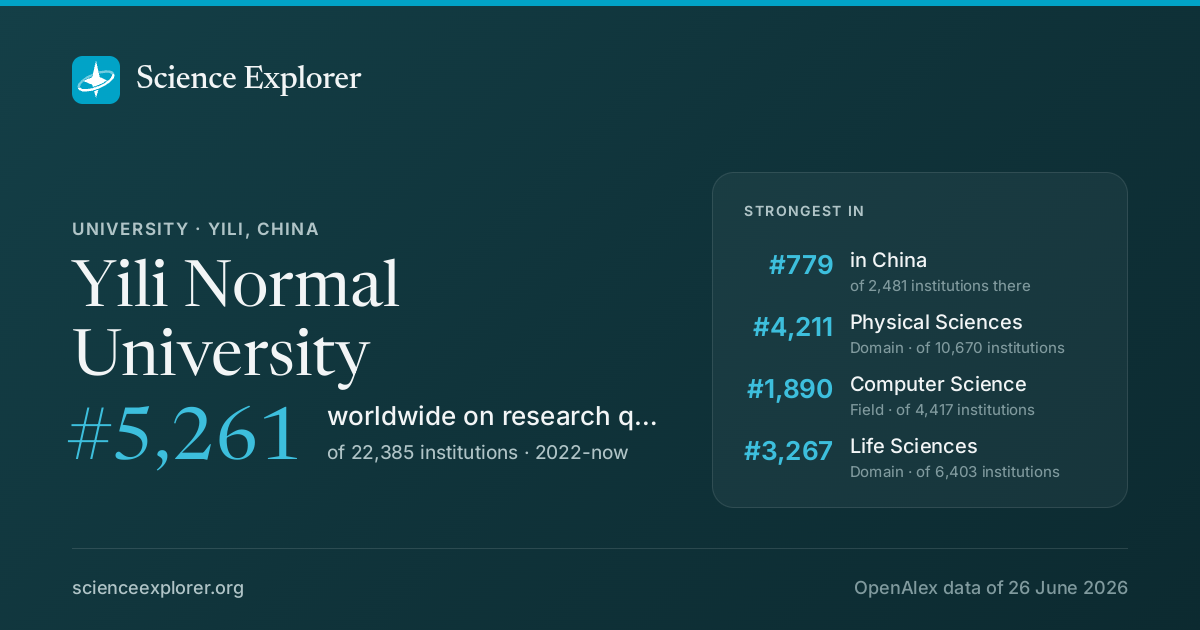
Yili Normal University on Science Explorer

A card with Yili Normal University's standing and the fields it leads in, for a post or a slide. A link to this page previews as the same card.

Download the card

1200 × 630 PNG, sized for social posts, drawn from the latest snapshot.

Badges for a website1Each links back here and updates with every snapshot

Research measures only: rankings here say nothing about teaching, admissions or student experience. Comparable institutions and collaboration partners have tabs of their own, above.

Discussion

Ask a question or share a note about Yili Normal University. Keep it to the research: no personal attacks, advertising or links. Any reader can report a post, which collapses it for everyone until it is opened.
