Science Explorer Back to mapMap
Discussion
Country

Science in Barbados

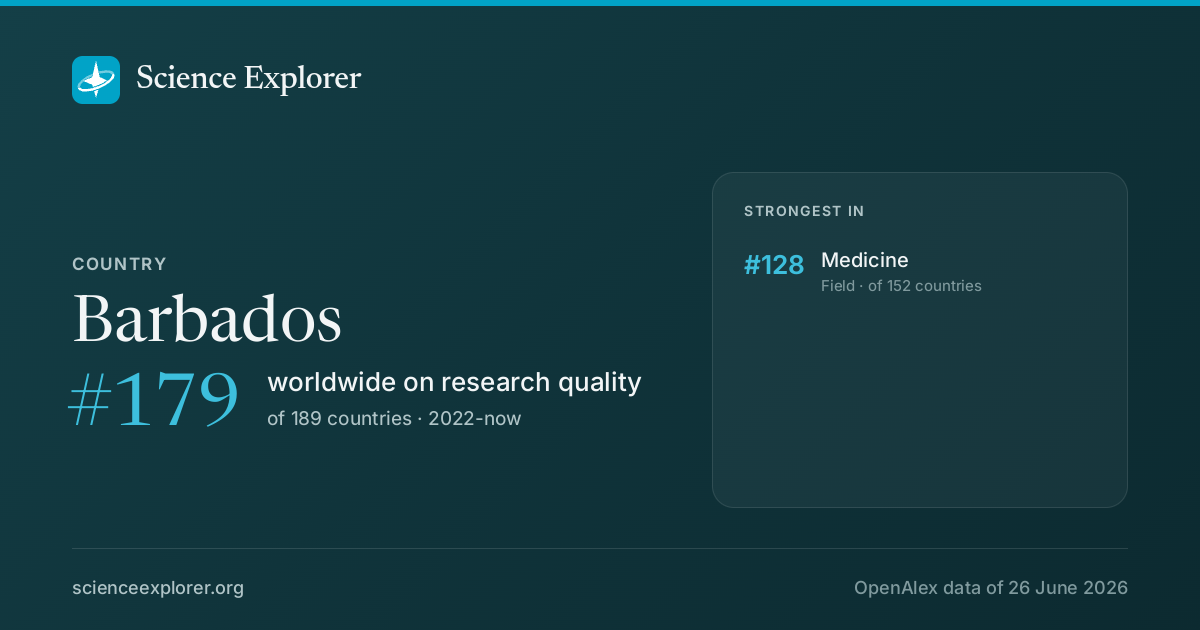
Barbados ranks #179 of 189 countries on research quality in 2022-now (#181 all time), with 622 research works and 6.3% of them in the world's top 10%.

World rank, 2022-now
#179
of 189 · #181 all time
Works, 2022-now
622
▲ 27% vs 2018-21
Citations
58k
18.4 per fractional work, all time
Top-10% rate
6.3%
all institutions 10.0%
vs its own fields
0.78×
1.00× is exactly expected
In the world top 100
0
0 in the top 1,000
Open access
36%
world 40%
International
41%
world 18%

What is Barbados strongest at in science?

On research quality in 2022-now, Barbados ranks highest in Medicine (#128 of 152). Relative to its size it is most specialised in Virology, Physical and Theoretical Chemistry and Family Practice.

FieldWorld rankWhere that sitsTop-10% rateWorksAll timeInstitutions
MedicineField #128 of 152 5.6%212 #141 Institutions

Where its research is concentrated

Location quotient: how much more (or less) of each node it does than its size predicts. Drawn around 1×, where "twice the world share" and "half of it" are the same distance apart in opposite directions. A volume reading, which on a country axis is largely population and industrial structure.

  1. VirologySubfield · 2.6 works · #138 of 204 active here6.3×
  2. Physical and Theoretical ChemistrySubfield · 3.4 works · #108 of 179 active here6.2×
  3. Family PracticeSubfield · 1.4 works · #129 of 191 active here4.3×
  4. HealthSubfield · 8.5 works · #148 of 217 active here4.1×
  5. MusicSubfield · 2.3 works · #122 of 174 active here4.1×
  6. Linguistics and LanguageSubfield · 3.1 works · #151 of 194 active here3.9×
  7. Obstetrics and GynecologySubfield · 7.7 works · #142 of 213 active here3.9×
  8. Applied Microbiology and BiotechnologySubfield · 1.3 works · #152 of 202 active here3.8×
← less than its size predicts1×more →

The whole field profile

All 26 fields at once. A specialist and a generalist produce the same ranked list and a completely different shape.

Agricultural and Biological Sciences: 0.80× its world share, 26 worksAgricultural and Bio…Biochemistry, Genetics and Molecular Biology: 0.75× its world share, 28 worksBiochemistry, Geneti…Immunology and Microbiology: 1.49× its world share, 10 worksImmunology and Micro…Neuroscience: 0.53× its world share, 6 worksNeurosciencePharmacology, Toxicology and Pharmaceutics: 0.79× its world share, 2 worksPharmacology, Toxico…Chemical Engineering: 0.24× its world share, 1 worksChemical EngineeringChemistry: 1.20× its world share, 13 worksChemistryComputer Science: 0.40× its world share, 21 worksComputer ScienceEarth and Planetary Sciences: 0.97× its world share, 11 worksEarth and Planetary …Energy: 0.14× its world share, 1 worksEnergyEngineering: 0.15× its world share, 16 worksEngineeringEnvironmental Science: 1.11× its world share, 39 worksEnvironmental ScienceMaterials Science: 0.13× its world share, 3 worksMaterials ScienceMathematics: 0.46× its world share, 4 worksMathematicsPhysics and Astronomy: 0.25× its world share, 4 worksPhysics and AstronomyDentistry: 1.05× its world share, 4 worksDentistryHealth Professions: 1.90× its world share, 35 worksHealth ProfessionsMedicine: 1.85× its world share, 248 worksMedicineNursing: 2.13× its world share, 7 worksNursingVeterinary: 0.43× its world share, 0 worksVeterinaryArts and Humanities: 1.12× its world share, 22 worksArts and HumanitiesBusiness, Management and Accounting: 0.94× its world share, 21 worksBusiness, Management…Decision Sciences: 0.71× its world share, 5 worksDecision SciencesEconomics, Econometrics and Finance: 1.75× its world share, 26 worksEconomics, Econometr…Psychology: 1.06× its world share, 22 worksPsychologySocial Sciences: 1.38× its world share, 122 worksSocial Sciences1×world share
more than its size predictsabout as predictedless

Rings at 0.5×, 1× and 2×. Widest outward: Nursing, 2.1×. Every wedge is a field page.

All 26 fields, with their numbers
  1. Nursing2.13×7 works
  2. Health Professions1.90×35 works
  3. Medicine1.85×248 works
  4. Economics, Econometrics and Finance1.75×26 works
  5. Immunology and Microbiology1.49×10 works
  6. Social Sciences1.38×122 works
  7. Chemistry1.20×13 works
  8. Arts and Humanities1.12×22 works
  9. Environmental Science1.11×39 works
  10. Psychology1.06×22 works
  11. Dentistry1.05×4 works
  12. Earth and Planetary Sciences0.97×11 works
  13. Business, Management and Accounting0.94×21 works
  14. Agricultural and Biological Sciences0.80×26 works
  15. Pharmacology, Toxicology and Pharmaceutics0.79×2 works
  16. Biochemistry, Genetics and Molecular Biology0.75×28 works
  17. Decision Sciences0.71×5 works
  18. Neuroscience0.53×6 works
  19. Mathematics0.46×4 works
  20. Veterinary0.43×0 works
  21. Computer Science0.40×21 works
  22. Physics and Astronomy0.25×4 works
  23. Chemical Engineering0.24×1 works
  24. Engineering0.15×16 works
  25. Energy0.14×1 works
  26. Materials Science0.13×3 works

Which fields of science does Barbados work in?

In 2022-now, 42% of research in Barbados is in Health Sciences, 31% in Social Sciences. Its largest fields are Medicine (36%), Social Sciences (17%), Environmental Science (6%). It does 1.8× the world's share of Health Sciences.

Health Sciences: 294 fractional works · 42.2% of its workMedicine: 248 fractional works · 35.6% of its workSurgery: 31 fractional works · 4.5% of its workPublic Health, Environmental and Occupational Health: 29 fractional works · 4.2% of its workEpidemiology: 20 fractional works · 2.9% of its workPediatrics, Perinatology and Child Health: 16 fractional works · 2.3% of its workInfectious Diseases: 15 fractional works · 2.2% of its workPulmonary and Respiratory Medicine: 15 fractional works · 2.1% of its workEndocrinology, Diabetes and Metabolism: 13 fractional works · 1.9% of its workCardiology and Cardiovascular Medicine: 10 fractional works · 1.5% of its workOncology: 10 fractional works · 1.4% of its workPhysiology: 8 fractional works · 1.1% of its workObstetrics and Gynecology: 8 fractional works · 1.1% of its workRheumatology: 7 fractional works · 1.0% of its workEmergency Medicine: 6 fractional works · 0.9% of its workPsychiatry and Mental health: 5 fractional works · 0.7% of its workNeurology: 5 fractional works · 0.7% of its workPathology and Forensic Medicine: 4 fractional works · 0.6% of its workPharmacology: 4 fractional works · 0.6% of its workRehabilitation: 4 fractional works · 0.5% of its workHematology: 3 fractional works · 0.5% of its workReproductive Medicine: 3 fractional works · 0.4% of its workGenetics: 3 fractional works · 0.4% of its workDermatology: 3 fractional works · 0.4% of its workHealth Informatics: 3 fractional works · 0.4% of its workRadiology, Nuclear Medicine and Imaging: 3 fractional works · 0.4% of its workHepatology: 2 fractional works · 0.3% of its workGastroenterology: 2 fractional works · 0.3% of its workCritical Care and Intensive Care Medicine: 2 fractional works · 0.2% of its workNephrology: 2 fractional works · 0.2% of its workGeriatrics and Gerontology: 1 fractional works · 0.2% of its workFamily Practice: 1 fractional works · 0.2% of its workOphthalmology: 1 fractional works · 0.2% of its workSmaller subfields together: 8 fractional works · 1.2% of its workHealth Professions: 35 fractional works · 5.0% of its workGeneral Health Professions: 20 fractional works · 2.9% of its workHealth Information Management: 5 fractional works · 0.7% of its workEmergency Medical Services: 4 fractional works · 0.5% of its workOccupational Therapy: 2 fractional works · 0.3% of its workRadiological and Ultrasound Technology: 1 fractional works · 0.2% of its workSmaller subfields together: 3 fractional works · 0.4% of its workNursing: 7 fractional works · 1.0% of its workNutrition and Dietetics: 6 fractional works · 0.9% of its workSmaller subfields together: 1 fractional works · 0.1% of its workDentistry: 4 fractional works · 0.5% of its workOral Surgery: 2 fractional works · 0.3% of its workSmaller subfields together: 2 fractional works · 0.2% of its workVeterinary: 0 fractional works · 0.1% of its workSocial Sciences: 219 fractional works · 31.3% of its workSocial Sciences: 121 fractional works · 17.4% of its workSociology and Political Science: 39 fractional works · 5.5% of its workEducation: 18 fractional works · 2.5% of its workDemography: 10 fractional works · 1.5% of its workHealth: 9 fractional works · 1.2% of its workPolitical Science and International Relations: 7 fractional works · 1.0% of its workCultural Studies: 7 fractional works · 0.9% of its workGender Studies: 5 fractional works · 0.8% of its workSafety Research: 4 fractional works · 0.6% of its workLaw: 4 fractional works · 0.5% of its workTransportation: 3 fractional works · 0.5% of its workAnthropology: 3 fractional works · 0.5% of its workLinguistics and Language: 3 fractional works · 0.4% of its workGeography, Planning and Development: 3 fractional works · 0.4% of its workUrban Studies: 2 fractional works · 0.4% of its workDevelopment: 2 fractional works · 0.3% of its workCommunication: 2 fractional works · 0.2% of its workSmaller subfields together: 1 fractional works · 0.1% of its workEconomics, Econometrics and Finance: 26 fractional works · 3.7% of its workEconomics and Econometrics: 20 fractional works · 2.8% of its workFinance: 4 fractional works · 0.5% of its workGeneral Economics, Econometrics and Finance: 3 fractional works · 0.4% of its workPsychology: 23 fractional works · 3.2% of its workClinical Psychology: 8 fractional works · 1.2% of its workSocial Psychology: 8 fractional works · 1.1% of its workDevelopmental and Educational Psychology: 3 fractional works · 0.4% of its workExperimental and Cognitive Psychology: 2 fractional works · 0.3% of its workSmaller subfields together: 1 fractional works · 0.2% of its workArts and Humanities: 22 fractional works · 3.2% of its workLanguage and Linguistics: 5 fractional works · 0.7% of its workHistory: 4 fractional works · 0.6% of its workLiterature and Literary Theory: 4 fractional works · 0.5% of its workMusic: 2 fractional works · 0.3% of its workVisual Arts and Performing Arts: 2 fractional works · 0.3% of its workArcheology: 2 fractional works · 0.2% of its workSmaller subfields together: 4 fractional works · 0.6% of its workBusiness, Management and Accounting: 21 fractional works · 3.0% of its workOrganizational Behavior and Human Resource Management: 7 fractional works · 1.0% of its workStrategy and Management: 5 fractional works · 0.7% of its workAccounting: 3 fractional works · 0.5% of its workMarketing: 3 fractional works · 0.4% of its workSmaller subfields together: 3 fractional works · 0.4% of its workDecision Sciences: 5 fractional works · 0.7% of its workManagement Science and Operations Research: 3 fractional works · 0.4% of its workSmaller subfields together: 2 fractional works · 0.3% of its workPhysical Sciences: 112 fractional works · 16.1% of its workEnvironmental Science: 39 fractional works · 5.5% of its workGlobal and Planetary Change: 10 fractional works · 1.4% of its workEcology: 8 fractional works · 1.1% of its workManagement, Monitoring, Policy and Law: 7 fractional works · 1.0% of its workHealth, Toxicology and Mutagenesis: 4 fractional works · 0.6% of its workWater Science and Technology: 4 fractional works · 0.5% of its workEnvironmental Engineering: 3 fractional works · 0.4% of its workSmaller subfields together: 4 fractional works · 0.5% of its workComputer Science: 21 fractional works · 3.1% of its workArtificial Intelligence: 7 fractional works · 0.9% of its workInformation Systems: 7 fractional works · 0.9% of its workHuman-Computer Interaction: 3 fractional works · 0.4% of its workComputer Vision and Pattern Recognition: 2 fractional works · 0.3% of its workComputer Networks and Communications: 2 fractional works · 0.2% of its workSmaller subfields together: 2 fractional works · 0.3% of its workEngineering: 16 fractional works · 2.3% of its workBiomedical Engineering: 6 fractional works · 0.8% of its workElectrical and Electronic Engineering: 3 fractional works · 0.5% of its workBuilding and Construction: 2 fractional works · 0.2% of its workSmaller subfields together: 5 fractional works · 0.7% of its workChemistry: 13 fractional works · 1.9% of its workOrganic Chemistry: 5 fractional works · 0.7% of its workPhysical and Theoretical Chemistry: 3 fractional works · 0.5% of its workInorganic Chemistry: 3 fractional works · 0.4% of its workSpectroscopy: 1 fractional works · 0.2% of its workSmaller subfields together: 1 fractional works · 0.1% of its workEarth and Planetary Sciences: 11 fractional works · 1.5% of its workOceanography: 6 fractional works · 0.9% of its workAtmospheric Science: 3 fractional works · 0.4% of its workSmaller subfields together: 1 fractional works · 0.2% of its workMathematics: 4 fractional works · 0.5% of its workModeling and Simulation: 2 fractional works · 0.3% of its workSmaller subfields together: 2 fractional works · 0.3% of its workPhysics and Astronomy: 4 fractional works · 0.5% of its workAtomic and Molecular Physics, and Optics: 3 fractional works · 0.5% of its workSmaller subfields together: 1 fractional works · 0.1% of its workMaterials Science: 3 fractional works · 0.5% of its workEnergy: 1 fractional works · 0.1% of its workChemical Engineering: 1 fractional works · 0.1% of its workLife Sciences: 73 fractional works · 10.4% of its workBiochemistry, Genetics and Molecular Biology: 28 fractional works · 4.0% of its workMolecular Biology: 13 fractional works · 1.9% of its workGenetics: 7 fractional works · 1.0% of its workCell Biology: 3 fractional works · 0.4% of its workCancer Research: 2 fractional works · 0.2% of its workSmaller subfields together: 4 fractional works · 0.5% of its workAgricultural and Biological Sciences: 26 fractional works · 3.8% of its workPlant Science: 9 fractional works · 1.2% of its workFood Science: 5 fractional works · 0.7% of its workSoil Science: 3 fractional works · 0.4% of its workGeneral Agricultural and Biological Sciences: 2 fractional works · 0.3% of its workEcology, Evolution, Behavior and Systematics: 2 fractional works · 0.3% of its workAquatic Science: 2 fractional works · 0.3% of its workSmaller subfields together: 3 fractional works · 0.5% of its workImmunology and Microbiology: 10 fractional works · 1.5% of its workImmunology: 3 fractional works · 0.4% of its workVirology: 3 fractional works · 0.4% of its workMicrobiology: 2 fractional works · 0.3% of its workSmaller subfields together: 3 fractional works · 0.4% of its workNeuroscience: 6 fractional works · 0.9% of its workCellular and Molecular Neuroscience: 2 fractional works · 0.3% of its workCognitive Neuroscience: 2 fractional works · 0.3% of its workSmaller subfields together: 2 fractional works · 0.2% of its workPharmacology, Toxicology and Pharmaceutics: 2 fractional works · 0.3% of its workALL ITS WORKBarbados697fractional works, 2022-now
Life Sciences10%Physical Sciences16%Health Sciences42%Social Sciences31%

Each ring splits the one inside it: the four domains of science, their fields, their subfields. Size is fractional works in 2022-now. Every slice is a page; the interactive view zooms down to single topics and colours each by how much more of it this country does than the world.

Its 4 domains and 26 fields, with their numbers
    1. Medicine24835.6%
    2. Health Professions355.0%
    3. Nursing71.0%
    4. Dentistry40.5%
    5. Veterinary00.1%
    1. Social Sciences12117.4%
    2. Economics, Econometrics and Finance263.7%
    3. Psychology233.2%
    4. Arts and Humanities223.2%
    5. Business, Management and Accounting213.0%
    6. Decision Sciences50.7%
    1. Environmental Science395.5%
    2. Computer Science213.1%
    3. Engineering162.3%
    4. Chemistry131.9%
    5. Earth and Planetary Sciences111.5%
    6. Mathematics40.5%
    7. Physics and Astronomy40.5%
    8. Materials Science30.5%
    9. Energy10.1%
    10. Chemical Engineering10.1%
    1. Biochemistry, Genetics and Molecular Biology284.0%
    2. Agricultural and Biological Sciences263.8%
    3. Immunology and Microbiology101.5%
    4. Neuroscience60.9%
    5. Pharmacology, Toxicology and Pharmaceutics20.3%
All of science, and how each field's share has moved since 1950: the Science domain explorer

Which keywords describe research in Barbados?

By fractional works in 2022-now, weighted toward what it does more of than the world: Epidemiology, Public Health, Vulnerability, Globalization, Climate Change, Postcolonialism, Diabetes and Sustainability.

▲ more of its work than of the world's◆ about the world's share▼ less than the world's

Size is fractional works in 2022-now in the topics tagged with each word; colour is the word's share of this country's work against its share of the world's. The 40 words are chosen for being large and distinctive. Each links to the topic it comes from most.

All 40 words, with their numbers
  1. Epidemiology57▲ 2.0×113 topics
  2. Climate Change28▲ 1.49×60 topics
  3. Public Health27▲ 2.7×47 topics
  4. Globalization27▲ 1.96×45 topics
  5. Sustainability26▲ 1.50×40 topics
  6. Mental Health20▲ 1.99×30 topics
  7. Inflammation18▲ 1.19×57 topics
  8. Treatment18▲ 2.1×44 topics
  9. COVID-1918▲ 1.93×23 topics
  10. Diagnosis17▲ 2.6×39 topics
  11. Risk Factors16▲ 2.1×30 topics
  12. Quality of Life16▲ 1.59×46 topics
  13. Vulnerability15▲ 9.3×8 topics
  14. Diabetes15▲ 4.2×16 topics
  15. Identity14▲ 2.9×18 topics
  16. Cardiovascular Disease14▲ 1.71×31 topics
  17. Depression13▲ 2.2×17 topics
  18. Pandemic13▲ 1.93×11 topics
  19. Gender13▲ 3.5×18 topics
  20. Obesity12▲ 2.3×20 topics
  21. Management12▲ 2.2×28 topics
  22. Culture12▲ 3.3×12 topics
  23. Postcolonialism12▲ 12×7 topics
  24. Health Education12▲ 3.8×8 topics
  25. Non-Communicable Diseases11▲ 5.9×3 topics
  26. Maternal Mortality11▲ 7.1×5 topics
  27. Resilience11▲ 3.2×11 topics
  28. Global Burden10▲ 2.7×11 topics
  29. Pathogenesis10▲ 2.9×23 topics
  30. Infectious Diseases9▲ 4.0×7 topics
  31. Primary Care9▲ 3.5×12 topics
  32. Vaccine Development9▲ 5.0×10 topics
  33. Governance9▲ 3.9×6 topics
  34. Race8▲ 10×8 topics
  35. Decolonization8▲ 14×5 topics
  36. Politics8▲ 4.4×7 topics
  37. Global Trade8▲ 5.7×6 topics
  38. Chronic Disease8▲ 6.3×4 topics
  39. Ocean Acidification7▲ 13×3 topics
  40. Caribbean7▲ 54×3 topics

Which research topics does Barbados publish the most in?

Its largest topics in 2022-now are Caribbean history, culture, and politics, COVID-19 Pandemic Impacts, Global Public Health Policies and Epidemiology.

  1. 1 Caribbean history, culture, and politics Cultural Studies 6 works
  2. 2 COVID-19 Pandemic Impacts Economics and Econometrics 5 works
  3. 3 Global Public Health Policies and Epidemiology Organizational Behavior and Human Resource Management 5 works
  4. 4 Public Health and Nutrition Pediatrics, Perinatology and Child Health 5 works
  5. 5 Global Maternal and Child Health Pediatrics, Perinatology and Child Health 5 works
  6. 6 Island Studies and Pacific Affairs Demography 4 works
  7. 7 Malaria Research and Control Public Health, Environmental and Occupational Health 4 works
  8. 8 Child Nutrition and Water Access Nutrition and Dietetics 4 works
  9. 9 Coral and Marine Ecosystems Studies Ecology 3 works
  10. 10 Diabetes Management and Education Endocrinology, Diabetes and Metabolism 3 works
  11. 11 Innovations in Medical Education Public Health, Environmental and Occupational Health 3 works
  12. 12 Vaccine Coverage and Hesitancy Health 3 works

Which universities in Barbados lead research?

University of the West Indies, Ross University School of Medicine and Ministry of Health rank highest in Barbados on research quality in 2022-now.

  1. 1University of the West IndiesUniversity · Bridgetown · #10,634 worldwide5.7% top 10% · 307 works
  2. 2Ross University School of MedicineUniversity · Bridgetown · #17,333 worldwide4.5% top 10% · 141 works
  3. 3Ministry of HealthGovernment institution · Bridgetown · #20,265 worldwide10.1% top 10% · 68 works

The track on each row is its top-10% rate; the tick is the average of all institutions, 10.0% (how it is set): teal above it, red below.

All ranked institutions in Barbados

Who are the top researchers in Barbados?

Anselm J. M. Hennis, David Farrell and Roché Mahon rank highest among researchers based in Barbados.

  1. 1 Anselm J. M. Hennis #269,326 worldwide 5.5k citations · 141 works
  2. 2 David Farrell #278,464 worldwide 2.7k citations · 98 works
  3. 3 Roché Mahon #483,598 worldwide 1.1k citations · 36 works
  4. 4 Nkemcho O. Ojeh #680,211 worldwide 2.7k citations · 56 works
  5. 5 Ian Richard Hambleton #817,897 worldwide 35k citations · 263 works
  6. 6 Ramesh Jonnalagadda #846,071 worldwide 1.4k citations · 30 works
  7. 7 Kassim Kamara #980,004 worldwide 544 citations · 42 works
  8. 8 Hazel A. Oxenford #1,093,678 worldwide 4.2k citations · 136 works
  9. 9 Srinivasa R. Popuri #1,216,160 worldwide 3.2k citations · 92 works
  10. 10 Philmore Alleyne #1,459,225 worldwide 1.6k citations · 43 works
Top researchers in Barbados

How open and international is Barbados's research?

36% of its research is openly available (world: 40%), and 41% is written with international co-authors (world: 18%).

openly available36.4%not open63.6%

World: 40% of research is openly available.

with international co-authors41.4%domestic only58.6%

World: 18% is written across borders.

In 2022-now, 63% of its research is openly available (world 63%) and 55% is written with co-authors abroad (world 22%). Against what its own mix of topics predicts, that is 0.94× the expected open access and 1.88× the expected international share, which puts it #131 of 173 countries on openness.

How has Barbados's research grown?

Output in 2022-2025 was 27% higher than in 2018-2021.

still counting1990200020102020
grewheldshrank

The same series as a ribbon: one cell per year, darker for more. The line above answers how much; this answers when.

Its share of all research

Growing output can still be a shrinking share: all of science grows. This is Barbados as a percentage of every work published that year, 0.0027% in 2024.

still counting0.0020%0.0040%0.0060%Barbados0.0027% in 202519801990200020102020

Fractional works of Barbados over all fractional works that year. How the balance of science has shifted.

How much of it reaches the world top 10%

Over the whole record, 7.6% of its 3.2k works since 1950 reached the world top 10% for their field and year.

still counting10%20%all institutions10.0% in 2025Barbados6.3% in 2025200020102020

Of each year's output, the share that reached the world's 10% most cited for its field and year. Peak 16.2% in 1993.

Which countries have research most like Barbados'?

Jamaica is Barbados' closest research twin: of all countries, its research is spread across the fields most like Barbados', with both strong in Nursing.

  1. 1 JamaicaBoth strong in Nursing, Economics, Econometrics and Finance, Health Professions 0.82 Compare
  2. 2 Democratic Republic of the CongoBoth strong in Nursing, Health Professions, Economics, Econometrics and Finance 0.81 Compare
  3. 3 HaitiBoth strong in Nursing, Health Professions, Economics, Econometrics and Finance 0.75 Compare
  4. 4 MaliBoth strong in Nursing, Health Professions, Medicine 0.74 Compare
  5. 5 CuraçaoBoth strong in Health Professions, Medicine, Nursing 0.73 Compare

Similarity is the correlation of each side's location quotients across every field it publishes in, on a log scale: 1 is the same shape of research, 0 is unrelated. It ignores size. How it is measured.

Compare Barbados with
Compare any two

Share Barbados's ranking

Barbados on Science Explorer

A card with Barbados's standing and the fields it leads in, for a post or a slide. A link to this page previews as the same card.

Download the card

1200 × 630 PNG, sized for social posts, drawn from the latest snapshot.

Badges for a website1Each links back here and updates with every snapshot

Research fields in Barbados

Discussion

Ask a question or share a note about Barbados. Posts are plain text and can be reported.