Allen Institute
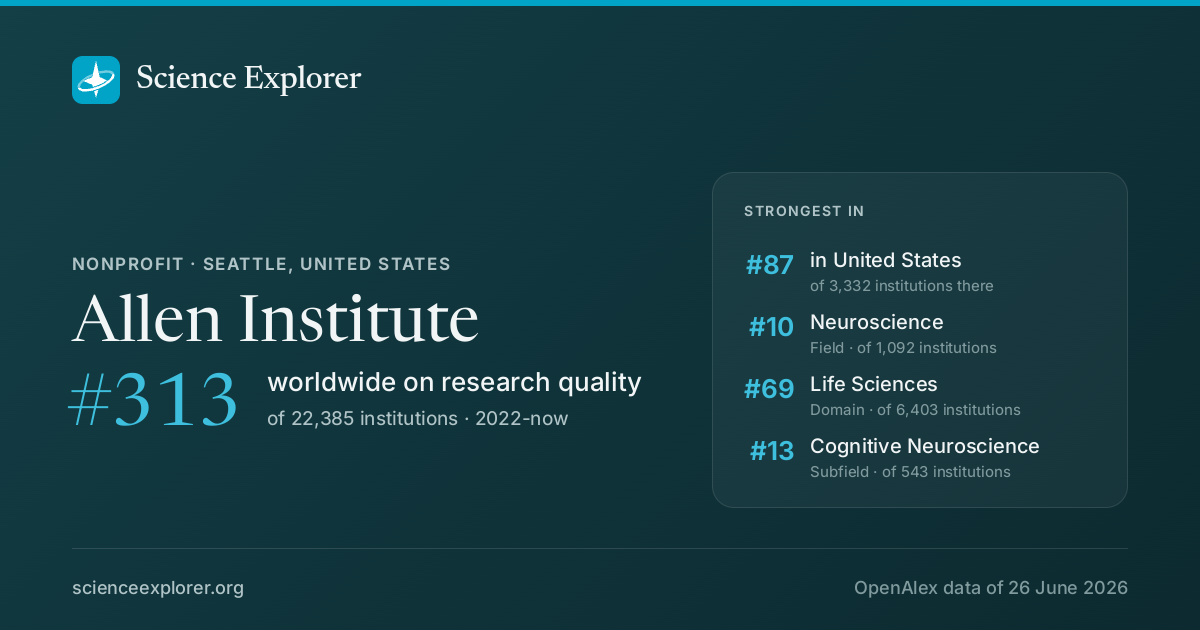
In research, Allen Institute stands highest in Neuroscience (#10 of 1,092 worldwide), Life Sciences (#69 of 6,403 worldwide) and Cognitive Neuroscience (#13 of 543 worldwide), 2022-now. Relative to its size it is most specialised in Developmental Neuroscience, Cellular and Molecular Neuroscience and Biophysics (Developmental Neuroscience is 26.8× its share of world research).
- World rank, 2022-now
- #313 of 22,385 · #261 all time
- Rank in United States
- #87 of 3,332
- Research works
- 4.3k ▲ 42% vs 2018-21
- Citations
- 239k 54.9 per fractional work
- Top-10% rate
- 18.2% all institutions 10.0%
- vs its own fields
- 1.51× 1.00× is exactly expected
- Open access
- 68% world 40%
- International
- 37% world 18%
What is Allen Institute known for in research?
The fields where it stands highest, 2022-now, ranked among every institution above the floor in each field.
| Field | World rank | Where that sits | Top-10% rate | Works | All time |
|---|---|---|---|---|---|
| NeuroscienceField | #10 of 1,092 | 18.2% | 374 | #10 | |
| Life SciencesDomain | #69 of 6,403 | 18.2% | 632 | #65 | |
| Cognitive NeuroscienceSubfield | #13 of 543 | 17.0% | 185 | #11 | |
| Health SciencesDomain | #338 of 9,902 | 17.2% | 314 | #273 | |
| Computer ScienceField | #159 of 4,417 | 28.2% | 122 | #251 | |
| Biochemistry, Genetics and Molecular BiologyField | #111 of 2,964 | 17.5% | 216 | #110 | |
| Cellular and Molecular NeuroscienceSubfield | #8 of 213 | 19.7% | 88 | #5 | |
| Artificial IntelligenceSubfield | #74 of 1,862 | 30.1% | 77 | #112 | |
| MedicineField | #341 of 8,541 | 17.4% | 292 | #289 | |
| Molecular BiologySubfield | #100 of 1,880 | 18.2% | 124 | #104 |
Each strip is that field's whole ranked pool, with the notch where Allen Institute sits in it, in the colour of the band that rank falls in. The track under the rate is the rate itself: it carries no average mark, because the average differs by field (from about 6% in Dentistry to 21% in Economics).
Which of those standings moved
The same fields on both windows: where it stood over the whole record, and where it stands in 2022-now. The distance is the story, and it is the one thing the two rank columns above cannot show.
- Neuroscience#10 #10
- Life Sciences#65 #69
- Cognitive Neuroscience#11 #13
- Health Sciences#273 #338
- Computer Science#251 #159
- Biochemistry, Genetics and Molecular Biology#110 #111
- Cellular and Molecular Neuroscience#5 #8
- Artificial Intelligence#112 #74
- Medicine#289 #341
- Molecular Biology#104 #100
A dot further right is a better standing. Fields it was not ranked in over the whole record are left out.
Which fields of science does Allen Institute work in?
In 2022-now, 50% of research at Allen Institute is in Life Sciences, 25% in Health Sciences. Its largest fields are Neuroscience (30%), Medicine (23%), Biochemistry, Genetics and Molecular Biology (17%). It does 3.8× the world's share of Life Sciences.
Each ring splits the one inside it: the four domains of science, their fields, their subfields. Size is fractional works in 2022-now. Every slice is a page; the interactive view zooms down to single topics and colours each by how much more of it this institution does than the world.
Its 4 domains and 26 fields, with their numbers
- Life Sciences77350.2%
- Health Sciences38224.8%
- Medicine35723.2%
- Health Professions171.1%
- Nursing50.3%
- Veterinary20.1%
- Dentistry10.1%
- Physical Sciences23315.1%
- Computer Science1409.1%
- Engineering473.0%
- Physics and Astronomy130.8%
- Environmental Science130.8%
- Materials Science90.6%
- Chemistry50.3%
- Earth and Planetary Sciences30.2%
- Mathematics20.2%
- Chemical Engineering00.0%
- Energy00.0%
- Social Sciences1529.9%
- Psychology915.9%
- Social Sciences281.8%
- Decision Sciences171.1%
- Economics, Econometrics and Finance60.4%
- Arts and Humanities50.3%
- Business, Management and Accounting50.3%
What does Allen Institute specialise in?
Where its research is concentrated relative to its size: Developmental Neuroscience takes 26.8× the share of its output that it takes of world research.
- Developmental NeuroscienceSubfield · 20.5 works27×
- Cellular and Molecular NeuroscienceSubfield · 106.6 works22×
- BiophysicsSubfield · 38.0 works22×
- Cognitive NeuroscienceSubfield · 227.8 works20×
- NeuroscienceField · 460.9 works18×
Location quotient, a volume reading rather than an impact one. It surfaces small, lopsided specialities.
Field profile
Location quotient across every field it publishes in: outside the ring is more than an institution of this size would be expected to publish, inside it is less.
Rings at 0.5×, 1× and 2×. Widest outward: Neuroscience, 18.4×. Every wedge is a field page.
All 26 fields, with their numbers
- Neuroscience18.44×461 works
- Biochemistry, Genetics and Molecular Biology3.18×261 works
- Immunology and Microbiology2.10×32 works
- Psychology1.94×91 works
- Medicine1.21×357 works
- Computer Science1.17×140 works
- Decision Sciences1.12×17 works
- Veterinary1.02×2 works
- Pharmacology, Toxicology and Pharmaceutics0.64×4 works
- Nursing0.63×5 works
- Health Professions0.42×17 works
- Physics and Astronomy0.37×13 works
- Chemistry0.21×5 works
- Agricultural and Biological Sciences0.20×15 works
- Engineering0.20×47 works
- Dentistry0.19×1 works
- Economics, Econometrics and Finance0.19×6 works
- Environmental Science0.17×13 works
- Materials Science0.17×9 works
- Social Sciences0.14×28 works
- Earth and Planetary Sciences0.13×3 works
- Mathematics0.13×2 works
- Arts and Humanities0.11×5 works
- Business, Management and Accounting0.10×5 works
- Chemical Engineering0.09×0 works
- Energy0.02×0 works
- Neuroscience 18.4×
- Biochemistry, Genetics and Molecular Biology 3.2×
- Immunology and Microbiology 2.1×
- Psychology 1.9×
- Medicine 1.2×
- Computer Science 1.2×
- Decision Sciences 1.1×
- Veterinary 1.0×
- Pharmacology, Toxicology and Pharmaceutics 0.6×
- Nursing 0.6×
- Health Professions 0.4×
- Physics and Astronomy 0.4×
- Chemistry 0.2×
- Agricultural and Biological Sciences 0.2×
- Engineering 0.2×
- Dentistry 0.2×
- Economics, Econometrics and Finance 0.2×
- Environmental Science 0.2×
- Materials Science 0.2×
- Social Sciences 0.1×
- Earth and Planetary Sciences 0.1×
- Mathematics 0.1×
- Arts and Humanities 0.1×
- Business, Management and Accounting 0.1×
- Chemical Engineering 0.1×
- Energy 0.0×
Who are the top researchers at Allen Institute?
Ranked on the quality score, Hongkui Zeng, Ed S. Lein and Bosiljka Tasic lead among researchers whose main affiliation is Allen Institute.
- 1
Hongkui Zeng
 United States · #236 worldwide
58k citations · 378 works
- 2
Ed S. Lein
United States · #785 worldwide
53k citations · 293 works
- 3
Bosiljka Tasic
United States · #2,378 worldwide
31k citations · 219 works
- 4
Mary McGraw
United States · #4,820 worldwide
37k citations · 71 works
- 5
Kimberly A. Smith
United States · #4,834 worldwide
33k citations · 145 works
- 6
Nick Dee
United States · #6,750 worldwide
31k citations · 112 works
- 7
Zizhen Yao
United States · #7,260 worldwide
25k citations · 148 works
- 8
R. Clay Reid
United States · #8,353 worldwide
23k citations · 196 works
- 9
Trygve E. Bakken
United States · #9,738 worldwide
18k citations · 141 works
- 10
Michael Hawrylycz
United States · #11,318 worldwide
54k citations · 208 works
Which keywords describe research at Allen Institute?
By fractional works in 2022-now, weighted toward what it does more of than the world: Neurological Disorders, Neurodegeneration, Neuroinflammation, Neuronal Oscillations, Brain Development, Neurobiology, Working Memory and Synchronization.
- RNA-Seq
- Default Mode Network
- Memory
- Neural Plasticity
- GABAergic
- Neuroimaging
- Hippocampus
- Microglia
- Cytokines
- Neuronal Circuits
- Genetics
- Depression
- Synaptic Plasticity
- Gamma Rhythms
- Cognitive Functions
- Working Memory
- Neurobiology
- Neuronal Oscillations
- Oxidative Stress
- Deep Learning
- Neurological Disorders
- Neurodegeneration
- Neuroinflammation
- Brain Development
- Neural Networks
- Synchronization
- Cortical Networks
- Prefrontal Cortex
- Gene Expression
- Functional Connectivity
- Neural Circuits
- Neural Mechanisms
- Dendritic Spines
- Innate Immunity
- Data Integration
- Astrocyte Function
- Neurotransmission
- Parkinson's Disease
- Ischemic Stroke
- Resting-State fMRI
Size is fractional works in 2022-now in the topics tagged with each word; colour is the word's share of this institution's work against its share of the world's. The 40 words are chosen for being large and distinctive. Each links to the topic it comes from most.
All 40 words, with their numbers
- Neurological Disorders100▲ 11×18 topics
- Deep Learning80▲ 1.50×54 topics
- Neurodegeneration73▲ 15×11 topics
- Oxidative Stress73▲ 2.9×44 topics
- Neuroinflammation70▲ 16×6 topics
- Neuronal Oscillations65▲ 56×2 topics
- Brain Development63▲ 23×6 topics
- Neurobiology62▲ 15×10 topics
- Neural Networks62▲ 2.6×26 topics
- Working Memory61▲ 44×3 topics
- Synchronization60▲ 33×3 topics
- Cognitive Functions60▲ 54×2 topics
- Cortical Networks59▲ 69×1 topic
- Gamma Rhythms59▲ 69×1 topic
- Prefrontal Cortex57▲ 43×3 topics
- Synaptic Plasticity52▲ 16×6 topics
- Gene Expression49▲ 5.1×17 topics
- Depression47▲ 3.5×21 topics
- Functional Connectivity44▲ 21×3 topics
- Genetics44▲ 4.0×17 topics
- Neural Circuits43▲ 29×4 topics
- Neuronal Circuits43▲ 36×2 topics
- Neural Mechanisms43▲ 27×4 topics
- Cytokines41▲ 9.2×8 topics
- Dendritic Spines41▲ 34×2 topics
- Microglia39▲ 22×2 topics
- Innate Immunity37▲ 7.4×10 topics
- Hippocampus35▲ 36×2 topics
- Data Integration34▲ 13×4 topics
- Neuroimaging34▲ 8.0×11 topics
- Astrocyte Function34▲ 36×2 topics
- GABAergic33▲ 44×1 topic
- Neurotransmission33▲ 44×1 topic
- Neural Plasticity32▲ 11×5 topics
- Parkinson's Disease32▲ 8.2×8 topics
- Memory31▲ 8.3×4 topics
- Ischemic Stroke31▲ 13×3 topics
- Default Mode Network31▲ 27×1 topic
- Resting-State fMRI31▲ 27×1 topic
- RNA-Seq30▲ 16×2 topics
Which research topics does Allen Institute publish most on?
By volume in 2022-now: Neural dynamics and brain function, Neuroscience and Neuropharmacology Research, Functional Brain Connectivity Studies and Single-cell and spatial transcriptomics.
Area is fractional works; colour is the subfield each topic belongs to.
- 1 Neural dynamics and brain function Cognitive Neuroscience 59 works
- 2 Neuroscience and Neuropharmacology Research Cellular and Molecular Neuroscience 33 works
- 3 Functional Brain Connectivity Studies Cognitive Neuroscience 31 works
- 4 Single-cell and spatial transcriptomics Molecular Biology 29 works
- 5 Neuroinflammation and Neurodegeneration Mechanisms Neurology 27 works
- 6 Cell Image Analysis Techniques Biophysics 25 works
- 7 Memory and Neural Mechanisms Cognitive Neuroscience 23 works
- 8 Topic Modeling Artificial Intelligence 22 works
- 9 Neural and Behavioral Psychology Studies Cognitive Neuroscience 20 works
- 10 Alzheimer's disease research and treatments Physiology 20 works
How open and international is its research?
Against the world's own shares: the tick on each track. Both are shares of its output, so they sit on one scale and can be read against each other as well as against the world.
World: 40% of research is openly available.
World: 18% is written across borders.
How has Allen Institute's research output changed?
Output in 2022-2025 was 42% higher than in 2018-2021.
The same series as a ribbon: one cell per year, darker for more. The line above answers how much; this answers when.
Its share of all research
Growing output can still be a shrinking share: all of science grows. This is Allen Institute as a percentage of every work published that year, 0.0052% in 2024.
Fractional works of Allen Institute over all fractional works that year. How the balance of science has shifted.
How much of it reaches the world top 10%
Year by year, against all institutions in the same year.
Of each year's output, the share that reached the world's 10% most cited for its field and year. Peak 27.2% in 1993.
Other research institutions in Seattle
- University of Washington
- Seattle University
- Fred Hutch Cancer Center
- Seattle Children's Hospital
- Amazon (United States)
- Virginia Mason Medical Center
- Cancer Research And Biostatistics
- Williams & Associates

Which institutions have research most like Allen Institute's?
Among the world's leading institutions, National Institutes of Health has the research profile closest to Allen Institute's, with both strong in Neuroscience.
- 1
National Institutes of HealthUnited States · Both strong in Neuroscience, Biochemistry, Genetics and Molecular Biology, Immunology and Microbiology
0.83 Compare
- 2
University of Massachusetts Chan Medical SchoolUnited States · Both strong in Biochemistry, Genetics and Molecular Biology, Immunology and Microbiology, Neuroscience
0.81 Compare
- 3
Mayo ClinicUnited States · Both strong in Immunology and Microbiology, Biochemistry, Genetics and Molecular Biology, Neuroscience
0.81 Compare
- 4
Vanderbilt UniversityUnited States · Both strong in Neuroscience, Immunology and Microbiology, Biochemistry, Genetics and Molecular Biology
0.80 Compare
- 5
Baylor College of MedicineUnited States · Both strong in Biochemistry, Genetics and Molecular Biology, Neuroscience, Immunology and Microbiology
0.80 Compare


Similarity is the correlation of each side's location quotients across every field it publishes in, on a log scale: 1 is the same shape of research, 0 is unrelated. It ignores size. How it is measured.
Compare Allen Institute with
- vs
 Central China Normal University
- vs University of Electronic Science and Technology of China
- vs
 Royal Netherlands Academy of Arts and Sciences
- vs Yangzhou University
- vs Guangdong University of Technology
- vs
 University of Sussex
Share Allen Institute's ranking



Research measures only: rankings here say nothing about teaching, admissions or student experience. Comparable institutions and collaboration partners have tabs of their own, above.
Discussion
Ask a question or share a note about Allen Institute. Posts are plain text and can be reported.