Angelo State University

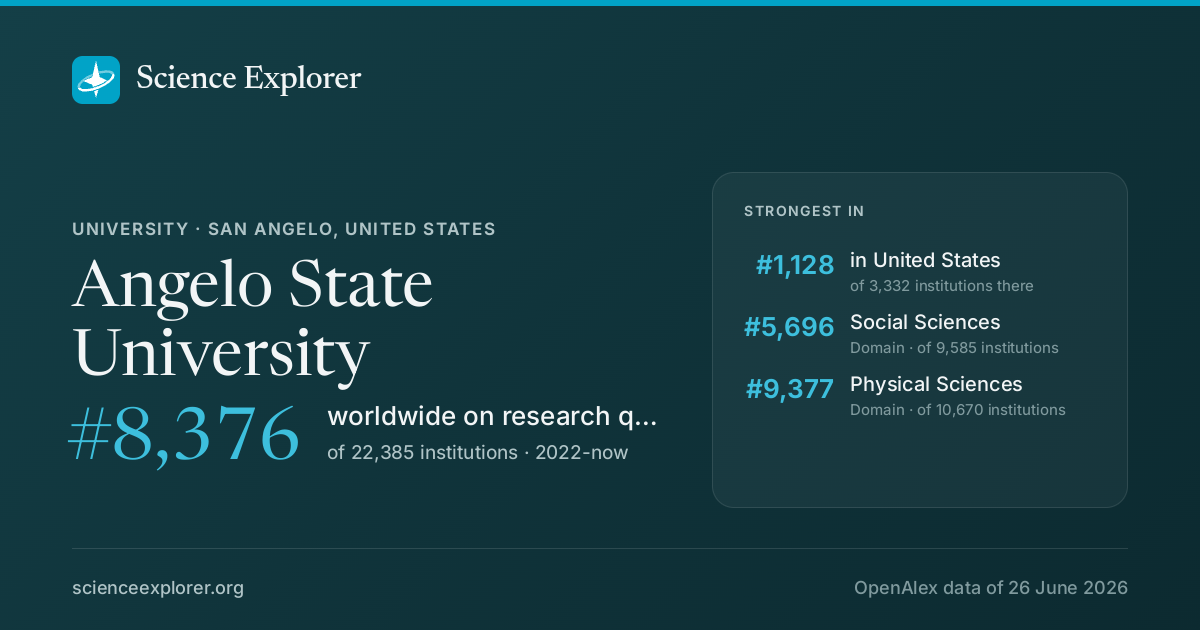
In research, Angelo State University stands highest in Social Sciences (#5,696 of 9,585 worldwide), Social Sciences (#4,478 of 5,988 worldwide) and Physical Sciences (#9,377 of 10,670 worldwide), 2022-now.
- World rank, 2022-now
- #8,376 of 22,385 · #7,075 all time
- Rank in United States
- #1,128 of 3,332
- Research works
- 1.5k ▼ 24% vs 2018-21
- Citations
- 12k 7.6 per fractional work
- Top-10% rate
- 6.1% all institutions 10.0%
- vs its own fields
- 0.78× 1.00× is exactly expected
- Open access
- 44% world 40%
- International
- 12% world 18%
What is Angelo State University known for in research?
The fields where it stands highest, 2022-now, ranked among every institution above the floor in each field.
| Field | World rank | Where that sits | Top-10% rate | Works | All time |
|---|---|---|---|---|---|
| Social SciencesDomain | #5,696 of 9,585 | 5.2% | 169 | #3857 | |
| Social SciencesField | #4,478 of 5,988 | 5.0% | 88 | #3703 | |
| Physical SciencesDomain | #9,377 of 10,670 | 5.4% | 63 | #9258 |
Each strip is that field's whole ranked pool, with the notch where Angelo State University sits in it, in the colour of the band that rank falls in. The track under the rate is the rate itself: it carries no average mark, because the average differs by field (from about 6% in Dentistry to 21% in Economics).
Which of those standings moved
The same fields on both windows: where it stood over the whole record, and where it stands in 2022-now. The distance is the story, and it is the one thing the two rank columns above cannot show.
- Social Sciences#3,857 #5,696
- Social Sciences#3,703 #4,478
- Physical Sciences#9,258 #9,377
A dot further right is a better standing. Fields it was not ranked in over the whole record are left out.
Which fields of science does Angelo State University work in?
In 2022-now, 55% of research at Angelo State University is in Social Sciences, 22% in Physical Sciences. Its largest fields are Social Sciences (29%), Medicine (12%), Engineering (9%). It does 2.2× the world's share of Social Sciences.
Each ring splits the one inside it: the four domains of science, their fields, their subfields. Size is fractional works in 2022-now. Every slice is a page; the interactive view zooms down to single topics and colours each by how much more of it this institution does than the world.
Its 4 domains and 26 fields, with their numbers
- Social Sciences17955.3%
- Social Sciences9228.5%
- Psychology257.9%
- Arts and Humanities216.4%
- Economics, Econometrics and Finance196.0%
- Business, Management and Accounting154.7%
- Decision Sciences61.8%
- Physical Sciences7121.9%
- Engineering288.7%
- Computer Science154.6%
- Environmental Science123.6%
- Physics and Astronomy82.4%
- Earth and Planetary Sciences30.8%
- Materials Science30.8%
- Chemistry10.4%
- Energy10.3%
- Chemical Engineering10.2%
- Mathematics00.1%
- Health Sciences5015.5%
- Medicine3811.8%
- Health Professions103.2%
- Dentistry10.2%
- Nursing10.2%
- Veterinary00.1%
- Life Sciences237.2%
Field profile
Location quotient across every field it publishes in: outside the ring is more than an institution of this size would be expected to publish, inside it is less.
Rings at 0.5×, 1× and 2×. Widest outward: Economics, Econometrics and Finance, 2.8×. Every wedge is a field page.
All 26 fields, with their numbers
- Economics, Econometrics and Finance2.82×20 works
- Psychology2.58×25 works
- Social Sciences2.25×92 works
- Arts and Humanities2.21×21 works
- Decision Sciences1.88×6 works
- Business, Management and Accounting1.47×15 works
- Health Professions1.22×10 works
- Physics and Astronomy1.08×8 works
- Environmental Science0.73×12 works
- Immunology and Microbiology0.69×2 works
- Neuroscience0.66×4 works
- Agricultural and Biological Sciences0.65×10 works
- Veterinary0.63×0 works
- Medicine0.61×38 works
- Pharmacology, Toxicology and Pharmaceutics0.59×1 works
- Computer Science0.59×15 works
- Engineering0.58×28 works
- Earth and Planetary Sciences0.52×3 works
- Dentistry0.50×1 works
- Chemical Engineering0.48×0 works
- Biochemistry, Genetics and Molecular Biology0.40×7 works
- Nursing0.37×1 works
- Energy0.32×1 works
- Chemistry0.26×1 works
- Materials Science0.23×3 works
- Mathematics0.13×0 works
- Economics, Econometrics and Finance 2.8×
- Psychology 2.6×
- Social Sciences 2.2×
- Arts and Humanities 2.2×
- Decision Sciences 1.9×
- Business, Management and Accounting 1.5×
- Health Professions 1.2×
- Physics and Astronomy 1.1×
- Environmental Science 0.7×
- Immunology and Microbiology 0.7×
- Neuroscience 0.7×
- Agricultural and Biological Sciences 0.7×
- Veterinary 0.6×
- Medicine 0.6×
- Pharmacology, Toxicology and Pharmaceutics 0.6×
- Computer Science 0.6×
- Engineering 0.6×
- Earth and Planetary Sciences 0.5×
- Dentistry 0.5×
- Chemical Engineering 0.5×
- Biochemistry, Genetics and Molecular Biology 0.4×
- Nursing 0.4×
- Energy 0.3×
- Chemistry 0.3×
- Materials Science 0.2×
- Mathematics 0.1×
Who are the top researchers at Angelo State University?
Ranked on the quality score, Jun Huang, Jaeyong Choi and Arnoldo De León lead among researchers whose main affiliation is Angelo State University.
- 1
Jun Huang
 United States · #1,770,912 worldwide
781 citations · 25 works
- 2
Jaeyong Choi
United States · #2,047,338 worldwide
632 citations · 76 works
- 3
Arnoldo De León
United States · #2,151,908 worldwide
1.2k citations · 83 works
- 4
Soyoon Kum
United States · #2,183,904 worldwide
418 citations · 21 works
- 5
J. Clint Perkins
United States · #2,302,731 worldwide
198 citations · 16 works
- 6
Bryan P. Cutsinger
United States · #2,323,844 worldwide
89 citations · 38 works
- 7
Marta N. Lukacovic
United States · #2,459,382 worldwide
68 citations · 40 works
- 8
Derek M. Bolen
United States · #2,504,865 worldwide
220 citations · 21 works
- 9
Roya Choupani
United States · #2,505,232 worldwide
119 citations · 42 works
- 10
Jerry W. Thornton
United States · #2,777,329 worldwide
265 citations · 15 works
Which keywords describe research at Angelo State University?
By fractional works in 2022-now, weighted toward what it does more of than the world: Gender, Globalization, Engineering Education, Epidemiology, History, Public Opinion, Identity and Human Rights.
- Assessment Methods
- Property Rights
- Constitutional government
- Neural Correlates
- Society
- Lifelong Learning
- Distance Education
- Monetary Policy
- Prevention
- Religion
- Security
- Prevalence
- Colonialism
- Nationalism
- Ethics
- Economic Growth
- History
- Mental Health
- Climate Change
- Globalization
- Epidemiology
- Gender
- Public Health
- Human Rights
- Identity
- Risk Factors
- Literature
- Engineering Education
- Online Learning
- Higher Education
- Public Opinion
- Social Support
- Feminism
- Well-being
- International Relations
- Injury Prevention
- Evidence-Based Practice
- American founding
- Inclusion
- Social Identity
Size is fractional works in 2022-now in the topics tagged with each word; colour is the word's share of this institution's work against its share of the world's. The 40 words are chosen for being large and distinctive. Each links to the topic it comes from most.
All 40 words, with their numbers
- Epidemiology16▲ 1.21×37 topics
- Globalization16▲ 2.5×35 topics
- Gender11▲ 6.2×21 topics
- Climate Change10▲ 1.19×26 topics
- Public Health10▲ 2.1×25 topics
- Mental Health10▲ 2.1×23 topics
- Human Rights9▲ 2.7×19 topics
- History8▲ 3.6×13 topics
- Identity8▲ 3.4×19 topics
- Economic Growth8▲ 2.9×12 topics
- Risk Factors8▲ 2.1×14 topics
- Ethics6▲ 4.0×9 topics
- Literature6▲ 3.5×13 topics
- Nationalism6▲ 4.2×9 topics
- Engineering Education6▲ 22×4 topics
- Colonialism6▲ 3.8×10 topics
- Online Learning6▲ 2.2×9 topics
- Prevalence6▲ 4.3×9 topics
- Higher Education6▲ 3.2×11 topics
- Security6▲ 2.5×8 topics
- Public Opinion5▲ 14×4 topics
- Religion5▲ 3.5×9 topics
- Social Support5▲ 2.9×7 topics
- Prevention5▲ 3.7×9 topics
- Feminism5▲ 5.0×8 topics
- Monetary Policy4▲ 5.9×6 topics
- Well-being4▲ 3.6×11 topics
- Distance Education4▲ 6.7×3 topics
- International Relations4▲ 5.3×7 topics
- Lifelong Learning4▲ 6.3×5 topics
- Injury Prevention4▲ 10×4 topics
- Society4▲ 6.2×5 topics
- Evidence-Based Practice4▲ 8.4×5 topics
- Neural Correlates4▲ 11×6 topics
- American founding3▲ 38×1 topic
- Constitutional government3▲ 38×1 topic
- Inclusion3▲ 7.0×6 topics
- Property Rights3▲ 16×4 topics
- Social Identity3▲ 11×4 topics
- Assessment Methods3▲ 9.2×2 topics
Which research topics does Angelo State University publish most on?
By volume in 2022-now: American Constitutional Law and Politics, Sports injuries and prevention, Engineering Education and Curriculum Development and Historical Studies and Socio-cultural Analysis.
Area is fractional works; colour is the subfield each topic belongs to.
- 1 American Constitutional Law and Politics Political Science and International Relations 3 works
- 2 Sports injuries and prevention Orthopedics and Sports Medicine 3 works
- 3 Engineering Education and Curriculum Development Media Technology 3 works
- 4 Historical Studies and Socio-cultural Analysis History and Philosophy of Science 3 works
- 5 Online and Blended Learning Education 3 works
- 6 Business Law and Ethics Accounting 2 works
- 7 Terrorism, Counterterrorism, and Political Violence Sociology and Political Science 2 works
- 8 Foot and Ankle Surgery Orthopedics and Sports Medicine 2 works
- 9 Race, History, and American Society Sociology and Political Science 2 works
- 10 Legal Education and Practice Innovations Law 2 works
How open and international is its research?
Against the world's own shares: the tick on each track. Both are shares of its output, so they sit on one scale and can be read against each other as well as against the world.
World: 40% of research is openly available.
World: 18% is written across borders.
How has Angelo State University's research output changed?
Output in 2022-2025 was 24% lower than in 2018-2021.
The same series as a ribbon: one cell per year, darker for more. The line above answers how much; this answers when.
Its share of all research
Growing output can still be a shrinking share: all of science grows. This is Angelo State University as a percentage of every work published that year, 0.0014% in 2024.
Fractional works of Angelo State University over all fractional works that year. How the balance of science has shifted.
How much of it reaches the world top 10%
Year by year, against all institutions in the same year.
Of each year's output, the share that reached the world's 10% most cited for its field and year. Peak 9.2% in 2012.
Other research institutions in San Angelo
Share Angelo State University's ranking
Badges for a website1Each links back here and updates with every snapshot

Research measures only: rankings here say nothing about teaching, admissions or student experience. Comparable institutions and collaboration partners have tabs of their own, above.
Discussion
Ask a question or share a note about Angelo State University. Keep it to the research: no personal attacks, advertising or links. Any reader can report a post, which collapses it for everyone until it is opened.