Science Explorer Back to mapMap
Discussion
Institution · Antananarivo · Madagascar

Association Vahatra

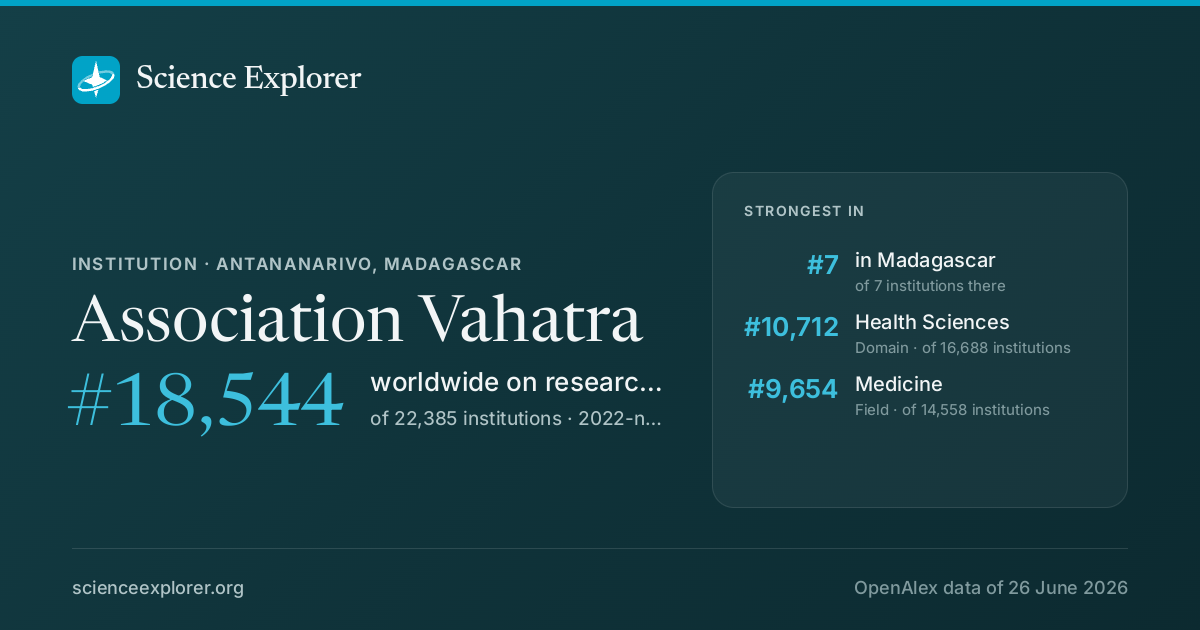
In research, Association Vahatra stands highest in Health Sciences (#10,712 of 16,688 worldwide) and Medicine (#9,654 of 14,558 worldwide), over all time.

World rank, 2022-now
#18,544
of 22,385 · #21,056 all time
Rank in Madagascar
#7
of 7
Research works
330
▲ 24% vs 2018-21
Citations
2.4k
7.2 per fractional work
Top-10% rate
6.1%
all institutions 10.0%
vs its own fields
0.93×
1.00× is exactly expected
Open access
53%
world 40%
International
40%
world 18%

What is Association Vahatra known for in research?

The fields where it stands highest, over all time, ranked among every institution above the floor in each field.

FieldWorld rankWhere that sitsTop-10% rateWorks
Health SciencesDomain #10,712 of 16,688 3.0%203
MedicineField #9,654 of 14,558 2.8%182

Each strip is that field's whole ranked pool, with the notch where Association Vahatra sits in it, in the colour of the band that rank falls in. The track under the rate is the rate itself: it carries no average mark, because the average differs by field (from about 6% in Dentistry to 21% in Economics).

Which fields of science does Association Vahatra work in?

In 2022-now, 57% of research at Association Vahatra is in Health Sciences, 16% in Physical Sciences. Its largest fields are Medicine (45%), Health Professions (12%), Environmental Science (8%). It does 2.3× the world's share of Health Sciences.

Health Sciences: 57 fractional works · 57.0% of its workMedicine: 44 fractional works · 44.8% of its workSurgery: 7 fractional works · 6.8% of its workInfectious Diseases: 5 fractional works · 5.3% of its workEpidemiology: 4 fractional works · 4.3% of its workPulmonary and Respiratory Medicine: 4 fractional works · 3.5% of its workPublic Health, Environmental and Occupational Health: 4 fractional works · 3.5% of its workPediatrics, Perinatology and Child Health: 3 fractional works · 2.5% of its workPathology and Forensic Medicine: 2 fractional works · 2.2% of its workNeurology: 2 fractional works · 1.7% of its workNephrology: 2 fractional works · 1.6% of its workPhysiology: 2 fractional works · 1.6% of its workOphthalmology: 1 fractional works · 1.0% of its workRadiology, Nuclear Medicine and Imaging: 1 fractional works · 1.0% of its workOncology: 1 fractional works · 0.9% of its workHematology: 1 fractional works · 0.8% of its workCardiology and Cardiovascular Medicine: 1 fractional works · 0.8% of its workGenetics: 1 fractional works · 0.8% of its workRheumatology: 1 fractional works · 0.8% of its workRehabilitation: 1 fractional works · 0.8% of its workDermatology: 1 fractional works · 0.6% of its workEndocrinology, Diabetes and Metabolism: 1 fractional works · 0.6% of its workObstetrics and Gynecology: 1 fractional works · 0.6% of its workTransplantation: 0 fractional works · 0.4% of its workPharmacology: 0 fractional works · 0.4% of its workComplementary and alternative medicine: 0 fractional works · 0.3% of its workPsychiatry and Mental health: 0 fractional works · 0.3% of its workReproductive Medicine: 0 fractional works · 0.3% of its workGastroenterology: 0 fractional works · 0.3% of its workInternal Medicine: 0 fractional works · 0.3% of its workSmaller subfields together: 1 fractional works · 0.9% of its workHealth Professions: 12 fractional works · 11.8% of its workGeneral Health Professions: 10 fractional works · 10.3% of its workHealth Information Management: 1 fractional works · 0.9% of its workSmaller subfields together: 1 fractional works · 0.6% of its workVeterinary: 0 fractional works · 0.3% of its workSmall Animals: 0 fractional works · 0.3% of its workNursing: 0 fractional works · 0.1% of its workPhysical Sciences: 16 fractional works · 15.7% of its workEnvironmental Science: 8 fractional works · 8.5% of its workEcology: 4 fractional works · 3.6% of its workGlobal and Planetary Change: 2 fractional works · 1.6% of its workManagement, Monitoring, Policy and Law: 1 fractional works · 1.0% of its workNature and Landscape Conservation: 1 fractional works · 0.9% of its workEcological Modeling: 1 fractional works · 0.6% of its workHealth, Toxicology and Mutagenesis: 0 fractional works · 0.5% of its workEnvironmental Engineering: 0 fractional works · 0.2% of its workSmaller subfields together: 0 fractional works · 0.2% of its workEngineering: 2 fractional works · 2.4% of its workMechanical Engineering: 1 fractional works · 0.9% of its workBiomedical Engineering: 1 fractional works · 0.7% of its workBuilding and Construction: 0 fractional works · 0.2% of its workSmaller subfields together: 1 fractional works · 0.5% of its workEarth and Planetary Sciences: 2 fractional works · 1.8% of its workPaleontology: 1 fractional works · 1.0% of its workAtmospheric Science: 0 fractional works · 0.4% of its workOceanography: 0 fractional works · 0.3% of its workSmaller subfields together: 0 fractional works · 0.2% of its workComputer Science: 1 fractional works · 1.4% of its workArtificial Intelligence: 1 fractional works · 0.7% of its workComputational Theory and Mathematics: 0 fractional works · 0.5% of its workSmaller subfields together: 0 fractional works · 0.2% of its workMaterials Science: 1 fractional works · 1.0% of its workBiomaterials: 0 fractional works · 0.3% of its workPolymers and Plastics: 0 fractional works · 0.3% of its workSmaller subfields together: 0 fractional works · 0.3% of its workMathematics: 0 fractional works · 0.2% of its workChemistry: 0 fractional works · 0.2% of its workEnergy: 0 fractional works · 0.1% of its workLife Sciences: 15 fractional works · 15.5% of its workAgricultural and Biological Sciences: 6 fractional works · 6.5% of its workEcology, Evolution, Behavior and Systematics: 2 fractional works · 2.4% of its workPlant Science: 1 fractional works · 1.4% of its workForestry: 1 fractional works · 0.7% of its workFood Science: 1 fractional works · 0.6% of its workInsect Science: 0 fractional works · 0.4% of its workGeneral Agricultural and Biological Sciences: 0 fractional works · 0.3% of its workAnimal Science and Zoology: 0 fractional works · 0.2% of its workSmaller subfields together: 0 fractional works · 0.4% of its workBiochemistry, Genetics and Molecular Biology: 4 fractional works · 4.5% of its workGenetics: 2 fractional works · 1.7% of its workMolecular Biology: 1 fractional works · 1.4% of its workDevelopmental Biology: 0 fractional works · 0.4% of its workCell Biology: 0 fractional works · 0.3% of its workCancer Research: 0 fractional works · 0.2% of its workSmaller subfields together: 0 fractional works · 0.5% of its workImmunology and Microbiology: 3 fractional works · 2.9% of its workParasitology: 2 fractional works · 2.2% of its workMicrobiology: 0 fractional works · 0.5% of its workSmaller subfields together: 0 fractional works · 0.2% of its workNeuroscience: 1 fractional works · 1.1% of its workCellular and Molecular Neuroscience: 1 fractional works · 0.6% of its workEndocrine and Autonomic Systems: 0 fractional works · 0.3% of its workSmaller subfields together: 0 fractional works · 0.2% of its workPharmacology, Toxicology and Pharmaceutics: 0 fractional works · 0.5% of its workDrug Discovery: 0 fractional works · 0.3% of its workSmaller subfields together: 0 fractional works · 0.2% of its workSocial Sciences: 12 fractional works · 11.8% of its workSocial Sciences: 4 fractional works · 4.1% of its workSociology and Political Science: 2 fractional works · 2.2% of its workUrban Studies: 1 fractional works · 0.7% of its workDemography: 0 fractional works · 0.4% of its workHealth: 0 fractional works · 0.3% of its workAnthropology: 0 fractional works · 0.3% of its workPolitical Science and International Relations: 0 fractional works · 0.2% of its workSmaller subfields together: 0 fractional works · 0.1% of its workArts and Humanities: 4 fractional works · 4.1% of its workPhilosophy: 4 fractional works · 3.9% of its workSmaller subfields together: 0 fractional works · 0.3% of its workPsychology: 2 fractional works · 1.9% of its workSocial Psychology: 1 fractional works · 1.4% of its workClinical Psychology: 0 fractional works · 0.4% of its workSmaller subfields together: 0 fractional works · 0.1% of its workBusiness, Management and Accounting: 2 fractional works · 1.5% of its workMarketing: 1 fractional works · 0.7% of its workStrategy and Management: 1 fractional works · 0.7% of its workSmaller subfields together: 0 fractional works · 0.2% of its workEconomics, Econometrics and Finance: 0 fractional works · 0.1% of its workALL ITS WORKAssociationVahatra99fractional works, 2022-now
Life Sciences15%Physical Sciences16%Health Sciences57%Social Sciences12%

Each ring splits the one inside it: the four domains of science, their fields, their subfields. Size is fractional works in 2022-now. Every slice is a page; the interactive view zooms down to single topics and colours each by how much more of it this institution does than the world.

Its 4 domains and 23 fields, with their numbers
    1. Medicine4444.8%
    2. Health Professions1211.8%
    3. Veterinary00.3%
    4. Nursing00.1%
    1. Environmental Science88.5%
    2. Engineering22.4%
    3. Earth and Planetary Sciences21.8%
    4. Computer Science11.4%
    5. Materials Science11.0%
    6. Mathematics00.2%
    7. Chemistry00.2%
    8. Energy00.1%
    9. Physics and Astronomy00.0%
    1. Agricultural and Biological Sciences66.5%
    2. Biochemistry, Genetics and Molecular Biology44.5%
    3. Immunology and Microbiology32.9%
    4. Neuroscience11.1%
    5. Pharmacology, Toxicology and Pharmaceutics00.5%
    1. Social Sciences44.1%
    2. Arts and Humanities44.1%
    3. Psychology21.9%
    4. Business, Management and Accounting21.5%
    5. Economics, Econometrics and Finance00.1%
All of science, and how each field's share has moved since 1950: the Science domain explorer

Field profile

Location quotient across every field it publishes in: outside the ring is more than an institution of this size would be expected to publish, inside it is less.

Agricultural and Biological Sciences: 1.36× its world share, 6 worksAgricultural and Bio…Biochemistry, Genetics and Molecular Biology: 0.84× its world share, 4 worksBiochemistry, Geneti…Immunology and Microbiology: 2.90× its world share, 3 worksImmunology and Micro…Neuroscience: 0.66× its world share, 1 worksNeurosciencePharmacology, Toxicology and Pharmaceutics: 1.43× its world share, 0 worksPharmacology, Toxico…Chemistry: 0.11× its world share, 0 worksChemistryComputer Science: 0.19× its world share, 1 worksComputer ScienceEarth and Planetary Sciences: 1.17× its world share, 2 worksEarth and Planetary …Energy: 0.15× its world share, 0 worksEnergyEngineering: 0.16× its world share, 2 worksEngineeringEnvironmental Science: 1.71× its world share, 8 worksEnvironmental ScienceMaterials Science: 0.29× its world share, 1 worksMaterials ScienceMathematics: 0.19× its world share, 0 worksMathematicsPhysics and Astronomy: 0.01× its world share, 0 worksPhysics and AstronomyHealth Professions: 4.48× its world share, 12 worksHealth ProfessionsMedicine: 2.33× its world share, 44 worksMedicineNursing: 0.29× its world share, 0 worksNursingVeterinary: 2.06× its world share, 0 worksVeterinaryArts and Humanities: 1.42× its world share, 4 worksArts and HumanitiesBusiness, Management and Accounting: 0.48× its world share, 2 worksBusiness, Management…Economics, Econometrics and Finance: 0.06× its world share, 0 worksEconomics, Econometr…Psychology: 0.63× its world share, 2 worksPsychologySocial Sciences: 0.33× its world share, 4 worksSocial Sciences1×world share
more than its size predictsabout as predictedless

Rings at 0.5×, 1× and 2×. Widest outward: Health Professions, 4.5×. Every wedge is a field page.

All 23 fields, with their numbers
  1. Health Professions4.48×12 works
  2. Immunology and Microbiology2.90×3 works
  3. Medicine2.33×44 works
  4. Veterinary2.06×0 works
  5. Environmental Science1.71×8 works
  6. Pharmacology, Toxicology and Pharmaceutics1.43×0 works
  7. Arts and Humanities1.42×4 works
  8. Agricultural and Biological Sciences1.36×6 works
  9. Earth and Planetary Sciences1.17×2 works
  10. Biochemistry, Genetics and Molecular Biology0.84×4 works
  11. Neuroscience0.66×1 works
  12. Psychology0.63×2 works
  13. Business, Management and Accounting0.48×2 works
  14. Social Sciences0.33×4 works
  15. Materials Science0.29×1 works
  16. Nursing0.29×0 works
  17. Computer Science0.19×1 works
  18. Mathematics0.19×0 works
  19. Engineering0.16×2 works
  20. Energy0.15×0 works
  21. Chemistry0.11×0 works
  22. Economics, Econometrics and Finance0.06×0 works
  23. Physics and Astronomy0.01×0 works

Who are the top researchers at Association Vahatra?

Ranked on the quality score, Rainer Dolch, Bodo Sahondra Randrianasolo and Voahangy Soarimalala lead among researchers whose main affiliation is Association Vahatra.

  1. 1 Rainer Dolch Madagascar · #851,399 worldwide 1.3k citations · 29 works
  2. 2 Bodo Sahondra Randrianasolo Madagascar · #1,442,672 worldwide 600 citations · 36 works
  3. 3 Voahangy Soarimalala Madagascar · #1,864,064 worldwide 963 citations · 84 works
  4. 4 Toky Maheriniaina Randriamoria Madagascar · #4,007,920 worldwide 102 citations · 38 works
  5. 5 A. Ranaivozanany Madagascar · #4,590,041 worldwide 42 citations · 17 works
  6. 6 H.Y.H. Rantomalala Madagascar · #4,699,765 worldwide 48 citations · 18 works
  7. 7 A.J.C. Rakotoarisoa Madagascar · #4,748,125 worldwide 28 citations · 17 works
  8. 8 Ny Ony Andrianandrasana Madagascar · #4,854,229 worldwide 7 citations · 20 works
  9. 9 H.J.C. Razafimahandry Madagascar · #4,920,809 worldwide 47 citations · 21 works
  10. 10 F.A. Hunald Madagascar · #5,051,427 worldwide 41 citations · 26 works
All ranked researchers at Association Vahatra

What are the most cited papers from Association Vahatra?

The most cited paper from Association Vahatra is "Spatial filtering to reduce sampling bias can improve the performance of ecological niche models" (Robert A. Boria, Link E. Olson, Steven Michael Goodman et al., 2014), with 1,553 citations. Next come "Extreme vulnerability of smallholder farmers to agricultural risks and climate change in Madagascar" (722) and "Revised stratigraphy and chronology for Homo floresiensis at Liang Bua in Indonesia" (328).

Most cited papers
#PaperReleasedCitations
1 Spatial filtering to reduce sampling bias can improve the performance of ecological niche models Robert A. Boria, Link E. Olson, Steven Michael Goodman et al. · Ecological Modelling 14 Jan 2014 1,553
2 Extreme vulnerability of smallholder farmers to agricultural risks and climate change in Madagascar Célia A. Harvey, Zo Lalaina Rakotobe, Nalini S. Rao et al. · Philosophical Transactions of the Royal Society B Biological Sciences Open access 17 Feb 2014 722
3 Revised stratigraphy and chronology for Homo floresiensis at Liang Bua in Indonesia Thomas Sutikna et al. · Nature Open access 29 Mar 2016 328
4 Patterns of species change in anthropogenically disturbed forests of Madagascar Mitchell T. Irwin, Patricia Chapple Wright, Christopher R. Birkinshaw et al. · Biological Conservation 26 Feb 2010 236
5 The challenge of modeling niches and distributions for data‐poor species: a comprehensive approach to model complexity Peter J. Galante, Babatunde Alade, Robert Muscarella et al. · Ecography 13 Jun 2017 181
All 60 most cited papers, with filters and sorting

Which keywords describe research at Association Vahatra?

By fractional works in 2022-now, weighted toward what it does more of than the world: Epidemiology, Treatment, Public Health Policy, Public Health, Quality of Life, Aging, Palliative Care and Elderly.

▲ more of its work than of the world's◆ about the world's share▼ less than the world's

Size is fractional works in 2022-now in the topics tagged with each word; colour is the word's share of this institution's work against its share of the world's. The 40 words are chosen for being large and distinctive. Each links to the topic it comes from most.

All 40 words, with their numbers
  1. Epidemiology14▲ 3.6×54 topics
  2. Treatment7▲ 5.7×20 topics
  3. Public Health6▲ 4.3×20 topics
  4. Quality of Life6▲ 4.2×12 topics
  5. Public Health Policy5▲ 20×3 topics
  6. Climate Change5▲ 1.86×26 topics
  7. Diagnosis5▲ 5.3×18 topics
  8. Mental Health5▲ 3.2×2 topics
  9. Aging4▲ 8.0×3 topics
  10. Palliative Care4▲ 28×2 topics
  11. Elderly4▲ 18×3 topics
  12. Healthcare4▲ 3.7×4 topics
  13. Healthcare Legislation4▲ 75×1 topic
  14. Patient Rights4▲ 61×1 topic
  15. Caregiving4▲ 58×1 topic
  16. Religion4▲ 8.6×2 topics
  17. Social Support4▲ 7.4×1 topic
  18. Hermeneutics4▲ 48×1 topic
  19. Narrative4▲ 25×1 topic
  20. Population Dynamics4▲ 15×7 topics
  21. Immune Response4▲ 6.1×10 topics
  22. Biodiversity3▲ 4.3×13 topics
  23. Pandemic3▲ 2.8×5 topics
  24. Invasive Species3▲ 6.1×7 topics
  25. Vaccine3▲ 6.6×9 topics
  26. Conservation2▲ 6.0×11 topics
  27. Mortality2▲ 4.2×7 topics
  28. Conservation Biology2▲ 21×3 topics
  29. Genetic Diversity2▲ 5.1×7 topics
  30. Molecular Phylogeny2▲ 14×4 topics
  31. Evolution2▲ 8.1×7 topics
  32. Habitat Fragmentation2▲ 9.1×5 topics
  33. Chronic Kidney Disease2▲ 7.7×4 topics
  34. Drug Resistance2▲ 6.6×5 topics
  35. ACE2 Receptor2▲ 8.1×3 topics
  36. Helminth Infections2▲ 45×2 topics
  37. Insecticide Resistance2▲ 22×4 topics
  38. Thrombosis2▲ 6.3×3 topics
  39. Prenatal Diagnosis2▲ 11×6 topics
  40. Disease Burden2▲ 20×2 topics

Which research topics does Association Vahatra publish most on?

By volume in 2022-now: Health, Medicine and Society, Aging, Elder Care, and Social Issues, Hermeneutics and Narrative Identity and Parasites and Host Interactions.

  1. 1 Health, Medicine and Society General Health Professions 4 works
  2. 2 Aging, Elder Care, and Social Issues General Health Professions 4 works
  3. 3 Hermeneutics and Narrative Identity Philosophy 4 works
  4. 4 Parasites and Host Interactions Parasitology 2 works
  5. 5 COVID-19 Clinical Research Studies Infectious Diseases 1 works
  6. 6 Primate Behavior and Ecology Social Psychology 1 works
  7. 7 Public Health and Nutrition Pediatrics, Perinatology and Child Health 1 works
  8. 8 Wildlife Ecology and Conservation Ecology 1 works
  9. 9 Inflammatory Myopathies and Dermatomyositis Epidemiology 1 works
  10. 10 Bat Biology and Ecology Studies Ecology, Evolution, Behavior and Systematics 1 works

How open and international is its research?

Against the world's own shares: the tick on each track. Both are shares of its output, so they sit on one scale and can be read against each other as well as against the world.

openly available53.2%not open46.8%

World: 40% of research is openly available.

with international co-authors40.5%domestic only59.5%

World: 18% is written across borders.

How has Association Vahatra's research output changed?

Output in 2022-2025 was 24% higher than in 2018-2021.

still counting1990200020102020
grewheldshrank

The same series as a ribbon: one cell per year, darker for more. The line above answers how much; this answers when.

Its share of all research

Growing output can still be a shrinking share: all of science grows. This is Association Vahatra as a percentage of every work published that year, 0.00021% in 2024.

still counting0.00025%0.00050%0.00075%Association Vahatra0.00040% in 20251990200020102020

Fractional works of Association Vahatra over all fractional works that year. How the balance of science has shifted.

Other research institutions in Antananarivo

All research institutions in Antananarivo

Share Association Vahatra's ranking

Association Vahatra on Science Explorer

A card with Association Vahatra's standing and the fields it leads in, for a post or a slide. A link to this page previews as the same card.

Download the card

1200 × 630 PNG, sized for social posts, drawn from the latest snapshot.

Badges for a website1Each links back here and updates with every snapshot

Research measures only: rankings here say nothing about teaching, admissions or student experience. Comparable institutions and collaboration partners have tabs of their own, above.

Discussion

Ask a question or share a note about Association Vahatra. Posts are plain text and can be reported.